Showing posts with label fiber network. Show all posts

Monday, February 17, 2025

Overbuilding Offers Broadband Choices

By: John Shepler

There was a time when you had just a single choice for Internet connectivity. That was the incumbent local phone company. Now you may have many other choices, as competing networks move into your area. Let’s have a look at overbuilding and the opportunities it provides.
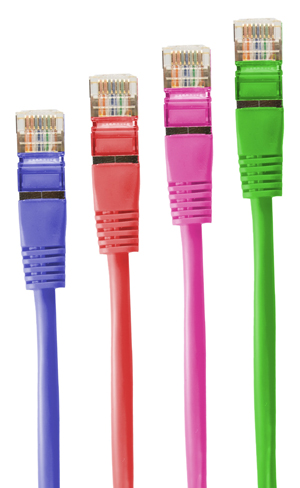
Choose your broadband connection from multiple suppliers.In the Beginning…
In the beginning there was only one network and that was the PSTN or public switched telephone network. The phone network is the original telecom network that started with Alexander Graham Bell and expanded to cover the world. It’s a very specific network, designed for voice communications. Computers came later. Any computer that wanted to talk to any other computer had to mimic human telephone users. Hence, the acoustically coupled audio modem.

That had to change fast. First, with ditching the acoustic coupling. Then overcoming the 64 Kbps limits of a standard phone line. Telephone companies developed digital phone lines to multiplex or combine multiple circuits in to one larger capacity circuit. Business quickly adapted the copper DSL and T1 lines, and then SONET fiber optic lines, for computer connectivity.

Still, there was one place to get service and that was the phone company. After all, Ma Bell owned all the wires. Even when “deregulation” was introduced, those competitive carriers were simply rebranding telco lines they got at wholesale rates.

Cable: The First Overbuilder
Each town has a single incumbent local phone company. But each town also can have a community antenna company, later called a cable company, to deliver television. Utility poles might have power, telephone and cable wires running one above the other all over town.

The cable companies made technical upgrades. First, they added modem service to offer Internet access. Then they converted their networks to digital, with fiber optics as the backbone and coaxial copper as the drop to the premises. This, plus regular modem standard upgrades, allows cable to offer broadband Internet service that meets or exceeds what the phone company can provide.

When two different providers install networks to serve the same locations, that’s called overbuilding. It’s one on top of or over the other. It could also mean excessive building, but that hasn’t generally been the case in the almost insatiable demand for broadband.

Fiber Overbuilds in Cable Territory
Cable pretty much overtook landline telephone, including DSL broadband, for residential and small business Internet. So much so, that the telephone companies are decommissioning their copper assets. Twisted pair copper technology just couldn’t keep up.

What the telcos have done is overbuild their own copper networks with fiber optic cables. They actually had a specialized fiber service called SONET before cable came around, but it was too expensive for residential and smaller businesses. They’ve now adopted the more standard Carrier Ethernet over Fiber technology that is directly compatible with most computer networks.

Recently, competing fiber optic network companies have been overbuilding both cable and telco networks with their own fiber. Some cities have contracted with these companies to install fiber that passes every home and business. This is in direct competition with cable broadband that is already serving many if not most of those customers.

Telco Overbuilds with Fixed Wireless Access
The telcos have been busy building out wireless networks to serve mobile phones and computing devices. It this case there may be several competing wireless companies serving each town. The big three in the US are AT&T, Verizon, and T-Mobile. You never had a choice in landline phone service or cable, but you have had this advantage in wireless.

Now wireless is challenging cable and even fiber. As cellular networks upgraded to 4G LTE and 5G, the broadband speeds have increased. In areas where microwave 5G bands are installed, the speeds can easily compete with cable and fiber.

A proliferation of towers, large and small, is expanding the coverage so that a cellular modem, basically a phone that does just broadband, can provide primary broadband service for residential and business users. If the wireless companies have their way, they’ll displace cable in the same way cable displaced landline phone.

What does all this overbuilding mean for you? The competition tends to lower prices and increase service bandwidth. In other words, you wind up getting more value for less cost.

Which broadband option is best for your business? Check pricing and coverage for fiber optic, cable broadband and fixes wireless access now.


Click to check pricing and features or get support from a Telarus product specialist.


Follow Telexplainer on Twitter


Wednesday, June 27, 2018

Fiber to the Curb and Premises

By: John Shepler

Copper is rapidly disappearing in telecommunications networks. It’s replacement, fiber optic cabling, may be run through the same conduits when copper bundles are removed, or it may be trenched nearby. The old copper lines are then left to slowly return to nature, much like obsolete two lane highway superseded by newer interstate construction.

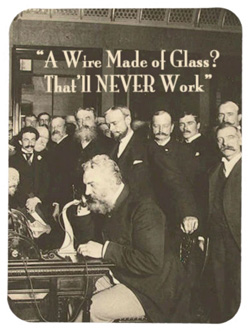
A Wire Made of Glass Tech GiftsBut, you say, I still have copper connections. The RJ45 cable to my computer is clearly twisted pair copper wiring. So is the coaxial cable that provides broadband to the office. Just where is all that fiber you are talking about?

Mostly Fiber Outside, Mostly Copper Inside
The quiet revolution in fiber optic transmission is occurring just out of sight. The reason is simple. Standard Ethernet cabling works great in the home or office. You can easily get 1 Gbps and perhaps even 10 Gbps performance… as long as you keep the cables short. That’s 100 meters or 328 feet for CAT5e or CAT6 at 1 Gbps and CAT6A at 10 Gbps. CAT 6 can also do 10 Gbps at 180 feet or less.

In most smaller offices you never need longer runs to get to the nearest switch or router. Since most network equipment you use every day has a RJ45 10/100/1000 Mbps interface, you’ll probably never have to deal with a fiber optic connection. That is, unless you work in the IT department in a company large enough to have one, or work for one of the telecom carriers.

Just beyond your view, the interface changes from copper to fiber optic wiring. Why? Speed and distance. If you want 100 Mbps Fast Ethernet or 1,000 Mbps Gigabit Ethernet, you need fiber to carry those high speed packets across campus and beyond. You may have copper patch cables at each end, but in-between it’s all fiber.

Fiber To The Curb
If you don't look inside the beast, you can pretend that the Internet is millions of miles of shiny copper wire in a web that covers the Earth. Actually, that’s how it started out. Today that notion is as dated as those obnoxious dial-up tones. The world’s long distance networks have long since been converted to fiber. Fiber is also rapidly replacing the local telco physical plant. When hurricanes and other disasters strike, the phone companies jump to install new fiber to replace plastic coated and even paper coated multi-pair bundles that might be many decades old. Both capacity and reliability are improved and higher speed services are possible.

Why, then, do telephone and broadband connections look the same as they always have? Someday they’ll be changed out, too, but right now it makes more sense to avoid the high cost of running new lines in from the street or rewiring old buildings. The trick to keeping the old twisted pair and coaxial cable able to meet today’s needs is to run the fiber to the junction box at the curb and connect to the existing copper. As you might guess, this is called Fiber To The Curb or FTTC. It’s a stop-gap measure that works well… for now.

Fiber To The Premises
The next logical step is for the service providers to just run the fiber right to your building and give you a fiber or copper connection at the demarcation point. For business bandwidth services, this is becoming the norm. Tens of thousands of cell towers are also being newly served by fiber optic lines. These replace the trusty T1 lines that work great up through 3G, but aren’t up to 4G speeds and certainly not 5G wireless.

This service is logically called Fiber To The Premises or FTTP. For residential service it is often referred to as FTTH or Fiber To The Home. There are two main flavors being deployed. One is active fiber that has all the electronics end to end. The other is a less expensive approach called passive fiber that uses passive optical splitters to connect multiple locations to one shared active fiber strand.

Is It Time to Upgrade to Fiber?
You can pretty much bet that whatever provider you use is running their core network on high speed fiber, probably at 40 Gbps or 100 Gbps. The question is whether they are connecting to you via legacy copper twisted pair leased from the telephone company or bringing fiber right to the premises. Cable companies use HFC or Hybrid Fiber Coax systems, so the less expensive coax broadband service joins their fiber plant nearby on a pole or curb termination box. Cable companies can also connect you directly to their fiber network for higher performance services.

The beauty of bringing fiber to your premises is that it helps future-proof your service. If you install, say, a Gigabit Ethernet port, you can subscribe to any line speed up to 1 Gbps. If you only need 100 Mbps or even 10 Mbps right now, you’ll have the option to turn up the speed quickly with only a phone call. Some providers are now letting their customers log into the system and upgrade their service themselves. Billing accounts for upgrades and downgrades automatically.

Not sure what service makes the most sense for your business? Discuss your needs with one of our expert consultants and see the range of bandwidth options available for your location.

Click to check pricing and features or get support from a Telarus product specialist.


Follow Telexplainer on Twitter


Note: A humorous collection of tech giffts with the theme, "A Wire Made of Glass" are available through Zazzle.