Showing posts with label bandwidth. Show all posts

Tuesday, August 19, 2025

Why Symmetric Bandwidth?

By: John Shepler

Bandwidth is bandwidth and the more the better, right? Well, not so fast. There is bandwidth and then there is bandwidth. All connectivity solutions are not the same. Let’s see why.

Get symmetrical bandwidth for highest performance.Sharing Isn’t Always Caring
Some connections are dedicated. Some are shared. You need to know which you are ordering.

A dedicated connection means a fixed amount of bandwidth that you are contracted for and are guaranteed to have all the time. The classic T1 line, SONET fiber optic, and many Ethernet over Fiber and private wireless solutions are dedicated. They may be set up as point to point private lines , cloud connections or last mile Internet access.

The advantage of dedicated lines is that your network capacity is always there even when you are not loading it up to the max. This improves latency and congestion compared to your other choice, shared bandwidth.

Shared bandwidth connections have other company’s traffic on the same line as yours. You have no idea how many there are or what they are doing. You may well feel their presence, however, as your WAN connection speeds up and slows down for unknown reasons.

So, why on Earth would you share bandwidth? Simply to save cost. Shared lines are dedicated lines that the carrier has sliced and diced to support many users instead of just one. If there is enough bandwidth and not so many users, you may not have a problem and can save considerably on monthly rates. Typical shared bandwidth services include cable broadband, wireless 4G LTE and 5G, and some passive optical fiber optic services that are available at bargain rates.

Symmetric vs Asymmetric Bandwidth
Symmetric bandwidth is when you upload and download speeds are the same. Asymmetric bandwidth means that one direction has much more capacity than the other. The high speed link is almost always the download path. Download speeds may be 10x faster than upload speeds.

Why? Asymmetric setups were designed to mimic the way people actually use the Internet. For the most part you download videos much more often than upload them. You enter short addresses in your browser and download web pages and content far more than you upload them. Or… Do you?

Business users may use their networks much more symmetrically than typical residential users. Business users likely transfer large files back and forth. Many of their applications reside in the cloud with data flowing up and down. VoIP phone and video conferencing are inherently symmetrical. Voice and images go both ways. Remote back-up is asymmetric for the most part… but the other way. Most data is being uploaded to the remote storage.

Traditional telecom networks are designed with symmetric bandwidth in mind. Consumer solutions, which are also typically shared bandwidth, are asymmetric in nature. For casual users and small businesses this may not be an issue. However if you are a heavy bandwidth user, depend on software as a service, do extensive video conferences or back-up your data to remote storage, you will likely be better served with symmetric and dedicated solutions.

Is your business running out of bandwidth or are you just frustrated with the solution you have now? Discuss your real needs with a technology expert and get quotes for multiple options that will work for you. There’s more available and at better prices than you think.

Click to check pricing and features or get support from a network technology expert.


Follow Telexplainer on Twitter


Wednesday, June 25, 2025

Goodbye Employees, Hello Bandwidth

By: John Shepler

Office employment has been undergoing a major shift since the rise of the Covid Pandemic in 2020 and it’s likely to accelerate rather than return to “normal.” Office buildings nationwide have been emptying out, some being converted to residential units or commercial malls. Even with employees being ordered to return to the office or be replaced, things aren’t really going to go back to mass commutes five days a week, as we’ll soon see. This also has major ramifications for the bandwidth you’ll need and where you’ll need it.

Bandwidth to support the changing business officeReluctant Office Workers Offer Opportunities
How do you get ‘em back in the office after they’ve seen work from home?

That might be the title of a song for the 2020’s. The abrupt culture shock from everyone being sent home, with most expected to keep on working, did indeed break the expected paradigm of where you are supposed to be all day. Once appropriate computers and Internet connections got settled, quite a few customer service reps, programmers, and other information workers found they could work just as well from a spare bedroom or dining room table as in the corporate cubicle. Their productivity even improved without the distractions of office chatter or pro-forma meetings.

Employees might have picked up an hour or two of extra personal time not spent commuting and some could drop the expense of outside daycare for children. Meanwhile, companies that continued this arrangement after the pandemic threat had passed found they could reduce office space expense, including real estate and utilities.

One demand that might have increased is the need for fast highly reliable bandwidth to connect now far-flung individuals. Residential Internet connections have improved greatly during this millennium. High speed cable broadband, fiber to the home and 5G fixed wireless access have made most connections nearly transparent. For more demanding applications, SD-WAN and dedicated point to point private lines can reduce latency and congestion.

Not All of Us Are Coming Back to the Office
Remote work may be a boon for some employees and their employers, but many other companies, including some of the largest ones, want the old culture of co-located teams back for camaraderie and supervision. In fact the managers are insisting on it. To some extent this coalescence will occur, but there is another force at work that is going to disrupt it again.

Artificial Intelligence is heralded to be the next dramatic productivity improvement. There is a mad scramble on to build data centers and secure baseload power to support the coming tsunami of AI applications. These promise to be far more sophisticated than the inane chatbots on many sites that can’t seem to answer the simplest questions. Expect these to get a lot smarter. A lot of the coming AI will not be customer facing. It will handle back office paperwork, data entry, report writing, proposal generation, language translation, code generation, graphic arts, network monitoring & troubleshooting, quality control, financial analysis, legal research and medical image diagnosis just to name a few.

In other words, the century long migration from farm to factory to office is about to hit a brick wall of automation. There is already concern that new hires in white collar professions will be facing an increasingly tough job market, followed by job eliminations right up the ladder.

What Network Technology Will You Need?
If office automation is soon taking over, what do you need to plan for to support this transition? In addition to remote worker systems and bandwidth, you’ll need robust connectivity to the AI data centers where many of these applications will reside. Any apps that deal with the customer directly will require substantial Internet connections, likely right from the data center. Your office team will also need solid connections to those same data centers. The Internet may not be adequate for high bandwidth, low latency, jitter, packet loss and general congestion. A dedicated fiber optic private line, also called a cloud on-ramp, can make this connection transparent and help maximize productivity.

A lot of your communications may be in the form of video conferences, including a mobile workforce and well as the office staff. Don’t forget to include enough mobile bandwidth so that the people in the field are as well connected as those in the office.

Finally, you may be looking at whole new systems of computers, phones, pads and other devices that integrate your staff, management, suppliers and customers along with the AI applications that make it all work seamlessly.

Are your business needs in a state of change? Yesterday’s solutions might not support your future. Let an experienced technology advisor help you acquire the networking services you need to stay at the top of your markets.

Click to check pricing and features or get support from a Telarus product specialist.


Follow Telexplainer on Twitter


Thursday, January 16, 2025

The Cable vs Fiber Broadband War

By: John Shepler

There’s a broadband battle underway right now. It pits cable business broadband against Ethernet fiber optic bandwidth. These are the two leading technologies that will dominate business Internet now and for the foreseeable future. There is also a third contender warming up that we’ll discuss a bit later. Let’s see what the two big players have to offer.

Cable Broadband and Fiber Optic Bandwidth vie for your business. Get quotes now!Fiber Takes Over From Copper
The first century of telecommunications was dominated by twisted pair copper wires that provided the last mile for landline telephones, multi-line business phones, point to point computer connections and, when it started developing, the nascent Internet. The ground is chock-full of multi-pair cables. Some will be pulled out and recycled. Others will be left to slowly disintegrate.

Their technological replacement is fiber optic cables. Glass fibers take the place of plastic coated copper strands. Optical fibers have tremendously more bandwidth carrying capacity. A copper T1 line can deliver 1.5 Mbps. A fiber can deliver a Gigabit per second up to at least 10 Gbps. It’s no longer uncommon to have 100 Gbps fiber optic service available for business use.

Fiber itself has undergone a technical evolution in protocol from the early SONET telecom standard to Carrier Ethernet, otherwise known as Ethernet over Fiber. This upgrade made sense as telecom traffic changed from largely audio phone calls to digital computer packets.

What Fiber Optic Service Can Provide
Fiber broadband is readily available and can offer 10 Mbps to 10 Gbps bandwidth. This bandwidth is usually symmetrical, meaning the same speed for upload and download. It is also generally dedicated. That means you don’t share your fiber capacity with any other businesses. It’s all your traffic from your building to where it joins the Internet. This makes for much more consistent Internet performance.

Many companies have been moving from having their own in-house data centers to hosting that equipment at a co-location facility or leasing the same capability from a cloud provider. If your business software is running remotely, it often makes sense to have a direct connection from your offices, factories and warehouses to the cloud provider and avoid any potential congestion from the Internet.

Direct connections are also useful between company facilities, such as branch offices and any owned data center facilities. Essentially, you are extending your LAN out to include all your locations.

How Can Cable Compete with Fiber?
Cable got its start as a community antenna that fed a small town or city. Like fiber, cable has come a long way technically. Analog has transformed into digital. Still, isn’t cable a bandwidth limited copper connection?

Less than you might think. The drop or final connection to your business is still the familiar coaxial copper cable. The innards of the system have long ago upgraded to fiber, just like the telecom industry. That means most of the distance travelled is over fiber optic cables, some with as many as 100 fibers. The TV and Internet signal is converted to drive a copper drop cable just before it reaches your building. This system is referred to as HFC or Hybrid Fiber Coax.

The other big advance in Cable broadband has been the upgrading of cable modems using the DOCSIS standard. Most modems are now DOCSIS 3.1 that has the ability to support downstream data speeds of up to 10 Gbps and upstream speeds of 1 Gbps.

DOCSIS 4.0 is in the process of being deployed. This equipment upgrade will support downstream speeds of 10 Gbps plus upstream speeds of 6 Gbps.

Clearly, today’s cable broadband is easily a match for all but the most demanding fiber speeds. One difference between Ethernet fiber and cable broadband is that cable is usually asymmetrical to match the typical usage of retail customers on the Internet. In other words, the demand for download speed is usually more than the demand for upload speed. Often download is 10 times as fast as upload.

Another difference is that cable broadband is a shared access service in the last mile. This means that some heavy users may impact the performance of other users from time to time. For consumers, this is usually not a problem. For a business that depends of steady high performance for employee productivity using cloud services, it could present an issue.

Why Pick One Service Over the Other?
For consumers and many smaller businesses, cost is tie-breaker. Cable business broadband is generally less costly than Ethernet over Fiber for similar bandwidths. However, if you need symmetrical bandwidth, dedicated Internet access, dedicated point to point connections, or a dedicated line to your cloud provider, fiber optic connections can be well worth the added monthly cost. It should also be mentioned that some Cable companies are now offering access to their internal fiber optic networks as a premium bandwidth service.

Wireless is the Next Competitor
There is a new entry to the broadband wars that is also worthy of consideration. That is fixed wireless broadband. Once a niche service over very small areas, fixed wireless is now being offered by the major cellular carriers. What has made this possible is the advancement to 4G LTE and 5G. Mobile phones with 300 Mbps or more Internet service are now common. By providing a high performance modem without the telephone features but including Wi-Fi or LAN connection, carriers can deliver high speed broadband over their wireless networks already in place. Advantages include very reasonable pricing and little or no construction cost. You pick up the modem at the cellular store or have it shipped to you and install it yourself right away. It’s also perfect for pop-up stores and construction sites that are only temporary locations.

Which is best for your business? Cable broadband? Ethernet over Fiber? Fixed Wireless? Get pricing and availability for each of these bandwidth options and then choose the right solution for you.

Click to check pricing and features or get support from a Telarus product specialist.


Follow Telexplainer on Twitter


Thursday, May 25, 2023

Bandwidth Without Usage Metering

By: John Shepler

Perhaps the most unpleasant experience of broadband is hitting your data cap. You may have forgotten it was even there. But, like the cop hiding behind the highway billboard, it pops out at the most inconvenient times and, boy, are you in trouble. Let’s have a look at what data limits are all about and what you can do to avoid hitting them.

Avoid data usage limits with dedicated Internet access and private lines.Where Did Usage Metering Come From?
The big problem is scarcity. Bandwidth is like electricity. If we had unlimited amounts at minimal costs, there would be no need to meter it or even limit your line speed. Such is not the case.

Take 5G cellular for instance. The demand for Internet broadband has always been way ahead of capacity buildout for the cellular networks. 2G was pitiful. 3G was still bandwidth starved. 4G LTE greatly improved on cellular capacity to the point that most people didn’t run out before the end of the month.

5G offers the promise of billions of “things” all communicating autonomously and people using fixed wireless from their cellular provider to replace services like DSL, cable and T1 lines.

Have you been watching what is happing with 5G? There is a mad scramble to build towers, feed them with fiber optic cables or microwave backhaul, and lobby the government to assign more and more of the limited radio spectrum to high speed Internet. It’s cellular vs satellite vs independent WISPs (Wireless Internet Service Providers) vs television vs government vs everybody else to grab as much bandwidth as possible.

Why? The amount of spectrum you can press into service determines the speed of your connection and the amount of data to divvy up among users. Thus the feeding frenzy among service providers.

Even wireline and fiber optic services have their limits. Twisted pair landlines are pretty pokey by today’s standards and fiber optic requires a huge capital investment. A fiber bundle has enormous capacity, but only where the fiber has been run. It doesn’t blanket an area like wireless does. Each location needs its own fiber connection.

How Carriers Allot Their Capacity
All bandwidth services have limited capacity. Wireless has the most constraints because the electromagnetic spectrum has only so much available in the popular frequencies that travel reasonable distances and penetrate walls. Fiber and HFC (Hybrid Fiber Cable) is less constrained but has high costs to build out.

Carriers divvy up their capacity and sell it to users by slicing and dicing what they have. The two limitations that they put on users are speed in Mbps or Gbps and usage in total Gigabytes. Speed determines how much of the total bandwidth you can use at any given moment. Total capacity limits keep a few high data users from uploading and downloading continuously so that other’s can’t get online.

You see, the price you pay for Internet access is much less if the carrier can assume that you aren’t sending or receiving all the time. Much of the time you may not even be accessing remote servers. When you do, you’ll send or receive a certain bundle of data and then pause before doing more. By allowing many customers to share one big line, providers can give everyone reliable access at greatly reduced cost. That’s the principle behind cable broadband, satellite services, and cellular broadband.

In practice, this works well for consumers and many smaller businesses. They just don’t need to be sending enormous files one right after the other. On cable, you may never hit your allotted limit or even know what it is. With cellular and satellite, you may have and “unlimited” plan, but just try continuously streaming video or doing massive data transfers and you’ll run into what the carriers call “fair use” provisions. Yes, there are limits to unlimited plans.

What happens if you consume more that your “fair share”? Your service provider may choose to simply issue a warning, or may slow your speed so you can’t hog so much of their capacity. Or they may charge you for extra GBs of usage. Worst case, they’ll simply cut off your service until the next month’s billing cycle begins.

How to Avoid Usage Metering
Medium and larger businesses and heavy Internet using companies with cloud services and remote backup storage may well exceed even the most generous fair use quotas. The best option then is to order services that aren’t metered at all. Those tend to be private lines and dedicated Internet access.

Dedicated lines without usage metering give you two advantages. First, you are not sharing with other companies or residential users. The capacity of the channel is yours and yours alone. If you order a Gigabit Dedicated Internet Access fiber service, you can feed it traffic continuously and nobody is going to complain. Plus the speed of your service won’t vary with competing traffic, because you have sole usage. This is particularly valuable with business critical applications and real-time services like video conferencing that run in the cloud.

A private line is like dedicated access except that the Internet is never involved. You connect point to point or in a private mesh network where others cannot interfere. Even the core Internet gets congested from time to time. Your private lines are like private superhighways. Your traffic, and yours alone, is what is carried. If you are using cloud services extensively, consider a direct line from your business to your cloud provider for the highest performance.

Have you been hitting the limits of your Internet service or being warned by your provider that they may heavily up-charge you or cut off access? Consider the advantages of ordering dedicated private lines and dedicated Internet access without usage limits to keep your business running smoothly.

Click to check pricing and features or get support from a Telarus product specialist.


Follow Telexplainer on Twitter


Thursday, November 17, 2022

Ethernet Replacements For SONET

By: John Shepler

High bandwidth fiber optic Wide Area Networks have their basis in a decades old telephone company standard called SONET. Highly reliable, but highly expensive, SONET is giving way to the newer technology of Ethernet WAN. As demand for business bandwidth keeps increasing, so does the attractiveness of Ethernet for long distance connections.

Get competitive quotes on Ethernet fiber optic WAN service.Why SONET Ruled For So Long
SONET or Synchronous Optical Network was born out of a burgeoning demand for higher and higher levels of traffic. In this case, the traffic was long distance telephone calls. In the early days of telephony, this demand was met with dense webs of overhead copper lines.

Multi-channel analog technology made it possible for each copper pair to carry many phone conservations on a carrier-based system, much like many radio stations in a single band.

Digital technology eliminated the noise and crosstalk of carrier telephony by converting the analog conversations to pulse coded digital streams and multiplexing many together on a single pair. The transmission medium was still copper wire.

One thing about phone company standards is that they are all backwards compatible down to a single phone line. After all, that’s the telco business. So, the digital T1 lines were actually carrying 24 separate phone calls. A T3 line was 28 T1 lines or 672 phone calls.

When the fiber optic standard was developed, it picked up where copper left off. The OC3 SONET line is 155 Mbps and is equivalent to three T3 lines. Within all those multiplexed channels is the same 64 Kbps voice channel to support one phone call.

How did we get from really big phone lines to data transmission? Basically, SONET was the only game in town if you needed large amounts of bandwidth. So, all those voice channels in the line were combined to create one large data channel to carry packets of information. That requires protocol conversion circuitry to go from Ethernet network protocol to SONET telephone line protocol.

This works beautifully, but there are a few issues. For one thing, SONET levels are very specific and not scalable. If you want to move up from, say, a 155 Mbps OC3 to a 622 Mbps OC-12, you’ll at least need to swap out the termination controller or interface card in your router. Also, since analog phone traffic is now trivial compared to packet based data traffic, wouldn’t it be more efficient to just keep everything Ethernet from end to end? Indeed, it would.

Ethernet Replacements For SONET
Most competitive carriers and even many of the traditional telecom companies have adopted Ethernet as their network standard, as that’s where the traffic is. As a result, you can find much better pricing for Ethernet circuits than for traditional SONET. Ethernet WAN is also highly scalable. If you install a Gigabit Ethernet port, you can order service at any bandwidth level up to 1 Gbps. That covers OC-3 at 155 Mbps, OC-12 at 622 Mbps and pretty much OC-24 at 1.2 Gbps.

No hardware changes are needed until you require more 1 Gbps. At that point you may install a 10 Gbps port which will cover OC-24, plus OC-48 at 2.5 Gbps and OC-192 at 10 Gbps. Today, 100 Gbps is becoming more and more available to take the place of OC-768 at 40 Gbps.

If you are looking to upgrade your fiber optic WAN connections or are just curious about how much you might save by switching from SONET to Ethernet WAN service, you can easily get a set of competitive quotes from multiple service providers with no obligation. That applies to private line services, including cloud communications, as well as dedicated Internet access. Now would be a good time to make that inquiry.

Click to check pricing and features or get support from a Telarus product specialist.


Follow Telexplainer on Twitter


Tuesday, October 25, 2022

The Connectivity You Need For Digital Transformation

By: John Shepler

Most every business is now in some phase of digital transformation. It’s the process of moving from analog mechanical and paper based operations to digital and online processes. The promise of this transformation is faster and more efficient business methods that save cost and expand your customer base. But, what do you need to put in place to support this digital transformation?

Get the connectivity you need for digital transformation.Plan on Doing Most Everything Online
While most products and services are not digital, the tools to support them now are. Everything from finding prospects to converting prospects to customers, servicing those customers and keeping the products flowing has a digital element to it. The Internet is now the hub of operation for many businesses. Others may be local and walk-in for the most part, but may have an online presence and accounting or other processes in the cloud.

What makes the Internet so compelling is that after a decades of development, it is largely in-place, paid for, and ubiquitous. People who don’t even have bank accounts do have smartphones with Internet apps that allow them to buy, sell and get paid. While there are challenges, especially in the area of security, the Internet is a must for most companies.

Start With High Speed Reliable Internet Access
You’ll need a solid connection to the online world. It will have to be fast enough to be transparent to you and your customers, always available, and have a minimum of latency, jitter and packet loss. The best connections are the ones you never have to think about. That customer on the other side of town or the other side of the world will seem as close as someone in the next office.

There are basically two types of broadband connections. One is called Dedicated Internet Access. The other is Shared Internet access.

Dedicated Internet Access, particularly with symmetrical bandwidth that gives you the same speed uploading as downloading is the gold standard. While the Internet is certainly a shared resource, most of the congestion and outages occur in that “last mile” between you and your service provider. Dedicated connections give you a private road to the Internet. You always have the bandwidth you are paying for, whether you are using it every second or not.

Shared Internet Access is just that. A service provider leases a dedicated access line and then divides it up among many users. If the speed is high enough and there aren’t so many users demanding the same bandwidth simultaneously, you may not even know you are sharing. Sometimes, though, everybody wants to download videos or large files and things slow down. Then, like every traffic jam, they just as mysteriously dissipate and everything is back to normal.

The advantage of dedicated access is performance. The advantage of shared access is cost. Shared services such as cellular and cable broadband can cost a fraction of what a similar speed dedicated fiber or fixed wireless access service costs.

A Hybrid Approach to Increase Reliability and Lower Cost
There is also a third option that has been recently developed. That is the Software Defined Network (SDN) or Software Defined Wide Area Network (SD-WAN). What these systems do is take multiple Internet connections and bond them together so that you get one higher capacity, lower latency and more reliable connection. A SD-WAN box can combine a cable broadband line, a cellular broadband modem, and a small fiber optic service. Even satellite and landlines can be included. The software in the controller monitors each line constantly and selects the most appropriate for every packet.

With SD-WAN, your most sensitive applications, such as telephone and conference calling, get the highest priority for speed, latency and jitter. Business process are next in line. Less sensitive needs, like remote backups, get the lowest priority because a few seconds here and there probably won’t make any difference. SD-WAN can save you money compared to one very large fiber line that you can’t keep busy or perhaps can’t even get installed. It is also a lifesaver when one line is accidentally cut or has an equipment failure. SD-WAN will simply use the other connections to keep things running seamlessly.

Don’t Forget Your Cloud Connections
Your main office, store or factory connection to the Internet is critical, but so are the connections for your cloud based operations. Once those servers and applications leave the premises to be co-located elsewhere or run in a public or hybrid cloud, they need the same reliable and transparent connectivity you had in-house.

There are two connections to be concerned with. The first is the connection between you and the cloud. This may be the same Internet access you use for everything else, but for business critical operations you may want to consider a dedicated private line between your office and the colocation center or cloud service provider. This bypasses the Internet completely and gives you much greater control of your traffic since nothing is shared outside of your business.

The other connection of importance is the connection between the remote servers in the colo center or cloud and the outside world. For this you want the same high performance Internet access with enough bandwidth, low latency and minimal jitter and packet loss. Fortunately, this quality of service is easy to find for colo and cloud, as they deal in massive amounts of bandwidth on a regular basis.

Are you properly connected for digital transformation? That old DSL line or bandwidth limited T1 probably won’t get the job done anymore. Consider an upgrade to highly reliable fiber or wireless broadband for your business. Recent buildouts have made this much more affordable than you might expect.

Click to check pricing and features or get support from a Telarus product specialist.


Follow Telexplainer on Twitter


Wednesday, August 24, 2022

Metro and Long Haul Dark Fiber

By: John Shepler

High performance companies with diverse locations and significant staffing may get to the point where the usual Internet access and private line offerings just won’t get the job done anymore. At that point, you may wish to take total control of your network so that you can set the standard for performance and make upgrades as quickly as they are needed.

Sounds good, but how are you going to exercise the same control over a network that leaves your premises as you do within your facilities? Get into the network provider business yourself and install fiber to each of your facilities? Hardly. That would be cost prohibitive and way too time consuming. There’s a more reasonable approach, and that is to lease dark fiber.

Find dark fiber for your high bandwidth needs now.What is Dark Fiber?
We’re all familiar with fiber optic cables and the reliable high speed connectivity they provide. Most incumbent and competitive telecom companies now offer a wide range of bandwidth options within their service areas. Even traditional Cable companies are offering connections to their core network as an alternative to the coaxial copper drops. What is less known is that nearly all of these companies have extra fibers available within their bundles for spares, expansion and leasing. These fibers sit unlit, not installed to any network equipment.

Think about it. If you can lease a strand of dark fiber that runs very near to your business locations, it’s almost like you installed the fiber cable yourself. You pay a provider who has already gone to the trouble of installing this fiber and it is already in place. It was likely much less costly for them to do this than it would be for you, because they install many other fiber strands in the same conduit at the same time. Those strands won’t have any effect on your usage.

With dark fiber, you get access to the unlit fiber strand. You’ll need the expertise to select and install the termination equipment, but that is much easier than having to hire or contract with crews to trench the fiber conduits and negotiate the right of ways.

There Are Two Types of Dark Fiber
Dark fiber comes in two varieties, although they are closely related. The first is Metro dark fiber that is installed in cities and their related suburbs. It may be installed on poles above ground or in underground conduit. Metro fiber tends to be installed in large bundles, as there is a lot of demand for fiber optic connectivity within metropolitan areas.

The other variety of dark fiber is called long haul dark fiber. This is the fiber that runs between cities to designated points of presence. With long haul fiber, you can span the country to connect your regional offices and factories. Long haul fiber tends to use smaller glass core single mode fiber which can limit the transmission rate. It’s a tradeoff of capacity for distance.

If all of your connection requirements are within a single city, Metro dark fiber will likely get the job done. If you need to connect between cities you’ll probably need a combination of Metro and long haul dark fiber.

Dark Fiber Alternative
Dark fiber requires a budget and level of expertise that not every company can commit to, even though the control, scalability, and security are very attractive features. A related service is called dark wavelength. It is commonplace to “light” a fiber strand with a spectrum of discrete frequency lasers to create independent wavelengths or lambdas. In effect, the fiber strand becomes a set of non-interfering sub-fibers all multiplexed on the same physical strand. It is possible to lease a wavelength instead of a whole fiber at a lower cost. You still have control of the protocols used on that wavelength and it is solely dedicated to your use. If this will work for you, a dark wavelength can both save money and give you the connectivity you desire in areas when an entire strand might not be available.

Do you have a need that exceeds the typical ISP or dedicated fiber optic bandwidth service offerings? If so, explore the possibility of leasing a dark fiber or dark wavelength now.

Click to check pricing and features or get support from a Telarus product specialist.


Follow Telexplainer on Twitter


Wednesday, July 27, 2022

Copper Decommissioning Expands Demand for Metro Ethernet

By: John Shepler

If you are still getting by with last mile Internet over DSL, T1 lines, or Ethernet over Copper, you should take a serious look at Metro Ethernet over Fiber. You’ll get more bandwidth, better pricing and… it will continue to be available.

Metro Ethernet gives you the bandwidth you need at an affordable price.Copper Decommissioning is Now
Copper based telecom services have been the go-to technology for the last century, but not this century. The ubiquitous twisted pair telephone line has supported our needs from the introduction of the telephone through the fevered growth of the commercial Internet. But, like cellphones the size of a brick, the technology has run its course. Copper just can’t keep up with today’s and tomorrow’s needs.

The phone companies know this. The network operators know this. They are well aware that we are way past “peak copper”. As you read this, copper lines nationwide are being retired or “decommissioned”. In some cases the copper is physically ripped out of conduits so that fiber optic cables can be pulled right back in. In other cases the copper bundles in the ground are simply disconnected and left to rust away on their own. In the coming years there will be fewer and fewer copper options available to order, until a copper wireline is as rare as a cranked telephone set.

Fiber is the Future AND the Present
The replacements for copper telco right now are Cable in the form of hybrid fiber/copper systems, Fixed Wireless Access, and Fiber Optic bandwidth. Fiber in cities is also called Metro Fiber or Metro Ethernet. Most urban, suburban and even small town businesses now have access to Metro Ethernet and its flexible options.

Fiber is your most flexible option for several reasons. First, fiber optic strands offer extremely high bandwidths, to 10 Gbps or more. With wavelength division multiplexing, you might get a dozen or more 10 Gbps lambdas, each a virtual fiber in itself. Now, consider that nearly all fiber cables have multiple strands, even dozens, and you can see how fiber bandwidth is nearly unlimited. Once installed, that fiber will likely last as long as you need.

Second, fiber, unlike cable or most wireless, can provide exclusive dedicated line services. You can order private point to point connections and have all of the bandwidth available for your traffic. Compare that to the consumer-oriented broadband services that share bandwidth among many users to keep the cost down. With dedicated Internet access or private point to point lines, you won’t be competing with everybody else for limited resources at high traffic times. This can be especially valuable in connecting your network to a distant cloud provider that hosts business critical applications.

In addition to massive available bandwidth, fiber service is also very scalable. You can typically start off as low as 10 Mbps at pricing comparable with a current T1 line, but with over 6x the bandwidth. Many smaller businesses find that 100 Mbps is plenty, but Gigabit bandwidth is easy to come by and very affordable. If your applications demand it or your workforce is substantial, 10 Gbps is easily available on fiber. Even 100 Gbps is now being offered to larger companies and hospital complexes, content developers, etc.

Why Ethernet over Fiber
The earlier implementations of fiber optic service were based on a telephone company standard called SONET that offered fixed bandwidth levels and was designed for voice calls, not data. While protocol conversion circuitry made SONET the backbone of the Internet, Carrier Ethernet is now the standard to be embraced. This is the same switched Ethernet that runs on your local network, but extended to transport packets over hundreds or thousands of miles.

Metro Ethernet uses the Carrier Ethernet standard running over fiber optic cabling. This makes it virtually plug-and-play with your network. You can even set it up so that your business locations all over the state or country act like they are on one big network. Metro Fiber Ethernet is the new standard for business connections. Network connections within the metro area are often referred to as MAN or Metropolitan Area Network, while those more distant are referred to as WAN or Wide Area Network.

Are you ready to replace aging T1, DS3, DSL or other network services with something more modern that is future-proof and likely less expensive? Check your Metro Fiber Ethernet options for one or more business locations now.

Click to check pricing and features or get support from a Telarus product specialist.


Follow Telexplainer on Twitter


Thursday, April 14, 2022

Ethernet WAN is the New SONET

By: John Shepler

High speed communications lines progressed from copper analog to copper digital to fiber optic digital over most of the last century. The technology that drives fiber has also evolved from time sliced synchronous multiplexing to packet based protocols, mirroring the transition to networked computing for nearly every business. While older SONET telco lines still provide effective connections, there are real advantages to be gained by upgrading to Ethernet WAN, the newer technology for fiber optic service.

Find Ehternet WAN services now.It Started With Really Fast Phone Lines
SONET, which stands for Synchronous Optical NETwork, is a phone company invention that was developed to bundle or multiplex thousands of individual phone calls onto an optical fiber for long distance transmission. To make operations easier, SONET was made backwards compatible with legacy T1 service that does exactly the same thing with 24 calls over two twisted copper pair… in other words, ordinary telephone line.

SONET allowed the phone companies to bundle T1 line into DS3 lines into OC3 fiber lines and demultiplex or unbundle them anywhere along the way. Everything was compatible down to the single telephone channel.

SONET to Link Computers
So, how did SONET come to support computer networking? The protocol had to be converted between SONET’s time division multiplexing and Ethernet’s packet switching. That was accomplished using protocol conversion on a plug-in module. To the user, It made no difference what was going on under the hood. Packets would go in one router and come out another miles or thousands of miles away.

SONET was developed for fiber and all of the early fiber optic links for computer networks were connected using one of the SONET levels. OC3 was the lowest speed at 155 Mbps. This was the first fiber service that most corporations ordered when they outgrew their T1 and T3 lines. Each increase in speed required swapping out an adaptor module for the particular SONET level.

In fact, the Internet was built on SONET. SONET rings, which offer redundant paths, formed the core of the Internet as it grew. Internet service providers would connect via SONET and then divvy up the bandwidth for multiple 64Kbps dial-up modems or, later, DSL or Cable broadband modems.

The Ethernet Revolution
Ethernet, developed by the Xerox Palo Alto Research Center in the mid to late 1970’s, grew to become the dominant networking protocol, thanks in no small part to the proliferation of the personal computer at the same time. Most small and large users adopted Ethernet, as adaptor cards, cabling, hubs and routers became more and more affordable. Every PC soon came with an RJ-45 Ethernet jack as standard equipment and peripherals, such as printers, did the same for compatibility.

Once Ethernet became the de-facto networking standard and computer data traffic greatly exceeded voice traffic, it started to make sense to just adopt Ethernet for Wide Area Networks as well as Local Area Networks. When business phones became digitized and used VoIP to connect on the same network as the computers, the need for a separate voice network faded away.

Another factor that has moved WAN services from SONET to Ethernet is the rise of competitive network service providers independent of the telephone companies. Since these companies had no legacy analog phone service to support, they could simply focus on offering Ethernet connections to their customers in competition to the telcos.

By this time the original Ethernet protocol has been expanded to provide technical specifications for Carrier Ethernet, which is the same as LAN Ethernet but extended to support the MAN (Metropolitan Area Network) and WAN (Wide Area Network).

What Ethernet WAN Has to Offer
You remember that SONET has distinct service levels, each with it’s own bandwidth and specific adaptor requirements. Ethernet doesn’t have this limitation. Instead, you have an Ethernet port with a maximum bandwidth, say 1 Gbps. It will support any bandwidth up to the max limit of 1 Gbps. You can order 100 Mbps service today and easily upgrade to 500 Mbps or 1 Gbps later. Only if you want a service level above 1 Gbps, will you need to have a higher capacity port installed. This process is so seamless that many providers will let you change service levels at will by logging into your online account.

Ethernet services tend to be less expensive than SONET. Usually, much less expensive. You pay for the service level you want, be it 10 Mbps, 100 Mbps, 1 Gbps, 10 Gbps, and so on. Remember you can change this easily after you have service installed and your bill will be adjusted to the new level you select.

Since there are many, many competing Ethernet MAN and WAN service providers, pricing per Mbps has dropped rapidly over the years and continues to do so. Some of the service providers are the traditional telephone companies, but with much improved pricing. Others are independent carriers serving regional, national, or international areas. They can also provide excellent customer service, high reliability, and very good deals on bandwidth.

There are usually two types of service you’ll be interested in. One is a dedicated connection to the Internet at a bandwidth you select. The other is a point to point dedicated private line that is just like having a very long Ethernet cable connecting two LANs separated by many miles. These are useful for interconnecting main offices and branch offices, warehouse, manufacturing centers and so on with maximum performance and privacy. Another popular application is a direct connection between your offices and your cloud service provider. This avoids the vagaries of Internet performance and makes the cloud seem like it is right down the hall.

Perhaps you still have legacy SONET service that was installed years ago. It’s been working fine so no one has paid much attention. This would be a good time to see if competing Ethernet WAN services can give you more bandwidth for the same budget or offer a considerable cost savings if you are happy with the bandwidth level you have now. It doesn’t cost anything to look, so why not see what’s available?

Click to check pricing and features or get support from a Telarus product specialist.


Follow Telexplainer on Twitter


Wednesday, March 16, 2022

Upgrade your ISP to GigE and 10GigE

By: John Shepler

Regardless of whether your business is strictly e-commerce or a traditional bricks and mortar operation, Internet access is essential to conducting business these days. One thing we never seem to have enough of is bandwidth. This is the right time to upgrade your broadband connection to handle the throughput you really need to efficiently get the job done. Surprisingly, it may be more affordable than you think.

Dramatically increase your broadband speed to 1 Gbps or 10 GbpsHow Much Do You Need?
Small businesses, including home offices, single person professional offices, small retail stores and the like, may find that 100 Mbps Fast Ethernet service is plenty. You might even get by with less than that… for now. For every other situation, you’ll want to look at bandwidth fast enough to be transparent. Transparent means you don’t even know it is there. There’s always enough that you won’t get slowed down no matter what you are doing. That’s the gigabit range. Consider Gigabit Ethernet (GigE) and 10 Gigabit Ethernet (10GigE).

Why speeds so much higher than you’ve expected over the years? Today’s business is different. Much of what we call content is high consumption video versus email messaging. Images are much larger, if not in physical size then in Mbps. Databases are huge. They don’t call it “big data” for no reason. On top of all this, most processing has moved or is moving to the cloud. Those high speed Ethernet cables that connected you in-house have to be replicated between you and your cloud provider.

Really Fast Connections Readily Available
Fortunately, the networking industry is keeping pace. The incentives of greater business demand, 4G and 5G wireless, and consumer cord cutting has pushed providers to expand their networks and lower the cost per Mbps and Gbps. You likely have multiple options to get the bandwidth you need at a price you can afford.

You should know that Internet Server Provider (ISP) bandwidth comes in multiple flavors, each with its own characteristics and pricing. There’s a reason why they don’t all cost the same. The first reason is provider competition. The more options that are available in a particular area, the more competitive pricing will be, especially on the higher end business connections.

Another reason is whether you can live with shared bandwidth or need to have exclusive use. Your lower cost options, of which cable is the biggest provider by far, have the bandwidth multiplexed or shared among many users. You’ll notice that your bandwidth is “up to 1 Gbps” rather than guaranteed to be that speed at all times. The idea is that not everyone is using the line to full capacity at all times. In fact, that’s highly unlikely. So, while you are reading something online, somebody else is downloading a file… and vice versa.

If you are running a server or running business critical software in the cloud that needs to hesitate as little as possible, you’ll want Dedicated Internet Access (DIA) at a minimum. In fact, you may even need to upgrade to a direct connection between you and your cloud provider to get the performance you desire. That gets you off the Internet and its vagaries completely. Dedicated Internet Access keeps you on the Internet, but you don’t share your “last mile” bandwidth. That’s where most of the congestion occurs anyway.

Another consideration is whether you need symmetrical bandwidth or not. Most Internet services that offer shared bandwidth are also asymmetrical. That means the download speed is much higher, sometimes 10x higher, than the upload speed. It makes sense if you are mostly accessing web sites or downloading videos, like most consumers. However, if you run cloud processes where you upload as much as you download or do large backups to remote storage, you’ll want symmetrical bandwidth options.

Your ISP Bandwidth Options
So, what’s available? Cable broadband using DOCSIS 3.0 or 3.1 standards will get you 100 to 1000 Mbps shared bandwidth Internet access, usually asymmetrical. It’s quite reliable these days and you can’t beat the price.

If you are out in the boonies where there is no cable, you might get by with 4G or 5G wireless broadband. Yes, it’s the same broadband that runs your smartphone, but with a special modem that connects an office network. Another option is satellite business broadband. This will work just about anywhere and offers decent bandwidth. Latency can be an issue, especially for VoIP telephony and video conferencing, but otherwise may be just the ticket. Note that both of these wireless options have limited resources so that you may run into usage limits.

Fiber optic bandwidth is the gold standard these days. It’s more available than ever before and you can generally get as much bandwidth as you care to. This is where you find DIA and symmetrical options. You'll also find the services to directly connect you to your cloud provider or other business locations.

Fixed Wireless Access used to be very limited and only in major downtown metro areas. It’s expanded quite a bit recently and can often function as fiber optic without the fiber. That works to your advantage when fiber construction costs are high or you can’t wait long for service installation.

Should you upgrade your ISP to GigE or 10 GigE? Perhaps even 100 GigE? If your current Internet service is stifling your business you really can’t afford not to. Check high speed business Internet and direct connection prices and availability now to see what is available for your business locations.

Click to check pricing and features or get support from a Telarus product specialist.


Follow Telexplainer on Twitter


Wednesday, February 23, 2022

Fiber WAN is Closer Than You Think

By: John Shepler

You know you really need fiber optic WAN service to give you the speed to make cloud-based business application responsive and keep everyone at peak productivity. The problem has been lack of availability. If fact, you may have given up after an extensive search a few years ago. It’s time to take another look.

Search for fiber optic service near you now.Why Should Fiber Be More Available Now?
Fiber optic connectivity used to be exotic. It was only available to the largest companies and was very expensive. The only way to get this service was to go through the telephone company and hope they had built out to near your location. Even then, the cost of getting hooked up could be significant.

Times have changed. Fiber is becoming the default telecommunications medium. Copper bundles, such as analog landlines, T1 lines and even ISDN PRI phone service are being abandoned as they corrode in the ground and are too expensive to replace with demand steadily dwindling.

A big onus for fiber is that the speed of business communications has multiplied. The apps we run today are far more sophisticated, use much more data and often include bandwidth demanding services such as video. Text based email and small file transfers may have worked fine with lower speeds decades ago. Today our tools and data sets slow to a crawl with anything less than fiber capacity.

Another driver in making fiber the default technology for any new construction is that at the data center is moving to the cloud. In-house, you can get Gigabit and even 10 Gigabit speeds with twisted pair copper Ethernet cable. Once you leave the building, that arrangement won’t work. Twisted pair speeds fall off rapidly with distance, which is why you don’t see it being installed in trenches or on utility poles.

To maintain the congestion free speeds you need to run entire offices via cloud based applications, you need a fiber optic WAN connection from your location to your cloud service provider. Fortunately, that’s easier to come by than ever before.

Finally, the fiber tipping point has really been reached with the deployment of 5G wireless to replace 3G and 4G on cell towers. Many of these towers are located far from business districts that were initial wired for fiber. They are in residential areas and even out in the countryside. Fiber runs now stretch further than anyone envisioned a decade ago.

Who Offers Fiber Connections and Where?
Yes, the big telco companies are also leaders in fiber optic services. However, there are many, many more competitive service providers that service both the telco footprints and far beyond. If you have looked and failed to find fiber service recently, you may just not have access to know newer providers who can hook up your location at little or no construction cost.

Telarus, a major technology solutions broker, has contractual arrangements with dozens upon dozens of tech providers, many who offer business grade fiber optic service. A quick inquiry will generate a comprehensive search of fiber optic service near you. There is no charge to see what is out there and how much it costs. So, why not get a complementary fiber list now?

Click to check pricing and features or get support from a Telarus product specialist.


Follow Telexplainer on Twitter


Wednesday, January 19, 2022

Fixed Wireless As Fiber Backup

By: John Shepler

You need large amounts of rock solid bandwidth to enable your business systems, including telephone, conferencing and business process software in the cloud. Normally, that says fiber optic connectivity. But what if that fiber gets cut (it happens) or just can’t be installed soon enough or the construction is just too expensive? Then what? If you happen to be located in the right areas, fixed wireless can be your best solution.

Take a look at fixed wireless microwave as a backup or substitute for fiber optic connectivity.What is Fixed Wireless?
Cell phones have brought mobility to all of us, including having both a phone and a small computer in our pockets. This is wireless mobility. Each device has a modem and radio that communicates with the nearest cell tower. As you move, the session keeps getting handed off to the next towers as you get closer to them. All of this is imperceptible to you, the user. The complexities of handling mobile signals is hidden in the cellular network.

Perhaps you’ve tethered your phone to your PC to keep working when your cable or landline Internet service was interrupted. That’s an example of fixed wireless. It’s the same as mobile wireless, but you’re not moving.

Cellular Fixed Wireless
Ideally, you’d like to tether your entire network to your phone during an outage rather than just one PC. Some phones allow this by acting as WiFI hotspots. In a small business, you may find this work-around to be just fine for short periods of time. Not being able to walk away with your phone can be a real inconvenience. Running out of minutes and getting cut off or big overage charges can be an even bigger inconvenience.

Fortunately, there are fixed cellular services designed for exactly this use. The box you receive looks something like a Wi-Fi router. It has better antennas than your phone, an Ethernet jack to feed your network, and, perhaps, built in WiFi routing. Some have provisions for mounting an antenna outside in weak signal areas.

Best of all, fixed cellular wireless services for business know that you can’t get by with a few Gigabytes a month. You can order 100 GB and more, even unlimited (within reason) usage. Services include 4G LTE and, now, 5G to give you the speed you need to run your business.

Microwave Fixed Wireless
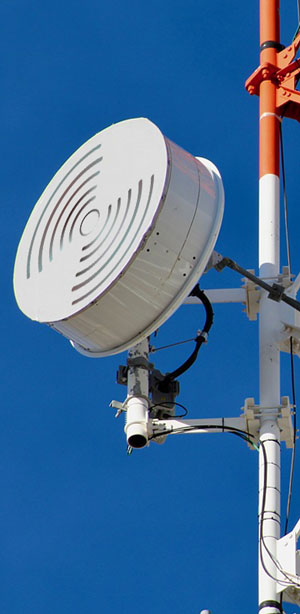
The big brother to cellular is point to point microwave fixed wireless. This is a modern version of the old telco point to point microwave relay. You get a small dish or other microwave antenna that attaches to the side of your building or sits on the roof. It points directly at the provider’s antenna at their central location. This is a line of sight service and generally limited to metropolitan areas.

A major advantages of this type of service is that it is private and dedicated to business use. You won’t be competing with everybody else’s cell phones for bandwidth. The bandwidths can be as high as 1 Gbps or even 10 Gbps. They can also be symmetrical, unlike cellular. With many services your upload and download speeds are the same and your bandwidth is guaranteed. Usage limits? Not usually an issue.

You might even think of microwave fixed wireless as fiber optic without the fiber. Ditching the physical fiber means fewer construction headaches and delays. It is possible that you can have service installed in as little as a few days compared with weeks or months if your building isn’t already lit for fiber.

An unexpected benefit is that fixed wireless can have lower latencies than fiber services with the same bandwidth. That’s because the wireless signal is a direct beam from provider to you. Fiber systems tend to weave all over town with lots of switching gear in the path. Lower latency is critical to some businesses, especially in financial trading. It’s a boon for improving the quality of VoIP phone calls and video conferencing, and for interactive processes running in the cloud.

Cellular broadband uses the Internet and whatever latencies and congestion exist. Fixed Wireless can avoid the Internet and its limitations, or be connected to the Internet so that you can easily connect to customers and suppliers.

Why Not The Best of Both Fiber and Wireless?
Perhaps the best arrangement for your business is a combination of fiber optic service and fixed wireless service. Why both? One reason is to get service started fast with fixed wireless and then add fiber when you can get it installed.

Once you have both running, consider keeping your fixed wireless as a backup to the fiber. Fiber interruptions, often caused by the cable being cut during unrelated construction work, can take days to repair, leaving you high and dry. With automatic failover installed, your traffic will simply move to the wireless link without interruption. When the fiber comes back online, the system will switch back.

Note that fixed wireless offers a true diversity path to fiber. That means fiber and wireless are very unlikely to exhibit failures at the same time. Some businesses think they have this in place by ordering redundant fiber lines or even fiber services from two separate providers. What they don’t realize is that all the fiber serving their location runs in the same bundle or conduit and can all be taken out at the same time by one accident.

Do you need fast installation of high speed business connectivity and/or a robust backup to the fiber you already have? Consider microwave fixed wireless service for your bandwidth needs.

Click to check pricing and features or get support from a Telarus product specialist.


Follow Telexplainer on Twitter


Wednesday, November 03, 2021

You Need a Fiber Optic WAN Network

As your business ramps up, you start to feel the pinch of too small bandwidth connections to the Internet, your cloud service providers, and among your business locations. Clearly, it’s high time to add capacity before network congestion brings everyone’s work to a crawl. But, what do you order? Is it more of what you’ve got or…

Fiber Optic Ethernet WAN for you business bandwidth needs.Yesterday’s Connections Don’t Cut It Anymore
When you started business, networking mostly involved interconnecting in-house equipment with some modest bandwidth to the outside. The rise of cloud based IT services has inverted that topology. Now you have some in-house facilities, mostly PCs and printers, with all of the heavy storage and processing done remotely. You still need decent connectivity inside, but you also need robust connections to the Wide Area Networks.

What WAN connections do you have now? A bevy of T1 lines coming in on telephone cable? DS3 bandwidth with special interfaces? Perhaps you’ve upgraded to SONET fiber optic services, such as OC3, OC12 or OC48. You can layer on more of the same if they are still be offered for new installations. But, should you?

What’s Wrong With Tried and True Telecom?
All of the outside network lines just mentioned are telephone company products. For decades, they were all that was available and you were lucky to get connected at any price. That’s changed now. The old T-Carrier and SONET technologies built on time division multiplexing are rapidly being swept away by packet based technologies based on the same Ethernet standard that runs on your local area networks.

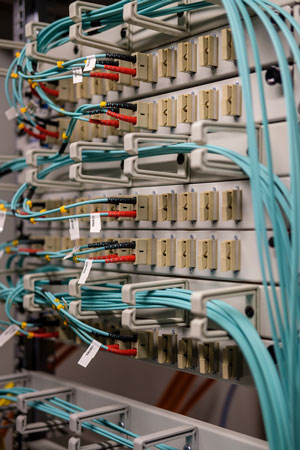
Those legacy services have some issues. They require specialized interfaces that are unique to each service level. If you want to upgrade, you’ll need a truck roll to replace at least an interface card and perhaps a complete box. The copper and fiber services aren’t compatible at all. If you have copper, say T1 lines, and want to upgrade to fiber, say OC3 SONET, you need a complete re-do. Once you get on fiber, you can upgrade to higher speeds by swapping out interfaces again, but only with major jumps in bandwidth levels.

There are two other issues you should know about. Telephone companies, which, by law own the copper telco lines, are starting to abandon these lines because demand is dwindling for such low bandwidth and the copper is aging and disintegrating. It’s become a maintenance problem and an expensive one. You may not be able to order new service or add additional lines. Eventually, the lines you have will be disconnected.

The second issue is cost. There is no great build-out of legacy services going on. That’s all been done. There is also no competition in the marketplace, especially on copper lines. With increasing maintenance costs, prices have pretty much bottomed and, in some cases, may be going up. There are much better options available on a cost per Mbps basis and they are much more scalable.

Ethernet over Fiber is the New Gold Standard
Your next bandwidth service or replacement service should be what is known as Carrier Ethernet or Ethernet over Fiber. This will give you all the bandwidth you need both now and in the future. It’s been built-out by multiple carriers, most of which are not incumbent telephone companies. So competitive is this market, that you may be shocked to see how much bandwidth you can get for your current budget.

Ethernet over Fiber or EoF WAN is directly compatible with your current Ethernet LAN. You just plug in a standard copper or fiber link to your network and you’re ready. What’s more, the bandwidth is easily scalable in small increments. The maximum speed is determined by the speed of the Ethernet Port that is installed by your service provider. If you get a Gigabit port, you can start off at 10 Mbps and then move to 50, 100, 250 or more up to 1000 Mbps any time you want. All it takes is a phone call or do it yourself on a web interface. No hardware changes needed. Need higher bandwidth? Get a 10 Gbps or 100 Gbps port installed.

There are two basic types of connections. First is dedicated Internet access. This is what gets you to the Internet, but without all the line speed variations that are inherent with shared bandwidth connections like cable, DSL cellular or satellite broadband. Pretty much every company needs a good solid Internet connection.

The other type of connection is a direct point to point dedicated line service. This gives you a more secure connection, especially if you encrypt the data. It’s also more solid, with less jitter, latency and packet loss than you’ll get through the Internet. Dedicated lines are great for linking business locations and connecting to your cloud service provider. With the right direct connection, you may not be able to perceive any performance loss even though your IT resources have moved from down the hall to across the country.

Do you need to expand your connectivity or want to get more bandwidth for less money than you are currently paying? Find out what Fiber Optic WAN Network services are available for your business locations now.

Click to check pricing and features or get support from a Telarus product specialist.


Follow Telexplainer on Twitter


Wednesday, October 13, 2021

Dark Fiber Gives You Control

By: John Shepler

Higher and higher bandwidths are expected in business IT infrastructure. That includes the local networks and leased lines for metro and wide area bandwidth. It’s about more than that, though. Just as important are parameters such as latency, packet loss and jitter. Security is a major concern for all network operations. Finally, the ability to make changes, create workarounds and rapidly bring resources online are important to keeping network operations running smoothly.

Find Dark Fiber for business bandwidthBig Bandwidth Means Big Pipes
The need for increasing bandwidth has resulted in a mass migration from copper wirelines to fiber optic cables. Copper may still make sense to the desktop, but outside network connections need the capacity of fiber.

Fiber leased lines are available from 10 Mbps to at least 10 Gbps, with 100 Gbps service becoming more readily available. They can be configured as point to point dedicated lines or dedicated Internet access. Many companies need some combination of the two. The Internet is essential to communicating with customers and suppliers. Direct lines to cloud service providers and between company facilities provide more consistent performance, lower latency and higher security.

Wavelengths are Like a Private Fiber Link
Fiber optic cables are said to have unlimited bandwidth. While that might seem like an exaggeration, in practice it is pretty hard to run out of bandwidth. Each cable has multiple fibers, sometimes as many as 100 in a bundle. Each of those fibers can carry multiple streams of non-interfering data through a process of wavelength division multiplexing.

There are two schemes. Coarse Wavelength Division Multiplexing can divide the fiber into a dozen or more laser colors called Lambdas, all traveling the same time. Dense Wavelength Division Multiplexing ups that count to 80, 96 or more separate wavelengths using more sophisticated equipment.

Note that each wavelength acts like its own fiber. It is unaware of other wavelengths on the same strand. When you lease a wavelength your data is not multiplexed with anyone else’s. You have exclusive use of all the bandwidth on that wavelength, which might be as high as 10 Gbps. Need more bandwidth? Lease another wavelength. Until the fiber bundle is fully loaded, you’ll never have to run more cable.

Dark Fiber Gives You Ultimate Control
What’s better than a wavelength? Having the entire fiber to yourself. That sounds great until you think about the cost of running your own fiber. It makes total sense on your own property, but what about connections across town or across the country? Unless you are in the business of providing carrier services, you’ll find trenching your own fiber to be cost prohibitive.

There is a way to get pretty much your own fiber. Lease an unused strand from a service provider. That’s more doable than you might think. Remember that it doesn’t make sense to go to all the trouble of burying a single fiber strand when you can bury a multi strand cable or even multiple multi strand cables for not much more cost. That way, a carrier only has to lay in the fiber once and have capacity to spare for decades.

These unused strands are called “dark” fiber because there is no laser light illuminating them. It could be your job to light the fiber. The carrier will simply give you access at each end of the fiber and the rest is up to you.

Clearly this beyond the capability of smaller companies, but they are likely well served by lit fiber options already available. Larger and more sophisticated IT organizations may be able to make good use of dark fiber for research labs, medical campuses, video content creation and transport, engineering & manufacturing, and other demanding applications.

Benefits of Dark Fiber
Owning exclusive rights to use an entire fiber is the next best thing to building your own. You do need to provide the termination equipment at each end and manage those resources. That may include your own DWDM equipment to generate multiple wavelengths for all the bandwidth you can reasonably use.

Without competing customers, there is no need for multiplexers to add and drop connections along the route. The fiber serves your locations only. The lack of unnecessary equipment in the line minimizes latency. Unlike the Internet there is no need for routers every so often to direct traffic. You not only have minimal latency, there is no reason it should vary from common carrier routing decisions, and no congestion as long as you are not overloading the capacity of the fiber or individual wavelength.

Security is another big benefit of dark fiber. There is no sharing of bandwidth among customers. This is similar to the old “nailed up” copper private point to point line. You need to trust the operator of the fiber, but don’t have to worry about the other customers. Of course, encryption on top of dedicated fiber gives you the most security you’ll get in point to point transmission.

Dark Fiber Availability
As fiber is being extensively deployed for Internet, cable television, and cellular towers, dark fiber is also becoming more and more available. Competitive fiber network operators and some cable system operators have lots and lots of extra capacity installed. They are more than happy to lease out unused strands when there are dozens sitting dark.

Do your needs demand the capacity, flexibility, and security that dark fiber offers? Find out what dark fiber options are available for your business locations.

Click to check pricing and features or get support from a Telarus product specialist.


Follow Telexplainer on Twitter


Thursday, June 24, 2021

Are T1 Lines Still Used?

By: John Shepler

In these days of gigabit fiber optic connections and cable broadband, it may seem quaint to talk about twisted copper pair lines for WAN networking service or Internet access. Yet, the venerable T1 line is still in use today. OK, but why would anyone choose this legacy technology option?

Check T1 prices and availability now!Who Needs a T1 Line?
In an ideal world, we’d be swimming in choices when it comes to networking offerings. Some people actually are, but you’ll find them in the commercial districts of major U.S. cities. Every networking provider wants to serve New York City, Chicago and Los Angeles. How about out where the cows moo, well beyond the incorporated limits of podunk towns that dot the countryside? Any takers?

No, not so much. The problem is that we, as a country, haven’t accepted Internet access as a basic utility yet. Time was when electricity was in the same category. It was considered a luxury item. By 1936 it was obvious that standard AC electrical power was of strategic importance to the country and should be distributed everywhere. Thus, the Rural Electrification Act brought power lines into every farm, ranch and rural homestead. Everybody got the same quality of electrical service regardless of where they were located.

Fast forward to today. Broadband Internet access is still widely considered to be an optional service for businesses and home use despite the fact that you can hardly access a government service, take a school course or run any sort of business without getting online. So, you either pony up for whatever service is available in your area, do everything on your phone, or settle for shared options like the public library or free WiFi hotspots.

How T1 Fits In
T1 lines are no screaming broadband service by any stretch of the imagination. But they work and work well, often in places where even wireless service is unavailable.

How’s that possible? it’s by design. The original purpose of the T1 Carrier System was to transport multiple telephone conversations on a single digital line. That’s right. It’s a phone company invention that was intended for phone company office use. What T1 did was replace up to 24 telephone wires strung on poles between offices with a pair of lines that carried all 24 calls at once without them interfering with each other.

As a telephone company standard, T1 was designed to use ordinary twisted pair wiring just like plain old telephone service. it was also designed with repeaters spaced every mile or so to boost the signal so it could reach as far as needed.

When the Internet came along decades later, T1 was already heavily in use for phone service. The local phone companies began to offer it to businesses as an upgrade to the dial-up Internet access of the time. T1 was considered broadband in the ’90’s. Instead of carrying multiple phone calls, a T1 line provides 1.5 Mbps of always-on and dedicated bandwidth. There’s no competition with other users and no busy signals.

T1 Lines Today
Just as you can still get landline telephone, you can still get a T1 line installed for your business in many locations. Some businesses have multiple phone lines coming into a local PBX phone system on a T1 line set up as ISDN PRI. At the same time, they may have another T1 line for Internet access or a T1 private point to point connection between two locations.

A few things have changed over the years. T1 is no longer the broadband of choice for most business users with other options simply because the bandwidth is so limited. Prices have come down dramatically from eye popping levels to something much more reasonable, although that is starting to reverse in areas that are phasing out T1. Indeed, this legacy service still works great but is slowly being replaced by fiber optic lines and microwave fixed wireless.

What you do get for your monthly T1 lease is a rock solid line at 1.5 Mbps in both the up and down directions. These lines are highly reliable and quickly repaired if something goes wrong. That may not sound like much bandwidth, but it can easily work for modest retail or office operations that need credit card verification, email, updates to simple websites, inventory updates, ordering, and casual web browsing.

Note that Point to Point T1 lines offer an interconnection that avoids the public Internet and the congestion and security issues that come with that giant network. You get a private, dedicated, symmetrical link between your locations that's like extending your own network over long distances.

Where can you get a T1 line installed? Do you have a landline phone? Can you get one? Chances are the same location can still have T1 line service installed.

Alternatives to T1 Lines
These days, cable broadband is pushing farther and farther out of town to serve industrial parks and residential subdivisions. Fiber optic providers are also expanding their service areas as they extend their cable to more remote cell towers. Fiber prices have come down dramatically, as service areas have increased.

Speaking of cellular towers, most areas have at least some cell service and 4G LTE broadband, if not 5G. You can get a specialized cellular modem designed to connect to your computers or WiFI router at a reasonable price. The companies that offer this service have plans with generous usage limits available.

Some rural areas have what are called WISPs or Wireless Internet Service Providers that serve the underserved locations that are too few and far apart to attract wired connections. A WISP is like a very large WIFI hotspot and some use the same frequencies. Most often, you’ll need to install an outside antenna and point it at the WISP tower to get connected. When you do, you’ll get fairly high speed broadband.

In business districts, fixed microwave wireless offers bandwidths and latency similar to fiber but without the fiber. Instead, a small dish on your roof points at the service provier's tower to deliver a highly reliable high speed connection. This is similar to WISPs but can deliver dedicated rather than shared bandwidth.

Satellite broadband is also widely available just about anywhere with a clear view of the southern sky and some electrical power. This is true broadband service, with plans that can accommodate most business users. It’s a shared service, so your bandwidth will depend on how many others are accessing the same “bird”. There’s also the matter of a half-second delay or latency because the satellite is in geostationary orbit far above the Earth. Many business users think satellite broadband works just fine for their needs, especially with the newer higher power and higher throughput satellites that have become available recently.

So, is a T1 line still the right solution for your network access needs? Or is one of the fiber or wireless solutions a better choice? Before you decide, find out just what bandwidth service options and pricing are available for your particular business location.

Click to check pricing and features or get support from a Telarus product specialist.


Follow Telexplainer on Twitter


Tuesday, May 25, 2021

When You Need Massive Bandwidth

By: John Shepler

Most businesses do just fine with common bandwidth offerings from telco, cable and fiber service providers. Sometimes, though, your application just won’t squeeze through the pipe. You need more than typical WAN bandwidth. You need massive bandwidth.

Find massive bandwidth for your big data. How Massive Are We Talking?
Over the last few decades, mirroring the growth of the Internet, WAN bandwidth needs have multiplied from a paltry T1 level of 1.5 Mbps up to 10 or 20 Mbps for the smaller businesses, at least 100 Mbps for companies with many employees, to a now commonly expected Gigabit per second.

Those bandwidths levels are easily accommodated by most service providers. Copper twisted pair can bring in 20 Mbps or so. Cable broadband is good for at least 100 Mbps and pushing 1 Gbps in many areas. Fiber optic service easily delivers 1 or 2 Gbps and can readily scale to 10 Gbps. Where you might find yourself limited is in rural or underserved locations where your choice is still T1 lines, LTE or 5G wireless, or synchronous satellite broadband.

Massive bandwidth starts at 10 Gbps and goes up from there. Can you reasonably take advantage of 100 Gbps up and down? OK. How about 400 Gbps, 800 Gbps or even a full Terabit per second? Those are carrier level services, but not out of the realm of possibility for the most data or streaming intensive businesses.

Who On Earth Needs THAT Much Bandwidth?
What were absurd levels of bandwidth are now aspirational and may become common sooner than you think. One big driver is the move of everything digital to the cloud. When your data center was just down the hall, nobody worried about bandwidth. You can string as much fiber as you want above the ceiling tiles. Once you pay for installation, usage is pretty much free.

Not so much anymore. When the connection leaves your building you lose control. You’re not going to string any cable across town, much less across several states. For that you need to hand off your traffic to a carrier or service provider. This third party will then lease you the amount of bandwidth you need, or at least can afford, for a monthly fee. The carrier, not you, takes care of all maintenance and reliability between locations.

Some companies get a surprise when they realize that the 30 Mbps Internet connection that was more than adequate when the data center was on premises is now painfully slow when all the applications are in the cloud. One solution is to install a high speed direct line to the cloud service provider and keep the old Internet connection as-is. That solves the bandwidth problem and avoids business critical apps having to deal with the vagaries of Internet performance.

Another application that just won’t play on standard connectivity is content distribution. If you are sending massive amounts of content consistently, you may need to avoid the standard Internet and move over to a purpose built privately run network called a content delivery network. These are designed to handle continuously high levels of video or data without congestion.

Sometimes you only need massive data for a brief time. Say you have Terabytes of disk drives full to the brim and you want to send that to the cloud for safe keeping or to a customer who needs those design or simulation models on their system. Shoving it through a normal connection will take forever. Is there a better option?

Colocation and Cloud Data Centers
If there is one place that you’ll find massive bandwidth already installed and running, it is in cloud and colo centers. Both are massive facilities with nearly unlimited servers, disk drives and bandwidth connections from multiple carriers. The difference between cloud and colo is that cloud centers provide all of the equipment and service needed. A colo or colocation facility lets you bring in your own equipment and set up your own data center in their racks and cages. It’s like what you would have at home, but in a shared building with plenty of space, backup power, HVAC, security and even round the clock staffing.

Some colos will provide a direct fiber hookup between your company and any others located in the same facility. if you need to connect outside, you won’t have to worry about finding a service provider or paying hefty fees to bring in service from afar. They are already inside and serving other customers. You just get a hookup at whatever bandwidth you need.

More Exotic Massive Bandwidth Options
There really is no limit to how much bandwidth you can utilize these days, other than your budget. If you can afford it, consider these options:

Wavelength Services
Most fibers are now lit with DWDM or dense wavelength division multiplexing. That means multiple lasers feeding the same fiber, but on different frequencies or wavelengths. A wavelength can handle perhaps 10 Gbps and each fiber strand can handle perhaps 100 wavelengths. Combine them all and the total bandwidth is mind boggling.

Many carriers are now leasing entire wavelengths for your use. It’s like a fiber within a fiber. Some will combine multiple wavelengths to create 100 Gbps and higher bandwidths for you, or you can lease the wavelengths and multiplex them yourself.

Dark Fiber
The ultimate in bandwidth and control is had by leasing one or more dark fiber strands. Dark means that the fiber is in the cable but totally unused at present. You add the laser termination and multiplexing equipment at each end and “light” the fiber.

Dark fiber is as close to having your own in-house cabling as you can get outdoors. There is nobody else’s traffic to contend with. You decide how much capacity to press into service. Run out of bandwidth? Just upgrade your terminal equipment. Same fiber, more Gbps. You don’t have total control. The carrier still owns and maintains the fiber physical plant, including cabling and repeaters. The rest is up to you.

Are you feeling unduly restricted when it comes to bandwidth to efficiently run your business and take advantage of new opportunities? If so, look into higher bandwidth fiber optic services now. You may find them more affordable than you think.

Click to check pricing and features or get support from a Telarus product specialist.


Follow Telexplainer on Twitter