Showing posts with label connectivity. Show all posts

Friday, February 27, 2026

Can You Afford a Slow Internet Connection?

By: John Shepler

Time is money. In business, that’s almost always true. Your expenses for labor, facilities and services keep draining the cash register. You need to refill it faster than it is draining or you’ll be out of the game at some point. Things need to keep moving at a steady clip just to make your nut each month. On top of that, customer satisfaction often depends on how fast you can service them. What’s the last thing you need? A process that slows you down!

Where are the Bottlenecks?
Most businesses have at least some online presence and many have their business processes inextricably connected with software running on remote or cloud servers. That means that no matter how much you scurry about in the office or shop, you may be inherently limited by computer processing a thousand miles away and the connections to them.

Let’s assume for the moment that your data center has all the resources needed to process any requests instantly. With elastic computing you don’t even have to worry about peaks and dips in traffic. The system automatically assigns whatever computing hardware and software are required to keep up with the necessary tasks. Let’s also assume that the data center has as much Internet bandwidth as needed to handle all the incoming and outgoing traffic. That's more than likely as major carriers tend to have points of presence with massive bandwidth located within key data centers.

So, where might things slow down? The Internet itself is vulnerable. It is designed to work around traffic jams to keep things moving. Even so, there are times when too many things go wrong and the entire network drags. Far more often, the problem is not within the backbone of the Internet but with your connection to it. This is referred to as the last-mile connection.

Unclogging the Last Mile
Last mile problems tend to be caused by limited bandwidth, congestion from too many users needing that bandwidth at the same time, latency from long paths and repeated transmissions to get the packets through intermittent connections.

Bandwidth is the easiest to address. If you are still stuck with aging T1 lines or DSL you likely don’t have near enough bandwidth to handle modern Web traffic. In the dial-up days, a Megabit per second was considered broadband. Today that’s more like a Gigabit per second. Smaller users may get by with fractional Gbps, but large operations may be needing 10 Gbps or even 100 Gbps to keep traffic streams from interfering with each other.

Fortunately, fiber optic bandwidth is more the norm than the exception now. If you have a 1 Gbps or 10 Gbps port installed, you should have the bandwidth you need unless your requirements are extraordinary.

Fiber bandwidth also tends to be low in latency. That’s important to responsiveness because when you have enough bandwidth latency will make communication sluggish and adding more bandwidth won’t help. Low latency is especially important in real-time processes including phone calls and video conferencing. You want those communications channels to be full duplex or instantly two-way all the time.

A fiber connection is the gold standard in the office, but you may also need high performance while portable or mobile. That’s where 5G rises to meet the challenge. You likely have this on your smartphone. Other devices can also have built-in 5G or connect through a portable hotspot that is essentially a 5G phone without the user interfaces or apps. It simply converts 5G bandwidth to WiFi. Any WiFi compatible device can then access the Internet.

Private Lines offer Superior Performance
One limitation to the most readily available Internet connections, such as cable and 5G broadband, is that they are a shared resource. The price is kept low by sharing the cable or radio channels with many users at the same time. When things are going well, you don’t even know there is anybody else on the line. But when everybody wants to send huge files are download video simultaneously, you’ll definitely feel the speed bumps.

If the loss in productivity due to varying congestion is a problem, consider a direct private line from your location to your cloud service provider. This bypasses the Internet completely and is available only to your organization. This service is sometimes called “direct access.” You may also want private lines among your facilities and even key suppliers and customers. In essence, you create your own private Internet.

An alternative that can enhance performance and improve reliability of your connection is called SD-WAN. This involves having two or more Internet connections with a special router that prioritizes traffic and selects which path offers the best performance at the time. The SD means software defined, which is the intelligence in the router that monitors your connections and makes instant decisions on how to best route traffic.

Is your business struggling to keep up because your Internet connection isn’t responsive enough? Look into better alternatives for faster, more reliable connectivity to boost productivity and ensure customer satisfaction.


Click to check pricing and features or get support from an expert technology specialist.


Follow Telexplainer on Twitter


Wednesday, January 21, 2026

Redundant Internet Connections Keep You Online

By: John Shepler

The Internet has become so ubiquitous that we take it for granted. It’s a utility, like gas, water and electricity. It’s always there quietly and efficiently running in the background… until it isn’t.

Redundant Internet connections keep you in business.The Danger of Single Point Failure
Any time we’re dependent on one key element, we’re subject to what is called “single point failure.” Your entire business could be running like a well oiled machine, with orders being fulfilled and customers pouring in. It’s high efficiency and high profits. Then, the connection goes down and stays down. Computers do nothing. Point of sale terminals are frozen. Business grinds to a halt.

Somewhere, somehow the Internet has stopped cold. But it’s designed not to do that, right? Indeed it is. The technology behind the Internet was designed by the military to keep functioning during a nuclear attack when whole areas were vaporized. No one cable or router can stop the data flow. It simply re-routes to paths that are still functional. Well, except for that last connection. You, know. The one that hooks your business to your Internet service provider. How many lines is that? That’s right… ONE. What happens when that gets cut? Right again. Service to and from the Internet stops cold.

The Value of Redundancy
Redundancy is what protects you from single point failure. For things that are so critical you can can’t do business without them, you need a backup. When you have a primary connection and a backup you have redundancy

A simple example of redundant connections is found with many home based businesses. As a solopreneur, you probably can’t justify having a second fiber optic or cable service just in case one goes down. But you likely do have redundancy. Your desktop computer is connected through the router and modem to the ISP. Rarely do you lose service, but it does happen. What then? No need to call up and order another service, you already have one on your phone. Simply use the personal hotspot feature with your phone to supply cellular broadband to your computer and you’re back in business.

There are a couple of fine points here. First, you wan’t to get back to your primary service as quickly and you can or you may get overage charges on your cell phone bill. You typically get only so may GBs per month before they start tacking on extra fees. Second, is your primary Internet service a Fixed Wireless Access from the same provider as your phone service. That might be a great money saver but likely not a redundant connection. If the tower you are accessing is off the air, your phone goes dead and your FWA goes dead at the same time. What’s left to do? Pack up the laptop and head for a hotspot. Hopefully that coffee shop has a different ISP and is still Internet ready. Best to check before you settle in and order.

Robust Business Redundancy
Most businesses don’t have the option to flee the office or store and head out for a break to get reconnected at the nearest hotspot. It makes a lot more sense to have redundant service connections with enough speed to keep running no matter what. Also in most offices it isn’t practical to have everyone pair their PC with their smartphone, although that can work for a short period in some cases. It’s better to have a second redundant service available for the network you already use.

What are some things to think about when setting up this redundant connection? Ideally, you want at least automatic failover. That means when one line goes down, the other picks up the load automatically. This is similar to the way a battery backup power supply works. When the line drops, the battery powers an inverter and the computer doesn’t even blink.

Even better than automatic failover is having a dual or multi-port router that can automatically share the load or pick and choose what route to send each packet for best performance. That’s SDN (Software Defined Networking) or SD-WAN (Software Defined Wide Area Network). The beauty of this approach is that instead of one line sitting idle until it is needed, you can make use of all the available bandwidth all the time. Only when one connection goes down does the total bandwidth available get reduced for the duration of the outage.

A good SDN supplier will ensure that you have truly redundant services, but here are a few guidelines if you are going to set this up yourself. First, don’t just have a pair of lines going from your location to your iSP using the same route. Chances are they run in the same bundle. If a backhoe cuts the bundle, you lose all your connectivity at once. Instead, use diverse pathways so that no one disaster can take out all your lines.

You may also want to have different providers for each service. They can be fiber, cable, wireline, fixed wireless, or satellite. At least use two different providers and you may want to consider two different technologies that are unlikely to be affected by a particular outage… be that wire cut, storm, or power loss. It’s valuable to have battery, generator, or solar power backup for your own equipment as well as redundant Internet.

Have you experienced Internet outages or concerned that a sudden loss of service could damage your business? If so, speak with a technology expert and see what redundant Internet options are available for your situation.

Click to check pricing and features or get support from an expert technology specialist.


Follow Telexplainer on Twitter


Friday, July 25, 2025

Bandwidth to Support Your Data Center

By: John Shepler

Data centers are hot these days. Oh, not just the temperature of the air exiting the servers. Data centers are hot business. As businesses are transformed digitally and AI is implemented to improve productivity, all eyes are on the data center and what it takes to gain the benefits of this technology.

Get data center connections at great prices.Not Yesterday’s Server Closet
You can see advances in data center technology as information tech has grown in importance. Once a company is big enough to have more than one PC, it needs networking to interconnect computers and shared resources such as storage, printers and servers. Hot and noisy racks of equipment are quickly moved out of the office and into their own room, which might be the size of a broom closet. Hence, the server closet.

Little rooms soon become big ones with lots of equipment, special floors and ceilings for wiring, uninterruptible power and heavy duty HVAC. This is the genesis of the data center. Today’s businesses are dependent more and more on information technology and require substantial data centers and staff to process and serve that data 24/7.

Some companies still choose to maintain their own data centers in-house or at remote facilities. Others outsource that function to colocation facilities or cloud service providers. Still others see the skyrocketing demand for data center services to support crypto and AI and look to get a piece of the action.

What Connections Do You Need?
Even if you keep everything in-house, you’ll need external connections. That’s at least broadband Internet and telephone connections. If you have other locations in the same area, you can’t go trenching your own cables. You’ll need carrier connections from point to point or connect everything via the Internet.

There are two flavors of Internet access. They are called dedicated and shared. Dedicated Internet Access or DIA offers the highest performance. Dedicated means that the connection is for your use only and no other company is on the same circuit… at least until you get to the core of the Internet. Since most of the congestion occurs in that first mile, DIA can avoid many slowdowns during peak usage times. Fiber optic DIA is available from 10 Mbps to 10 Gbps, with 100 Gbps available in some areas.

Shared Internet Access is what is available with Cable broadband and Fixed Wireless Access. Your cost is lower because you are not the only one using the line. How well this works depends on how sensitive you are to interruptions and how many high volume users are sharing the same link.

Your data center servers will also likely need Internet access. Most colocation and cloud facilities have multiple carriers serving their facilities. This give you the option to have redundant connections so that if one goes down, another service provider is unlikely to be out at the same time. You can set up an arrangement like this for your own in-house data center. Just be sure that the two or more Internet Service Providers are not sharing the same fiber or other facilities or you may lose all service with a single point failure.

You can also get dedicated Ethernet point to point fiber optic service between two or more of your own locations. This gives you high performance networking without the security issues and variable performance seen on the Internet.

Connecting to the Data Center
If you choose to place your equipment in a colocation facility or contract for cloud services, you’ll need a way to connect from your company building to the remote data center. Some companies choose to do this through the Internet, but you can get much higher performance and better security with a dedicated point to point line also called direct cloud access. This is a private fiber optic circuit that runs from your facilities to the cloud service provider no matter how far away. You’ll generally have lower latency and more consistent performance than connectivity via the Internet.

Do you need a high performance connection to a data center or cloud service or Internet service to the Internet? If so, get highly competitive prices and availability of connection services for your business locations now.

Click to check pricing and features or get support from a Telarus product specialist.


Follow Telexplainer on Twitter


Wednesday, August 28, 2024

Hotspots for Fixed and Mobile Business

By: John Shepler

You need connectivity and you need it wherever you are. In the office, no problem. But what if you need to pick up your office and take it to another location at a moment's notice? What if you need to conduct business on the road or on the waves. Yes, that’s right. What if you need to connect from your boat? Are you set for that? OK, how about overseas?

Get Internet service anywhere, on land or sea.Your Smartphone as a Hotspot
There’s a lot of business we can do right from our cellphones. Certainly, voice conversations. Text and short email messaging work great. You can access sites on the Internet using a browser or apps. Maps are great for find your way around.

When it gets a little more complicated you want to use your tablet or laptop. Then you have a decent size screen and you can upload or down load files or easily work on documents and images. Oh, no. The other devices you want to use don’t have any connectivity except WiFi. There’s no WiFi nearby.

Actually, there is. You just need to turn on the hotspot feature in your phone. You log-in using the passcode your phone provides and your other device now shares the broadband on your phone.

Business Grade Portable and Mobile Hotspots
A smartphone hotspot can be a lifesaver in a pinch. But it has limitations. A dedicated portable or mobile hotspot designed for business has a lot more capability. A good example is the Surf & Turf Router from Infinite Wireless. This device is equipped with two external antenna rods and can pull in 4G LTE from over 20 miles away. That’s important when you’re on the boat well away from shore. It supports up to 16 simultaneous devices on WiFi. Instead of a SIM card this one uses vSIM to support multiple carriers and will select the carrier with the strongest signal. It also works in 135 countries.

Other business oriented hotspots are may support one or more carriers and are designed to let you get connected quickly for pop-up stores or on-site business, such as construction work. When your work is only scheduled for the short term, there is no reason to pay for and wait for a fixed line installation. You can choose to access via WiFi or set up a wired Ethernet network on-site.

Wireless is the New Wired Internet
It may not be long before you access the Internet in one of two ways: Fiber optic broadband or wireless broadband. Cable is still a hybrid fiber/copper system, but will likely move more and more to fiber, especially as other fiber network competitors build-out in cable areas. The cellular wireless companies, such as T-Mobile, Verizon and AT&T are now pushing hard for fixed location broadband service using hotspot boxes that are easily installed and moved by customers, as needed. Service gaps are being filled-in by geosynchronous or LEO satellite constellations.

What are your business needs? Do you require extreme bandwidth for a fixed location network? Do you need quick connectivity for mobile or temporary locations? How about Internet of Things applications that may be installed anywhere but need to attach to the Internet? There are great solutions to all of these situations, and more. Find out what bandwidth solutions are available for your size business and budget.

Click to check pricing and features or get support from a Telarus product specialist.


Follow Telexplainer on Twitter


Thursday, July 18, 2024

How Fiber Future-Proofs Your Business

By: John Shepler

Chances are that connectivity is not just another expense item in your business. It is critical to your being in business and for your employee productivity. What you need is solid, reliable, fast, low latency and uncongested network connections to the Internet, cloud services, and your other business locations. This is the time to ensure you have it now and in the future.

Fiber optic bandwidth for your business.What You Are Looking For Is Fiber
Telecommunications, the genesis of computer to computer connections, was historically built on twisted pair copper wiring. That era is essentially over. The remaining T1 lines and DS3 coax are relics of an earlier day and will soon be moved to the recycling bin. Not only have they been eclipsed in bandwidth, but the infrastructure buildouts now are based on multi-strand fiber optic cables.

Fiber historically has been expensive and rare. That changed with the introduction of Ethernet over Fiber or EOF services directly compatible with today’s most popular computer networks. Fiber optic Ethernet has the widest availability of bandwidths and the lowest cost per Mbps or Gbps. In many areas, fiber is available to just about every business location and in others it soon will be. As you drive down the road you can see crews installing underground fiber conduits in both business and residential areas.

Where Do You Want to Connect?
The most popular connections are to the public Internet. This is a must if you are going to communicate with customers and suppliers. You can also use the Internet to connect to cloud services and link multiple business locations. The beauty of the Internet is that it is already built-out to connect just about everyone, everywhere. This makes worldwide connections fast and inexpensive.

While the Internet itself is a shared network that doesn’t favor one user over another, you can improve your company’s connection by using dedicated instead of shared access. A DIA or Dedicated Internet Access line is a private connection between your business and your Internet Service Provider. It lets you avoid the congestion that can occur when you are sharing access locally with many other business and consumer users.

Dedicated Cloud On-Ramps
Productivity is key to any business. If a key element to your productivity is provided by cloud services, you may be plagued with varying slowdowns and even dropouts caused by a congested Internet not able to keep up with the massive flow of data between you and your cloud provider. The solution is a direct line between your network and your cloud service provider. This is called a cloud connection or cloud on-ramp. It shields you from competition for bandwidth from other users. Such a dedicated leased line can make the cloud server perform like it is right down the hall.

Multiple Locations on the Same Network
Within your building, you have complete control of your LAN that connects terminals, PCs, printers, storage and so on. With multiple locations, you need some way to connect their networks, since they can’t all be on the same LAN… or can they? Dedicated fiber optic bandwidth can go a long way to creating the perception that all of your users, and perhaps some customers and suppliers, are on the same network with the same performance. This is usually done with a central hub and separate links to each location. For vastly separated locations, you can also achieve similar performance with a dedicated link to a MPLS or Multi-Protocol Label Switching network that provides regional, national or international coverage.

How Fast is Fast?
While single Megabits per second was once considered speedy, It doesn’t cut it for most uses today. Even consumers are demanding 300 Mbps, 600 Mbps or even 1 Gbps or more for their Web access and video streaming. Businesses, especially those with cloud services, must have at least this much. Entry level connections of 1 Gbps are now common. As demands increase or business size expands, 10 Gbps is a readily available and affordable service level. Once core network speeds of 100 Gbps are now being offered to businesses in metro areas and will soon be universally available.

How is this possible? Fiber optic strands have nearly unlimited bandwidth capacity. The limitation is often defined by the equipment powering, switching and terminating the strands. Wavelength division multiplexing divides one strand into a dozen or a hundred separate high bandwidth connections. Each cable may have a dozen to a hundred separate fiber strands.

How much low latency high performance bandwidth do you need? You may be surprised to find how much costs have come down the last few years. See now the availability and pricing for fiber optic connections that can grow with your business.

Click to check pricing and features or get support from a Telarus product specialist.


Follow Telexplainer on Twitter


Wednesday, April 17, 2024

Is 5G Bandwidth Slicing The New Private Network?

By: John Shepler

The Internet is a wonderful way to connect… except when it isn’t. Oh, it works great for much of what we need: universal connectivity, rock bottom cost, and support for most applications. It’s when we need higher than usual performance or extreme reliability that our broadband connections can fall short. Latency, packet loss, and congestion can degrade interactive applications or make them impossible to implement. What to do? Switch to private networks.

5G bandwidth slicing for private networks.What is a Private Network?
The Internet is what is known as a public network. It’s accessible by just about everyone, everywhere. All you need is an account at an ISP, cable company or cell phone provider and you’re connected with always-on broadband.

The beauty of this public network is that it has been built out over several decades so that it literally covers the world. Everyone has equal standing on the Internet. The average user’s traffic gets the same priority as a major corporation, research institute or any of the billions of “things” that are now connected online. This is what is known as network neutrality. The only preferences you can pay up for is a more direct connection to the backbone of the Internet and the amount of bandwidth you have access to.

All this equality sounds great, doesn’t it? Most of the time it serves everyone well. But, if you are trying to have a videoconference at the same time as everyone else is streaming a popular concert or engaged in an important phone call when the rest of the world is doing backups to the cloud, your connection may start to degrade. It’s much worse for high speed interactive gaming, remote surgery, high frequency stock and options trading, or control of an electric vehicle. These applications have a low tolerance for hiccups and delays.

The alternative to the public network is the private network. Your company LAN is a private network. It isn’t shared with every other company or consumers watching online TV. Chances are that it has all the low latency bandwidth you need all the time.

Now, extend that LAN across town or across the country. Can you do that? Yes, you can, but you won’t be building it yourself. Instead, you’ll contract with a network provider that offers private point to point connections. There will be other customers sharing their extensive facilities, but they won’t interfere with you. You will be guaranteed the bandwidth and other network characteristics, such as latency and packet loss, that you contract for.

Types of Private Networks
In the past, nailed-up twisted pair wires, T1 lines and SONET fiber were the way to go. Today, Ethernet over Fiber is the most popular along with MPLS networks.

Ethernet connections use the same protocol as your LAN, so they are easy to interface. You can also order direct point to point, point to multipoint, or mesh networks that connect multiple locations. Ethernet over Fiber offers bandwidths from 10 Mbps up to 10 Gbps, with 100 Gbps becoming more common.

Some popular uses for these Ethernet services include direct connections to cloud providers, interconnecting multiple business locations, and content delivery.

MPLS networks are a specialized technology that offers connectivity over wide areas, including the entire country or even Internationally. MPLS uses its own unique protocol, making it more secure than IP networks. These are multi-user networks, but are managed so that each customer has the bandwidth promised at all times. MPLS networks with Ethernet on-ramps can give you tremendous coverage at less cost than multiple private lines.

5G Slicing as the New Private Network
More and more applications are portable and mobile these days. That means a wired connection just won’t do. Instead, we settle for wireless Internet services, usually over the extensive cellular networks. This started becoming popular when 3G networks were implemented and really took off with 4G LTE. It’s only continued at a faster pace with 5G networks.

The limitation with even 5G is that you are still dealing with Internet broadband and its foibles. Bandwidth is more limited than with fiber and congestion can bring your applications to a crawl during busy times in crowded areas. A feature designed into 5G offers a way around this for an extra charge.

5G slicing technology allows carriers to partition or “slice” off a part of the available bandwidth for private use. Everybody is clogged up on the freeway, but you get to zip along on your own private road. Pretty nice, right?

5G slicing can give you a more direct connection to the Internet for better performance or can remain as a private network or connection to a private fiber network. It’s like your LAN, but with the freedom of being wireless over wide areas.

On their own campuses, some companies are implementing private 5G networks to gain the same advantages. 5G slicing takes this a step further to give you connectivity anywhere you go. That includes moving vehicles as well as smartphones, tablets and all those “things” the need connectivity but don’t perform well on the Internet.

Issues with 5G Slicing
The implementation of 5G slicing is just starting to roll out, so you may or may not be able to find this service yet. One concern is how much slicing can there be if everybody wants a private piece of the spectrum. While 5G bandwidth, especially on the new higher frequencies, is more plentiful, there are practical limits to how much traffic can be carried over the air. This is why there is still a mad scramble to make more frequencies available for 5G, including some spectrum currently assigned to the military.

Another potential bug-a-boo is the old network neutrality issue. How can a network be neutral when you can pay up for a private box seat? For now, regulators seem to be OK with 5G slicing as long as the main core of the network used for Internet is not prioritized, or that some services aren’t being throttled for competitive advantage. As more and more of the wireless spectrum goes private, it remains to be seen how much pushback there will be.

Would private networking be an advantage for your business? Find out what bandwidth services are available now for your business locations.

Click to check pricing and features or get support from a Telarus product specialist.


Follow Telexplainer on Twitter


Tuesday, August 29, 2023

How Managed SD-WAN Can Help Your Business

By: John Shepler

Digital transformation is a wonderful thing for business… until you run into snags trying to implement it. One of those unanticipated snags is the need for WAN bandwidth connections far beyond what you ever thought you’d need. You can slug it out trying to make everything work and not break the bank. Or, you can enlist the help of managed SD-WAN to make your connectivity something you don’t even think about anymore.

Get a quote on Managed SD-WAN for your business needs.How Did Connectivity Get to Be Such a Big Deal?
Chances are that when your business was primarily bricks and mortar, you installed a broadband connection for when you needed to access the Internet and that was plenty good enough. It works for point of sale. It works for online ordering. It’s even good enough for a brochure-style web site so that potential customers can easily find you.

Then the transformation began. First it was VoIP phone to replace the old analog landlines. Then came online ordering for both you and your customers, followed by automatic restocking, customer relationship management, financial and tax accounting in the cloud, lead generation, online advertising management, factory planning and on, and on and on. Under the weight of too many software packages to keep track of, eventually some these processes relocated to cloud servers, with some still in your local data center.

That good old broadband service that got you started with the Internet is no longer satisfactory. Even upping the speed as much as you can still doesn’t make it work right. Phone calls get garbled, but not all the time. Workflow slows to a crawl, but not all the time. This inconsistency is driving everybody crazy. You never know when things will zip along seamlessly or when it will all slow to a crawl for a few seconds or a few minutes or the entire afternoon. You need better and you can get it.

The Expensive Solution: Build Your Own WAN Network
You can avoid many of the vagaries of the Internet, especially on shared broadband connections, by building a private network for your operations. This means getting everything off the Internet that you can. All connections to branch offices, warehouses, factories, and any cloud providers can be made with dedicated private lines. As you might expect, each line costs plenty and you’ll need lots of them.

MPLS networks with guaranteed performance levels can reduce the cost when operations are spread over long distances. MPLS is a privately run Wide Area Network with a special protocol that makes it more secure than the Internet. The general public also has no access. It’s business subscribers only and they are only admitted if the network can handle the traffic. For multiple locations, MPLS is less expensive than private lines, but still pricey.

Managed SD-WAN Is More Cost Efficient
SD-WAN stands for Software Defined Wide Area Networking. The software defined aspect is where the savings come from. The managed aspect takes the burden of running all of it off your back. If done correctly, Managed SD-WAN makes your connectivity invisible. You don’t have to worry about it. It just works.

Here’s briefly how SD-WAN does its magic. The trick is to use the least cost connections that will get the job done, but make sure that quality doesn’t suffer. Take the Internet. The least costly connections are shared bandwidth, like cable broadband and wireless, but these are also the most likely to get congested and vary in performance. The most costly are dedicated private lines, but these may be wasted on low priority traffic that doesn’t need low latency and jitter and isn’t bothered by a bit of congestion. If you aren’t using a private line, it’s just idling and you are paying for it anyway.

SD-WAN needs at least two connections in order to make traffic decisions. These can be a mix of cable broadband, Ethernet fiber optic WAN, fixed wireless access, satellite broadband, LTE or 5G cellular, MPLS network and even older wireline services such as T1, PRI or DS3.

What SD-WAN does is continuously monitor each connection’s performance so that it knows the available bandwidth, latency, jitter, and packet loss on a moment by moment basis. When you have traffic in the form of packets, it notes the quality of service you require and then picks the best connection for those packets. Phone conversations and video conferences need very stable connections to work well, so they get a higher priority and QOS requirement. Backups to off-side storage aren’t so demanding and can live with a lower quality link. Other processes are assigned to the right connections for their needs.

Better Performance, Less Cost, Fewer Headaches
Managed SD-WAN is handled by your provider so that you don’t have to worry about day to day connectivity issues. You add locations or policies as you need to. The supplier figures out how to program the system to make everything work. It’s all transparent to you and the cost is considerably lower than trying to optimize a morass of connections yourself.

Are you frustrated with your current connections enough to want an easier and more reliable solution? If so, get a competitive quote for your needs by one or more SD-WAN providers and see if they can save you money and improve performance at the same time.

Click to check pricing and features or get support from a Telarus product specialist.


Follow Telexplainer on Twitter


Friday, July 21, 2023

10 Gbps Dedicated Internet Access Availability

By: John Shepler

Once considered a massive bandwidth suitable only for carriers, 10 Gbps is rapidly becoming the in-demand connectivity for businesses, municipalities, medical centers, content providers, and e-commerce. But is this bandwidth level readily available at a reasonable price? Indeed, it is.

Find 10 Gbps and higher bandwidth connections now.Where is 10 Gbps Dedicated Internet Available?
Most municipalities have 10 Gig Ethernet readily available because of the rapid deployment of fiber optic infrastructure. Fiber is necessary to provide the bandwidth to support 4G LTE and 5G cell towers, replacing legacy T1 copper lines. Fiber is also at the heart of cable systems even though the connection to the cable modem is still coaxial copper. Cities are now installing fiber infrastructure as a utility to serve all homes and businesses.

Once you have fiber optic cables, getting Gigabit and 10 Gigabit broadband is a piece of cake. Each strand can transport 10 Gbps with only one channel. Those same strands can be set up to use multiple wavelengths to carry numerous Gigabit and 10 Gigabit services. A fiber cable can bundle a few to over a hundred fiber strands. Rest assured, there is plenty of 10 Gbps capacity to go around.

What 10 Gbps Options Are Available?
The universal service in demand is Dedicated Internet Access. Dedicated means that your connection to the Internet carries only your traffic. Any capacity that you aren’t using at the moment is idle and available. There is no competition with other companies sharing your line.

Dedicated Internet Access gives you the best consistency and lowest latency way to access the core of the Internet. This is important if your company has remote servers in the cloud or colocation hosting. It’s also key if you are doing business over the Internet and want your customers to have the best online experience.

There are also 10 Gbps private lines that connect point to point between your business locations or from your company to your cloud service provider. This is a step above using the Internet for access. Private lines give you the lowest latency and least congestion. Having a dedicated private line makes your servers seem like they are right down the hall even if they are on the other side of the country.

Cable broadband is now offering a shared bandwidth service that enables 10 Gbps in the download direction using DOCSIS 3.1 and will offer 10 Gbps symmetrical service with DOCSIS 4.0. By sharing Internet access with other users, you can save a significant amount of money, but with the vagaries of varying bandwidth and congestion.

How about wireless? In some metro areas, microwave wireless broadband can give you bandwidths as high as 10 Gbps with no wired connections. Service can be installed rapidly, sometimes within a matter of days or a week.

What About Pricing?
Fiber optic service prices used to be sky high, but that has changed in recent years due to intense competition among service providers and the economies of scale that come from having so many more customers using high bandwidths. If you haven’t checked 10 Gbps prices lately, you owe it to yourself to get a set of current quotes from multiple providers. Yes, there are likely several carriers that can meet your needs right now.

Click to check pricing and features or get support from a Telarus product specialist.


Follow Telexplainer on Twitter


Tuesday, February 21, 2023

Colocation Hosting vs Cloud Data Centers

By: John Shepler

You’ve run your own in-house data center for years, but business is growing and you’ve hit the limit on what your server room can support. Now you’ve got a choice to make. Lease new space for the additional servers, storage and other appliances you need or consider moving everything to the cloud. It’s a big decision and one that needs careful consideration before funds are committed.

Choose colocation instead of cloud hosting.Isn’t Everyone in the Cloud?
If you read the tech headlines and articles, it looks like everyone is clearing out the old server room and simply leasing cloud services. That does have a lot of attraction. With your data and applications deep within the cloud, you no longer have any capital investment, no power bills, no physical security worries, no HVAC worries, and perhaps less IT support staffing. If you need more bandwidth, server processing or storage, you simply ask the cloud to increase your allowance, perhaps even automaticlly.

Why Wouldn’t You Join the Stampede to the Cloud?
Perhaps you’re feeling a little uncomfortable. You’ve heard that joke: “There is no cloud. It’s just somebody else’s computer.” What it really amounts to is somebody else’s thousands of computers, all nicely divvied-up to share among thousands or millions of clients. The promise of the cloud is that it looks to you like you have your own computing resources all by themselves.

Does that sound exciting or does it give you a bit of a twinge? After all, you’re really happy with how responsive your IT staff is and the control you have over all the equipment and software. There are no other companies sharing your facilities. Security involves keeping bad actors out of the building and on the far side of the firewall. So, is your only choice to bite the bullet and lease a new building for expansion?

Consider the Colo Option
Perhaps a third option is best. Lease space in someone else’s specialized building but keep your computing resources to yourself. This is the idea behind Colo or colocation hosting. These facilities were once called carrier hotels when their tenants were primarily telecom carriers. Now colo is popular with businesses of all sizes.

A colocation facility provides the physical building with controlled access and security personnel. It is staffed 24/7, which may even be more than you are able to provide now. Massive redundant power lines feed the facility so there is never a question of having enough amps to power new equipment. Moreover, that power is backed up by emergency generators and often batteries to keep things running no matter what.

With all that power, you are also going to need to get rid of the heat generated by the electronics. That is handled by redundant HVAC equipment to provide cooling air to the servers and other equipment. Air filters keep the facility dust-free.

What about connectivity? That’s one reason why companies move out of their own facilities and to a colocation center. With so many clients wanting so much bandwidth, major carriers have a presence in the colo. Often you have multiple carriers to choose from and they each have multiple fiber links for dedicated access and Internet service. Not every business is served with high bandwidth fiber yet, but the colocation centers are. They’ll get you as many Gbps as you need along with IP addresses.

Moving to a Colo Facility
When you move to a colo, you lease racks with power and cooling plus connections for bandwidth. Want more security? You can have those racks installed within a locked cage that keeps everybody but your staff out. Your people can come and install their own equipment, do maintenance, and make upgrades as needed.

Many colo facilities also offer additional services if you want them. You can have the colo tech staff monitor, troubleshoot and repair your equipment. You can even lease servers and storage from the colo instead of buying them yourself.

Are you outgrowing your tech facilities but want to explore options other than simply relocating to a cloud? Consider colocation data center facilities as an option that gives you more control but saves money compared to leasing your own dedicated buildings.

Click to check pricing and features or get support from a Telarus product specialist.


Follow Telexplainer on Twitter


Tuesday, October 25, 2022

The Connectivity You Need For Digital Transformation

By: John Shepler

Most every business is now in some phase of digital transformation. It’s the process of moving from analog mechanical and paper based operations to digital and online processes. The promise of this transformation is faster and more efficient business methods that save cost and expand your customer base. But, what do you need to put in place to support this digital transformation?

Get the connectivity you need for digital transformation.Plan on Doing Most Everything Online
While most products and services are not digital, the tools to support them now are. Everything from finding prospects to converting prospects to customers, servicing those customers and keeping the products flowing has a digital element to it. The Internet is now the hub of operation for many businesses. Others may be local and walk-in for the most part, but may have an online presence and accounting or other processes in the cloud.

What makes the Internet so compelling is that after a decades of development, it is largely in-place, paid for, and ubiquitous. People who don’t even have bank accounts do have smartphones with Internet apps that allow them to buy, sell and get paid. While there are challenges, especially in the area of security, the Internet is a must for most companies.

Start With High Speed Reliable Internet Access
You’ll need a solid connection to the online world. It will have to be fast enough to be transparent to you and your customers, always available, and have a minimum of latency, jitter and packet loss. The best connections are the ones you never have to think about. That customer on the other side of town or the other side of the world will seem as close as someone in the next office.

There are basically two types of broadband connections. One is called Dedicated Internet Access. The other is Shared Internet access.

Dedicated Internet Access, particularly with symmetrical bandwidth that gives you the same speed uploading as downloading is the gold standard. While the Internet is certainly a shared resource, most of the congestion and outages occur in that “last mile” between you and your service provider. Dedicated connections give you a private road to the Internet. You always have the bandwidth you are paying for, whether you are using it every second or not.

Shared Internet Access is just that. A service provider leases a dedicated access line and then divides it up among many users. If the speed is high enough and there aren’t so many users demanding the same bandwidth simultaneously, you may not even know you are sharing. Sometimes, though, everybody wants to download videos or large files and things slow down. Then, like every traffic jam, they just as mysteriously dissipate and everything is back to normal.

The advantage of dedicated access is performance. The advantage of shared access is cost. Shared services such as cellular and cable broadband can cost a fraction of what a similar speed dedicated fiber or fixed wireless access service costs.

A Hybrid Approach to Increase Reliability and Lower Cost
There is also a third option that has been recently developed. That is the Software Defined Network (SDN) or Software Defined Wide Area Network (SD-WAN). What these systems do is take multiple Internet connections and bond them together so that you get one higher capacity, lower latency and more reliable connection. A SD-WAN box can combine a cable broadband line, a cellular broadband modem, and a small fiber optic service. Even satellite and landlines can be included. The software in the controller monitors each line constantly and selects the most appropriate for every packet.

With SD-WAN, your most sensitive applications, such as telephone and conference calling, get the highest priority for speed, latency and jitter. Business process are next in line. Less sensitive needs, like remote backups, get the lowest priority because a few seconds here and there probably won’t make any difference. SD-WAN can save you money compared to one very large fiber line that you can’t keep busy or perhaps can’t even get installed. It is also a lifesaver when one line is accidentally cut or has an equipment failure. SD-WAN will simply use the other connections to keep things running seamlessly.

Don’t Forget Your Cloud Connections
Your main office, store or factory connection to the Internet is critical, but so are the connections for your cloud based operations. Once those servers and applications leave the premises to be co-located elsewhere or run in a public or hybrid cloud, they need the same reliable and transparent connectivity you had in-house.

There are two connections to be concerned with. The first is the connection between you and the cloud. This may be the same Internet access you use for everything else, but for business critical operations you may want to consider a dedicated private line between your office and the colocation center or cloud service provider. This bypasses the Internet completely and gives you much greater control of your traffic since nothing is shared outside of your business.

The other connection of importance is the connection between the remote servers in the colo center or cloud and the outside world. For this you want the same high performance Internet access with enough bandwidth, low latency and minimal jitter and packet loss. Fortunately, this quality of service is easy to find for colo and cloud, as they deal in massive amounts of bandwidth on a regular basis.

Are you properly connected for digital transformation? That old DSL line or bandwidth limited T1 probably won’t get the job done anymore. Consider an upgrade to highly reliable fiber or wireless broadband for your business. Recent buildouts have made this much more affordable than you might expect.

Click to check pricing and features or get support from a Telarus product specialist.


Follow Telexplainer on Twitter


Wednesday, February 23, 2022

Fiber WAN is Closer Than You Think

By: John Shepler

You know you really need fiber optic WAN service to give you the speed to make cloud-based business application responsive and keep everyone at peak productivity. The problem has been lack of availability. If fact, you may have given up after an extensive search a few years ago. It’s time to take another look.

Search for fiber optic service near you now.Why Should Fiber Be More Available Now?
Fiber optic connectivity used to be exotic. It was only available to the largest companies and was very expensive. The only way to get this service was to go through the telephone company and hope they had built out to near your location. Even then, the cost of getting hooked up could be significant.

Times have changed. Fiber is becoming the default telecommunications medium. Copper bundles, such as analog landlines, T1 lines and even ISDN PRI phone service are being abandoned as they corrode in the ground and are too expensive to replace with demand steadily dwindling.

A big onus for fiber is that the speed of business communications has multiplied. The apps we run today are far more sophisticated, use much more data and often include bandwidth demanding services such as video. Text based email and small file transfers may have worked fine with lower speeds decades ago. Today our tools and data sets slow to a crawl with anything less than fiber capacity.

Another driver in making fiber the default technology for any new construction is that at the data center is moving to the cloud. In-house, you can get Gigabit and even 10 Gigabit speeds with twisted pair copper Ethernet cable. Once you leave the building, that arrangement won’t work. Twisted pair speeds fall off rapidly with distance, which is why you don’t see it being installed in trenches or on utility poles.

To maintain the congestion free speeds you need to run entire offices via cloud based applications, you need a fiber optic WAN connection from your location to your cloud service provider. Fortunately, that’s easier to come by than ever before.

Finally, the fiber tipping point has really been reached with the deployment of 5G wireless to replace 3G and 4G on cell towers. Many of these towers are located far from business districts that were initial wired for fiber. They are in residential areas and even out in the countryside. Fiber runs now stretch further than anyone envisioned a decade ago.

Who Offers Fiber Connections and Where?
Yes, the big telco companies are also leaders in fiber optic services. However, there are many, many more competitive service providers that service both the telco footprints and far beyond. If you have looked and failed to find fiber service recently, you may just not have access to know newer providers who can hook up your location at little or no construction cost.

Telarus, a major technology solutions broker, has contractual arrangements with dozens upon dozens of tech providers, many who offer business grade fiber optic service. A quick inquiry will generate a comprehensive search of fiber optic service near you. There is no charge to see what is out there and how much it costs. So, why not get a complementary fiber list now?

Click to check pricing and features or get support from a Telarus product specialist.


Follow Telexplainer on Twitter


Wednesday, January 19, 2022

Fixed Wireless As Fiber Backup

By: John Shepler

You need large amounts of rock solid bandwidth to enable your business systems, including telephone, conferencing and business process software in the cloud. Normally, that says fiber optic connectivity. But what if that fiber gets cut (it happens) or just can’t be installed soon enough or the construction is just too expensive? Then what? If you happen to be located in the right areas, fixed wireless can be your best solution.

Take a look at fixed wireless microwave as a backup or substitute for fiber optic connectivity.What is Fixed Wireless?
Cell phones have brought mobility to all of us, including having both a phone and a small computer in our pockets. This is wireless mobility. Each device has a modem and radio that communicates with the nearest cell tower. As you move, the session keeps getting handed off to the next towers as you get closer to them. All of this is imperceptible to you, the user. The complexities of handling mobile signals is hidden in the cellular network.

Perhaps you’ve tethered your phone to your PC to keep working when your cable or landline Internet service was interrupted. That’s an example of fixed wireless. It’s the same as mobile wireless, but you’re not moving.

Cellular Fixed Wireless
Ideally, you’d like to tether your entire network to your phone during an outage rather than just one PC. Some phones allow this by acting as WiFI hotspots. In a small business, you may find this work-around to be just fine for short periods of time. Not being able to walk away with your phone can be a real inconvenience. Running out of minutes and getting cut off or big overage charges can be an even bigger inconvenience.

Fortunately, there are fixed cellular services designed for exactly this use. The box you receive looks something like a Wi-Fi router. It has better antennas than your phone, an Ethernet jack to feed your network, and, perhaps, built in WiFi routing. Some have provisions for mounting an antenna outside in weak signal areas.

Best of all, fixed cellular wireless services for business know that you can’t get by with a few Gigabytes a month. You can order 100 GB and more, even unlimited (within reason) usage. Services include 4G LTE and, now, 5G to give you the speed you need to run your business.

Microwave Fixed Wireless
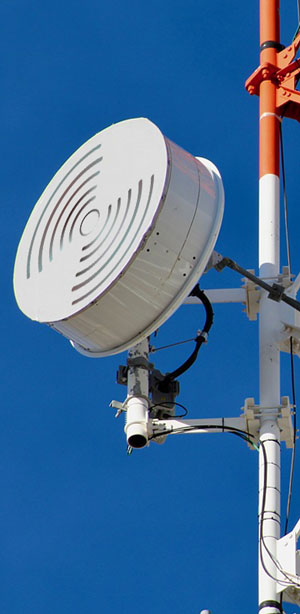
The big brother to cellular is point to point microwave fixed wireless. This is a modern version of the old telco point to point microwave relay. You get a small dish or other microwave antenna that attaches to the side of your building or sits on the roof. It points directly at the provider’s antenna at their central location. This is a line of sight service and generally limited to metropolitan areas.

A major advantages of this type of service is that it is private and dedicated to business use. You won’t be competing with everybody else’s cell phones for bandwidth. The bandwidths can be as high as 1 Gbps or even 10 Gbps. They can also be symmetrical, unlike cellular. With many services your upload and download speeds are the same and your bandwidth is guaranteed. Usage limits? Not usually an issue.

You might even think of microwave fixed wireless as fiber optic without the fiber. Ditching the physical fiber means fewer construction headaches and delays. It is possible that you can have service installed in as little as a few days compared with weeks or months if your building isn’t already lit for fiber.

An unexpected benefit is that fixed wireless can have lower latencies than fiber services with the same bandwidth. That’s because the wireless signal is a direct beam from provider to you. Fiber systems tend to weave all over town with lots of switching gear in the path. Lower latency is critical to some businesses, especially in financial trading. It’s a boon for improving the quality of VoIP phone calls and video conferencing, and for interactive processes running in the cloud.

Cellular broadband uses the Internet and whatever latencies and congestion exist. Fixed Wireless can avoid the Internet and its limitations, or be connected to the Internet so that you can easily connect to customers and suppliers.

Why Not The Best of Both Fiber and Wireless?
Perhaps the best arrangement for your business is a combination of fiber optic service and fixed wireless service. Why both? One reason is to get service started fast with fixed wireless and then add fiber when you can get it installed.

Once you have both running, consider keeping your fixed wireless as a backup to the fiber. Fiber interruptions, often caused by the cable being cut during unrelated construction work, can take days to repair, leaving you high and dry. With automatic failover installed, your traffic will simply move to the wireless link without interruption. When the fiber comes back online, the system will switch back.

Note that fixed wireless offers a true diversity path to fiber. That means fiber and wireless are very unlikely to exhibit failures at the same time. Some businesses think they have this in place by ordering redundant fiber lines or even fiber services from two separate providers. What they don’t realize is that all the fiber serving their location runs in the same bundle or conduit and can all be taken out at the same time by one accident.

Do you need fast installation of high speed business connectivity and/or a robust backup to the fiber you already have? Consider microwave fixed wireless service for your bandwidth needs.

Click to check pricing and features or get support from a Telarus product specialist.


Follow Telexplainer on Twitter


Tuesday, December 14, 2021

From Megabit Copper to Gigabit Fiber

By: John Shepler

You know it’s time to upgrade your WAN bandwidth. There are two major forces at work to make this a necessity. First, the load on your network connections is steadily increasing. Second, legacy copper services that have worked so well for decades are being phased out by the carriers. It’s the right time to make a move to gigabit fiber.

Your path to gigabit Ethernet is here. See what is available now.What’s Driving The Need to Upgrade
Information technology is a different animal than it was in years past. If you’ve been working in technology for ages, you probably remember when computers, their peripherals, and software were all in-house. Connections to the outside were for communication between locations and to the Internet. When there weren’t that many resources to access outside, there wasn’t a need for very high bandwidth.

That’s all changed. The entire IT architecture has been turned on its head. Now, there is very little computing done in-house and a crying need for massive connectivity to the cloud where the computers, storage, and software reside. The Internet has evolved from a simple messaging system to an almost infinitely deep well of resources on all subjects. Communications via the Internet are much more demanding due to the heavy concentration of massive files and high resolution video.

Even small businesses need what used to be considered extremely high bandwidth. Medium and larger companies can’t live without the throughput of high speed fiber optic connections.

Why Copper Connections are Disappearing
Until just a few years ago, twisted pair copper cables connected to a telephone company central office were considered standard fare for both voice and data. That was before the migration away from POTS (Plain Old Telephone Service) landlines. The replacement is VoIP telephony running on the same computer network that interconnects desktop computers, network storage, printers and servers. The in-house telephone switch, called the PBX, has suffered the same fate as most in-house servers. It has moved to the cloud.

The other use for these twisted pair cables was point to point and dedicated Internet connections at 1.5 Mbps. Those T1 lines have faded in popularity as speed demands exceeded their capacity long ago. The upgrade, DS3 delivered on coaxial copper cables, travelled most of the distance multiplexed on SONET fiber optic cable. Only the connection from the curb was copper.

Faced with a waning demand for copper-based telecom services that are ordered less often by businesses and are too slow to support 4G LTE and 5G cellular stations, the telephone companies that own the copper are either ripping it up for recycling or letting it corrode in the ground. It won’t be long and you’ll have to upgrade even if you don’t need the additional bandwidth.

The New Standard is Fiber Optic Ethernet WAN
The majority of telecom traffic now is Ethernet packets. Rather that convert the protocol to and from legacy telco services, Ethernet over Fiber is the new WAN standard.

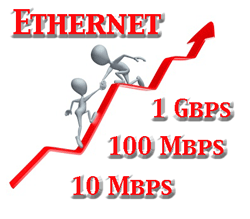
Bandwidths are typically available from 10 Mbps at the low end to 10 Gbps at the high end, with 100 Gbps available in some major areas.

Like earlier copper telecom solutions, you have the option of setting up point to point private lines or dedicated Internet access. Both are supported by Ethernet over Fiber. Private lines offer dedicated bandwidth so you don’t have to compete with other companies for the capacity of the line. Dedicated Internet Access also gives you exclusive use of last mile connectivity. Of course, the Internet itself is a shared medium.

How about availability? Fiber optic lines are becoming almost ubiquitous these days. The exception is rural areas or remote business and industrial parks that aren’t served by fiber yet. Sometimes you can get near-fiber performance by cable broadband solutions that can reach 1 Gbps of shared bandwidth at bargain prices. If you are located remotely, you can often get 4G LTE and 5G wireless business solutions that many not offer the ultimate in bandwidth, but are often great solutions to replace obsolete copper lines.

Is your business running short on bandwidth or have you been notified that your copper bandwidth options are being discontinued? If so, now is the perfect time to check out prices and availability of gigabit fiber optic bandwidth for your business locations.

Click to check pricing and features or get support from a Telarus product specialist.


Follow Telexplainer on Twitter


Tuesday, April 20, 2021

10 Gigabit Ethernet WAN

By: John Shepler

As business becomes more online and companies relocate IT operations to the cloud, the need for WAN bandwidth has steadily increased. Today it is not uncommon for even smaller operations to need 100 Mbps to 1 Gbps of reliable dedicated Internet and inter-office network bandwidth. Medium and large companies, especially those with highly technical products and services or medical imaging, can easily keep Gigabit connections busy. It may well be time to move up to 10 Gigabit Ethernet WAN.

10 Gbps bandwidth for high throughput.Types of High Speed WAN Networks
Very high bandwidth connectivity tends to break down into two categories: Dedicated Internet Access and dedicated private or virtually private lines.

Dedicated Internet Access connects your business location to the Internet through a highly reliable, usually fiber optic, broadband connection. It is called “dedicated” to distinguish it from shared bandwidth services such as cable, DSL, satellite, and cellular wireless services. Dedicated means that all of capacity of the line is dedicated to your needs. There is no competition from other users over this connection.

The Internet, certainly, is a shared resource and your packets are competing with everyone else’s online. There is no way to give yourself priority or to designate certain services such as latency sensitive VoIP phone calls and video conferences as more important than run-of-the-mill file transfers. Usually, though, employing a dedicated access line greatly improves your Internet experience because most of the congestion tends to be in the “last mile” connections to the end users.

Even so, you may want to bypass the Internet for business critical applications such as call centers, core cloud services and the like. You need a direct connection from your location to your service provider, who may or may not be located in the cloud. You may also wish to interconnect your own business locations via a private network of dedicated lines.

Content Delivery Networks
Another type of “private Internet” is the content delivery network. Studios and other video content providers have found that the Internet may not always be able to handle the number of simultaneous high definition streams that users demand. A way to improve performance for the end user short of a direct connection is to deliver the content to the Internet at a point closest to the customer. Entire private networks with multiple geographically diverse server locations are interconnected and then terminated at “Points of Presence” near the users.

Content Delivery Networks need to be very high speed to handle the amount of streaming traffic at a given time. 10 Gbps bandwidth could easily be a minimum, with needs expanding to 100 Gbps connections and more possible.

Content Delivery Networks aren’t just for high volume video steaming. They are also useful to make websites more responsive and easier to handle surges of requests by distributing the content of the website to servers nearer the users. By spreading the load geographically, response time is better and no one server becomes overloaded.

MPLS Networks
A Multi-Protocol Label Switching network is a privately run multi-user network that also helps companies get their most critical operations off the Internet. The advantage of a MPLS network is that it has regional, national or even international points of presence. You only have to supply the line from a particular business location to the nearest network POP. The network operator takes care of the long haul connections between POPs.

As you might guess, the big advantage of MPLS networks versus running your own private network is cost. Unlike the Internet, MPLS performance is guaranteed. The label switching protocol that is employed on the network for traffic control is not hackable using standard Internet Protocol tools and access is limited to paying customers, not the general public. This provides an extra layer of security for your data.

Where Do You Find 10 Gbps Connections?
Until recently, 10 Gbps bandwidth was considered high enough that it was only needed for carrier core networks and the largest business users. The original telco fiber optic standard was OC-192 at 10 Ghz, with 40 Gbps available as OC-768.

A newer standard is Carrier Ethernet that is easily scalable over fiber from 10 Mbps to 100 Gbps, with 10 Gbps readily available today. In some locations, 100 Gbps Ethernet WAN connections are available for the most demanding applications. It’s likely that this service level will be common in years to come with the next advancements being in the Terabit per second range.

If your location or one nearby is lit for fiber optic service, you can likely get 10 Gigabit Ethernet fairly quickly. In some metro areas, 10 Gbps service is also available using point to point line of sight microwave. This makes the service even faster to install and potentially avoids high construction costs of brining in fiber if it isn’t installed already.

Do you have a need for very high bandwidth connections that are also highly reliable and low in latency and packet loss? If so, see what 10 Gigabit Ethernet WAN services are available for your business locations.

Click to check pricing and features or get support from a Telarus product specialist.


Follow Telexplainer on Twitter


Tuesday, February 09, 2021

Bandwidth for Cloud and On-Premises

By: John Shepler

Whether you choose to have your data center on-premises or in the cloud, you’ll need high performance WAN bandwidth for connectivity. Let’s look at the various options.

Find the bandwidth connection you need at a great price.Everything’s On Premises
One big advantage of maintaining your own in-house servers and other data center equipment is that you control the premises network. Your local area network (LAN) likely runs at least 100 to 1000 Mbps. The connections in the data center may be much higher for the short runs needed to interconnect storage, processing security appliances and the rest.

It’s important to note that this is a dedicated network for your exclusive use. If congestion is a problem, you need to upgrade the weak links because it is your operation that is causing the problem. There are no outsiders to cause interference. We’ll come back to that later.

Since all of your company connections are local, why do you need a a wide area network (WAN) at all? For one thing, you’ll have remote employees or employees that occasionally connect from home. For another, your operation may not be contained in one closed campus. You may have multiple offices, retail sites, franchises, warehouses or factories. Even if they are just across town, you have to lease network bandwidth to connect.

Ideally, you’d like these operations to look like they are also on your local network. You can do that with WAN network connections that look like your LAN connections. Metro Ethernet and long haul Ethernet connections are available from 10 Mbps to 10 Gbps and look just like very long LAN cables. Transparent LAN service (TLS) is a managed carrier service that links locations no matter how far apart they as switched nodes.

Connecting to the Outside World
How is it that you connect to your customers and suppliers? These days it is probably via the Internet. You’ll want a high speed dedicated Internet connection to reach out to customers and suppliers and access Internet resources. You may well have a security appliance in the line between the Internet link and your network to keep malicious actors out of your company.

Remote employees will also use the Internet but may connect using a VPN or Virtual Private Network. This adds encryption to your Internet sessions so that they can’t be accessed by anyone not authorized.

Another consideration is the connection that customers use to access your E-commerce servers. Sometimes that bandwidth for this activity is much larger than what you are actually using in-house. You’ll want a fiber optic dedicated Internet access connection to your customer facing servers.

Facilities in the Cloud
The joke going around is that there really is no cloud, it’s just somebody else’s computer. Strictly speaking, that’s true. The advantage of the cloud is that one massive data center can host and maintain thousands of servers with backup power and massive connectivity at reasonable prices. Some companies may want to keep their in-house processes under local control and have their e-commerce servers in the cloud where they can have those massive scalable resources.

The cloud provider will take care of Internet bandwidth out to your customers. You’ll also need an Internet connection with enough bandwidth to efficiently upload and download files from your cloud servers. If you choose to have business process software running on cloud servers, you connectivity will be crucial to the in-house user experience. Latency can be a big issue in responsiveness. Variations in latency due to congestion or line issues can kill productivity and become a major morale problem.

For the best performance, you’ll want a high speed dedicated connection directly to your cloud service provider, avoiding the Internet completely. If that is not available or beyond the budget, a dedicated Internet connection with enough capacity for everyone is a reasonable substitute.

Why Dedicated Bandwidth?
As you may have surmised, there are two types of line services: Dedicated and shared. Dedicated lines are assigned to your traffic only. Whatever you don’t use at the moment sits idle, but you never have to contend with someone else hogging the bandwidth. Point to point E-Line, E-Line and E-Tree connections are all dedicated, as are T1 lines and DS3 bandwidth.

MPLS networks are actually a shared resource, but are a private network carefully managed to ensure that the committed resources in the contract are available at all times. They behave like dedicated resources, but with a cost savings if you need to link many sites.

The public Internet is inherently a shared resource. The core network has reasonably high performance, although equipment failures can occasionally grind performance to a halt. The Internet is designed to work around faults, but may not be able to maintain full speed if some nodes are overloaded.

The real issues with the Internet revolve around the last mile connection performance and no ability to set priority for highly sensitive packets like VoIP telephone calls and video conferences. Shared Internet connections include DSL, cable and cellular broadband. They work well for many uses and offer bargain rates, but you have to accept variations in performance that can range from unnoticeable to highly annoying.

It also should be noted that shared Internet connections tend to offer much higher download than upload speeds, often in the range of 10 to 1. That’s because most users, especially those watching video, are receiving far more data from the Internet than they are sending. Dedicated connections usually offer the same speeds on download and upload, which might be important for business processes, file transfers, telephone, video conferencing and data backups.

Are you in need of a bandwidth upgrade or new service? Get a suite of quotes from competitive providers to see what’s available for your location and how prices compare.

Click to check pricing and features or get support from a Telarus product specialist.


Follow Telexplainer on Twitter


Tuesday, March 24, 2020

Connectivity for Telemedicine and Remote Work

By: John Shepler

The sudden onset of the Coronavirus pandemic is accelerating a couple of trends that were already in progress. One is telemedicine. The other is remote work. Both have a common critical path, which is broadband Internet bandwidth. Let’s look at what’s available to get connected.

Network Service OptionsConnecting the User
Most remote workers and patients accessing telemedicine will be connecting at home, perhaps using a desktop PC or Mac, or on the move through their smartphones, laptops and tablets. The most popular option at home is cable broadband, with bandwidths of 30 to 100 Mbps. Remotely, the most popular options are public WiFi and 4G & 5G cellular broadband.

The individual user who is an employee or patient seldom has the budget for business grade connections such as private lines, fiber optic bandwidth or point to point microwave. Their connection is to the Internet through whatever last mile connection they can afford. That’s almost always a cable or cellular connection which is shared bandwidth and asymmetric, with download speed perhaps 10x upload speed.

These connections generally work fine for remote log-in, video chat and website access. They’re pretty reliable and budget friendly.

Special Cases
Certain medical equipment doesn’t work well over home Internet. The patient may need a classic analog landline (yes, even today) or built-in proprietary wireless access.

A business needing higher performance than consumer broadband offers may have to pay the cost of a dedicated leased line. This might be a T1 line, Ethernet over Copper, or Fiber to the Premises, if available. Dedicated Internet Access generally offers a performance improvement over shared consumer broadband first-mile connections. You also have the option of setting up a dedicated private line, although higher bandwidths are often not available to consumers.

If broadcast quality live video is required, you may need to set up a small remote studio near your talent. A Metro Ethernet private line will support the quality you need to avoid the distorted audio and video glitches common with consumer Internet video chat services.

Business Bandwidth Options

If you are the provider rather than the user, your connectivity needs are likely more demanding. As the company or medical organization you will probably be supporting more than one simultaneous employee or patient. That could be dozens, hundreds or even thousands of users connecting into your central system, which might be cloud-based.

There are two types of connectivity you’ll want to consider. First is connection to those outside users, mostly likely through Internet broadband. Second is connections within your own organization. Your internal connectivity will be by Local Area Network and either Metropolitan or Wide Area Networking to include more than one business location. You may also want a dedicated high bandwidth cloud connection to make your cloud applications perform as if they were hosted in a local data center.

You’ll need enough Internet bandwidth to support the maximum number of simultaneous users that will commonly be connected, plus some surge ability to support additional users when things get busy. A dedicated broadband Internet connection using scalable Ethernet over Fiber bandwidth can handle heavy demands. Gigabit and 10 Gig E services are readily available.

Within the organization, you may wish to stay off the Internet both for higher performance and better security. Point to Point dedicated private lines can be nearly transparent to your network. If multiple locations are involved scattered over a wide geographical area, an MPLS network can save cost while still preserving high performance and excellent security.

The performance of the last-mile Internet connection can also be improved by using an SD-WAN connection. SD-WAN or Software Defined Wide Area Network combines several types of Internet connections, including wired, fiber optic and wireless. The SD-WAN software constantly monitors the various connections and chooses the most appropriate for each packet. This helps ensure that more demanding applications have priority over activities that can be run in the background.

Is your company planning or already engaged in remote work or telemedicine? If so, we can help you find the right type of connectivity at the best price.

Click to check pricing and features or get support from a Telarus product specialist.


Follow Telexplainer on Twitter

Thursday, October 10, 2019

Can Satellite Be Part of Your SD-WAN?

By: John Shepler

Software Defined Networks (SDN) or Software Defined Wide Area Networks (SD-WAN) are being implemented more and more to provide high quality business bandwidth at lower costs. In some cases, SD-WAN is the only way to get decent bandwidth levels in rural and remote areas. You might think of these software defined networks as a potpourri of different connection technologies, but it’s more than that. it’s an intelligent approach to making the most of every connection available, including satellite.

Consider satellite as part of your SD-WAN solutionWhy The Need For SD Networks
Say you want to connect to the Internet or to your cloud service provider. Traditionally, you’ve done that by ordering up a “last mile” connection from your business location to the Internet or a private point to point line between two locations, such as your office and your cloud provider.

That’s great as long as there are providers who can give you all the bandwidth you need and at a price that won’t choke your business. The problem is that you often overpay for premium bandwidth that goes unused or settle for what the budget can handle and regret the performance limitations every day.

In reality, different tasks have different connection requirements. Telephone lines for a call center or even ordinary office use don’t need tremendous amounts of bandwidth but are highly sensitive to latency, jitter and packet loss. Backing up files to a remote data center or storage in the cloud is fairly insensitive to the latency, jitter and packet loss characteristics but needs lots of bandwidth to get done in a reasonable time.

This is where SDN / SD-WAN work their magic. An intelligent processor acts as a traffic manager for each and every packet entering the network. Those voice packets get routed to a dedicated high performance but limited bandwidth circuit like like a T1 or ISDN PRI. File backups can go via cable broadband or as lower priority on the T1 or fiber optic line. Business applications in the cloud need reliability and quick response. They’ll go over a high performance connection.

How SD Networks Optimize Cost
The processing power within the SDN controller makes note of what each type of traffic needs. You’ve told it that. The processor is also constantly monitoring the status of each connection that you’ve provided it. It can truly be a potpourri of T1, DS3, cable broadband, 4G and 5G wireless, Point to Point Microwave, Ethernet over Copper, Ethernet over Fiber, SONET, MPLS networks, DSL, and two-way Satellite.

What’s key is that the controller knows at each instant how each connection is performing. Low cost connections aren’t always low performing. That DSL or cable link might be zooming along right now. The low cost usually comes from these being shared rather than dedicated connections. Other users, not in your company, can be hogging bandwidth and creating congestion to slow you down.

Satellite may well have excellent speed and low packet loss. The geosynchronous satellites now in service do have long latency times that can’t be avoided. That can be an issue with voice and video conversations, but makes little difference for file transfers or downloaded video.

Wireless connections in general have usage limits simply because wireless bandwidth is a scarce resource. SDN needs to be mindful of that in assigning the connections to avoid bandwidth slowdowns or additional charges.

The point is that you don’t need to buy the most expensive bandwidth solution in many cases. You won’t be able to load up that line 100% of the time with traffic that absolutely needs it. SDN / SD-WAN can ensure that your costly connections get used to the max but offload traffic that doesn’t need such high performance to a lower cost link. You also gain the advantage of automatic failover in case one of your links fails.

When Availability Is Most Important
There are many locations in rural America where you can stand outside and waive a fist full of money to buy connectivity and have no takers. This is where an SD network solution can really help. The newer high bandwidth satellites offer fast speeds and quality connections. You can include a dedicated SIP trunk based on a T1 line for your VoIP phone calls to get around the latency issue. it is likely that cellular broadband is also available in most areas. Combine these and you may well get all the bandwidth you need with the performance you also need without having to pay a fortune to bring in a fiber cable… if anyone will even do it.

Are you frustrated with either the cost of connectivity or its availability? This would be a good time to look into SDN / SD-WAN solutions that can give you the performance you need at a cost you can afford.

Click to check pricing and features or get support from a Telarus product specialist.


Follow Telexplainer on Twitter