Showing posts with label wireless. Show all posts

Wednesday, April 30, 2025

Today’s Best Business Broadband Options

By: John Shepler

If you are still using a copper wireline service, such as DSL or T1, for your business Internet connection, it’s time to upgrade your service… before you are forced to.
Find today's best Internet connections for businessForced to? Why would that be? Fact is, the major telecom companies are all in the process of decommissioning their copper wire assets. Basically anything that uses century-old twisted pair wiring is on the way out.

Technology marches on. T1 lines were once considered broadband. They don’t even qualify with today’s standard. DSL? Pretty much an obsolete system that was once a good way to re-purpose standard telephone lines for fast Internet access.

AT&T and others have made it clear that they are either pulling up old copper lines or abandoning them to rust in place. The wire centers or central offices that connect to these lines are being repurposed as data centers for the insatiable needs of AI.

So what are better options? Surprisingly, one of the best is also an older technology that has continuously upgraded to keep it competitive with the times.

Cable Broadband Is a Great Deal for Small Business
That coaxial cable that plugs into the back of a set-top box or cable modem has been a familiar tech standard for many decades. Physically, it’s the same. What’s changed is the signal that comes out that center wire.

Cable was originally analog, just like TV signals back in the day. When the Internet came along, some of the unused TV channels were set aside for digital transmission using a standard called DOCSIS or Data Over Cable Service Interface Specification, an invention of the industry’s R&D organization CableLabs. The current standard is DOCSIS 3.1 with a migration underway to DOCSIS 4.0.

Today’s cable modems are cable of gigabit speeds, with common service levels of 300 Mbps downstream, 30 Mbps upstream. That’s fast enough for pretty much all web browsing, video streaming and data transfer. What’s hard to beat at those speeds is the price. Cable is easily affordable by both consumers and smaller businesses, often with telephone service included.

Wireless Broadband is Now Both Mobile and Fixed
Like cable, cellular wireless had humble beginnings as a mobile telephone service, but has kept up with the times through multiple technology advancements. The first standard that really supported broadband as well as telephone was called 3G. That’s evolved to the current standards of 4G LTE and 5G. With 300 Mbps or so, an iPhone has all the bandwidth it can really make use of.

That high bandwidth, which can reach a Gigabit per second near some of the 5G towers, is easily competitive with fixed broadband services. The capacity limits have been largely eliminated with 5G buildouts and the extra spectrum acquired from government auctions of unused television bandwidth. Now the wireless companies are in a competitive battle to roll out cellular modems that work like cable modems but without the wires. You can put one at a construction site or a pop-up store in minutes. If you move soon, take it with you and have connectivity at your next location.

Cable broadband is being built into laptop computers and tablets and other devices, called the Internet of Things. Remote data acquisition and control are now possible in remote areas that have cell towers but no other connectivity.

Fiber, The Gold Standard and Secret Backbone
The magic that makes cable and cellular broadband so fast is the fiber optic lines that feed these services. It’s all behind the scenes, of course. Even so, you may want to connect directly to fiber yourself.

What’s the fiber advantage? Nearly unlimited bandwidth for one thing. Today’s service levels run from 10 Mbps to 10 Gbps just about everywhere, with 100 Gbps service available in some metro locations. That’s important for medium and larger enterprises with many employees who need simultaneous Internet access.

Another big advantage is symmetrical bandwidth That means if you have 1 Gbps downstream, you also have 1 Gbps upstream. Contrast that with most cable and wireless services that offer much higher download than upload speeds. If you need to transfer files up and down regularly or have demanding video conferencing requirements, this can be important.

A third advantage is very low latency and jitter with minimal congestion. This is because fiber is usually a dedicated service, not shared like cable and cellular. For even higher performance, consider a dedicated line between your company and your cloud service that bypasses the Internet completely.

Need the ultimate in performance? Dark Fiber that you “light” with your own equipment gives you complete control of protocols and bandwidth allocation. It’s like having your own network extended across town or across the country.

Do you need a replacement Internet connection or are ready for a bandwidth upgrade or perhaps even a cost saving? Check out the Business Broadband Options available right now.


Click to check pricing and features or get support from a Telarus product specialist.


Follow Telexplainer on Twitter


Tuesday, March 18, 2025

Is Cellular the New ISP?

By: John Shepler

Internet Service Provider technology has evolved dramatically in the last few decades. It stated out as audio modems over classic landline phones. Then came broadband with DSL and Cable. Business broadband started with ADSL, T1 lines & DS3, upgraded to SONET fiber and then Ethernet over Copper and Ethernet over Fiber. Now we may be headed back to telephone technology, as 5G cellular make a move to become an accepted Internet Service Provider.

Find 5G fixed wireless access for businessWhat’s 5G Got to Offer?
5G is the latest in a long line of technology evolution for wireless mobile phone service. The earliest cellular 0 and 0.5G emerged in the 1970’s, followed by 1G and 2G technologies in the 1980’s. These were voice technologies designed to make the traditional telephone set wireless and mobile. SMS messaging appeared in 2G with e-mail and simple Web browsing added with 2.5G and 2.75G.

The first mobile service that really could be called broadband Internet access was 3G, 3.5G and 3.75G. This is what supported the rise of smartphones. The next generation (G stands for generation level of technology) 4G and 4G LTE (long term evolution) made cellular broadband a real contender as an Internet Service Provider.

The latest phones with 5G are seeing Internet speeds in the dozens to hundreds of Mbps with low latency, jitter and packet loss. The millimeter wave bands support Gigabit per second service and that may be upgraded to 10 Gbps downlink and 1 Gbps uplink with 5G-Advanced upgrades.

5G vs Cable and Fiber
More and more business is being conducted on smartphones and tablets vs desktop computers and even laptops. WiFi is useful indoors to avoid burning cell usage quotas, but while mobile and at customer locations you’ll likely be connecting via 5G from your service provider. Since that applies to all of your mobile devices, the value of an Ethernet connection is limited to desktops and wired phones, with WiFi helpful in moving about in the office or at select locations, such as restaurants.

With so much computing being done via 5G, is it possible to replace everything with a 5G account that supports all your devices?

For an increasing number of consumers and small business users, the answer is yes. Replace your cable modem or fiber termination equipment with a 5G hotspot and continue using the Internet as you always have. You may not even notice a difference in performance. Let’s face it. Once you’ve got all the bandwidth you can reasonably use at one time, doubling or tripling it doesn’t make things go any faster. The limit will likely be the server at the other end that you are connecting to.

Since 5G speeds are often a couple of hundred Mbps or more, the difference between wireless, DOCSIS 3.1 cable and Ethernet over Fiber might not even be noticeable. Where the difference does show up is in your usage limit. That’s only important if you are a heavy user or a corporate operation with dozens or hundreds of users online at the same time. It’s especially true if your business applications are being run from the cloud and accessed via the Internet.

Limitations of 5G Broadband
Yes even with “unlimited” plans, you can’t hog all the bandwidth of the cellular provider all the time. The system isn’t designed for continuous uploads or download from a single customer. Bandwidth is scarce and must be shared with a multitude of users on each tower. Your provider may not drop your connection, but you might find it slowing down severely, especially during busy times, when you are using more that your fair share of capacity.

Another issue to consider is upload vs download performance.Casual web browsing and media streaming is demanding on the download side and not so much for upload. Business applications that transfer large files to and from remote servers or the cloud may well need upload bandwidth that rivals download performance. Video conferencing and telephone call centers also need both upload and download capability about equally. This is where fiber shines. Business fiber is typically symmetrical with upload and download speeds the same. This is also usually provided with no usage restrictions, something you are unlikely to find with cable and 5G.

Selecting a Service
What service works best for your business? It depends on what you are doing and how intensely you are doing it. Some companies will find that only high speed fiber optic service will meet their needs. Others will be fine with cable or 5G wireless service at a lower cost.

Another consideration is ability to connect. While fiber may offer the best performance, there may be no fiber near your rural location or you may be in a dense metro location that hasn’t been “lit” yet. Some companies have found it best to quickly connect with a 5G hotspot and use that service while waiting for fiber to be brought in over a period of weeks or longer.

If you have a need for new or expanded broadband Internet service or are simply curious if you can make a better deal, learn what business broadband options are available and suitable for your business.

Click to check pricing and features or get support from a Telarus product specialist.


Follow Telexplainer on Twitter


Tuesday, April 18, 2023

5G Fixed Wireless Fills the Copper Gap

By: John Shepler

For almost a century and a half, twisted pair copper wiring has been the way telecom services were delivered. This ranges from classic plain old telephone service, to T1 digital lines for Internet access and point to point private connections. Copper, however, is on the way out. If you haven’t run up against its bandwidth limitations yet, you may still have a problem if your local telephone company (who owns all the copper lines) decides to discontinue service. Then what?

Find 5G Fixed Wireless Access for your business broadband.What Replaces Copper Lines?
When it comes to bandwidth, fiber optic cables can’t be beat. You can order any bandwidth from 10 Mbps up to 10 Gbps, and even 100 Gbps in many locations. Hybrid Fiber Cable, commonly known as cable broadband, can now deliver multi-gigabit speeds through the classic coaxial cable.

Sounds great, but what if you are in an area that is not served by Cable and has no fiber infrastructure nearby? Are you simply stuck with no service at all?

5G Wireless To the Rescue
Fifth generation or 5G smartphones have pretty much taken over the market from the 4G LTE standard that served us for years. With 5G comes new bands that offer expanded bandwidth and low latency for smart autonomous devices that are called the Internet of Things.

There is another application that 5G is pursuing aggressively. That is fixed wireless access or FWA. The “fixed” part of FWA means situations that are not mobile. Think of your desktop PC, point of sale terminals, or even your entire Local Area Network.

Internet service providers called WISPs or Wireless Internet Service Providers have been around to serve homes and businesses that can’t get wired or fiber Internet. They tend to be very local and independent and use systems that are not affiliated with cellular providers. If you have a WISP nearby, they can often step in and give you the service you need to stay online.

How 5G is different than the usual WISP is that it is true cellular broadband and serves both fixed and mobile users. The same broadband that you use on your phone can also be delivered directly to an office, store or residence wherever there is a cell tower nearby.

4G LTE service actually started the push for applications to use cellular broadband rather than depend on DSL, cable or other wired services. When 4G LTE became widely available it offered bandwidths that rivaled typical broadband services and had enough capacity to serve multitudes of customers rather than just a few at a time.

4G LTE is still a good option for many applications. What 5G does is offer bandwidths that can rival fiber at low latencies for sensitive applications. Major cellular carriers are promoting 5G wireless as a competitor to cable broadband in fixed locations. For business users, 5G can often substitute for unavailable T1 lines or even DS3 bandwidth.

How Do You Get 5G FWA?
You may have already paired your phone with your desktop PC or tablet using Bluetooth and setting up the phone as a personal Internet Hotspot. FWA expands upon this idea. Instead of a phone, you install a 5G or combination 5G / 4G LTE Gateway. This can be a simple box that sits on your desk in on a shelf near a window. It may have a wired Ethernet port to connect to your router or may even contain a router and WiFI hotspot. Some of these devices have special antennas that are more efficient in capturing the cellular tower signal for reliable operation.

A good way to research the availability of 5G and 4G LTE options for your business is to work with a bandwidth broker that represents a multitude of companies offering this type of service. You’ll want a solid connection with enough bandwidth to serve the size of your business and sufficient or no data limits. You may be surprised at the variety of offerings available, even in rural or otherwise underserved areas.

Click to check pricing and features or get support from a Telarus product specialist.


Follow Telexplainer on Twitter


Monday, January 23, 2023

What Replaces DSL, T1, ISDN PRI, EoC?

By: John Shepler

Have you seen recent cost increases for your copper-based telecom services? Did you even get a letter saying that service will be discontinued? This situation will only get worse, as telcos sunset their aging copper wire assets in favor of more modern technologies such as fiber and wireless. It’s time to make a change.

Find copper line network replacements now. The Copper That Isn’t Going Anywhere
The copper that’s in trouble is twisted-pair analog copper telephone lines. They started the electronic communication revolution over a century ago and have run their course from innovation to obsolescence. There is another copper network line, however, that is still going strong. That is cable broadband using coaxial copper cable as a curb to premises connection.

The copper nature of cable services is something of a fooler. The vast majority of the network is fiber optic based. Only the last few hundred feet is the well known RG-6 terminated with an F-type connector. You might think of this wiring as old-school, but with the latest DOCSIS modems, it can easily deliver Gigabit broadband up to 10 Gbps.

Cable companies offer television, broadband and telephone service over the same cable line at a very reasonable cost that is attractive for small businesses, especially those that can use the TV feature for their customer waiting rooms.

Fiber Optic: The New and Improved Copper
The telephone and network industry standard that is replacing twisted pair copper is Ethernet based fiber optic service. The original standard, SONET, is still the backbone of many networks, but has actually transitioned from carrying channelized telephone calls to packet based Ethernet network traffic. Newer networks are all Ethernet, to reflect the standard Ethernet protocol used in the majority of digital networks worldwide.

Ethernet over Fiber has the advantage that it plugs directly into company routers and is vastly scalable, from 10 Mbps to 10 Gbps just about everywhere, and up to 100 Gbps in many metro locations. Fiber takes over from copper data services, include DSL, T1, DS3 and even the newer Ethernet over Copper. EoC was meant to provide higher bandwidth using the same twisted-pair infrastructure, but is falling victim to the decommissioning of the copper bundles themselves.

Business telephone, which standardized its own analog and digital networks, is largely switching to a computer networking standard of Voice over IP or VoIP. This offers the benefit of supporting many newer technology features and allows computers and phones to share the same company Local Area Network.

To make VoIP work, your phones need to connect to the Public Switched Telephone Network to make and receive outside calls. This is done using a standard called SIP or Session Initiated Protocol that runs on the network and connects to your phone service provider over an Ethernet WAN connection, using fiber. Both the Internet and direct connections can be employed. SIP trunks replace analog phone lines and ISDN PRI trunks to carry telephone traffic to the PSTN.

The Special Case of POTS Replacement
In many cases, the move to fiber optic private line and Dedicated Internet Access will handle business needs for voice, video and data traffic. There are special cases of FAX, fire alarms, burglar alarms, elevator phones, analog point of sale systems and some others that are specifically designed to phone company standards and don’t work well on packet based networks, such as the Internet.

For these uses, you may want to look into specialized POTS (Plain Old Telephone Service) replacement options. These usually work wirelessly through private connections to the LTE cellular phone network and don’t traverse the Internet at all. An advantage of POTS replacement equipment is that it connects directly to the systems you already have.

Fixed Wireless Where There Is No Fiber
The day may come where fiber is everywhere, but today were are still in the build-out phase. Fiber is going into the ground at a rapid pace, but in more rural locations are still waiting for access. Even metro areas that don’t have lit fiber installed may be faced with huge construction costs to connect to the fiber access points.

The alternative is to skip the fiber but get high speed Ethernet bandwidth using Fixed Wireless Access. FWA is similar to cellular broadband but is intended to connect to in-house networks rather than cell phones. In fact, the major cellular companies are in competition to offer 5G Fixed Wireless broadband service to both residential and commercial users.

Other wireless companies, often called WISPs for Wireless Internet Service Providers, don’t handle cell traffic but have towers that serve a limited area with wireless Internet access.

Other microwave-based FWA providers focus on business customers with high bandwidths that can reach 10 Gbps. This can be private line as well and Internet service. An advantage to business FWA is that a small dish or other antenna can be installed on your building for reliable operation and service can get started in days rather than weeks or months for fiber construction.

Are you facing a loss of your traditional DSL, T1, ISDN PRI, EoC or analog telephone service and need replacement soon? If so, you may have an opportunity to upgrade your service and save money at the same time. Check out telephone and network replacement options now.

Click to check pricing and features or get support from a Telarus product specialist.


Follow Telexplainer on Twitter


Wednesday, March 16, 2022

Upgrade your ISP to GigE and 10GigE

By: John Shepler

Regardless of whether your business is strictly e-commerce or a traditional bricks and mortar operation, Internet access is essential to conducting business these days. One thing we never seem to have enough of is bandwidth. This is the right time to upgrade your broadband connection to handle the throughput you really need to efficiently get the job done. Surprisingly, it may be more affordable than you think.

Dramatically increase your broadband speed to 1 Gbps or 10 GbpsHow Much Do You Need?
Small businesses, including home offices, single person professional offices, small retail stores and the like, may find that 100 Mbps Fast Ethernet service is plenty. You might even get by with less than that… for now. For every other situation, you’ll want to look at bandwidth fast enough to be transparent. Transparent means you don’t even know it is there. There’s always enough that you won’t get slowed down no matter what you are doing. That’s the gigabit range. Consider Gigabit Ethernet (GigE) and 10 Gigabit Ethernet (10GigE).

Why speeds so much higher than you’ve expected over the years? Today’s business is different. Much of what we call content is high consumption video versus email messaging. Images are much larger, if not in physical size then in Mbps. Databases are huge. They don’t call it “big data” for no reason. On top of all this, most processing has moved or is moving to the cloud. Those high speed Ethernet cables that connected you in-house have to be replicated between you and your cloud provider.

Really Fast Connections Readily Available
Fortunately, the networking industry is keeping pace. The incentives of greater business demand, 4G and 5G wireless, and consumer cord cutting has pushed providers to expand their networks and lower the cost per Mbps and Gbps. You likely have multiple options to get the bandwidth you need at a price you can afford.

You should know that Internet Server Provider (ISP) bandwidth comes in multiple flavors, each with its own characteristics and pricing. There’s a reason why they don’t all cost the same. The first reason is provider competition. The more options that are available in a particular area, the more competitive pricing will be, especially on the higher end business connections.

Another reason is whether you can live with shared bandwidth or need to have exclusive use. Your lower cost options, of which cable is the biggest provider by far, have the bandwidth multiplexed or shared among many users. You’ll notice that your bandwidth is “up to 1 Gbps” rather than guaranteed to be that speed at all times. The idea is that not everyone is using the line to full capacity at all times. In fact, that’s highly unlikely. So, while you are reading something online, somebody else is downloading a file… and vice versa.

If you are running a server or running business critical software in the cloud that needs to hesitate as little as possible, you’ll want Dedicated Internet Access (DIA) at a minimum. In fact, you may even need to upgrade to a direct connection between you and your cloud provider to get the performance you desire. That gets you off the Internet and its vagaries completely. Dedicated Internet Access keeps you on the Internet, but you don’t share your “last mile” bandwidth. That’s where most of the congestion occurs anyway.

Another consideration is whether you need symmetrical bandwidth or not. Most Internet services that offer shared bandwidth are also asymmetrical. That means the download speed is much higher, sometimes 10x higher, than the upload speed. It makes sense if you are mostly accessing web sites or downloading videos, like most consumers. However, if you run cloud processes where you upload as much as you download or do large backups to remote storage, you’ll want symmetrical bandwidth options.

Your ISP Bandwidth Options
So, what’s available? Cable broadband using DOCSIS 3.0 or 3.1 standards will get you 100 to 1000 Mbps shared bandwidth Internet access, usually asymmetrical. It’s quite reliable these days and you can’t beat the price.

If you are out in the boonies where there is no cable, you might get by with 4G or 5G wireless broadband. Yes, it’s the same broadband that runs your smartphone, but with a special modem that connects an office network. Another option is satellite business broadband. This will work just about anywhere and offers decent bandwidth. Latency can be an issue, especially for VoIP telephony and video conferencing, but otherwise may be just the ticket. Note that both of these wireless options have limited resources so that you may run into usage limits.

Fiber optic bandwidth is the gold standard these days. It’s more available than ever before and you can generally get as much bandwidth as you care to. This is where you find DIA and symmetrical options. You'll also find the services to directly connect you to your cloud provider or other business locations.

Fixed Wireless Access used to be very limited and only in major downtown metro areas. It’s expanded quite a bit recently and can often function as fiber optic without the fiber. That works to your advantage when fiber construction costs are high or you can’t wait long for service installation.

Should you upgrade your ISP to GigE or 10 GigE? Perhaps even 100 GigE? If your current Internet service is stifling your business you really can’t afford not to. Check high speed business Internet and direct connection prices and availability now to see what is available for your business locations.

Click to check pricing and features or get support from a Telarus product specialist.


Follow Telexplainer on Twitter


Wednesday, January 19, 2022

Fixed Wireless As Fiber Backup

By: John Shepler

You need large amounts of rock solid bandwidth to enable your business systems, including telephone, conferencing and business process software in the cloud. Normally, that says fiber optic connectivity. But what if that fiber gets cut (it happens) or just can’t be installed soon enough or the construction is just too expensive? Then what? If you happen to be located in the right areas, fixed wireless can be your best solution.

Take a look at fixed wireless microwave as a backup or substitute for fiber optic connectivity.What is Fixed Wireless?
Cell phones have brought mobility to all of us, including having both a phone and a small computer in our pockets. This is wireless mobility. Each device has a modem and radio that communicates with the nearest cell tower. As you move, the session keeps getting handed off to the next towers as you get closer to them. All of this is imperceptible to you, the user. The complexities of handling mobile signals is hidden in the cellular network.

Perhaps you’ve tethered your phone to your PC to keep working when your cable or landline Internet service was interrupted. That’s an example of fixed wireless. It’s the same as mobile wireless, but you’re not moving.

Cellular Fixed Wireless
Ideally, you’d like to tether your entire network to your phone during an outage rather than just one PC. Some phones allow this by acting as WiFI hotspots. In a small business, you may find this work-around to be just fine for short periods of time. Not being able to walk away with your phone can be a real inconvenience. Running out of minutes and getting cut off or big overage charges can be an even bigger inconvenience.

Fortunately, there are fixed cellular services designed for exactly this use. The box you receive looks something like a Wi-Fi router. It has better antennas than your phone, an Ethernet jack to feed your network, and, perhaps, built in WiFi routing. Some have provisions for mounting an antenna outside in weak signal areas.

Best of all, fixed cellular wireless services for business know that you can’t get by with a few Gigabytes a month. You can order 100 GB and more, even unlimited (within reason) usage. Services include 4G LTE and, now, 5G to give you the speed you need to run your business.

Microwave Fixed Wireless
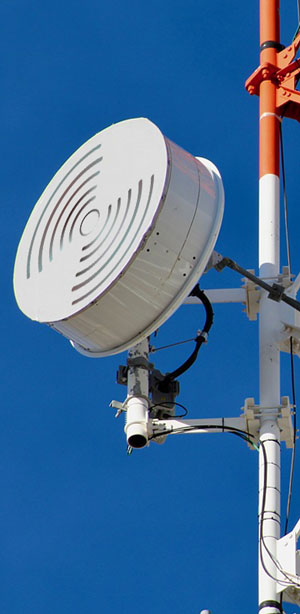
The big brother to cellular is point to point microwave fixed wireless. This is a modern version of the old telco point to point microwave relay. You get a small dish or other microwave antenna that attaches to the side of your building or sits on the roof. It points directly at the provider’s antenna at their central location. This is a line of sight service and generally limited to metropolitan areas.

A major advantages of this type of service is that it is private and dedicated to business use. You won’t be competing with everybody else’s cell phones for bandwidth. The bandwidths can be as high as 1 Gbps or even 10 Gbps. They can also be symmetrical, unlike cellular. With many services your upload and download speeds are the same and your bandwidth is guaranteed. Usage limits? Not usually an issue.

You might even think of microwave fixed wireless as fiber optic without the fiber. Ditching the physical fiber means fewer construction headaches and delays. It is possible that you can have service installed in as little as a few days compared with weeks or months if your building isn’t already lit for fiber.

An unexpected benefit is that fixed wireless can have lower latencies than fiber services with the same bandwidth. That’s because the wireless signal is a direct beam from provider to you. Fiber systems tend to weave all over town with lots of switching gear in the path. Lower latency is critical to some businesses, especially in financial trading. It’s a boon for improving the quality of VoIP phone calls and video conferencing, and for interactive processes running in the cloud.

Cellular broadband uses the Internet and whatever latencies and congestion exist. Fixed Wireless can avoid the Internet and its limitations, or be connected to the Internet so that you can easily connect to customers and suppliers.

Why Not The Best of Both Fiber and Wireless?
Perhaps the best arrangement for your business is a combination of fiber optic service and fixed wireless service. Why both? One reason is to get service started fast with fixed wireless and then add fiber when you can get it installed.

Once you have both running, consider keeping your fixed wireless as a backup to the fiber. Fiber interruptions, often caused by the cable being cut during unrelated construction work, can take days to repair, leaving you high and dry. With automatic failover installed, your traffic will simply move to the wireless link without interruption. When the fiber comes back online, the system will switch back.

Note that fixed wireless offers a true diversity path to fiber. That means fiber and wireless are very unlikely to exhibit failures at the same time. Some businesses think they have this in place by ordering redundant fiber lines or even fiber services from two separate providers. What they don’t realize is that all the fiber serving their location runs in the same bundle or conduit and can all be taken out at the same time by one accident.

Do you need fast installation of high speed business connectivity and/or a robust backup to the fiber you already have? Consider microwave fixed wireless service for your bandwidth needs.

Click to check pricing and features or get support from a Telarus product specialist.


Follow Telexplainer on Twitter


Monday, November 16, 2020

Wireless Business Internet Options

By: John Shepler

We live in a wired world. Your business is tethered to infrastructure of electrical power, telephone and Internet by a variety of copper cables. Electric power and landline phone are almost universally available, thanks to national plans and regulations.

Wireless Business Internet solutions for you.Internet? Not so much. While copper and fiber optic broadband are readily available in metro and suburban areas, as you get farther from the city center you options go down. Out in rural areas? There’s often no such thing as wired Internet infrastructure. You either go without or… go wireless.

Point to Point Microwave
Think of point to point microwave as fiber optic without the fiber. At high enough frequencies that could be an actual light beam from a laser, although it is much more common to use the centimeter and millimeter wave bands.

PTP microwave uses small dish antennas at the sending and receiving ends. This is a fixed, not mobile, service and you need the antenna on your building high enough to see the other dish without obstructions. These high frequencies don’t penetrate objects well, but they can supply high bandwidths of a Gigabit per second or more.

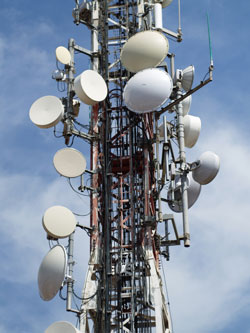
While PTP microwave established itself in dense metro areas that might be expensive to add fiber or cabling or take too long for construction, you see these little dishes on cell towers out in the country for the same reason. If there is a provider serving your area, you might be in luck for this service.

Wireless Internet Service Providers
A WISP, as it is known, is a centrally located tower that provides wireless Internet service to a small service area circling the tower. This is point to multi-point rather than a dedicated PTP link. Think of WISPs as high powered WiFI outdoor routers. Like PTP, you’ll need an outdoor antenna, perhaps one of those small dishes, pointed at the tower. They may operate in licensed or unlicensed spectrum and deliver typical broadband speeds.

WISPs are popular where fiber and cable don’t reach, but they are local operations. You may or may not have one that serves your location.

Cellular Broadband Service
Just about everyone has a smartphone these days and making phone calls is the least of the services we expect. No, it’s the broadband Internet connection feeding a myriad of apps that keeps us glued to the screen. That same broadband can be harnessed for business applications using an access point that has all the circuitry needed for broadband but minus the screen and telephone capability.

For limited or infrequent use, you might pick up one of these access points at a big box store. Have it set up for the carrier of your choice. These work well in areas where the cellular signal is strong and usually come with fairly limited usage plans. Plug the access point into your router or buy one that comes with a WiFi router and you can serve your entire business.

A more robust version designed especially for business uses specially designed antennas for better signal pickup or an outside antenna that will give you a strong signal even in rural areas. These business grade access points are usually 4G LTE or 5G where available. They also come with more extensive data plans, some even unlimited… just what you need to run a business with employees.

What makes this really attractive is that the cellular infrastructure is already widespread and extending out into many rural areas and smaller towns. If your business needs to move from job site to job site or your operate pop-up stores, cellular broadband may be the only reasonable option that will follow you.

Satellite Broadband
Yes, there are areas really out in the boonies where there is no cellular service and even landline phone and electric power are hard to come by. You can still get Internet, though. How? With a satellite dish pointed at the southern sky where the geostationary communication satellites are parked. Newer high power satellites offer high speeds, reliable service, reasonable data plans for business and reasonable prices.

The big limitation of satellite business broadband is the latency that is inherent in the long distances that the signal must travel up to the bird and back down. This half to one second or so delay can be an annoyance for business processes that use the cloud or VoIP phone calls and video conferences. For email, web browsing, remote data acquisition and file transfers, latency might not be much of an problem at all.

The latency issues will likely be solved by the new constellations of Low Earth Orbit or LEO satellites. These orbit hundreds rather than tens of thousands of miles up and support latencies similar to cable or long haul fiber. SpaceX is first to market with an extensive fleet of broadband satellites that will provide worldwide coverage, even at sea, in a few years. Other providers will likely follow, as the potential market for connecting the disconnected is enormous.

Are you in serious need of reliable broadband Internet service for your business at a reasonable price? Find out what wired and wireless solutions are available for your locations now.

Click to check pricing and features or get support from a Telarus product specialist.


Follow Telexplainer on Twitter


Friday, April 17, 2020

Business Grade 4G LTE Broadband for Work at Home

By: John Shepler

All of a sudden, everybody is working from home… or at least trying to. One of the big challenges is trying to get enough high speed, low latency bandwidth into a remote business or home office instantly. The more isolated your location, the tougher it gets. Well, thanks to the wide coverage of 4G LTE cellular broadband and high performance modem/routers, you can get the bandwidth you need fast, at low cost and with no long term commitment. Does that sound interesting?

Get business grade wireless broadband now.The Secret is Wireless
Forget having wires or, worse, fiber run to your location. That’s not going to happen fast and it might cost you a small fortune in construction fees plus a multi-year commitment. For a situation that may only last a few months to a year, it’s tough to take on a contract like that. Fortunately, you don’t have to.

Wireless broadband is now just about everywhere with any population at all. Can you get a decent cell phone signal? Then you are pretty much assured of having broadband Internet access. The cellular phone system started out as a replacement for voice-grade landlines, but has morphed into a broadband Internet service that also supports phone calls. The current widely deployed iteration is 4G LTE. Signals are strong and bandwidth is similar to many cable services. All you really need is a way to connect.

Instant Desktop Broadband
Here’s a little secret that I use to backup my own cable broadband. Your iPhone will act as a personal hotspot. Just turn that feature on, select that network name on your desktop WiFi and enter the password the phone gives you. Voila! Your desktop computer in on the Internet. No wires needed.

This works great for short term outages, but if you are going to use this service day after day, there is always the nasty issue of data limits. You may have 20 GB on your wireless plan, but typical monthly use is more like 250 GB. Your cellular plan won’t cut it for the long term. You need something designed for business.

Business Grade Wireless
Instead of a cell phone, you need something that looks more like a WiFi router but with 4G LTE driving it instead of DSL or Cable. These are made by companies like CradlePoint with service from business broadband providers like For2Fi.

A single box has a 4G LTE modem with antennas and a WiFi signal router. Some models include firewalls, Ethernet ports, and even Power over Ethernet (PoE). Unlike a cell phone, you can add an external antenna to boost the signal in areas with weak coverage.

Enterprise Grade Service
Would unlimited usage (subject to 300 GB acceptable use policy) at 20 to 50 Mbps download and 5 Mbps upload with low latency and low packet loss work for you?

You will be able to do the usual web browsing and email, but also video conferencing, file collaboration, teams and unified communications as a service (UCaaS).

But what does this cost? It’s about what you’d pay for business grade cable broadband and likely less than a 1.5 Mbps T1 line (sometimes the only other solution in rural areas). That’s with no contract. You just pay as long as you use the service.

For businesses that are really on a budget, there is also a basic plan with 1, 5, and 10 GB plans at a bargain rate. If you go over the limit, you pay a fee per GB used.

Are you faced with having to suddenly support a scattered workforce with no time to install the usual connections and in locations that might not even support high speed wireline or fiber installations? Get up and running in days, not months with a flexible enterprise grade wireless broadband solution. Use the handy online form or call toll free 888-848-8749 now.

Click to check pricing and features or get support from a Telarus product specialist.


Follow Telexplainer on Twitter

Tuesday, March 24, 2020

Connectivity for Telemedicine and Remote Work

By: John Shepler

The sudden onset of the Coronavirus pandemic is accelerating a couple of trends that were already in progress. One is telemedicine. The other is remote work. Both have a common critical path, which is broadband Internet bandwidth. Let’s look at what’s available to get connected.

Network Service OptionsConnecting the User
Most remote workers and patients accessing telemedicine will be connecting at home, perhaps using a desktop PC or Mac, or on the move through their smartphones, laptops and tablets. The most popular option at home is cable broadband, with bandwidths of 30 to 100 Mbps. Remotely, the most popular options are public WiFi and 4G & 5G cellular broadband.

The individual user who is an employee or patient seldom has the budget for business grade connections such as private lines, fiber optic bandwidth or point to point microwave. Their connection is to the Internet through whatever last mile connection they can afford. That’s almost always a cable or cellular connection which is shared bandwidth and asymmetric, with download speed perhaps 10x upload speed.

These connections generally work fine for remote log-in, video chat and website access. They’re pretty reliable and budget friendly.

Special Cases
Certain medical equipment doesn’t work well over home Internet. The patient may need a classic analog landline (yes, even today) or built-in proprietary wireless access.

A business needing higher performance than consumer broadband offers may have to pay the cost of a dedicated leased line. This might be a T1 line, Ethernet over Copper, or Fiber to the Premises, if available. Dedicated Internet Access generally offers a performance improvement over shared consumer broadband first-mile connections. You also have the option of setting up a dedicated private line, although higher bandwidths are often not available to consumers.

If broadcast quality live video is required, you may need to set up a small remote studio near your talent. A Metro Ethernet private line will support the quality you need to avoid the distorted audio and video glitches common with consumer Internet video chat services.

Business Bandwidth Options

If you are the provider rather than the user, your connectivity needs are likely more demanding. As the company or medical organization you will probably be supporting more than one simultaneous employee or patient. That could be dozens, hundreds or even thousands of users connecting into your central system, which might be cloud-based.

There are two types of connectivity you’ll want to consider. First is connection to those outside users, mostly likely through Internet broadband. Second is connections within your own organization. Your internal connectivity will be by Local Area Network and either Metropolitan or Wide Area Networking to include more than one business location. You may also want a dedicated high bandwidth cloud connection to make your cloud applications perform as if they were hosted in a local data center.

You’ll need enough Internet bandwidth to support the maximum number of simultaneous users that will commonly be connected, plus some surge ability to support additional users when things get busy. A dedicated broadband Internet connection using scalable Ethernet over Fiber bandwidth can handle heavy demands. Gigabit and 10 Gig E services are readily available.

Within the organization, you may wish to stay off the Internet both for higher performance and better security. Point to Point dedicated private lines can be nearly transparent to your network. If multiple locations are involved scattered over a wide geographical area, an MPLS network can save cost while still preserving high performance and excellent security.

The performance of the last-mile Internet connection can also be improved by using an SD-WAN connection. SD-WAN or Software Defined Wide Area Network combines several types of Internet connections, including wired, fiber optic and wireless. The SD-WAN software constantly monitors the various connections and chooses the most appropriate for each packet. This helps ensure that more demanding applications have priority over activities that can be run in the background.

Is your company planning or already engaged in remote work or telemedicine? If so, we can help you find the right type of connectivity at the best price.

Click to check pricing and features or get support from a Telarus product specialist.


Follow Telexplainer on Twitter

Wednesday, February 26, 2020

Gigabit Internet Near Your Business

By: John Shepler

No doubt about it, you need more broadband speed to conduct business than you ever have. Most businesses have an online presence now. The few that don’t still need the Internet for business processes and to offer WiFi hotspots for their customers. If yesterday’s connection solutions seem to have slowed to a crawl, you clearly need an upgrade. Gigabit Internet broadband could be exactly what you need now and for the foreseeable future.

Gigabit Internet broadband service near you. Find it now!Is Gigabit Internet Really Right for Me?
What you really need is invisible connectivity. No matter what you are doing, the speed of the line shouldn’t be getting in your way. In fact, you should completely forget about how you get to the Internet. It should just be there.

You probably need more speed than you think. Over the last 20 years, the “Internet” has evolved from email and some very simple HTML brochure-type websites to fully functional online operations. Many of your customers never set foot in your place of business anymore. They do everything online. It’s second nature. Their phone is really a web browser that is always in their pocket. Their desktop computer has relatively little boxed software anymore. Most everything is done online and in real time. Your phone system? Probably VoIP technology these days and more likely, integrated with a video conferencing system for unified communications.

How about your business processes? Do you keep manual books? How about customer or patient records? Your customer relationship management systems are all software based and most likely cloud based. In fact, fewer and fewer companies host their own data centers anymore. It’s all about the cloud and what isn’t cloud related is all about connecting to the outside world, especially customers and suppliers.

Making your connection invisible to you and your employees involves certain technical characteristics. The line must run fast enough. That’s speed or bandwidth. It also must respond quickly. That’s latency as much as speed. Long latency in the system means sluggish response. It must also be accurate and efficient in the sense that it doesn’t lose bits. That integrity is essential in the case of voice and video streams. Dropped bits garble conversations and make video distorted and even jerky. A high quality Gigabit Internet connection can go a long way to making all of this fairly easy to accomplish.

Your Gigabit Internet Connection
Is Gigabit Internet near you? Most likely, yes. Perhaps you checked around a few years ago and found nothing available. It’s highly likely that situation has changed. The demand for higher and higher speeds, especially 4G and 5G wireless broadband speeds, has resulted in a building boom for fiber optic and microwave circuits. In addition, new technology modems have enabled cable broadband systems to be able to deliver Gigabit speeds over their existing fiber and coaxial copper infrastructure.

Even if you don’t think you really need Gigabit speeds right now, you should seriously consider having that capability. You’ll need them sooner than you think. What you want is a DOCSIS 3.1 modem or a Gigabit Ethernet port to deliver your Internet connection. That way you can start out with, say 100 Mbps business broadband, and upgrade to as much as 1,000 Mbps, a Gigabit, later.

Know Your Broadband Types
You should know that there are two basic types of Internet broadband services. They are called dedicated and shared. Dedicated Internet Access has the highest prices, but is the most solid, reliable connection you can get. The "dedicated" name means the bandwidth is 100% dedicated to your use only. Whatever you don't use remains available when you need it. A dedicated connection also tends to be symmetrical, with upload and download speeds identical.

Shared connections, like what you get with cable broadband and 4G and 5G wireless, are far less costly, but are shared among multiple users. You many notice this as fluctuating line speed throughout the day. Shared connections also tend to be asymmetrical with download speeds about ten times upload speeds. Whether either of these characteristics matter depend on how you are using the service.

What Internet connection is best for your business? Find out now what Gigabit Internet broadband services are available near you.

Click to check pricing and features or get support from a Telarus product specialist.


Follow Telexplainer on Twitter

Wednesday, June 26, 2019

How to Feed a Hungry WISP

By: John Shepler

We’re a wired nation, except when it comes to locations that are a bit off the beaten path. That includes farms, rural households, businesses beyond the city limits, new subdivisions and some industrial parks. While they may have telephone, thanks to universal service, the availability of broadband Internet access is less of a sure thing. This is where the wireless broadband supplier or WISP fills the gap.

Get the best bandwidth pricing for your WISP.Why WISPs?
WISP or Wireless Internet Service Provider is similar to a cell phone provider, except specializing in high speed Internet access. While even 4G cell service has fairly low usage limits, WISP services are much more generous and try to emulate the type of service you’d get from cable, telco or even fiber optic lines. The real cost to hooking up less populated areas is trenching cable bundles or flying them on utility poles. The WISP eliminates the wires and their associated cost. The tradeoff is that you generally need a small dish antenna and receiver outside to pick up the signal from the WISP tower.

Where Do WISPs Get Their Broadband?
While the WISP distributes broadband much like WiFi, the broadband they serve must come from somewhere. When the Internet was young, T1 lines did an excellent job of feeding the WISP, just like they did feeding cell towers out in the countryside. The beauty of T1 is that it can be sent virtually any distance over standard twisted pair telephone wiring. The downside is that the bandwidth is fixed at 1.5 Mbps per T1 line. Higher speeds can be accomplished by adding or bonding additional lines to double, triple or quadruple the speed. The practical limit is around 10 to 12 Mbps. Pricing goes up linearly as you add each line.

Higher Speed Copper Lines
A newer technology that also runs over twisted pair copper is Ethernet over Copper (EoC). This service offers higher speeds, say 20 or 30 Mbps or even higher. Transmission is distance limited, but EoC is now more available beyond the city limits. Cost is much more attractive per Mbps than T1, if moderate speeds are adequate for what you need.

Business Cable Broadband can provide hundreds of Mbps these days but has suffered from very limited deployment outside of metro areas. That has changed somewhat as the cable has been extended to outlying subdivisions and business parks. If you can get this service and the Cable Company is OK with using it for a WISP, the cost will be very attractive.

Fiber Optic Service
The new gold standard of bandwidth service is fiber optic lines. These used to be few and far between, but provider competition has made them far more common even in rural areas. You can thank 4G cellular for providing the incentive to trench fiber conduits into rural areas. Prices have come down dramatically with Ethernet over Fiber (EoF) services. These are highly reliable and easily scalable up and down in bandwidth to meet your needs. Bandwidths of 10 Gbps up to 100 Gbps are common now.

Microwave Transmission
Why not feed wireless with wireless? That’s not a crazy idea and is being used more and more as telco companies upgrade to 5G towers. Microwave is a point to point wireless service. You mount a small dish on your tower and point it toward the service provider. It’s like fiber but without the fiber.

SDN Combines Bandwidth
What if you need more bandwidth than any one supplier can provide? One option is to combine them using a technique called SDN or Software Defined Network, also known as SD-WAN or Software Defined Wide Area Network. The SDN controller manages traffic to get the best performance for each packet. You can combine T1, EoC, cable broadband, microwave, fiber optic lines and even satellite Internet to create a higher speed robust feed for your WISP tower.

Do you operate a WISP service or have one in the planning stage? Find out what bandwidths and pricing are available for your desired locations now. A friendly consultant will help you sort through the options.

Click to check pricing and features or get support from a Telarus product specialist.


Follow Telexplainer on Twitter


Tuesday, May 21, 2019

20/20 Mbps Speed on Copper and Fiber

By: John Shepler


Business broadband bandwidth requirements have been on a steady slope upward. Some of this is the change from mostly text based information to graphical and video content. More is due to moving business processes from local desktop computers and company servers to cloud providers. Simple T1 lines and other low speed connections are no longer adequate. Entry level WAN (Wide Area Network) speeds, including Internet broadband, are now in the tens of Megabits per second.

Moving up to 20/20 Mbps bandwidthA popular service level for smaller businesses and remote workers is 20/20 Mbps. This is fast enough to support a single user, small team or small retail location while still being very affordable. Let’s take a look at the options available.

What is 20/20 Mbps?
The term 20/20 Mbps means 20 Mbps bandwidth in both directions. That’s 20 Mbps upload and 20 Mbps download. When the upload and download speeds are the same, the connection is said to be symmetrical. It makes no difference if you are watching a video clip or backing up files to cloud storage, the bandwidth is the same. In fact, if the connection is full-duplex, as most business grade lines are, you can be downloading and uploading at the same time without slowing down.

Wireline Connections
The 20 Mbps line speed, or bandwidth, is way beyond the capability of a T1 line that runs flat out at 1.5 Mbps. It’s also too much to achieve by bonding multiple T1 lines together. Does that mean that delivery over standard multi-pair telco lines is impossible? Not at all. Newer technology called Ethernet over Copper (EoC) can easily deliver that speed and perhaps even more provided that your business location is close enough to the telephone company office.

Telephone companies own all that twisted pair copper that connects telephone desk sets. The same bundles can carry T1 service and the newer Ethernet over Copper. Regardless of which service provider offers you the EoC service, it will come in on those telco lines. So, the phone company has to have the right termination equipment and you need to be within a couple of miles or so of the office. In populous areas, that’s generally the case.

Fiber Optic Connections
The whole world is converting to fiber at a rapid pace. One of the main drivers is the need for high bandwidth to cellular towers to support 4G and 5G broadband services. The other driver is the ever higher bandwidth requirements of business as cloud services expand.

Fiber is the gold standard of bandwidth connectivity. If you have a fiber optic line installed to your business location, you’ve pretty much future-proofed your business. It’s almost impossible to need more bandwidth than the fiber can support. Even if that happened, there are usually many fiber strands within a fiber optic cable.

Ethernet over Fiber (EoF) is the upgrade to EoC. You can get 20/20 Mbps dedicated, symmetrical bandwidth at a very reasonable price anywhere that fiber is available. Dedicated means that it is for your use only and the line speed doesn’t vary. Both EoF and EoC are dedicated services, although other types of bandwidth might not be.

Another advantage of Ethernet over Fiber is that it is easily scalable. That means that if you get 20/20 Mbps service now and in a few years need to move up to, say 50/50 Mbps because of a growing business, that can be done with a simple phone call to your provider and likely no equipment changes. Some carriers even offer user control panels that let you change bandwidth levels at will.

How about Cable, Satellite and Wireless?
Cable, Satellite and Wireless services have evolved to offer 20/20 Mbps bandwidth and beyond. These services may be less expensive that EoC or EoF, but they are likely to be shared, not dedicated bandwidth and asymmetrical (different upload and download speeds) rather than symmetrical. Satellite and Wireless tend to have some usage limits due to limited resources. In some locations you can get dedicated symmetrical microwave delivery that offers similar performance to EoC or EoF but without the wires.

Are you ready for a bandwidth upgrade but unsure what is the best option for your business? Our knowledgeable consultants can give you good advice and get you the best price on the service you need. Find business bandwidth options over copper, fiber, cable, satellite and wireless now.

Click to check pricing and features or get support from a Telarus product specialist.


Follow Telexplainer on Twitter

Tuesday, April 09, 2019

Can SD-WAN Solve Your Low Bandwidth Problem?

By: John Shepler

Can SDN or SD-WAN solve your low and unreliable bandwidth problem? Hey, you can probably solve your bandwidth problems right now by upgrading to a dedicated higher bandwidth service with a service level agreement, such as Ethernet over Fiber from a top-tier carrier. A better question is how can SD-WAN give you faster and better bandwidth at a more affordable price point?

WAN Man Coffee Mug. Get yours here...The Cause of Low & Unreliable Bandwidth
Companies with bandwidth woes generally fall into one of two categories. The first is being stuck with bargain basement options because of very limited budgets. The other is being frustrated because the service needed isn’t available in that particular location at any cost.

The really low cost options tend to be broadband services that were designed for the cost sensitive consumer market and then re-branded for business. These include DSL and cable broadband certainly, but may also include cellular wireless and some two-way satellite.

What these services have in common is that the bandwidth pool is shared among however many users are online at the moment. That makes your speed fluctuate during the day. They also tend to be Internet only. If you want point to point you have to set up an encrypted tunnel with VPN or take your chances on security. Finally, they tend to be offered as “best effort” information services with no uptime or performance guarantees.

Are All Non-Telecom Regulated Services Low Quality?
No. That’s unfair and untrue. Cable speed and performance has grown by leaps and bounds, especially since the introduction of DOCSIS 3.0 and now 3.1. You can get fiber speeds at bargain prices in most populated areas. Reliability tends to depend on the local service provider. Some have almost perfect uptime. Others are less dependable.

Likewise, cellular wireless and satellite have experienced technology upgrades over the years. Both suffered from low bandwidth, congestion and spotty service. That’s not much of a problem anymore. With 4G and now 5G wireless, fiber-like bandwidths are becoming commonplace with solid service. Satellite, too, is now 100 Mbps nationwide with gigabit service on the way. Spot beams provide highly reliable fade margins.

Both cellular and satellite do have limitations, however, Satellite has a latency issue that won’t be overcome until the Low Earth Orbit constellations are in place. Both services are bandwidth limited by the amount of spectrum available, so there is only so much to go around. That means data limits to keep some users from hogging the scarce resources. If you hit the limit, you either pay more or have your bandwidth throttled for the remainder of the month.

Just What Can SD-WAN Do About These Limitations?
SD-WAN or Software Defined Wide Area Network, part of the Software Defined Network (SDN) technologies, can’t change the laws of physics, provider unreliability, or service availability. What it can do is manage a collection of limited performance bandwidth options to create a single higher performing network.

This works because not every connection you have will have the same latency, packet loss, speed or reliability. Besides the inherent differences in technology, performance often varies moment to moment. Sometimes the cable runs blindingly fast. Sometimes it’s all clogged up. Same with wireless, satellite and even DSL.

No human can sit there with a switch and direct traffic fast enough to send each packet down the best or most appropriate path by the instant. A computer can. That’s what SD-WAN is all about. A processor running software monitors multiple links. It then follows a plan for where to route traffic and it keeps track of it all.

The Other SD-WAN Secret
Another thing that makes SD-WAN effective is that not all traffic is equally demanding. VoIP voice calls are extremely sensitive to latency and packet loss. Data file backups aren’t. Many cloud based business applications need high performance all the time. Some aren’t all that fussy. With that in mind, a SD-WAN controller can see what demands there are for service, what paths are available and with what instantaneous performances. It can pick and choose where to route traffic for the most optimum use of the resources you have provided.

Your choice of SD-WAN links might include DSL, cable, T1 lines, satellite, 4G or 5G wireless, point to point microwave, Ethernet over Copper or Ethernet over Fiber, and even SONET fiber optic lines. The right mix depends on what performance you must have, what connections are available and your budget for bandwidth.

Are you struggling to do business because your current bandwidth solution just isn’t getting the job done? You should know that you have more options now than ever before, especially since SD-WAN became available. Tell a network bandwidth consultant about your particular business needs and see if you can do a lot better than what you are living with now.

Click to check pricing and features or get support from a Telarus product specialist.


Follow Telexplainer on Twitter

Business products with the WAN Man theme are available through our Zazzle Gigapackets store.

Wednesday, September 19, 2018

Rural Doesn’t Mean Broadband Wasteland Anymore

By: John Shepler

Running a business in a rural area or even locating in a business park outside the city limits presents a challenge that urban companies seldom have to face. That is, how to get adequate broadband service at an affordable price.

Find rural broadband now.Is What I Need Even Available?”
Years ago, you could run a decent size business with a few phone lines and electric power service. Now you can hardly serve even local customers without broadband in addition to or combined with your telephone service. The performance you must have varies with the size and nature of your operation.

Small retail and service businesses have it easiest. A traditional T1 line at 1.5 Mbps can get you by. Prices have dropped dramatically, so you may only be looking at a few hundred dollars a month even in the unwired boonies. That’s because T1 uses the same twisted pair wiring that delivers analog and ISDN PRI PBX telephone service.
T1’s 1.5 Mbps may seem pretty pokey these days, but it’s enough to handle email, credit card verification, online ordering and operation of simple web sites on remote servers. You can often double or triple this bandwidth, at double or triple the price, by bonding multiple T1 lines together.

A competing service called Ethernet over Copper uses the same infrastructure but a more advanced technology to deliver 10 or 20 Mbps on the same telco lines. It’s less expensive than T1, but doesn’t deliver the higher bandwidths over long distances. If you are on the edge of a metro area, this can be a good solution.

The gold standard of broadband is now fiber optic service. Fiber has long been available in metro areas, but rarely out in the countryside. That’s changing fast. The killer app is 5G cellular wireless. High bandwidths are needed for 5G and even 4G LTE. That means every tower must get served by fiber or point to point wireless. With all that fiber being trenched and lit, the chances of a fiber optic connection at a reasonable price has gone up dramatically.

How About Cable?
DOCSIS Cable Broadband has traditionally stopped at the city limits. However, these lines are being strung farther and farther from town to serve new subdivisions and industrial parks. If the cable runs by your property, chances are excellent that the cable company can provide you with a drop at little or no construction cost.

Cable has also gotten a new lease on life with DOCSIS 3.0 and 3.1 modems. It’s fairly easy and inexpensive to get 100 Mbps downloads and 1 Gbps service is becoming more and more common.

When There Are No Copper or Fiber Lines
Some areas still aren’t being served. That’s especially true of small farming communities, farmsteads and ranches and any business located on historically rural property. Your option in this case is to go wireless. If you have a small home-based business you might even get by with cellular broadband. You can buy a wireless access point with this service installed or use your phone as a Wi-Fi hotspot to feed your computer and tablets. The main hitch with this approach is strict data limits of 20 GB or so per month. You have to buy more capacity or have your service slowed or cut off if you exceed your carrier’s limits.

Point to Point wireless broadband provided by WISPs (Wireless Internet Service Providers) offer higher data limits and higher bandwidths than cellular. There are no national providers. You have to be in the footprint of a local or regional provider to get service.

Business satellite can now give you the higher bandwidths you desire, even up to 100 Mbps with decent data packages. All you need is power and an open view of the Southern sky. Prices are similar to T1, cable and wireless. The remaining limitation is the half-second or more of latency as the signal goes up to the bird and back down. If what you are doing is OK with that delay, it is an option that works in the remotest of locations.

Don’t assume that just because your area wasn’t built out for broadband years ago that it still isn’t. Progress is happening rapidly in this field, often helped by federal programs to expand rural broadband. Check your rural broadband options now and see what may have become available recently.

Click to check pricing and features or get support from a Telarus product specialist.


Follow Telexplainer on Twitter

Wednesday, May 23, 2018

Metro Fiber Ethernet Handles Just About Everything

By: John Shepler

When it comes to a “one size fits all” network service, Metro Fiber Ethernet seems to be closest to meeting the criteria of a universal solution. Let’s see why that is and what Metro Fiber Ethernet can do for your business.

Metro Fiber Ethernet is available for most business locations.The Panoply of Connectivity
Telecommunications network transport services have evolved through a rich set of technical options that can be generally classed into copper, fiber optic and wireless.

Amazingly, copper-based telephone and broadband lines are still based on twisted pairs of small wires that can run for miles between a telephone company’s central office and the business location where they terminate. Copper can also include coaxial cable that is primarily used for cable broadband, often as part of a hybrid fiber coax network.

Wireless involves microwave, cellular and satellite. A major application for wireless is portable and mobile operations where any type of physical connection just won’t do.

Fiber has gone through its own evolution from a proprietary long distance telephone trunking system to the modern packet switched protocol that forms the heart of the Internet. It has also become the connection of choice for most business applications.

Why Metro Fiber Ethernet?
The beauty of Ethernet over Fiber is that it perfectly mirrors the now universal Ethernet protocol running on local area networks. As you might suspect, it is pretty much seamless to connect your LAN to a Ethernet transport service to the Internet or to another LAN hundreds or thousands of miles away.

Metro Fiber Ethernet is the name given to Carrier Ethernet over Fiber within populated areas. Ironically, perhaps, the growth of 4G and soon 5G cellular wireless has prompted a major deployment of metro fiber to cell towers well beyond the city limits. Traditional copper solutions just don’t have the bandwidth to support high speed broadband. Fiber has as much as you need… once you have the cables in place.

Don’t assume that just because your business isn’t located in the downtown business district of a major metropolitan area that you can’t get fiber optic service. Fiber is become more and more ubiquitous, even in smaller towns and some rural areas.

What Service Levels Are Available?
Unlike T-Carrier or SONET fiber technologies pioneered by the telephone companies, fiber optic Ethernet doesn’t require changing hardware every time to want to move up a level in speed. Most network equipment now supports 10/100/1000 Mbps, with some capable of 10 Gbps or 100 Gbps. These same service levels are available with Metro Fiber Ethernet.

Ease of Scaling Service
A typical fiber installation will include an edge switch or router with a Fast Ethernet (100 Mbps) or Gigabit Ethernet (1000 Mbps) port. The port speed determines the maximum, but not the minimum, speed of your connection. You order the bandwidth level you want and the carrier will rate limit the connection speed to that level, say 50 Mbps. If you find you need a faster connection, a quick phone call or online control panel change can increase that to 100 Mbps. If you have a Gigabit Ethernet port installed, you can change the speed to 250, 500, 750 or 1,000 Mbps at will. Of course, the price of your service will depend on the speed you select.

Other Characteristics of Metro Fiber Ethernet
This is commercial, not consumer, grade service. Regardless of speed, your fiber service will have high reliability, low latency, low packet loss and low jitter characteristics. Many carriers will spell out and guarantee the line performance in a SLA or Service Level Agreement.

Ethernet service is also dedicated, not shared like cable or wireless broadband. You have exclusive use of the bandwidth so there is no congestion caused by competing with other businesses on a common line. This gives you consistently high performance that is important for mission critical applications. There are no data caps. You can use as much or as little of the maximum line capacity as your wish.

Applications
Metro Fiber Ethernet can be thought of as a fast, nearly transparent, pipe. It can be your high speed connection to the Internet, a dedicated link to your cloud service provider, or a point to point line between two business locations. it can also be an “on ramp” to a larger MPLS network for linking multiple locations on a semi-private network that can include locations around the world.

Metro Fiber Ethernet is being rapidly deployed to support 4G and 5G cell towers. It can easily provide the Internet service connection for a WISP or Wireless Internet Service Provider as well. This offers a business opportunity in areas not well served by telco DSL or cable broadband.

Is your business being limited by inadequate Internet service or needing dedicated links to other locations? If so, you will likely be surprised by the cost and performance of Metro Fiber Ethernet service to your building.

Click to check pricing and features or get support from a Telarus product specialist.


Follow Telexplainer on Twitter

Thursday, February 15, 2018

Business Internet Service For Everyone

By: John Shepler

Unlike consumer Internet access, business Internet service has the reputation of being prohibitively expensive and sometimes hard to get, especially in rural areas. Much of that reputation goes back to a time when the incumbent telephone companies were the only provider available. Your choices were, indeed, limited and pricing could make your eyes bug out. Today’s deregulated environment has matured to the point where any business that needs and wants an Internet connection can get one… and at prices that won’t bust the budget.

Find your best small business Internet service options now.Best Options for SOHO, Small Office, Home Office
The smallest businesses are the sole proprietors. Often, these are one person consultancies, remote workers, "gig" workers or web designers who work from home offices. When at the client, they’re carrying a laptop or tablet, plus a smartphone. Budgets are tight, so they want to minimize the cost of Internet access… just as long as it gets the job done.

The lowest cost option for bootstrap operations is residential cable broadband at the home office and 4G LTE cellular on the road. You can pair your tablet and laptop with your smartphone where WiFi is not available. It doesn’t get cheaper than this. Note: Contact your local Cable company for residential broadband.

If you have special requirements such as static IP addresses, any type of server or symmetrical bandwidth, you'll be needing to look at Internet services designed for commercial operations.

Professional Offices
When your business needs a commercial office, you’re probably supporting more than one person. Insurance sales agents, physicians, and any business that wants walk-in clients fits this category. You won’t be able to get residential broadband at a commercial address, but you can get basically the same service branded as “business broadband.” Cable is still an excellent option, with bandwidths up to 100 Mbps common and more than adequate to support a small team. You may even set up a guest WiFi network for clients or bundle television service for waiting rooms.

Higher Tech Offices
Businesses that are tech oriented support such niceties as in-house servers, call centers, and mission critical cloud applications. If you do as much or more uploading as downloading or run a server, cable broadband with its shared bandwidth may be too limiting. Better choices include dedicated Internet access provisioned on Ethernet over Copper at 10 to 50 Mbps or Ethernet over Fiber at 10 Mbps to 10 Gbps. Fiber gives you more options, but isn’t always available, even with construction costs added. Costs are at least several times higher than cable, but performance is more robust for sensitive applications like VoIP telephony and cloud access.

Retail
Most restaurants and bars find the business cable bundles of Internet, television and telephone compelling. It’s a package that is more than adequate and well priced. Special circumstances involve pop-up retail stores that show up just in time for holidays or are located at special events. Wireless 4G is a good fit here. This service works like a smartphone but is built into a special access point that includes a high performance antenna to ensure a strong signal. You can plug in a wired network or WiFi router depending on your needs.

Out In The Boonies
Rural businesses, including retail, agribusiness, machine shops, farms and ranches, gas stations, and so on have needs like their city counterparts, but no wires or fiber nearby. Wireless 4G may work if you can live with the usage limits, which are similar to phone services. If not, high speed satellite can be a better option. Bandwidths up to 100 Mbps are readily available with 1 Gbps coming. Location is unimportant as long as you can point the dish at the bird in the Southern sky with a clear view. The newer satellites have a lot more capacity, meaning that you can get much higher usage limits that fit the needs of many businesses. Pricing is similar to cable and lower speed fiber.

Is Anyone Still Using T1?
Because it was designed to work using the same cable as analog telephone service, you can still get T1 just about anywhere you can get a landline phone. The bandwidth is only 1.5 Mbps, but it is rock solid and reliable. T1 works for applications like credit card verification, email, and light web browsing. Performance is similar to 3G cellular. Prices on T1 lines have fallen so much in recent years that this legacy service is still a good choice in some circumstances.

More Options Than You Think
Are you a small business owner or or an IT consultant serving small clients? You may be surprised at the variety of Business Internet Service Options available now at the locations you need.

Click to check pricing and features or get support from a Telarus product specialist.


Follow Telexplainer on Twitter

Wednesday, July 08, 2015

Broadband for the Bandwidth Starved

By: John Shepler

To say that we live in a connected society sounds like belaboring the obvious. It’s seems clear that everyone, and especially everyone in business, has pretty much claimed their piece of the bandwidth pie. But… not so fast. We’re not ALL connected the way we need to be. There are pockets of broadband wasteland out there that are still starved for bandwidth. If you find yourself in this situation, what hope is there?

Do you also need more bandwidth? Products with this theme are available. Click to see the selection.Yes, Virginia, There IS Broadband
Earlier in the century, there were islands of broadband access and vast areas where dial-up access was all that was available. That situation has pretty much reversed. Today, there is almost nowhere you can’t get at least some broadband Internet access. It’s just a question of what type of broadband service is available and how much you are going to pay.

Fiber Optic - The Cadillac of Bandwidth
I’ve said it before and I’ll say it again. We’re heading toward an almost all-fiber world. There really isn’t anything else that has the capacity of glass fiber strands. Try sending 10 Gbps down a copper pair. That’s only going to happen within a building. That signal is certainly not going to make it across town. The same 10 Gbps is child’s play for fiber. One strand with one laser can provide that bandwidth. You can easily multiply that by 10 to 100 times using WDM or Wavelength Division Multiplexing.

Fiber Everywhere?
You might think it’s fiber, fiber everywhere and not drop to drink. Actually, it might be not a drop to be had. Fiber really is everywhere. That long country road? There’s a good chance there’s fiber buried in the utility right of way. Highways, railroads and pipelines are popular routes for fiber conduit. The reason most of this fiber is invisible is because there are few drops, or places to connect with all that fiber.

That’s changing. What’s happening is that both consumer and business applications have become more bandwidth intensive. The cloud? You don’t dial-up into the cloud. You better have a decent bandwidth connection or you’ll wish you kept those servers at home.

The Fiber - Mobile Connection
Another big driver is mobile broadband. Feature phones are pretty much extinct. Everybody has an iPhone or an Android. Now they’ve got to have a 4G LTE smartphone. The latest apps and streaming content demand 10, 20 or 30 Mbps of bandwidth. In the future, even that capacity will seem like dial-up.

What’s fiber got to do with mobile? What gets transmitted from the towers has to get to the towers in the first place. That’s where fiber comes in. The T1 lines that have traditionally fed 2G and 3G cellular don’t have the capacity for 4G and the 5G to come. Carriers have long since realized this and have have been in a building frenzy to get fiber to the towers. In-town that’s no big deal. Out in the boonies? It’s a major construction project. No matter, there is a lot of fiber going in the ground and connecting to cell towers here, there and everywhere.

The end result is two-fold. One, wireless broadband speeds are going up like crazy (wireless is becoming the fiber for portable and mobile applications). The other benefit is that the actual fiber is becoming available in many, many more locations.

What Fiber is Available?
The ancient standard in fiber optic connectivity is called SONET. It’s far from obsolete, since many if not most long haul networks run over SONET rings. SONET makes a great backbone, but it’s often not the best connectivity for business.

The newer standard is called Carrier Ethernet. It’s an extension of the Ethernet that runs on your LAN. Because they are on the same technical standard, you simply plug your LAN into the Carrier Ethernet WAN and your network connects across town, to another state or around the world. Connect to the Internet using fiber and you have high speed access to your employees, suppliers and customers.

Carrier Ethernet comes in two flavors. Ethernet over Copper is the low speed standard. It runs on twisted pair copper and is good for 10 Mbps or so. Ethernet over Fiber starts at 10 Mbps and goes up to 10 Gbps and beyond. That’s the advantage of fiber Ethernet. It’s pretty hard to run out of bandwidth no matter how big your company grows.

Another advantage is scalability. You can start out at 10 Mbps and go to 100 Mbps or 1000 Gbps any time you want. The fiber can handle it. If you install a fast enough port, chances are that you won’t even have to replace equipment. Just call your provider and request a bandwidth increase.

What If There Still Is No Fiber?
Don’t write off fiber until you’ve gotten a new set of quotes. The fiber footprint for every carrier is changing daily. Just because you got turned down last year doesn’t mean you are still in the middle of nowhere. But… sometimes you still are.

For smaller or less bandwidth demanding businesses, such as small retailers and some farms and ranches, the trusty T1 line may still get the job done. You get a solid 1.5 Mbps up and down. That’s certainly good enough for email, much casual web browsing, and even online ordering. Video? Not so much. But, maybe that isn’t your critical need.

The beauty of T1 lines is that they are available nearly everywhere you can get a landline phone. They can also be bonded to double or triple your bandwidth. In some cases, 10 Mbps is entirely possible. That’s about the limit. Prices per line are a fraction of what they used to be, so you might find T1 is your most affordable option.

Can We Ditch The Wires?
Wireless is also more of an option than it used to be. Those same cell towers that are powering 4G smartphones can also feed a fixed receiver at your location that will give you broadband over your LAN. Today, most businesses are within good signal range of at least one cell tower.

For a lot of applications, bandwidth won’t be your problem. Usage will be. Wireless is a scarce resource, so even the so called “unlimited” plans have “fair usage” limits. If you go over, you’ll pay overage charges or have your service rate limited or cut off. Even so, many businesses are still not Internet-intensive and can get their online jobs done without going over, say, 10 GB per month.

Bird Is The Word
If you are so out in the woods that nothing else will work, there’s always satellite. Yes, you do need to be able to peek through the trees to see the southern sky. Yes, you do need to power the satellite equipment. If neither of those is a big problem, you can get broadband service for sure.

Satellite broadband used to be something of a joke. Bandwidth was pitiful and usage limits were paltry. Newer generations of bigger, higher power satellites have made a lot of those problems go away. You can get decent broadband levels, although nowhere near fiber capability. Still, 5 to 15 Mbps is reasonable for many businesses. Like cellular, there are usage limits on satellite and 10 GB per month is not untypical, although there are higher usage plans available. Once again, this is for web access and email, not video streaming.

The other issue you should be aware of is latency. The big birds are flying some 23,000 miles up there and it takes even a radio wave a half-second or more to get up, down and back again. Latencies of 500 mSec to 1 Sec or more mean that telephone calls over satellite are more like two-way radio conversations. You have to wait your turn. The same is true for video conferencing. Expect other cloud services to be similarly sluggish over geosynchronous satellite broadband.

What Flavor of Broadband Will Satisfy Your Bandwidth Appetite?
Options available to many locations include fiber, T1, cellular wireless and satellite. One of these should be usable for your applications. In many cases, you have more than one choice. Sometimes even cable broadband or high speed fixed point to point fixed wireless service are additional options. How do you know what’s available? It starts with a no-obligation quote from multiple service providers that you can request in just a minute or so.

Click to check pricing and features or get support from a Telarus product specialist.


Note: Products with the humorous theme "I Definitely Need More Bandwidth" shown on this page are available through the Gigapacket Zazzle Store.


Follow Telexplainer on Twitter