Showing posts with label WISP. Show all posts

Monday, November 16, 2020

Wireless Business Internet Options

By: John Shepler

We live in a wired world. Your business is tethered to infrastructure of electrical power, telephone and Internet by a variety of copper cables. Electric power and landline phone are almost universally available, thanks to national plans and regulations.
Wireless Business Internet solutions for you.Internet? Not so much. While copper and fiber optic broadband are readily available in metro and suburban areas, as you get farther from the city center you options go down. Out in rural areas? There’s often no such thing as wired Internet infrastructure. You either go without or… go wireless.

Point to Point Microwave
Think of point to point microwave as fiber optic without the fiber. At high enough frequencies that could be an actual light beam from a laser, although it is much more common to use the centimeter and millimeter wave bands.

PTP microwave uses small dish antennas at the sending and receiving ends. This is a fixed, not mobile, service and you need the antenna on your building high enough to see the other dish without obstructions. These high frequencies don’t penetrate objects well, but they can supply high bandwidths of a Gigabit per second or more.

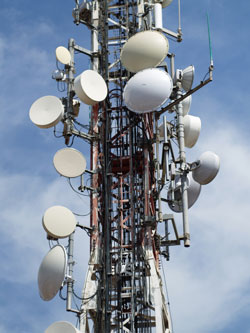
While PTP microwave established itself in dense metro areas that might be expensive to add fiber or cabling or take too long for construction, you see these little dishes on cell towers out in the country for the same reason. If there is a provider serving your area, you might be in luck for this service.

Wireless Internet Service Providers
A WISP, as it is known, is a centrally located tower that provides wireless Internet service to a small service area circling the tower. This is point to multi-point rather than a dedicated PTP link. Think of WISPs as high powered WiFI outdoor routers. Like PTP, you’ll need an outdoor antenna, perhaps one of those small dishes, pointed at the tower. They may operate in licensed or unlicensed spectrum and deliver typical broadband speeds.

WISPs are popular where fiber and cable don’t reach, but they are local operations. You may or may not have one that serves your location.

Cellular Broadband Service
Just about everyone has a smartphone these days and making phone calls is the least of the services we expect. No, it’s the broadband Internet connection feeding a myriad of apps that keeps us glued to the screen. That same broadband can be harnessed for business applications using an access point that has all the circuitry needed for broadband but minus the screen and telephone capability.

For limited or infrequent use, you might pick up one of these access points at a big box store. Have it set up for the carrier of your choice. These work well in areas where the cellular signal is strong and usually come with fairly limited usage plans. Plug the access point into your router or buy one that comes with a WiFi router and you can serve your entire business.

A more robust version designed especially for business uses specially designed antennas for better signal pickup or an outside antenna that will give you a strong signal even in rural areas. These business grade access points are usually 4G LTE or 5G where available. They also come with more extensive data plans, some even unlimited… just what you need to run a business with employees.

What makes this really attractive is that the cellular infrastructure is already widespread and extending out into many rural areas and smaller towns. If your business needs to move from job site to job site or your operate pop-up stores, cellular broadband may be the only reasonable option that will follow you.

Satellite Broadband
Yes, there are areas really out in the boonies where there is no cellular service and even landline phone and electric power are hard to come by. You can still get Internet, though. How? With a satellite dish pointed at the southern sky where the geostationary communication satellites are parked. Newer high power satellites offer high speeds, reliable service, reasonable data plans for business and reasonable prices.

The big limitation of satellite business broadband is the latency that is inherent in the long distances that the signal must travel up to the bird and back down. This half to one second or so delay can be an annoyance for business processes that use the cloud or VoIP phone calls and video conferences. For email, web browsing, remote data acquisition and file transfers, latency might not be much of an problem at all.

The latency issues will likely be solved by the new constellations of Low Earth Orbit or LEO satellites. These orbit hundreds rather than tens of thousands of miles up and support latencies similar to cable or long haul fiber. SpaceX is first to market with an extensive fleet of broadband satellites that will provide worldwide coverage, even at sea, in a few years. Other providers will likely follow, as the potential market for connecting the disconnected is enormous.

Are you in serious need of reliable broadband Internet service for your business at a reasonable price? Find out what wired and wireless solutions are available for your locations now.


Click to check pricing and features or get support from a Telarus product specialist.


Follow Telexplainer on Twitter


Wednesday, June 26, 2019

How to Feed a Hungry WISP

By: John Shepler

We’re a wired nation, except when it comes to locations that are a bit off the beaten path. That includes farms, rural households, businesses beyond the city limits, new subdivisions and some industrial parks. While they may have telephone, thanks to universal service, the availability of broadband Internet access is less of a sure thing. This is where the wireless broadband supplier or WISP fills the gap.

Get the best bandwidth pricing for your WISP.Why WISPs?
WISP or Wireless Internet Service Provider is similar to a cell phone provider, except specializing in high speed Internet access. While even 4G cell service has fairly low usage limits, WISP services are much more generous and try to emulate the type of service you’d get from cable, telco or even fiber optic lines. The real cost to hooking up less populated areas is trenching cable bundles or flying them on utility poles. The WISP eliminates the wires and their associated cost. The tradeoff is that you generally need a small dish antenna and receiver outside to pick up the signal from the WISP tower.

Where Do WISPs Get Their Broadband?
While the WISP distributes broadband much like WiFi, the broadband they serve must come from somewhere. When the Internet was young, T1 lines did an excellent job of feeding the WISP, just like they did feeding cell towers out in the countryside. The beauty of T1 is that it can be sent virtually any distance over standard twisted pair telephone wiring. The downside is that the bandwidth is fixed at 1.5 Mbps per T1 line. Higher speeds can be accomplished by adding or bonding additional lines to double, triple or quadruple the speed. The practical limit is around 10 to 12 Mbps. Pricing goes up linearly as you add each line.

Higher Speed Copper Lines
A newer technology that also runs over twisted pair copper is Ethernet over Copper (EoC). This service offers higher speeds, say 20 or 30 Mbps or even higher. Transmission is distance limited, but EoC is now more available beyond the city limits. Cost is much more attractive per Mbps than T1, if moderate speeds are adequate for what you need.

Business Cable Broadband can provide hundreds of Mbps these days but has suffered from very limited deployment outside of metro areas. That has changed somewhat as the cable has been extended to outlying subdivisions and business parks. If you can get this service and the Cable Company is OK with using it for a WISP, the cost will be very attractive.

Fiber Optic Service
The new gold standard of bandwidth service is fiber optic lines. These used to be few and far between, but provider competition has made them far more common even in rural areas. You can thank 4G cellular for providing the incentive to trench fiber conduits into rural areas. Prices have come down dramatically with Ethernet over Fiber (EoF) services. These are highly reliable and easily scalable up and down in bandwidth to meet your needs. Bandwidths of 10 Gbps up to 100 Gbps are common now.

Microwave Transmission
Why not feed wireless with wireless? That’s not a crazy idea and is being used more and more as telco companies upgrade to 5G towers. Microwave is a point to point wireless service. You mount a small dish on your tower and point it toward the service provider. It’s like fiber but without the fiber.

SDN Combines Bandwidth
What if you need more bandwidth than any one supplier can provide? One option is to combine them using a technique called SDN or Software Defined Network, also known as SD-WAN or Software Defined Wide Area Network. The SDN controller manages traffic to get the best performance for each packet. You can combine T1, EoC, cable broadband, microwave, fiber optic lines and even satellite Internet to create a higher speed robust feed for your WISP tower.

Do you operate a WISP service or have one in the planning stage? Find out what bandwidths and pricing are available for your desired locations now. A friendly consultant will help you sort through the options.

Click to check pricing and features or get support from a Telarus product specialist.


Follow Telexplainer on Twitter


Wednesday, September 19, 2018

Rural Doesn’t Mean Broadband Wasteland Anymore

By: John Shepler

Running a business in a rural area or even locating in a business park outside the city limits presents a challenge that urban companies seldom have to face. That is, how to get adequate broadband service at an affordable price.

Find rural broadband now.Is What I Need Even Available?”
Years ago, you could run a decent size business with a few phone lines and electric power service. Now you can hardly serve even local customers without broadband in addition to or combined with your telephone service. The performance you must have varies with the size and nature of your operation.

Small retail and service businesses have it easiest. A traditional T1 line at 1.5 Mbps can get you by. Prices have dropped dramatically, so you may only be looking at a few hundred dollars a month even in the unwired boonies. That’s because T1 uses the same twisted pair wiring that delivers analog and ISDN PRI PBX telephone service.
T1’s 1.5 Mbps may seem pretty pokey these days, but it’s enough to handle email, credit card verification, online ordering and operation of simple web sites on remote servers. You can often double or triple this bandwidth, at double or triple the price, by bonding multiple T1 lines together.

A competing service called Ethernet over Copper uses the same infrastructure but a more advanced technology to deliver 10 or 20 Mbps on the same telco lines. It’s less expensive than T1, but doesn’t deliver the higher bandwidths over long distances. If you are on the edge of a metro area, this can be a good solution.

The gold standard of broadband is now fiber optic service. Fiber has long been available in metro areas, but rarely out in the countryside. That’s changing fast. The killer app is 5G cellular wireless. High bandwidths are needed for 5G and even 4G LTE. That means every tower must get served by fiber or point to point wireless. With all that fiber being trenched and lit, the chances of a fiber optic connection at a reasonable price has gone up dramatically.

How About Cable?
DOCSIS Cable Broadband has traditionally stopped at the city limits. However, these lines are being strung farther and farther from town to serve new subdivisions and industrial parks. If the cable runs by your property, chances are excellent that the cable company can provide you with a drop at little or no construction cost.

Cable has also gotten a new lease on life with DOCSIS 3.0 and 3.1 modems. It’s fairly easy and inexpensive to get 100 Mbps downloads and 1 Gbps service is becoming more and more common.

When There Are No Copper or Fiber Lines
Some areas still aren’t being served. That’s especially true of small farming communities, farmsteads and ranches and any business located on historically rural property. Your option in this case is to go wireless. If you have a small home-based business you might even get by with cellular broadband. You can buy a wireless access point with this service installed or use your phone as a Wi-Fi hotspot to feed your computer and tablets. The main hitch with this approach is strict data limits of 20 GB or so per month. You have to buy more capacity or have your service slowed or cut off if you exceed your carrier’s limits.

Point to Point wireless broadband provided by WISPs (Wireless Internet Service Providers) offer higher data limits and higher bandwidths than cellular. There are no national providers. You have to be in the footprint of a local or regional provider to get service.

Business satellite can now give you the higher bandwidths you desire, even up to 100 Mbps with decent data packages. All you need is power and an open view of the Southern sky. Prices are similar to T1, cable and wireless. The remaining limitation is the half-second or more of latency as the signal goes up to the bird and back down. If what you are doing is OK with that delay, it is an option that works in the remotest of locations.

Don’t assume that just because your area wasn’t built out for broadband years ago that it still isn’t. Progress is happening rapidly in this field, often helped by federal programs to expand rural broadband. Check your rural broadband options now and see what may have become available recently.

Click to check pricing and features or get support from a Telarus product specialist.


Follow Telexplainer on Twitter

Sunday, June 18, 2017

Faster Internet Connectivity

By: John Shepler

More is often better when it comes to Internet access speed. Yes, at some point the bandwidth of the line is so wide and the latency so low that your connection appears to be transparent. That’s not the case for most of us. We’re bandwidth limited to what we can afford and what is available. So, do we have to settle for limited throughput? Not necessarily, and certainly not until we’ve checked out all the options now available.

Move up to high speed Internet connectivityTimes Have Changed
One thing that holds us back in achieving faster Internet connectivity is the status quo. We’re comfortable with our Internet service provider and may not give it much thought. You might have just lucked into a good broadband service years ago or did a thorough search before selecting your current provider and service level. Just remember… that was years ago. In Internet years, that’s forever!

The Oldies: T1 and DSL
T1 lines and DSL were once the hot tech services. In fact, they may have been the only thing affordable at the time. Sure, there were T3 lines (also called DS3 service) and telco provided SONET fiber, but those were grossly expensive and only ordered if you REALLY needed them.

DSL is pretty much yesterday’s tech. T1 lines, however are still alive and well. They’re either on very old contracts that haven’t been reviewed in years or for special needs like rural locations where there isn’t much else. Todays T1 lines cost about half what they did a decade ago and you can bond them to create higher bandwidths. For most of us, though, there are better choices.

Cable Business Broadband
Today’s most popular entry level broadband service is business cable. It’s 10x to 20x the speed of a T1 line for less cost… if you can get it. In metro areas, no problem. Outside of town, not so much. The DOCSIS standard has been upgraded over the years so that 100 Mbps bandwidth is fairly easy to find. Even 1,000 Mbps is possible with DOCSIS 3.0, the current standard. A max speed of 10 Gbps is possible with the latest release, DOCSIS 3.1.

Note that these speeds are typically only available for download. Upstream capacity is often a tenth the downstream bandwidth. That works great for typical Internet access, but can be a limitation if you upload large files extensively. Also, cable broadband is a shared service. You share the available bandwidth with others on the cable rather than having it all to yourself.

Fiber Optic Ethernet
If future-proof highly reliable high speed Internet access with nearly unlimited dedicated bandwidth and low latency is what you really want, then fiber optic Internet connections are the real answer. The pioneering but expensive legacy SONET fiber services, such as OC-3, OC-12 and OC-48, are being quickly replaced by Ethernet over Fiber or EoF.

Carrier Ethernet is a perfect match to your local area network and offers scalable bandwidth from 10 Mbps to 10 Gbps, and up to 100 Gbps in select areas. It’s the most cost effective service you can get in terms of $ per Mbps. You also have the option of starting with the bandwidth you need today and quickly scaling up as needed in the future, usually with no hardware changes required.

High Speed Wireless
While fiber is the most desirable connectivity, it isn’t available everywhere. This is especially true in rural areas or even just beyond the metro limits. If fiber lines run to or close by your building, then you are in luck. Otherwise construction costs might be totally unacceptable regardless of the monthly lease fees.

If wires, including cable and fiber, aren’t the answer for you, then wireless may get the job done. There are two good options to consider. One is fixed point business Internet that picks up the tower signal using a small antenna on your building. The other is two-way business satellite that uses a small dish pointed at the southern sky to do the same thing.

Fixed Point Wireless
These providers are also known as WISPs or Wireless Internet Service Providers. Small Business Internet is similar to cable broadband but without the cable. You may get up to 50/5 Mbps of shared bandwidth for a very reasonable monthly price with no data caps. Enterprise Business Internet offers symmetrical dedicated bandwidth like Ethernet Fiber from 10 Mbps up to 1 Gbps with low latency for sensitive traffic like voice and video. Like other services, you’ll need to be in a location that is served by a strong WISP signal.

Satellite Wireless
The one nearly universal Internet connectivity service is broadband business satellite. Perched thousands of miles over the equator, satellites the size of school busses beam strong signals that blanket the USA and beyond, including islands and ships at sea. Two-way satellite has long been used by gas stations, restaurants, bank branches and other small commercial locations that have limited access needs. The new generations of “birds” are serious contenders with wireline and fiber. Look for bandwidth options around 15 Mbps now and up to 100 Mbps soon. Latency is pretty much stuck around half a second due to the enormous distances involved. That may or may not be a factor depending on how sensitive your applications, like voice, video and cloud services, are to these time delays.

Did you know that there were so many options to get faster Internet connectivity for your business? Whether you are a large, medium or small organization, check out your options for high speed broadband Internet service at your location.

Click to check pricing and features or get support from a Telarus product specialist.


Follow Telexplainer on Twitter

Wednesday, August 27, 2014

When Broadband is Hard to Find

By: John Shepler

If your business is located downtown in a major metro area, the idea of network and telecom services being hard to find seems a little odd. You probably have at least a couple of competitive providers vying for your business, as well as the local telephone company. Your challenge is to find the best deal on connectivity, trunk lines and cloud services. There are likely options available that you don’t even know about.

Some places are a bit scarce on connectivity...If you are located in a rural area or working from a home office, this wealth of opportunity may be missing. You may feel that nothing is available or you are stuck with a single option that’s a real stretch for your budget. Actually, there may be more bandwidth options available than you think.

T1 Lines are Readily Available
Businesses with their own commercial addresses have it the easiest. They can almost always get at least some traditional telecommunications services. These include POTS phone service and T1 lines. Both use the same twisted pair copper cables that connect nearly every building.

T1 started out as a telephone trunking service, but has been used for dedicated private lines and Internet access for decades. Each T1 line provides 1.5 Mbps in both the upload and download directions. Today that’s pretty low-end broadband, but it’s more than sufficient for credit card verification, email and simple Web access. You can also run backups to the cloud and connect with headquarters.

Boosting T1 Bandwidth
Not enough bandwidth? T1 lines can be bonded together to create a larger data pipe. Two bonded lines gives you 3 Mbps, 4 lines offer 6 Mbps and so on up to 10 or 12 Mbps. Bonded T1 is highly reliable and readily available. You might find it a bit pricey because there is no economy of scale. Two lines cost 2x one line. Even so, out in the boonies T1 and bonded T1 is likely well worth the cost. That cost has dropped precipitously in the last few years, by the way. If you haven’t taken a look at T1 lately you may be surprised by the value. Even so, expect to spend a couple hundred dollars a month or more for T1 service.

Broadband From Space
Another service almost universally available is two-way satellite or VSAT. Many small retail locations use satellite for their transaction processing and connectivity to HQ. Satellite bandwidth has been similar to T1 at a somewhat lower cost. More advanced satellites now offer bandwidths of 10 Mbps or more for a higher price. The thing to know about satellites is that they can connect anywhere in the country with a clear view of the southern sky. You can even power the equipment “off the grid.” Limitations are that bandwidth is shared and you are generally limited in the amount of data you can upload or download each month. Latency is also high, making the service hard to use for VoIP telephony. Compare that with dedicated line services that offer low latency and have no usage limits.

Broadband From Cell Towers
If your needs are modest, you may get by with 3G or 4G fixed wireless. This is a fancier “all office” version of a smartphone hotspot. If you can get smartphone broadband at your location, this service should work for your office or store. Just know that usage is limited and sometimes involves overage charges. It’s great for transaction processing and simple Internet usage, but not for heavy video usage and software downloads.

What’s Available for the Home Office?
SOHO (Small Office Home Office) users generally choose DSL or Cable broadband because of the low cost with decent performance. It’s not uncommon to get all the speed you need for $50 or so. You won’t find anything like those prices with T1 or bonded T1 lines. That’s because the bandwidth is shared among many customers and is a “best effort” rather than guaranteed availability service.

I often get inquiries from home office users who can’t get or don’t “like” their cable or DSL choices, but are shocked at the cost of more reliable and higher performing business telecom services. Are there any other options available?

You, too, can get two-way satellite service. You may be quite happy with it or be frustrated by the latency (time delay hesitation), usage limits, and interruptions during bad weather. It depends on what you are doing.

Fixed Wireless for SOHO Use
How about fixed wireless? If you can get good cellular service, you might consider something like a “Mi-Fi” hotspot that creates a WiFi hotspot using bandwidth on your 3G or 4G LTE cellular plan. This lets you use your desktop and laptop computers, tablets and other Internet devices on the same Internet access available from your smartphone. Once again, this is “light duty” service that is great for limited or emergency usage, but not for consistently heavy traffic.

Other Wireless Options
Another option that’s available in some areas but not others is non-cellular fixed wireless. These are WISPs or Wireless Internet Service Providers. Generally, these companies install a small dish or antenna on your home or office building and give you a wired connection for your router. You’ll need to look for these locally, as they are typically local enterprises not connected with nationwide providers. You also need to be within line of sight from their tower or towers and not too far away.

Call for Fiber… Maybe
How about fiber optic service? Verizon, Google and other companies have been building out fiber systems in select locations around the country. If you are lucky enough to be within one of these service footprints, you can get a lot of bandwidth for the money with FTTP (Fiber to the Premises).

Finding Home Office Broadband
If you are have a home office, you can try checking for DSL/Cable services or 3G/4G cellular wireless. You can also do an Internet search for satellite broadband from Dish Network, DIRECTV and others. Look locally for non-cellular fixed wireless.

Finding Business Location Bandwidth
If your business has a commercial location, then the Telarus GeoQuote search on Megatrunks.com is for you. This service gives you instant pricing for T1 lines, DS3 bandwidth, Ethernet over Copper, fiber optic and business grade Cable broadband. A quick inquiry will also get you quotes on VSAT and high capacity fixed wireless services appropriate for your business locations.

Click to check pricing and features or get support from a Telarus product specialist.

Note: Photo of Monument Valley courtesy of Josep Renalias on Wikimedia Commons.


Follow Telexplainer on Twitter


Wednesday, March 13, 2013

Business DSL Alternatives

Business DSL has been popular with small businesses because of its ready availability and low monthly cost. It works just great for some businesses and not so good for others. Some are out of luck completely. The service is just not available to them. Here’s a bit of explanation and some alternative ideas for companies that either can’t get business DSL or don’t like the way it works.

Get the bandwidth you need at competitive prices...Business DSL is similar to residential DSL. It comes in on ordinary twisted pair telephone wiring. Usually this is just a single pair like a phone line. In fact, it is a phone line. This means that DSL is delivered by your telephone company. They own the copper and are the only ones who can connect to it. Often, though, they will lease out copper pairs to competitive carriers that also offer business DSL service.

One thing that often distinguishes business DSL from residential service is that the home variety is priced at bargain basement prices because it uses the same wires as your landline telephone. Filters are installed so that the low frequency voice signal and the higher frequency digital signal don’t interfere. Business DSL lines are often used only for the digital connection. The telephones have their own separate network.

Some things that business owners don’t like about DSL are the shared rather than dedicated bandwidth, relatively low speeds, outages that don’t get quick repairs and asymmetric bandwidth (for the ADSL variety).

If you’ve been disappointed with what you can get in DSL performance or can’t get DSL at all, consider these alternatives.

For about the same or a little more money, you can get either 3G wireless broadband or Cable broadband. Cable is like DSL on steroids. The much higher bandwidth can make up for shared and asymmetric bandwidth. Like DSL, Cable is distance limited and only available if the cable happens to pass near your business location. Forget DSL or Cable if you happen to be located in the countryside.

Wireless is now an option for businesses in rural and metropolitan areas. WISPs or Wireless Internet Service Providers offer what amounts a giant WiFi hotspot. In order to get a far enough reach, special antennas are needed at each business location. Another flavor of wireless service is fixed microwave wireless. This is business grade service only available mostly in downtown business districts. The provider installs a small antenna on the roof of your building and an Ethernet jack in your office. Bandwidths range from 1 to 45 Mbps for standard service and 50 to 100 Mbps for high speed options. You typically need a line of sight path within 6 miles of the provider’s tower.

There is a type of wireless service that is nationally available and usually doesn’t require outside antennas. This is 3G cellular using the same towers and signals as smartphone cellular. These towers offer strong signals for most businesses, especially if high performance indoor antennas and modems are employed. The 3G service is similar to many DSL service speeds. Now 4G is becoming available, with bandwidth similar to Cable.

One more wireless service that you can get even if there is no cellular service is satellite. All you need is a dish on the roof with a clear view of the southern sky. Prices and bandwidth are competitive with DSL, Cable and 3G. It’s good for many applications, but not VoIP or video conferencing. The latency or time delay is just too long going to and from the satellite.

Consider T1 and Ethernet over Copper if you want high reliability professional wireline connections with low latency. T1 is the classic telecom service. What’s changed is that it is now available nearly everywhere you can get landline phone service and prices are a fraction of what they were a few years ago. Bandwidth is competitive with many DSL services and this is symmetrical dedicated bandwidth. It also comes with a service level agreement that ensures your line will get the highest priority if a rare outage occurs.

Ethernet over Copper (EoC) has emerged recently as a competitor for T1. It is also dedicated rather than shared bandwidth, symmetrical with equal upload and download speeds, and service level agreements. EoC offers higher bandwidths that T1 that often rival the best you can get from Cable. Like T1, prices may be double what you pay for Cable or DSL, but the bandwidth is rock solid and highly reliable.

Are you dissatisfied with your current bandwidth options or simply want to see if you can get a better deal? If so, get complementary competitive business bandwidth options and prices to know the opportunities available for your business location.

Click to check pricing and features or get support from a Telarus product specialist.


Follow Telexplainer on Twitter

Friday, December 30, 2011

The Next Decade of Bandwidth - Part V

Wireless is the bandwidth service that gets most of the press these days, but there are big developments afoot in the wired world as well. We’ll wrap up our look into the next decade of bandwidth with what’s going on with copper and fiber optic services.

The future of computing is in the cloud...It’s no surprise that fiber optic networks are expanding. Some of this expansion is prompted by American Reinvestment and Recovery Act that appropriated $7.2 billion to expand broadband access across the country. Rural areas that have been largely ignored by commercial interests are especially targeted. With funds available for middle-mile fiber runs, competitive carriers are taking advantage of the opportunity to expand their networks.

While fiber is being trenched through the countryside to provide broadband delivery to Wireless Internet Service Providers (WISPs) that serve sparsely populated areas, even more fiber is being routed through metropolitan areas to hookup businesses of all sizes. Government incentives aren’t needed here. Businesses hungry for increased bandwidth either foot the bill for hookups to metropolitan fiber networks or commit to service levels that justify carriers to “light” their buildings for fiber service.

Why the interest in fiber optic connections? It’s not just mobile bandwidth that’s straining at the limits. T1 lines may have been all the bandwidth a small or even medium size business needed to handle email, general web browsing and communication with its website servers hosted elsewhere. Now, 1.5 Mbps seems a bit quaint and inadequate for all the smallest operations. What drives business now is cloud connections, Software as a Service, video conferencing, hosted VoIP and other bandwidth demanding applications.

The transition from 3G to 4G wireless also means that cellular carriers themselves are strained for fast enough backhaul connections. T1 lines works great to connect towers that handled voice calls. When users expect 10 or 15 Mbps of broadband service, fiber optics look like the ideal solution. The cost of construction, once a show stopper, becomes another part of the upgrade investment that’s paid once and offers almost unlimited upgrades for future needs.

Cloud computing is a major attraction for many businesses who find that pay-as-you-go is much easier to justify than requisitions for million dollar data center improvements. No need for racks and racks of servers, the environmentally controlled building to house them, the backup power generators, or the round-the-clock technical staff to keep everything running smoothly. Outsourcing that to a cloud service provider gets rid of those headaches, but adds a new one. How to you connect to the cloud? Low bandwidth, high latency connections will bring your operations to a grinding halt. What you need now is high bandwidth along with low latency, jitter and packet loss as a backbone to your virtual servers on the other side of the country. That means fiber optic lines and probably two of them for redundancy.

Fiber technology hasn’t been static during this expansion. Until recently you had a choice of SONET services from OC3 to OC12 and perhaps OC48. That was it. Now, Ethernet over Fiber is coming on strong as a direct competitor. Carrier Ethernet more closely matches the LAN networks that feed it. It is more scalable to meet changing business needs. Best of all, Ethernet services tend to cost less, often considerably less, than equivalent SONET fiber optic services.

But, wait! The era of copper is far from over. Just when carriers were thinking about decommissioning their twisted pair copper to let it corrode in the ground or be sold for scrap, Bonded T1 and Ethernet over Copper gain favor as business bandwidth options. While a single T1 line may be too constrained for many uses, multiple T1 lines can be bonded into a single larger bandwidth service up to 10 or 12 Mbps. Ethernet over Copper (EoC) technology uses the same twisted pair bundles as bonded T1, but a more advanced modulation scheme. EoC bandwidth is distance sensitive, but can easily deliver 10 or 20 Mbps to most businesses and 30, 50 or even 100 Mbps for short runs. Continuing development incorporating wireless techniques such as MIMO (Multiple Input, Multiple Output) for crosstalk cancelation is pushing the limits of copper into the hundreds of Mbps and even to a fiber-like Gigabit per second bandwidth.

The next decade of bandwidth is likely to be dominated by massive fiber optic build-outs for fixed locations, such as office and industrial parks, along with copper solutions to bridge the gaps where fiber doesn’t yet connect. Wireless is clearly headed for a common 4G LTE nationwide infrastructure. Compatibility will be built into portable and mobile devices, perhaps as prolifically as WiFi is now. There may be some surprises in store, such long range and interconnected WiFi hotspots or whitespace transmitters as wireless competitors, high bandwidth satellites covering rural areas better than spotty fiber and cable construction, and the development of much higher microwave frequencies (60 GHz and above) and even infrared mesh networks as new service options.

I hope you’ve enjoyed this speculative look into what’s likely to happen in the next 10 years or so, as our appetite for higher bandwidth Internet and private network connections demand satisfaction. There are many good options available right now to support your current business needs. You may not even be aware of how much development has been going on in your area to increase service levels and reduce costs. This would be an excellent time to get competitive options and quotes for business bandwidth services.

See what's available now in the way of T-carrier and Ethernet copper, SONET and Ethernet fiber, fixed wireless and Hybrid Fiber Cable (HFC). Get instant bandwidth pricing up to 1 Gbps and fast quotes on other services.

Click to check pricing and features or get support from a Telarus product specialist.


This has been a 5 part series on bandwidth. If you’ve missed any part of it, you can access Part I, Part II, Part III, or Part IV to catch up at any time.


Follow Telexplainer on Twitter

Wednesday, November 02, 2011

Internet Wholesale Bandwidth Options

There are two types of organizations that buy Internet bandwidth. Most are end users. They want the access for their employees. The others are resellers. They take large Internet connections and divvy up the bandwidth to hundreds or thousands of individuals and businesses. These are Internet Service Providers (ISPs) looking to buy at wholesale and sell at retail.

Better wholesale bandwidth prices for Internet direct Internet access...The largest networks in the world, called Tier 1, don’t purchase Internet access. They are part of the core network itself. Those major world wide networks exchange traffic on basis of equals called peering. Each network gets as much traffic as it sends to the others, so all benefit and no money is exchanged.

Everyone else has to get to the Internet by accessing one of these Tier 1 networks. The next level down, the Tier 2 networks, are also very large Internet service providers. Since they don’t have the enormous global traffic to participate in peering, they purchase what is called IP Transit. This is Internet access sold on a per Megabit per second per month basis.

Smaller Tier 3 networks can purchase IP Transit from Tier 2 networks, if they are large enough to have an assigned AS or Autonomous System number (ASN) to identify them as part of the Internet. Large scale ISPs fall into this category as well as some large corporations and other organizations.

Local and regional Internet Service Providers, including WISPs (Wireless Internet Service Providers), buy DIA or Dedicated Internet Access. DIA connections are like point to point private lines, except that one end connects to the Internet. Other private line characteristics still apply. The bandwidth provided is completely dedicated to the ISP and not shared with anyone else. There are generally SLAs or Service Level Agreements that spell out characteristics such as maximum latency, jitter and packet loss as well as time to respond to outages and time to make repairs.

Dedicated also means that there are no extra charges for heavily loading the line. You can use the entire capacity of the circuit in both directions or only some of it. The price is the same.

The smallest DIA service is usually a T1 line running at 1.5 Mbps. This is a symmetrical service, meaning 1.5 Mbps upload and 1.5 Mbps download. Usually the download path is much heavier loaded than the upload path for typical Internet access. If fact most consumer Internet access is sold with 5x to 10x higher speeds on download than upload. For business users, upload speeds can be important when transferring large files to remote backup sites and servers within colocation centers.

Obviously, T1 lines can’t serve a large user base but they work great for WiFi hotspots and rural or subdivision WISP service where signed-up customers number in the dozens, not hundreds. A nice feature of T1 lines is that they can be bonded by adding more lines to double, triple and quadruple bandwidth up to about 10 or 12 Mbps. The other nice feature of T1 lines is that they are available where other line services don’t reach. If you can get business telephone system into a facility, you can probably get T1 DIA service.

The next increment in traditional telecom bandwidth is DS3, also called T3 lines. This service runs at 45 Mbps which is large enough for a good size service provider to offer competitive bandwidth. Beyond that, SONET fiber optic services include OC3 at 155 Mbps, OC12 at 622 Mbps and OC48 at 2.5 Gbps are very popular.

A strong competitor to T-Carrier and SONET bandwidth is Carrier Ethernet. It comes in two flavors, Ethernet over Copper (EoC) typically from 1 to 50 Mbps and Ethernet over Fiber (EoF) from 10 Mbps to 10 Gbps. In a some metropolitan areas, you can also get EoFW or Ethernet over Fixed Wireless at DS3 and Fast Ethernet speeds. Where available, Carrier Ethernet tends to have considerably better pricing than other services.

Do you resell Internet access to other ISPs or end users? If so, see if you can get better wholesale pricing on Dedicated Internet Access and IP Transit services.

Click to check pricing and features or get support from a Telarus product specialist.


Follow Telexplainer on Twitter

Wednesday, August 24, 2011

Wireless Internet Access For Farms

There are many advantages to living and working on a farm, but one of the disadvantages is that broadband Internet access is harder to come by. No, DSL and Cable broadband probably aren’t in your future. But there are options available at reasonable prices right now.

Fixed wireless offers cost and performance advantages for rural broadband...It’s true that DSL and Cable are popular with independent professionals, small businesses and home-based occupations. You get a decent amount of bandwidth at a reasonable cost. The one hitch is that these services are distance limited. DSL signals decrease rapidly as you get a mile to two from the telephone company central office. Cable is a wired service that goes only where the Cable company has decided that there is enough population density to justify stringing the coaxial cable. Unfortunately, those factors keep Cable and DSL within or close to the city limits.

What you really want are either line services that don’t have distance restrictions or wireless services that don’t require stringing or burying cable of any type. There are several options that meet this description.

First is T1. This is a telco digital line service first used between telephone company switching centers. The beauty of T1 is that it is designed to be provisioned on two pair of ordinary telephone wires, available just about everywhere. The second advantage is that it was designed to work with regenerator boxes that clean up and boost the signal so that it can go another mile. You can generally get T1 line service miles from the nearest town, although it gets more expensive as you get farther out in the country.

Second is satellite. Satellite broadband service comes from above and needs no wires. All it requires is AC power that can even come from a gas generator or solar panels and an inverter. Disadvantages include the need to get a professionally installed two-way satellite dish installed on your roof and a half-second or so of latency due to the long path up to the stationary satellite. For many email and Web uses, this slight delay from issuing a command to getting data back is no big deal.

A third option is wireless terrestrial Internet service. Many communities have WISPs or Wireless Internet Service Providers. These tend to be locally owned and have a very limited service area. More often than not, WISPs target rural subdivisions and small towns to get enough customers to justify the cost of the equipment and bandwidth.

One of the most exciting new services is fixed wireless or cellular broadband. This service uses the data channels that every cell phone carrier has available for mobile phones and laptop computers. Accel Networks is a leader in this field and has contracts with the major carriers (AT&T, Verizon and Sprint) to connect with their broadband data channels. By combining the coverage areas of multiple carriers, Accel can pretty much blanket the nation except for mountainous and remote areas of the West where there is no cell phone coverage. If you can get a decent cell phone signal, you can probably get fixed wireless service.

The way this works is that Accel Networks customizes their standard interface box and antenna to optimize the signal strength for your particular location. That gives you a really good chance of getting a solid signal that will deliver decent bandwidth. How much bandwidth? This service is competitive with T1 lines with a minimum rate of 750 Kbps download and 250 Kbps upload, bursting up to 1 Mbps on downloads. This is more than adequate for most farm uses, such as getting agriculture reports, using email, general Web surfing and even watching video clips. It’s not intended for high intensity usage like downloading HD movies or running a server.

What makes fixed wireless broadband service so popular in rural areas is that it is readily available and costs half the price of a T1 line or less. Is this the right service for your farm, ranch or rural business? Get pricing, availability and complete details on fixed wireless broadband now. Installation is fast, often within a matter of days.

Click to check pricing and features or get support from a Telarus product specialist.


Follow Telexplainer on Twitter

Wednesday, January 19, 2011

IP Transit vs Peering vs DIA

We live in a world of networks and networks of networks. The Internet is the ultimate example of networks upon networks upon networks. All of these networks need some way to communicate. For that, you have the choice of IP transit or peering.

Check pricing options for IP Transit, Peering, and Dedicated Internet Access. Network to network communication would be unnecessary if the Internet was constructed the way most people envision it. When we think of the Internet, we think of one giant network that links everyone to everyone. It generally works that way for the end user, but the notion of a monolithic universal network is an illusion. Look inside the Internet and you’ll find it to be a collection of large, medium and small networks that all work together to get packets from one point to another. Let’s see what that takes.

At the top of the heap are Tier 1 networks. These are huge international IP networks that have points of presence in key locations around the world. Tier 1 networks are indeed the superhighways of the Internet. But like all highway systems, they don’t go everywhere. In order to create an Internet, you need to connect these superhighways together.

The connection process is called peering. The name suggests that this is a connection between equals or peers. That’s exactly right. Huge networks have huge amounts of traffic. If two of these networks peer to exchange traffic on an equal basis, then each network effectively doubles its reach. Network A has access to all the customers on Network B and vice versa.

Tier 1 networks peer on a settlement free basis. In other words, the networks are interconnected via high capacity routers and the traffic flows back and forth at will. Settlement free means that there are no toll booths at the border. Neither network pays the other because they are getting equal value through peering.

Not all networks are the same size. Smaller networks, called Tier 2, have less capacity and less reach than Tier 1 networks. Tier 1 networks aren’t about to peer with Tier 2 networks at no charge because the smaller network would be getting a lot more value from the arrangement than the larger one. What Tier 2 networks can do is ban together and peer among themselves to create a much larger entity that can compete with those Tier 1 networks. If they want access to the Tier 1 networks, they can pay a settlement charge based on the traffic imbalance. That charge is called IP transit.

Internet Service Providers have a choice when it comes to accessing the Internet. They can spend the capital and maintenance cost to build out their networks to the point where they can peer with other large networks, or they can just purchase IP transit services from a large network and avoid the investment in equipment and personnel.

Very small networks or medium size companies with their own internal networks will choose to buy Dedicated Internet Access rather than IP transit. You need to be a network operator with an assigned AS or Autonomous System number (ASN) that identifies each network on the Internet in order to qualify for IP Transit services. Some large organizations with connections to multiple networks may fit this definition, as well as large scale ISPs.

Everyone else, from local WISPs (Wireless Internet Service Providers) to SMBs (Small to Medium Size Businesses) simply purchases Dedicated Internet Access by the Mbps or Gbps of bandwidth. Operation of the Internet is left to those networks who specialize in that service.

What type of Internet connectivity makes the most sense for your business? It depends on whether you are a large ISP, a content delivery network, a large corporation with international locations, or a network of retail stores. Why not compare pricing options for IP Transit, Peering, or Dedicated Internet Access, as appropriate? Complementary consulting services are available to help you sort through the possibilities.

Click to check pricing and features or get support from a Telarus product specialist.


Follow Telexplainer on Twitter

Tuesday, November 30, 2010

Bonded T1 Solution Increases Bandwidth

T1 bandwidth at 1.5 Mbps has been a staple for smaller business applications. For many businesses, a solid 1.5 Mbps download and 1.5 Mbps upload is more than adequate. Some businesses can even use an Integrated T1 solution to deliver both telephone and Internet service on the same line. But other businesses are finding that T1 bandwidth is becoming a bottleneck to productivity. They need and want more bandwidth.

A bonded T1 solution increases line bandwidth for business applications.So, what is the easiest and most cost effective solution? A straightforward approach is to add another T1 line. This doubles your bandwidth from 1.5 Mbps to 3 Mbps. But don’t just run out and order a second T1 line just anywhere. If you want to two T1 lines to work as if they were one larger line, then you’ll need to get them from the same supplier and request a bonded T1 solution. Bonding is a technical process that combines the bandwidth of the otherwise independent T1 lines.

Why would you not want your lines bonded? One reason is redundancy. If the two lines are bonded and from the same source, chances are that a fault that takes out one line might well take out the other as well. You’ll be left with no bandwidth at all until repairs are completed. Fortunately, this is usually a matter of hours at most for top tier T1 line service providers. Even so, by keeping the lines separate and from totally different carriers coming in on different wire bundles from different directions, you stand a good chance of an outage being limited to one line or the other.

Redundant lines are easiest to implement when they feed different networks. Say, half your users are on one line and half on the other. Or, you can use a device called a TRUFFLE from Mushroom Networks to combine two or more broadband lines to create one larger bandwidth. If you lose one input to the TRUFFLE, the others keep feeding the network.

Another situation where a bonded T1 solution makes sense is delivering larger amounts of bandwidth to locations where fiber optic service isn’t available or is way too expensive to bring in. You can bond 3 T1 lines to get 4.5 Mbps, 4 T1 lines to get 6 Mbps, 5 T1 lines for 7.5 Mbps, 6 lines get you 9 Mbps, and bonding 7 T1 lines will deliver 10.5 Mbps. That’s equivalent to basic Ethernet network speeds and is more than enough for applications like video conferencing and broadband Internet access for medium size companies.

Bonding this many lines often makes a lot of sense for companies located in rural areas or just far enough from Metro Ethernet service that fiber isn’t practical. That includes WISPs (Wireless Internet Service Providers) and rural medical centers, as well as office buildings of all types. T1 line service is available just about anywhere you can get telephone service and is provisioned on the same type of twisted pair cable that brings in analog or digital phone lines.

Finally, a bonded T1 solution can provide short term connectivity while fiber optic service is under construction. In most cases, the copper wiring to support bonded T1 bandwidth is already in place. A service provider only needs to install customer premises termination equipment and provision the service. Once fiber has been brought in and turned up, you can discontinue the bonded T1 connection or keep it as a backup service that will be unaffected by faults in the fiber optic network.

Can you business benefit from a fast, reliable T1 based bandwidth service? Check prices and availability for a bonded T1 solution now. If you have an older T1 line contract, you may find that you can get more bandwidth for the same money today.

Click to check pricing and features or get support from a Telarus product specialist.


Follow Telexplainer on Twitter

Friday, July 16, 2010

What To Do If You Hate Your Internet Service

I regularly get inquiries with comments that go something like “I can’t get any broadband” or “I hate my slow Internet access.” Unfortunately, most of these come in as requests for quotes on high bandwidth services that are totally inappropriate. So, is there any real hope for the frustrated individual or small business Internet user? You bet there is.

Don't kill your computer just because you hate your Internet. Find better broadband now.Broadband access is a hot potato right now. So much so that the government is spending billions to help service providers extend their coverage into small towns and rural areas where broadband is largely non-existant. This will help... eventually. But no way is there enough money available to create the kind of universal access we have with telephone service and electricity. In the real boonies, your best bet is wireless.

Before I get deeper into this, are you sure you don’t have broadband options? New build-outs are always underway and there might be something that serves your address that you don’t realize has arrived. Before you do anything else, check for broadband availability using a broadband finder service like the appropriately named “Can I Get DSL?” This free availability check will give you a list of DSL, Cable, Satellite and 3G mobile broadband services for your location.

Notice the inclusion of 3G cellular wireless. Cell towers have become so prolific that you can almost always get a signal, even out in the country where no one is stringing broadband wires. Nearly all cell towers are now transmitting both voice and data on different channels. If you have a smartphone, that’s how you get your Internet access. But you can also get a wireless modem aircard and a data-only plan so that you can put broadband on your laptop computer. Yes, it is also possible to plug one of these into a desktop computer, but beware. There is such a shortage of wireless channels that service providers impose a relatively small download cap. It’s generally either 2 GB or 5 GB depending on the service you order. Most people find this more than adequate for mobile use in checking email and browsing websites. But if you go downloading big software files or movies, you can hit that limit pretty quickly. Go over and you’ll pay overage charges that can be eye-popping.

A faster and less restrictive wireless service is 4G WiMAX, now in some 40 cities. Someday WiMAX may be the answer to rural broadband needs. But for right now, it is rather tightly deployed around major population centers. If you can get it, you’ll enjoy 3 to 6 Mbps downloads with unlimited usage. In fact, this service is advertised as being suitable for both desktop and mobile usage. The strong signals penetrate most structures, so you don’t need an outside antenna. WiMAX 4G isn’t available everywhere, but it’s worth your while to check 4G wireless availability and see if it has come to your town yet.

Another wireless option is the WISP or Wireless Internet Service Provider. These are strictly local operations set up by entrepreneurs to cover smaller towns or subdivisions located too far from the city to get wired services. You’ll have to check your phone book or newspaper ads to see if one is nearby. If so, you can get DSL or Cable speeds delivered wirelessly line-of-sight to an antenna that mounts on your roof. Some of these look like a small satellite dish tipped downward.

Speaking of satellite, two-way satellite broadband is an established technology that will work just about anywhere you can get power and a clear view of the southern sky. Satellite has gotten a bad rap because of relatively high prices, low bandwidth caps and horrible latency. The latency is due to the radio signal having to travel some 22,500 miles up to the bird and back down. It introduces a half-second or so delay into everything. For email or Web browsing, that’s probably no big deal. Just forget about real-time gaming, VoIP telephone or video conferencing. You’ll drive yourself nuts waiting for responses. Even so, for many users, satellite is a decent option. Service prices have come down recently and are similar to many DSL and Cable prices.

A lucky few also have the option to get their broadband delivered by fiber optic cable. The Verizon FiOS service offers large bandwidth and the possibility of bundling telephone and television over the same passive optical fiber.

If none of these will do the trick, you may be tempted to look into business bandwidth solutions. Don’t do it unless you can pay $300 and up per month for T1 lines running 1.5 Mbps and even more for DS3 and Ethernet. Most providers won’t even install service unless your property is zoned for business. If you do have a business location and are willing to pay what rock solid reliable business bandwidth services demand, then by all means request a business broadband service quote and see what options are available to you.


Follow Telexplainer on Twitter

Thursday, April 29, 2010

What is 4G and Why Do You Want It?

You see ads for 3G cell phones and wireless modem aircards. Now here comes 4G. What is this advance in technology all about and why should you want it now?

4G wireless broadband2G, 3G, 4G. All those G’s, what do they mean? What we’re talking about is a shorthand for the generations of wireless broadband service. It’s been advancing so fast that it’s not unusual for different generations of service to be available in the same area. That’s by design. If you are in a weak service area for 3G, then your device will automatically seek out a lower speed service such as 2.5G or 2G. You won’t get as high a bandwidth, but at least you’ll be connected.

Wireless broadband is generally a companion service to cellular telephone. It uses the same towers and base stations. Coverage areas are pretty much the same. The exception is when a particular tower site hasn’t yet been upgraded to the latest cellular broadband generation. In that case, you’ll get a lower level of service until you move into the coverage of a cell tower that is at the latest standard.

I should mention here that there are two wireless broadband services that have nothing to do with cell phones. One is the WISP or Wireless Internet Service Provider that offers home and business broadband. You need to be within line of site of their tower and install an outdoor antenna on your roof. These WISPs are pretty much locally owned an operated, and generally serve locations that aren’t wired for DSL or Cable.

The other non-cellular wireless service is the WiFi hotspot. There are so many of them, that they could almost form a cellular-like network of their own. That hasn’t happened because hotspots are also largely local services, mostly offered by restaurants and hotels. There’s no network to tie them together, so once you leave a hotspot you have to log into another one at your next stop.

That’s where 4G steps in. Imagine that you are connected to a 4G service and are reading a document while parked in your car. You can go into a client’s office or your own and you’ll still be on the same service. The idea of 4G is to blanket a city with a signal strong enough that you have high bandwidth connectivity without worrying about where you are located.

But doesn’t 3G do that? To some extent, yes. But 4G has the advantage of higher bandwidths. With the 4G service that is available today using the WiMAX standard, you can get 3 to 6 Mbps on a normal basis, with bursts of to 10 Mbps.

WiMAX 4G is also not limited to mobile service the way that 2G and 3G are. It’s designed for both desktop and mobile service. That puts this 4G network in a class by itself. You can get a WiMAX modem for your desktop computer and a plug-in 4G aircard for your laptop computer. You’ll have the same service at your desk as you do on the road. There are even 4G phones coming out sometime this summer that look to become a game changer in the wireless service industry.

There are two standards that will dominate 4G service. One is LTE which will be deployed later this year and through 2011. The other is WiMAX broadband that is available now in many cities and states. Find out if your location qualifies for 4G wireless broadband
now.


Follow Telexplainer on Twitter

Monday, October 19, 2009

Celairo Offers Gigabit Wireless MWAN Services

Is your organization bandwidth frustrated? You need telecom network throughput and lots of it. Gigabit Ethernet would be nice, but it’s just not available for your location. Bonded copper solutions can’t deliver anything near the speed you require. Fiber optic line service would surely work, but that costs a fortune to build-out and will take forever even if you have the capital funding, which you don’t. What to do? How about carrier-grade gigabit wireless?

Wow! Gigabit wireless connections for businesses and other large organizations? Is there really such a thing?

Oh, yes, there is. Celairo Wireless Solutions specializes in just such high bandwidth point-to-point and Dedicated Internet Access services. They are experts in MWAN or Metropolitan Wide-Area Networks. They can give you the bandwidth you need from 1 Mbps to 3 Gbps without having to worry about how the wires are going to get to you. That’s because there are no wires. No wires means quick turn up times and often cost savings as well.

Celairo employs a combination of licensed and unlicensed WiMAX technology to deliver their high capacity services that include wireless Ethernet, high speed Internet, metropolitan point-to-point and multi-point services, and temporary high speed Internet for city events, emergency services and conventions. Bandwidth is symmetrical, scalable, reliable and secure. All connections are fully managed from Celairo network operating centers.

You may be familiar with the consumer oriented WiMAX services that are being built-out around the nation by Clearwire. But did you know that WiMAX technology isn’t just limited to wireless consumer broadband? WiMAX, meaning Worldwide Interoperability for Microwave Access, is a set of technical standards for wireless transmission that’s ideal for feeding WISPs (Wireless Internet Service Providers), campus WiFi networks, hospitality or hotel and motel broadband Internet, healthcare and general business. With high reliability and security, WiMAX connections are every bit as capable as wireline and fiber optic connections.

Another Celairo service is called the HotZone Mesh Network. This is a wireless system that can scale up to 1000 nodes that automatically form the mesh network and overcome line-of-sight obstacles. This system is perfect for temporary or portable networks, like you might need for fairs and festivals, sporting events, concerts or even emergency situations.

Are you stymied by a lack of wide area connectivity, or limited by wireline services that simply can’t provide the bandwidth you need or be provisioned fast enough to support your special project? If so, Celairo may have wireless solution that is just what you need. For pricing and availability on high capacity voice and data service from Celairo and other high reliability carriers, speak with a bandwidth consultant toll free or enter a quick request for quote at our GigaPackets service.

Click to check pricing and features or get support from a Telarus product specialist.


Follow Telexplainer on Twitter

Monday, April 27, 2009

Yes, There IS Rural Broadband For Businesses

One of the most anticipated provisions in the economic stimulus plan has been funding to build-out rural broadband solutions. But did you know that you can already get the bandwidth you likely need for your rural business location?

Rural areas have long been ignored by most broadband Internet service providers. It's not that a rural office, factory, warehouse or farm is any less important than businesses in the city. It's that the cost of running new coaxial cables or fiber optic bundles can't be amortized over very many users. When providers run the numbers, they wince and then set aside the whole idea of expanding their service footprints. That's why you don't see Cable TV or DSL services promoted out in the countryside. But that doesn't mean there isn't broadband service.

Does your business qualify? Do you have telephone service? It's really that simple. Thanks to 100 and some years of standardized phone lines and a mandate for universal telephone service, most every business location you can imagine can get dial tone over ordinary copper pair wiring. Those same copper pair can be pressed into service to carry digitized T1 line service instead of analog phone service. It's takes two pair per T1 line, but you get either 24 digital phone lines or 1.5 Mbps of Internet access.

In fact, most businesses have "binders" with many pair of copper wires brought in so that they can have multiple phone lines. Every two pair can support a T1 line. Those don't have to be completely separate lines, either. They can be combined or "bonded" to create high bandwidth services. A 2x T1 bonded service gives you 3 Mbps, 4x is good for 6 Mbps and so on, up to a practical limit of 10 or 12 Mbps. Honestly, do you really need more bandwidth than that? If so, you'll probably have to wait for fiber optic service to come your way.

Another way to drop-in broadband Internet to even the most remote of locations is to use two-way satellite broadband. Speeds are similar to T1 and bonded T1 lines, although there is a limit on how much bandwidth you can use in any given period of time. That's due to capacity limitations of the satellites. However, if satellite broadband works for you it can be less expensive than wireline solutions in rural areas.

Wireless line of sight broadband service have also been popping up in rural areas, mostly to serve new subdivisions where there are enough houses and businesses to justify the cost of erecting a tower and feeding it with, you guessed it, bonded T1 line service. There's no national network of these there way there is with wireline and satellite, so it really depends on exactly where you are located as to what service is available.

Do you have a rural or remote business location? Do you have a need for broadband Internet service? Then find out which rural broadband solutions are already available for you.

Click to check pricing and features or get support from a Telarus product specialist.


Follow Telexplainer on Twitter

Monday, January 05, 2009

Can Wireless Broadband Displace DSL and Cable?

What's allowed broadband to displace dial-up Internet access has been wireline technologies. For consumers, they are DSL and Cable broadband. For businesses, add T1 lines. But now there's a new contender that might just do to wireline broadband what wireline broadband did to dial-up. That contender is wireless.

Sure, WISPs or Wireless Internet Service Providers have been around for years without mounting too much of a threat to either the telephone or cable companies. That's because they tend to be scattered few and far between, with very small service footprints. Business wireless Internet access is mostly centered in the dense downtown areas of major cities. Consumer wireless has mostly targeted rural subdivisions where housing is dense enough to offer serious revenue potential but beyond where DSL and cable service exists.

One wireless service that has been somewhat prolific has been two-way satellite Internet service. You find dishes atop many gas stations, restaurants, car dealerships, and chain stores. These are there to support Point of Sale operations and communications back to the head office. Consumers also use two-way satellite Internet, but have been slower to adopt it than satellite television.

The newer competition that actually may have the muscle to carve out a significant chunk of the broadband market is based on cellular technologies. All of the major cell phone carriers also offer data service. But it's only within the last year or two that broadband speeds have been available to a majority of the service area. Right now there are two competing systems. They are EDGE offered by AT&T and EV-DO offered by Verizon, Alltel and Sprint. Both offer similar speeds of approximately 700 Kbps. That's similar to many DSL services and not that much below the actual speed you get with Cable during periods of heavy usage.

Cellular broadband is popular for road warriors and business users who tend to be out of the office and around town with their laptop and notebook computers. It costs about double what the consumer broadband services do and runs on cellular frequencies which have limited ability to penetrate buildings. The advent of smartphones such as the Apple iPhone and BlackBerry Storm is making cellular broadband more of a must-have option. The other new trend is toward netbooks, much smaller and lighter notebook computers that may have cellular broadband connectivity built-in.

WiFi is the true wireless service for the masses. It is now built-into nearly every laptop and notebook PC and some cell phones and even gaming consoles. Free WiFi is available in most hotels and many restaurants. It's also the home networking solution of choice. But WiFi still needs a wireline service to feed it and has a service radius of only a few hundred feet.

WiFi on steroids is how WiMAX is sometimes described, although it is a completely different technology and requires its own aircard. WiMAX has a service radius measured in kilometers and speeds measured in Mbps. In the 700 MHz band, it can easily penetrate buildings and provide home or office broadband service without the need for an outside antenna.

The competitor to WiMAX will soon be LTE, a cellular broadband standard that also offers cable Internet speeds of a few Mbps or more. It is also expected to be built-out using the 700 MHz frequencies auctioned off from the shutdown of analog television.

WiMAX and LTE will likely displace EV-DO and EDGE somewhere down the road. Both are just starting deployment, with only a few cities expected to be up and running this year. But will they obsolete DSL and cable broadband? Not for a long time. These technologies are well entrenched with sunk costs and the ability to offer lower pricing and higher speeds as competition develops. Wireless will probably grow on its own for users who are increasingly mobile. The real threat to wireline services is coming from fiber optic service that can offer speeds an order of magnitude or two above wireline bandwidths. But, then again, isn't fiber just a glass version of traditional wireline?


Follow Telexplainer on Twitter

Wednesday, September 24, 2008

No Business DSL? Go Wireless

You've just put up a new retail location and you'll be ready to take orders soon. All you need now is to order a DSL line and get it connected to your point of sales system. Oh-oh. You're beyond the range of the nearest telco central office. No DSL. No Cable broadband either. Oh, great. Now what?

One solution that will almost always work is to order a T1 data line. They're fast, highly reliable and available just about anywhere you can get telephone service. But if all you need is an Internet connection so you can process credit card transactions from a few terminals and perhaps upload inventory or accounting data to the home office, the cost and bandwidth of a full T1 line seems a bit much. Isn't there anything lower cost that you can get for nearly any location?

Actually, there is. First of all, don't write off T1 lines as too expensive until you check prices. They've come down a lot in recent years. However, it's true that lower bandwidth applications don't really keep a T1 busy. Have you considered wireless?

Yes, it's true that WISPs or Wireless Internet Service Providers are highly dependent on line of sight transmission. If you can't see the tower, you're probably out of luck. But there's another type of wireless service now available that covers 99% of locations where you're likely to put a business. Think cellular.

What Accel Networks has done is to form partnerships with the major cellular carriers to use their 2.5G, 3G, 3.5G and 4G data networks. As you already know, cell towers are everywhere. But did you know that some of their channels are used to transmit broadband data instead of phone calls? The iPhone is a good example of a cell phone that uses both voice and data channels. Most smartphones do. But if you use a standard flip phone you may not be aware that there is broadband Internet service available in most locations.

Each carrier has its own coverage footprint. Accel uses them all so that they can offer broadband wireless service just about anywhere. This is fixed location service, mind you. Your equipment comes setup for your location and should be up and running in about 15 minutes from when you unpack it.

How about access speeds? It's very similar to DSL business service, with 768Kbps - 1.4Mbps download speed in many areas and 140Kbps download in less populated areas. That's better than ISDN BRI and far superior to dial-up, even with the slower 2.5G data rates. Accel claims 2-4 second response speed for cashless transactions on service that meets or exceeds PCI compliance standards.

Don't fret about lack of DSL service. They may be doing you a favor. For about the same money you can have reliable private data service in as little as 3 days. Does that sound good to you? Find out more about the highly competitive wired and wireless data service available for your business location now.

Click to check pricing and features or get support from a Telarus product specialist.


Follow Telexplainer on Twitter

Tuesday, September 23, 2008

How Many T1 Lines Do You Need?

When your business is small and you're frustrated by DSL or Cable broadband services, you may aspire to a professional grade T1 line. The high reliability and dedicated bandwidth of T1 lines has made them the preferred voice and data line service for business. But one day your business will be much larger and you'll be hitting the bandwidth limit on that once spacious T1. Now what?

Another situation is the high technology business, such as a Wireless Internet Service Provider (WISP) or video production company. You may look at the 1.5 Mbps bandwidth spec on a T1 line and know you need twice that or several times. Now what do YOU do?

In many cases, the answer is simply to order more T1 lines. Yes, you can do that. Multiple T1 lines are not at all uncommon for larger or more demanding business applications.

Let's take a typical example. A small call center has a PBX system with a T1 line interface card. The T1 line is configured for ISDN PRI service. That gives them 23 outside lines with fast call switching and Caller ID for each line. Soon that call center gets more customers and finds that even with 23 lines they are running out of capacity. The answer is simply to order another T1 line configured the same way and get an additional 23 lines. Many modern PBX systems have the capability to handle 2 or more T1 lines on one or more interface cards.

A WISP finds that T1 dedicated Internet service offered enough capacity when they were getting started, but is now getting poky as more and more users sign-up. In this case the answer is to get 2 T1 lines bonded together. Bonding is a standardized way to combine the bandwidth of 2 or more lines so that they behave as one larger line. If you bond 2 T1 lines you get 2x the bandwidth or 3 Mbps. Bonding 4 lines gives you 6 Mbps and 6 lines gives you 12 Mbps.

So why order all these T1 lines instead of just getting a larger service? After all, DS3 will give you 45 Mbps, OC3 provides 155 Mbps, and Carrier Ethernet offers standard speeds of 10 Mbps, 100 Mbps and 1,000 Mbps.

There are good reasons to stick with T1 lines. First of all, you may want a service such as ISDN PRI telephone trunking that requires a TDM based service, not Ethernet. Or, you may want to start small and add bandwidth incrementally as your business grows. Most importantly, outside of major metropolitan areas you may find that it's T1 or nothing. T1 lines are provisioned on standard telephone trunk wiring, which is available just about anywhere. Higher bandwidth DS3, OC3 or Ethernet services may require fiber optic lines that are too expensive to install. That's especially true for wireless backhaul at WISP towers out in the countryside. T1 may be your only affordable solution.

What bandwidth solution is best for your company? It depends highly on where your business is located. Some areas have a wealth of competitive resources available. Others have only a few. The way to find out is to use the GeoQuote (tm) bandwidth search engine and see just what is available and at what cost.

Click to check pricing and features or get support from a Telarus product specialist.


Follow Telexplainer on Twitter

Thursday, April 10, 2008

Backhaul is Backing Things Up

If you primarily use a cell phone rather than a landline and make your Internet connection using cellular broadband or WiFi hotspots, you might start thinking the whole word is wireless. It is, between you and the nearest transmitting tower or access point. But then what happens? The connection between the wired and wireless worlds is called backhaul. You may never have heard of it or thought about it, but it could soon be limiting the bandwidth of your wireless connections. Backhaul is getting all backed up.

Backed up? What is this, a plumbing problem? In a way, it is. In the electronic world where wires and fiber optic strands represent pipes, backhaul isn't much of an issue. That's especially true for business telecom services. For instance, a T1 line is symmetrical and full duplex. It's actually a four wire system. One twisted pair is designated as the upload or transmit path. The other is the download or receive path. Each pair is running at a synchronous 1.5 Mbps. The twain, as they say, never meet. You can use the transmit and receive circuits independently. For instance, radio stations use T1 lines to send program audio from studio to transmitter. The signal pair coming back from the transmitter to the studio can be off-air audio, remote pickup signals, or a satellite network feed.

You may have T1 wirelines in your business. Popular uses are for dedicated Internet access and PBX telephone service. But go out to a cell tower and somewhere with the base station equipment you'll notice a little square gray box labeled "T1". That's the T1 line that connect the cellular tower back to the telephone switching office. That's how they do it and that's the part of the circuit called "backhaul." It hauls the traffic from the cell tower to the switching office. But, of course, it also hauls the phone calls and Internet data from the switching office to the cell tower.

Now that you know how it's done, here's the problem. Cell site and T1 lines are well matched. T1 lines can transport or "trunk" multiple telephone conversations and/or internet bandwidth. With few concurrent calls to a particular tower and dial-up speed data transmissions, one T1 line might be all that is needed to serve a tower site. But engineering advancements have greatly increased cellular broadband speeds to 1 Mbps and even 3 Mbps. Suddenly, that T1 line with plenty of bandwidth margin has hit its limit. Without some additional resources, users are limited in the service levels available from the site.

One easy and popular answer is more T1's. If you can run one T1 line, there's probably enough copper in the ground or overhead to support several. T1 lines can be bonded into contiguous data pipes of 3, 4.5, 6 or more Mbps. This solution also works for WISPs or Wireless Internet Service Providers with growing subscriberships. They can start off with 1 or 2 T1 lines and add more as more users come online and revenues increase.

So, that's it? Just add more T1 lines as you need them? To a point, that's it. But what happens when wireless bandwidth needs are 30 Mbps or even 70 Mbps? This is what WiMAX requires. Seventy Mbps would take nearly 50 T1 lines if you could even find a way to bond that many together. The costs are multiplied by the number of lines, so this would also get expensive. The logical approach is to move up to DS3 service over fiber optic lines. DS3 gives you 45 Mbps and two of them is 90 Mbps. SONET fiber optic services go up to a Gbps if you ever need that much.

There's only one little rub. No fiber in the boonies. Cell sites or new WiMAX towers in metropolitan areas can be connected to existing fiber optic rings. But what about up on the hill in the middle of nowhere? There's no fiber optic cable to those sites and the cost of providing them can be a major capital expense. This is where the backup on backhaul can rear its ugly head.

Solutions? New modulation techniques make Ethernet at 10 Mbps and even Fast Ethernet at 100 Mbps practical over copper pair without incurring big construction costs. Still, there are distance limits to these techniques even with repeaters. Point to point microwave transmissions may come back in vogue, especially given the transmitting height advantage of tower locations. Or it may be as simple as WiMAX backhauling WiMAX. After all, this is a wide area transmission scheme. By reserving half the bandwidth for backhaul and the other half for subscribers, a completely wireless system can be constructed.


Are you in need of serious bandwidth to support your business activities? We can help you with T1, DS3, SONET, Ethernet, and Satellite connections, with competitive pricing from a suite of 30 carriers.

Click to check pricing and features or get support from a Telarus product specialist.


Follow Telexplainer on Twitter

Wednesday, November 07, 2007

Oh, My Aching Internet Backbone

Bandwidth expansion is a sign of good business. As an Internet service provider or content provider, you see that once generous T1 pipe getting full to the limit. Now what? You wince a bit because revenues may not be accelerating at the same rate as bandwidth demand. Is there a way to ensure a solid dedicated connection to the Internet without going broke?

Today you have more cost competitive options than ever before. The standard upgrade path for ISPs and others with Internet backbone connections has been from T1 line to T3 line or DS3 over fiber, then OC3 SONET optical fiber, OC12, and on upward to OC48 bandwidth. You can still get all of these services at prices lower than ever before. But you now also have the options of Ethernet, Fast Ethernet and Gigabit Ethernet for your dedicated Internet connection. Let's take a look at what's currently available.

The most basic professional grade Internet connection is the T1 line at 1.5 Mbps. Some providers of free WiFi hotspots, such as restaurants, may get by with business DSL or a Cable Modem connection since the service is being offered on an "as available" basis at no charge to the patron. For everybody else, a T1 data line configured for dedicated Internet service is the opening ante.

If you fill up your T1 bandwidth, an incremental upgrade is to bond-in a second T1 to double the bandwidth. This process can be continued for 3x, 4x, 5x, and even 6x the original bandwidth. If you have a WISP (Wireless Internet Service Provider) tower in a rural area, T1 service over copper lines might be your only reasonable option. In metropolitan areas, you have a choice of staying with copper or moving up to fiber optic service.

T3 Internet runs at 45 Mbps and was originally designed for a coaxial cable physical layer. Today the same service is DS3 running on SONET metro fiber. T1, bonded T1, T3, and SONET fiber optic services are all based on TDM or Time Division Multiplexing. A protocol conversion is used to transport IP packets on TDM trunk lines. The last mile connection, or local loop, is almost always provided by the Incumbent Local Phone Company regardless of who supplies your Internet service port.

The native Ethernet connection is something fairly new. It is has come about primarily from competitive carriers with their own nationwide networks based on IP and not TDM, direct peering connections to the Internet, and local points of presence in metropolitan areas. XO communications is an example of a carrier that "lights" buildings for Ethernet fiber optic service in metro areas, bypassing the local phone companies completely. Check for Ethernet Lit Buildings in your area.

If you can get Ethernet, the cost savings can be substantial. A Fast Ethernet connection at 100 Mbps an easily be half the cost of a DS3 connection at 45 Mbps. The savings gets even better when you compare OC3, OC12, or OC48 to Fast Ethernet and Gigabit Ethernet.

What if you really need or want the cost savings of Ethernet but are nowhere near a carrier Point of Presence? Consider moving your equipment to "carrier hotel" or colocation facility. There you'll find multiple carriers offering a wide variety of standard and non-standard bandwidths at highly competitive prices. The construction costs are nil or minimal since you are in the same facility as the carrier's POP.

How much bandwidth can you get for the money? The answer depends on where you are located, where you might be willing to collocate, and how much of a bandwidth level and contract length you are willing to commit to. Don't spend a lot of time trying to run down these deals yourself. Let our team of expert bandwidth consultants review your needs and provide you with a suite of competitive options.

Click to check pricing and features or get support from a Telarus product specialist.


Follow Telexplainer on Twitter