Showing posts with label wireless broadband. Show all posts

Thursday, September 23, 2021

Gigabit Ethernet Replaces DS3 and T3

By: John Shepler

T3 lines and DS3 bandwidth have long been a staple of telecom service offerings. The rise of Carrier Ethernet WAN, point to point microwave for business and DOCSIS 3 cable broadband is causing these traditional telco services to fade into legacy services. Let’s have a look at what’s available for your business in the 50 to 1000 Mbps speed range.
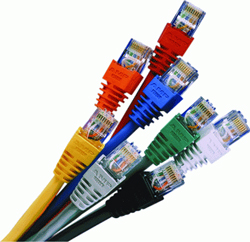
Gigabit Ethernet replaces DS3 and T3 now.Telco’s T1 Line Upgrade
The pioneering work on digital transmission over long distances was done by Bell Labs right after WWII. Their first product was called T-Carrier and consisted of T1 and T3 services that were compatible. T1 lines could replace 24 analog phone lines with one multiplexed T1 line.

T1 was designed to run on the same twisted pair copper wires that supplied analog POTS landlines for easy deployment. T3 is an upgrade that ran on coaxial copper lines and microwave towers at 45 Mbps. It can handle 672 voice lines. The protocol that runs on T3, called DS3, can also be carried on SONET fiber optic circuits. When the Internet arrived, both T1 and DS3 were offered in clear channel versions to carry packetized data. T1 runs at 1.5 Mbps. DS3 or T3 runs at 45 Mbps.

Carrier Ethernet over Fiber Takes Over
Computer generated data far exceeds telephone traffic these days. The near ubiquitous standard is Ethernet on the LAN running the Internet Protocol or IP. With T1 or DS3, you need to do a protocol conversion at each end to go from the computer standard to the telephone standard and back again. The introduction of Carrier Ethernet keeps everything in one standard, Ethernet, from end to end.

Carrier Ethernet has been deployed in two versions. The slower version is Ethernet over Copper or EoC. This is a direct replacement for T1 lines and fractional DS3 service and runs from about 1 Mbps to 20 Mbps or so depending on the length of the circuit. The key feature is that it uses the same twisted pair wiring as T1 line or analog phone lines.

The faster version of Carrier Ethernet is Ethernet over Fiber or EoF. This is the technology that is rapidly taking over the world. EoF gives you end to end Ethernet from about 10 Mbps to 10 Gbps and even 100 Gbps in some areas. As you might expect, Ethernet over Fiber easily replaces T3 lines or DS3 bandwidth over SONET. It also offers the ability to easily upgrade to higher speeds than 45 Mbps any time you want. With a Gigabit Ethernet port, you can start off at 50 or 100 Mbps and scale up to 1,000 Mbps with just a phone call or click of a mouse online. There is no need to change out equipment. Only the speed of the line and your monthly billing will change.

The other big advantage of Carrier Ethernet, and some say the most important one, is the cost reduction compared to traditional telco services. You can get EoF service at DS3 bandwidth speeds of 50 Mbps for a fraction of what you would pay for actual DS3 over SONET. 100 Mbps, 1000 Mbps and 10,000 Mbps are suddenly affordable when you upgrade to Ethernet over Fiber.

Wireless is Fiber Without the Fiber
There are situations where fiber just doesn’t work despite all its advantages. One is is rural or remote areas that haven’t been wired, perhaps not even for telephone. The other is in dense urban areas where fiber has yet to be installed. The cost of construction is astronomical in both situations but that doesn’t mean you are out of luck. Just skip the fiber or wires completely.

Point to point microwave was a staple of telephone long haul. Microwave relay towers would retransmit the phone calls every 30 miles or so. Microwave is still applicable on a smaller scale over reasonable distances. In downtown business districts a dish on the roof pointed at the provider's antenna a few blocks away can give you Gigabit level bandwidth with very little construction cost. it’s also fast to install compared with pulling cables under the street.

In more rural areas, a WISP or Wireless internet Service Provider gives similar service usually at somewhat lower bandwidth levels, but similar to DS3 or better. Customers point their antennas at the service tower which can be miles away, but in a direct line of sight.

Another popular arrangement is to take advantage of the fact that every cell tower is also transmitting Internet traffic for smartphones. 4G LTE is commonly available and can give you the performance of fractional DS3 at least on download. Many smaller businesses can get all the performance they need from 4G without any of the wiring headaches. This is especially valuable for mobile or pop-up stores and individual entrepreneurs. Now that 5G is well into deployment, cellular can easily replace DS3 and higher speeds.

One thing to be aware of with wireless services, especially cellular, is that there are usage limits to most plans. That’s because the system can handle less traffic than fiber and the bandwidth must be shared fairly among users. Even so, if you can get 300 GB per month plans and pay much less than DS3 or even a T1 line, wireless can make a lot of sense.

Cable Broadband Can Mimic Fiber
The old Cable TV networks have been vastly upgraded and are now mostly run on fiber. It’s just that last link into your building that is run with coaxial cable. The protocols have also been upgraded along with the switch from analog to digital television. DOCSIS 3.0 and 3.1 offer high speed performance at bargain prices. You might be surprised to know that DOCSIS 3.0 can support bandwidth up to 1 Gbps download and 200 Mbps upload. The newer DOCSIS 3.1 standard is good to 10 Gbps download and 1 to 2 Gbps upload. When DOCSIS 4.0 is deployed, that upstream capacity will increase to 6 Gbps.

Cable broadband is extremely popular with residential users and many businesses. You just can’t beat the pricing. The only limitations are that cable isn’t available in many rural areas and the bandwidth is multiplexed or shared among many users. Thus speeds can vary. Like wireless, there is a large difference between download speeds and upload speeds. Uploading is typically a tenth or less the speed of downloads. That reflects the way Internet traffic usually flows. In many cases, this may make no difference to your operation, but it you need very high upload and download speeds and dedicated bandwidth, especially for cloud services, you may need fiber optic service through cable companies or other competitive fiber network providers.

Do you still have an old DS3 or T3 contract or simply need high performance, low cost bandwidth in the 50 Mbps or above range? If so, discover what Gigabit Ethernet services are available for your business.


Click to check pricing and features or get support from a Telarus product specialist.


Follow Telexplainer on Twitter


Thursday, December 29, 2011

The Next Decade of Bandwidth - Part IV

It won’t be long until wireless broadband has commandeered all the spectrum it can between a few hundred and a few thousand MHz. These are seen by the industry as being the most desirable frequencies. They offer high bandwidth capacity, good penetration into buildings and small antennas. Unfortunately, there are only so many of these channels available. Just like in real estate, when all the best locations are bought up expansion continues into whatever is available.

The future of computing is in the cloud...Going up or down the electromagnetic spectrum in search of more broadband capacity has its challenges. As you go down in frequency, up in wavelength, channels have to be proportionally larger to get the same carrying capacity. A 1 MHz channel at 10 GHz seems small. A 1 MHz channel at 10 MHz eats up a huge chunk of that band. At 1 MHz, there would only be room for a single 1 MHz channel.

One way to deal with this is to divvy up your transmissions into hundreds or thousands of smaller channels. This is the principle behind OFDM or Orthogonal Frequency Division Multiplexing. The system generates an array of carriers spaced out across the available spectrum. Each carrier transmits only a portion of the data. When those pieces are combined at the far end, you have a single continuous transmission again.

OFDM is the system used for BPL or Broadband over Power Line Internet services. It uses the shortwave frequencies, with some carriers omitted to avoid interference with other services. By using many, many small channels instead of one big one, any packet losses are small and easily replaced. It also offers a way to fit a wireless service into a band that doesn’t have big open chunks of spectrum. Just use the channels you can and combine a bunch of them to create a larger bandwidth service.

BPL may not be going anywhere because other wireline and wireless services are more cost effective competitors. WiMAX uses OFDM, as do LTE, WiFi and digital radio broadcasting. Seems like there is no reason a wireless equivalent of BPL couldn’t be deployed to use available lower frequencies that haven’t been previously considered for broadband use.

Going up the spectrum in frequency is also challenging. The higher you go, the more line of sight transmission becomes. The Ku band that broadcast satellites use from 12 to 18 GHz has lots of capacity, but not much ability to penetrate obstacles. Even tree leaves will interrupt service, as will a heavy rain. Wireless point to point transmissions in the Super and Extremely High Frequency bands is via outdoor antennas within line of sight.

That’s the state of the art today, but does it need to be so limited? Perhaps someone will come up with a way to flood areas with many very low power cells to ensure that a mobile antenna can receive a signal no matter where it travels. That same idea is being put to use now with mesh networks consisting of WiFi radios. Each WiFi hotspot communicates with the radios nearby to share traffic, so you don’t need backhaul connections to a central controller.

This idea of mesh networks with low power transmissions and short range coverage has application for even higher parts of the spectrum. Above 300 GHz, electromagnetic waves start to be called infrared light waves. Infrared light is the carrier used in fiber optic cables. You can eliminate the fiber and use infrared beams from point to point, as long as you have a direct line of sight. This is called free space optical transmission. With enough emitters and receivers connected in a mesh network, you can create a very high capacity network with decent coverage.

In Part I, Part II, Part III, and Part IV, we’ve seen how wireless broadband has a near insatiable need for bandwidth and how that may be satisfied by reassignment of desirable channels and more efficient use of underutilized frequencies up and down the electromagnetic spectrum. In the fifth and final part of this series on the next decade of bandwidth, we’ll take a look at wired connections that include both copper and fiber to see what else is in store for business bandwidth.

Is your business running short on bandwidth or simply looking to get a better deal? See what's available for your business location in the way of T-carrier and Ethernet copper, SONET and Ethernet fiber, fixed wireless and Hybrid Fiber Cable (HFC). Get instant bandwidth pricing up to 1 Gbps and fast quotes on other services.

Click to check pricing and features or get support from a Telarus product specialist.


Follow Telexplainer on Twitter

Tuesday, July 26, 2011

4G Wireless Broadband Options

Wireless broadband is on an upward path to take over many of the applications that have long been the domain of wireline technologies. Wireless has the convenience of portability and mobility. What’s held back deployment and more powerful applications is the limited availability and speed of wireless connections. The move to 4G wireless looks to be a potential solution.

Wireless towers deliver 3G and 4G broadband for mobile and fixed applications...4G or fourth generation wireless doesn’t have a strict definition, but it is roughly stated as the bandwidth typical of Cable broadband or Ethernet over Copper business connections. With this level of transmission speed and a city-wide reach, 4G wireless can take over service for desktop as well as mobile devices.

One might throw WiFi into the 4G category. The bandwidth for a, b, g, and n WiFi technologies fall into the right bandwidth category. However, WiFi is a short distance system. It works well within and nearby particular locations, such as homes, offices, restaurants, hotels, airports and even park benches. But you can’t get in your car and drive away with a WiFi connection. It will disappear as soon as you leave the parking lot. In a way, WiFi is more of a PAN or Personal Area Network like Bluetooth.

The higher power wireless technologies, including 2G & 3G are associated with cellular phone service. These are based on using networks of fixed transmitters and receivers arranged as cells with signals that fill-in the coverage between towers. The trick of turning this system into a metropolitan or wide area network is to coordinate the handoff of an existing wireless connection as the user moves from cell to cell.

The most popular wireless technology right now is 3G. It offers bandwidths similar to T1 lines and basic DSL of around 1.5 Mbps on average in metropolitan areas. You may get two or more times this speed if you happen to be near a tower with few users. This is more than adequate for many mobile uses, such as Web browsing, email and viewing video clips on smartphone screens.

Beyond limited speed, 3G also suffers from limited bandwidth availability. It shares channels with cellular telephone on the same towers. Those channels were originally sized to support expected voice traffic. They’ve been overwhelmed by the higher bandwidth requirements of Internet data traffic. That’s why carriers are so insistent on bandwidth caps.

There are a couple of different approaches to 4G wireless. The one taken by the cell phone companies is to view 4G as an upgrade to their 3G systems. There are two differing cellular system that co-exist. One is a US-centric system called CDMA that is used by Verizon, Sprint and others. The other is a more global standard called GSM that is used by AT&T and T-Mobile.

Right now, AT&T and T-Mobile have upgraded their 3G networks to a faster version of the same thing called HSPA+ that delivers up to 6 to 8 Mbps. Verizon has moved to a 4G technology called LTE that offers downloads of 5 to 12 Mbps. Sprint has gone with another 4G technology called WiMAX that delivers downloads in the 3 to 6 Mbps speed range.

As wireless continues to evolve, 4G is expected to move into two camps. LTE is the technology most discussed as a truly universal standard. WiMAX deployment actually predated LTE and has installations worldwide. Both LTE and WiMAX have technical upgrade paths that can boost download speeds to over 100 Mbps and even 1000 Mbps. This is competitive with many fiber services and ensures that 4G wireless will be with us for a long time.

One thing we’re also seeing with 4G wireless is the use of lower frequency bands that can more easily penetrate buildings. These bands came from the re-deployment of those channels from UHF TV as part of a federal auction. Clear offers 4G fixed and mobile wireless service with a telephone option over WiMAX in over 80 cities nationwide. Right now, this service offers unlimited broadband service.


Follow Telexplainer on Twitter

Wednesday, April 21, 2010

3G 4G Mobile Bandwidth

The Internet long escaped the desktop and moved onto the mobile phone. The problem is that it has been following a similar learning curve that took us from 300 baud telephone modems to DSL & Cable broadband and now to high speed wireless and fiber optic service. Mobile bandwidth is undergoing a steady evolution, with the demand for higher and higher speeds pushing the technology. Let’s have a look at what’s available and what’s coming soon.

3G and 4G Mobile Bandwidth OptionsThe benchmark today is 3G wireless. This service offers somewhere between 500 Kbps and 1.5 Mbps and is owned and operated by the cellular carriers. The same company that sells you your cell phone minutes also sells you 3G wireless Internet access. The signals come from the same towers, so if you are in a dead spot for phone reception you won’t be surfing the Web or watching videos either.

The 3G build-out has been proceeding at something of a panic level, especially since the introduction of the Apple iPhone. The first iPhone used the AT&T EDGE network, which is actually called a 2.5G network. That means it has considerably less bandwidth than the newer HSPA or High Speed Packet Access 3G network, perhaps as little as a tenth as much. HSPA is offered by GSM carriers AT&T and T-Mobile and is also known as HSUPA.

A competing 3G service is offered by CDMA carriers Verizon and Sprint using a different technology. Theirs is known as EV-DO and EV-DO Rev A. Download bandwidths are in the range of 1 to 2 Mbps, depending on signal conditions.

Note that 2.5G and 3G cellular broadband not only gives cell phones the ability to download videos and surf the Web but also gives you the option of adding 3G to your laptop computer. The functionality is added using a plug-in wireless modem aircard. These are sold with data-only service plans, since they don’t work as telephones. The aircard and wireless service has been a boon to field sales people who don’t always have the ability to set up shop within a WiFi hotspot.

The newest service on the market is called 4G mobile bandwidth. Right now the run away leader is the WiMAX service offered by Clearwire and Sprint under the CLEAR trademark. WiMAX is yet another wireless standard, albeit a global one not associated with the cellular phone system. WiMAX offers a powerful signal that covers an entire city. It’s strong enough to penetrate buildings so that you can have the same WiMAX broadband on your desktop and laptop computers. Download bandwidth typically ranges between 3 and 6 Mbps, considerably faster than 3G networks.

The cellular companies aren’t sitting still, though. Both AT&T and Verizon plan to deploy another standard called LTE to compete with WiMAX. It will likely be a year or two before these two 4G technologies are competing head to head in most populated areas. For now, WiMAX gives you the most mobile bandwidth at the lowest cost in the cities and states where it is available.


Follow Telexplainer on Twitter

Friday, April 09, 2010

4G WiMAX Wireless Broadband Available Now

Have you been frustrated by your choices in home and mobile broadband service? How would you like to find a wireless broadband Internet service that you can use at your desk and take with you on your laptop? Would you like it even more if this service was cheaper than DSL, Cable and 3G wireless? Would you go for it right now if this service was screaming fast? You should really check and see if you can get 4G WiMAX broadband.

See if you can get 4G Wireless home and mobile broadband service. Click to check.


What’s WiMAX and why is it better than other broadband service options? WiMAX is a new worldwide standard for high speed wireless data service. If you think the name sounds a lot like WiFi, you are right. In fact, you can think of WiMAX as the coming replacement for public WiFi hotspots. The MAX in WiMAX hints at why. This service gives you a hotspot that covers an entire city. It can extend for 20 or 30 miles. Compare that with WiFi that disappears in a couple of hundred feet.

If you want to go mobile and not have to constantly look for WiFi hotspots to connect, you are probably considering or have a 3G modem aircard. This is a USB device that looks like a flash memory dongle. But the modem aircard has a two-way digital radio inside that connects to a cellular broadband signal. That gives you broadband at speeds similar to entry level DSL but without the wires. The upgrade is 4G or fourth generation wireless broadband. WiMAX is the implementation of 4G that is deployed and working right now.

What does 4G WiMAX have to offer? How about typical download speeds in the range of 3 to 6 Mbps with occasional bursts to 10 Mbps? How about a service that needs no telephone or cable TV wiring even at a desktop location? How about a service that you can run at your desktop and then take with you on your laptop? That pretty much rules out the wireline services doesn’t it? Combine that with a service plan price that starts at $30 a month, and even 3G wireless is left in the dust. You can order home service, mobile service, a combination plan and a plan that even includes 4G VoIP phone service in the bundle.

Now the question is can you get 4G WiMAX broadband at your location? CLEAR offers this service in parts of Texas, Washington, Oregon, Illinois, Idaho, Nevada, Hawaii, North Carolina, Georgia and Pennsylvania. More locations are under construction right now. The only way to know for sure is to check for CLEAR 4G WiMAX broadband service availability. Give it a try and see if you’ve been missing out on faster, cheaper wireless broadband service.


Follow Telexplainer on Twitter

Thursday, April 01, 2010

FCC Confiscates Remaining TV Channels For Twitter

Shocked and horrified by the geometrically expanding demand for wireless broadband services, the Federal Commfiscation Commission exercised its powers of eminent domain today and confiscated the remaining broadcast television channels not already sold at auction. Most surprising of all was the declaration that this rare and important spectrum is going to be dedicated exclusively to the text messaging service, Twitter.

Twitter gets a powerboostFCC Chairman Lowon B. Andwidth explained that the Commission just completed an intensive study of Internet usage and found that the Twitter service is growing at such an astonishing rate that it will soon devour all available bandwidth. “While it is bad enough that Twitter will bring web browsing, video streaming, text messaging and email to a halt,” said Mr. Andwidth, “a far worse situation will occur when Twitter users have to take a number and get in line to post their tweets. I don’t want to be in Washington when that mob of anti-social networkers descends on Capitol Hill.”

In shortest supply is wireless bandwidth. Apparently, the lion’s share of cellular phone activity involves posting messages to Twitter rather than the growth previously expected from mobile video and web browsing. One young smartphone user was heard to exclaim, “Does anyone actually surf the Web anymore? Who has the patience to read blogs and web pages? Anything worth saying can be said in 140 characters or less.”

Twitter itself issued a 130 character statement expressing delight at the government’s pre-emptive action to prevent a massive Fail Whale epidemic from sweeping the nation, and requesting re-tweets. They vowed to expand server capacity to match the new wireless bandwidth capacity as best they can. TV stations that follow Twitter have already been tweeted to cease broadcasting immediately and return their licenses. The remaining stations will be getting old school telegrams. “It’s unlikely anyone will be inconvenienced by this change,” explained Chairman Andwidth. “Everybody is on cable and satellite by now, anyway.”

Expectations are that a swift coordinated move by the public and private sectors can ensure adequate messaging capacity at least until after the fall elections. After that, the FCC will likely look at shutting down other less important uses of the electromagnetic spectrum including most AM and FM music stations. “We may even have to shut down microwave ovens and garage door openers if we can’t keep up with texting bandwidth demand,” exclaimed an obviously frustrated chairman.

Also making quick moves to protect its interests, Google announced that it is going to take over non-wireless Internet service by offering 1 Gbps fiber optic connections to every city that performed ridiculous stunts to try to win Google broadband service for its residents. “All other cities that didn’t make fools of themselves will be getting 10 Gbps Google Internet access free of charge,” according to an unofficial Google statement. It went on to say: “There is only one acceptable day for any foolishness and that is April 1.”


Follow Telexplainer on Twitter

Tuesday, November 10, 2009

Wireless Business Broadband Available In A Day

You’re opening a new store this week and everything is all set to go. Construction is done, the fixtures are in place and the shelves are stocked. The announcements have been sent to the media and all that’s left is the ribbon cutting. After that, let the profit making begin. Oh... NO... There won’t be any profit making because there won’t be any sales. The broadband service you were promised won’t be installed for another couple of weeks. Well, that’s what they said anyway. But they said that two months ago. What are you going to do without any connectivity? Is there anything that can jump in and save the day?

Cellular TowerYes there is and you’ll be glad you found out about it. Instead of grinding your teeth or just leaving the doors closed until your DSL or other provider can get around to bringing up your business broadband, get a wireless solution from Accel Networks. It’s highly secure and PCI/Visa compliant, so you can make cashless transactions with confidence. Data rates are typically 768 Kbps to 1.4 Mbps download and 384 Kbps to 512 Kbps upload with solid signals covering 90% of the United States. Best of all, it can be deployed in 1 to 3 business days.

A broadband wireless connection available in as little as a single business day? How come other providers don’t offer that. One word: Wires. No wires means no digging in the yard, stringing pole to pole, or fishing cables through the building. Those are things that take time. Avoid the wires and a good bit of the provisioning time goes away.

Accel offers a wireless solution that cleverly makes use of existing infrastructure. Most WISPs or Wireless Internet Service Providers are very localized and require direct line of sight to their towers. They likely will have to come out and put a dish or other external antenna on your building even if you can see the tower. Accel Networks doesn’t use proprietary towers like your local WISP. They’re using some or all of those cellular towers you see all over town. That's another reason why they need so little provisioning time.

Accel Networks has made agreements with the cellular carriers to use some of the data bandwidth that is available from every cell tower. But rather than limiting their options to one carrier, they’ve contracted with both CDMA and GSM carriers so that their service footprint covers 99% of business locations in the U.S., Canada and Puerto Rico. Their specially designed “Accelerator” customer location equipment is capable of 99.9% availability and network management from Accel headquarters. Installation takes less than an hour from the time your equipment arrives.

What can you do with a wireless network solution? The quick start option to have your business up and running in days, not weeks or months, is an obvious winner. It’s perfect for point of sale terminals in retail stores, quick service restaurants and hospitality providers like hotels and motels. It’s also a fast solution for disaster recovery in any business that can’t function without an Internet connection. Dial-up was once the answer to backing up broadband. But dial-up is just too slow for many applications anymore. Besides, the same disaster that took out your main wireline service might well have knocked out the phone lines as well.

The low capital and operating expenses per location for Accel Network’s wireless has given many businesses the incentive to upgrade from their old VSAT and frame relay connections or their current DSL and Cable broadband services. Accel is and can be the primary network service for restaurants, gas stations, banks, convenience stores and many other businesses. Some businesses have started with a panic call for quick start service and later decided to keep Accel Networks as their primary broadband connection.

Are you in dire need for fast and effective WAN network bandwidth at a reasonable price for a single or multiple business locations? Perhaps you’re just shopping around to see if you can do better than the high cost and unreliable service you have now. Either way, call the toll free number or enter an online inquiry for wireless business WAN bandwidth to get prices and availability.

Click to check pricing and features or get support from a Telarus product specialist.


Follow Telexplainer on Twitter

Wednesday, September 16, 2009

Backhaul Upgrades For Wireless Broadband

A funny thing happened on the way to mobile broadband. We ran out of bandwidth. While everyone was thinking that wireless channels would be the limiting factor, lack of backhaul capacity is threatening to stop wireless growth in its tracks. Fortunately, this limitation is recognized and being dealt with.

Just what is backhaul and why does it stand in the way of mobile services? Backhaul, as the term is used now, means the connection from the wireless tower site back to the provider’s central office or mobile switching center.

Backhaul is something you didn’t hear much about until recently. As cellular sites were originally envisioned, they consisted of a radio transmission system with spectrum divided into multiple channels. Those channels are used to communicate with the wireless handsets to transport telephone conservations. The backhaul system consists of T1 lines that offer up to 24 individual phone lines on a digital trunk.

The beauty of T1 lines is that they are provisioned on ordinary twisted pair copper. That’s right, they use telephone line. Each T1 requires two copper pair. But instead of carrying two phone conversations, the digital line can carry 24 conversations. That’s an efficiency improvement of 12x over analog telephony. Because they use ordinary telco cabling, T1 lines can be easily provisioned to both rural and urban tower sites.

T1 lines can also be used to carry broadband Internet services. Many businesses get their broadband service over a T1 line. All cellular phone companies need do is provide a data T1 line to the tower site and use some of the available wireless channels for Internet service. That gives the user both voice and data on their mobile device.

Everything worked smoothly until newer cell phones, especially the large touch screen models, made streaming audio and video and HTLM Web browsing possible. Video chews up bandwidth like crazy. If people expect to have a television watching experience on their cell phone, the cellular transmitters are going to need bandwidth and lots of it.

This is what’s underway now. The initial response to the increase in bandwidth utilization was met by bonding multiple T1 lines to create bigger bandwidth pipes out to the tower sites. But wireless broadband speeds are increasing by leaps and bounds. AT&T’s HSPA service for 3G mobile wireless offers a max download speed of 3.6 Mbps. They are currently in an upgrade mode to double that to 7.2 Mbps. The next generation technology is 4G using LTE that will offer speeds over 10 Mbps. Sprint and Clearwire are busy building out WiMAX, another 4G technology. Verizon is running EV-DO Rev A for it’s 3G network and will implement LTE for 4G, similar to AT&T.

What this means is a big demand for backhaul service to get the voice and data signals to and from the tower sites. Carrier Ethernet can address some of this demand over multiple copper pair. WiMAX is touted as both an end-user broadband service and a backhaul technology. It just depends on where the signals go. Ultimately, fiber optic cable is the solution to the backhaul bottleneck. Fiber has nearly unlimited capacity, but it is expensive to install where there is no fiber today.

It seems like there should be some synergy between the rural broadband initiative being pushed by the Federal Government and the need for higher bandwidths to carrier-owned cellular facilities. Why not just bite the bullet and get fiber to the boonies now? It won’t be long before that massive bandwidth is going to be a necessity rather than a luxury.

In the meantime, if you have a need for voice or data bandwidth for any business application, see what bandwidth options are available for your location. You may be surprised at how much you can get at a reasonable price these days.

Click to check pricing and features or get support from a Telarus product specialist.


Follow Telexplainer on Twitter

Thursday, February 26, 2009

4G Wireless Broadband Wars This Year

Later this year, the battle for 4G domination will begin in earnest.

4G? Has 3G really finished deployment yet? Actually, 3G wireless networks are pretty well out there. The big players, AT&T, Verizon and Sprint, have upgraded most of their tower sites in populous areas. Many 3G smartphones and wireless modem aircards are available. While user awareness and adoption of 3G is still early on the learning curve, there's seemingly no time to waste for the carriers. It's on to 4G!

What's the big hurry? Part of it is an increasing sophistication in mobile applications with a corresponding increase in bandwidth demand. Some is good old fashioned competition. Think of it something like the space race or the building of the transcontinental railroad. The real value of these 4G networks is less about what's absolutely needed now and what they will enable in the future.

The 3G competition is based on two competing incompatible standards. The CDMA networks of Verizon, Alltel, and Sprint have developed EVDO technology. GSM networks, including AT&T, T-Mobile and foreign carriers have developed UMTS broadband, notably EDGE and HSPA.

The 4G competition is also dividing along two lines. First out of the gate is WiMAX, a worldwide standard for fixed and mobile broadband. But building steam is LTE, which is oddly enough being embraced by both Verizon and AT&T. Who's pushing WiMAX? Sprint and a fixed wireless player, Clearwire.

Is this going to be something like the ongoing DTV transition where one technology goes dark and the other immediately takes its place? No, not really. Both 3G and 4G will co-exist for a long time to come. WiMAX is being deployed in the 2.5 GHz band using the combined channel licenses owned by Sprint and Clearwire. Verizon and AT&T will use 700 MHz spectrum acquired in the recent telecom auction that was formerly the domain of analog TV broadcasting. That allows 3G cellular broadband to continue on the existing cellular bands as long as it makes economical sense.

One question is how much additional bandwidth we'll get from 4G wireless. During the run-up to the WiMAX standards approval, it was widely touted that a single WiMAX tower would have a range of something like 30 miles with bandwidth anywhere from 30 to 70 Mbps near the transmitter. In practice, Sprint was offering 2 to 4 Mbps download speeds on its Xohm service in Baltimore. The Xohm name has been retired, as Clearwire is taking over management of the combined Sprint and Clearwire channels. Clearwire has upped that to 4 to 6 Mbps on its Clear (tm) 4G wireless service for Portland, OR.

LTE hasn't been deployed yet, but peak data rates of 60 to 80 Mbps have been observed in tests. Verizon has suggested that average LTE data rates of around 8 Mbps are likely in actual service, although that may be conservative. Since there is a tradeoff between bandwidth, number of users per transmitter and distance from the tower, it seems likely that both LTE and WiMAX could be scaled up to provide speedier service as customer demand and the competitive environment dictate.

WiMAX has a lead in the race to the 4G wireless marketplace, with systems already in commercial service. Verizon's LTE has an advantage of frequencies lower in the electromagnetic spectrum, which should translate into greater ability to penetrate into buildings. Verizon expects to have 2 markets served by LTE by the end of this year. In 2010, Verizon expects to launch around 25 to 30 markets with LTE service. WiMAX will likely have a similar service level. There are now 50 markets in the U.S. and Europe with a pre-market version of WiMAX service.

4G wireless will likely reach a tipping point in 2011 or 2012, depending on the economy. Both mobile and fixed location services will be available, offering competition to DSL and Cable modem service as well as powering smartphones and netbooks. What will all this bandwidth be used for? You can bet that video will be the proverbial "killer-app", along with cloud computing and interactive everything.


Follow Telexplainer on Twitter

Tuesday, October 28, 2008

XOHM, XOHM's Got The Range

Sprint's XOHM (say zome, like home) wireless broadband service is off and running in Baltimore. This is the start of the long anticipated deployment of WiMAX as the next generation of high speed Internet service. If Sprint is able to realize its 4G dream, WiFi hotspots may become a thing of the past. DSL? Cable? Who wants to be tethered by a wire when you can roam wirelessly, gloriously, free?

The dream is built on a new wireless technology that has been standardized for worldwide application in both fixed and mobile applications. WiMAX or Worldwide Interoperability for Microwave Access, offers coverage measured in dozens of miles and bandwidth that could extend to dozens of Mbps. Sprint's deployment offers 2-4 Mbps download and 0.5 to 1.5 Mbps upload. That's comparable to the majority of DSL, Cable broadband and even professional grade T1 and Ethernet connections.

WiMAX is often thought of as the big brother to WiFi. It's not a bad comparison if you are thinking in terms of laptop computers using wireless adaptors for broadband Internet access. WiFi's limitation is that it has a footprint pretty much limited to a single building. Drive away from the restaurant, home, or business office and your signal disappears. The best you can do is find another "hotspot" where you can resume operations.

WiMAX is meant to cover a town or major area of a city. It uses higher power signals on licensed frequencies. In Sprint's case it is their exclusive 2.5 GHz spectrum. The higher power levels of WiMAX transmissions allow their wireless signals to penetrate buildings and vehicles. OFDMA or Orthogonal Frequency Division Multiplexing Multiple Access modulation is resilient to service dropouts due to interference. MIMO or Multiple Input Multiple Output antenna technology also helps to improve system performance in the presence of multipath distortion that occurs when signals bounce off buildings in metro areas.

Sprint offers an XOHM base station modem for home or small office use. It looks a little like a high tech coffee brewer in shiny black. This device is self-contained with built-in antennas and Ethernet jack output. For mobile use, they have WiMAX aircards for PCMCIA slots or USB.

The direct competitor for WiMAX is 3G cellular broadband. Sprint also provides that service as EV-DO. You can order EV-DO service and air cards for nationwide access in most medium and major cities. Verizon offers a competing EV-DO service and AT&T has its own HSDPA broadband service, popularized by the Apple iPhone 3G.

XOHM is on its way to Chicago and Washington DC, with systems planned for Dallas, Fort Worth, Boston, Providence and Philadelphia. Nationwide deployment should roll out in the years ahead, economics permitting. Who knows, in the future there may well be XOHM where the buffalo roam.


Follow Telexplainer on Twitter

Wednesday, September 24, 2008

No Business DSL? Go Wireless

You've just put up a new retail location and you'll be ready to take orders soon. All you need now is to order a DSL line and get it connected to your point of sales system. Oh-oh. You're beyond the range of the nearest telco central office. No DSL. No Cable broadband either. Oh, great. Now what?

One solution that will almost always work is to order a T1 data line. They're fast, highly reliable and available just about anywhere you can get telephone service. But if all you need is an Internet connection so you can process credit card transactions from a few terminals and perhaps upload inventory or accounting data to the home office, the cost and bandwidth of a full T1 line seems a bit much. Isn't there anything lower cost that you can get for nearly any location?

Actually, there is. First of all, don't write off T1 lines as too expensive until you check prices. They've come down a lot in recent years. However, it's true that lower bandwidth applications don't really keep a T1 busy. Have you considered wireless?

Yes, it's true that WISPs or Wireless Internet Service Providers are highly dependent on line of sight transmission. If you can't see the tower, you're probably out of luck. But there's another type of wireless service now available that covers 99% of locations where you're likely to put a business. Think cellular.

What Accel Networks has done is to form partnerships with the major cellular carriers to use their 2.5G, 3G, 3.5G and 4G data networks. As you already know, cell towers are everywhere. But did you know that some of their channels are used to transmit broadband data instead of phone calls? The iPhone is a good example of a cell phone that uses both voice and data channels. Most smartphones do. But if you use a standard flip phone you may not be aware that there is broadband Internet service available in most locations.

Each carrier has its own coverage footprint. Accel uses them all so that they can offer broadband wireless service just about anywhere. This is fixed location service, mind you. Your equipment comes setup for your location and should be up and running in about 15 minutes from when you unpack it.

How about access speeds? It's very similar to DSL business service, with 768Kbps - 1.4Mbps download speed in many areas and 140Kbps download in less populated areas. That's better than ISDN BRI and far superior to dial-up, even with the slower 2.5G data rates. Accel claims 2-4 second response speed for cashless transactions on service that meets or exceeds PCI compliance standards.

Don't fret about lack of DSL service. They may be doing you a favor. For about the same money you can have reliable private data service in as little as 3 days. Does that sound good to you? Find out more about the highly competitive wired and wireless data service available for your business location now.

Click to check pricing and features or get support from a Telarus product specialist.


Follow Telexplainer on Twitter

Wednesday, March 26, 2008

Will WiMAX Become WiMedium?

WiMAX, the Worldwide Interoperability for Microwave Access wireless broadband standard, has been looked to as the enabling agent for 4G roaming and mobile networks. In all the ballyhoo of the last few years, though, other technologies have been creeping up and may now be poised to grab the 4G crown for themselves.

The promise of WiMAX was to extend the concept of WiFi hotspots from hundreds of feet to tens of miles. A mobile hand-off extension will enable WiMAX to maintain connections from tower to tower to increase its reach indefinitely. But isn't that how cell phone towers work? Similar concept. WiMAX has been expected to one-up the cellular carriers by offering 10x to 100x the bandwidth of 2.5G and 3G cellular broadband with enough punch to be useful inside buildings as well as on the street.

But WiMAX is planned to be much more than a mere public hotspot replacement. Much of the capital justification to build out the new system is based on using it for cellular backhaul, T1 and DS3 business line replacement, and perhaps more arcane uses such as industrial and utility data acquisition and control. The juicy consumer mobile Internet market is yet to come.

Had WiMAX muscled-in on the wireless scene a few years ago, it might well have been the 800 lb. gorilla in the field right now. But the need for standards approval, testing, equipment certification and worldwide coordination has kept the gorilla slogging along rather than jumping into the fray. Business wireless providers have had to go forward with pre-WiMAX implementations to grab a piece of the marketplace before it goes elsewhere.

Where might it go? Those sleepy cellular carriers with their poky Kbps data links have been making steady progress. EV-DO is now widely available on CDMA carriers such as Verizon and Sprint. It offers DSL grade bandwidth of 700 Kbps with bursts up to 1.4 Mbps. But the new EV-DO Rev. A upgrade is also being deployed with service of 800 Kbps with bursts of to 3.1 Mbps and a faster upload speed of around 500 to 700 Kbps.

Perhaps that doesn't sound like much, but it's about what most users really need on an individual basis. It's fast enough for Internet Web access, video and audio streaming and even video conferencing. The 50 to 70 Mbps WiMAX speeds will probably degrade to an average of around 2 or 3 Mbps for multiple roaming and mobile users who aren't standing right under the tower. All of a sudden EV-DO looks pretty competitive. Especially when you consider that the Rev B version could provide peak bandwidths of 5 to 15 Mbps depending on how how it's deployed.

But the real cellular broadband monster may be LTE which stands for Long Term Evolution. By long term, it's probably several years away. Verizon is moving ahead with this technology and AT&T is expected to also adopt it as their 4G standard. LTE will offer download speeds of 100 Mbps or more with uploads of 50 Mbps at low latencies. These are Ethernet speeds, even Fast Ethernet speeds, enabling applications such as high definition video.

The big advantage the major cellular carriers have is that they already own networks of tower sites that blanket the highly populated areas where there are lots and lots of potential mobile broadband users. Sprint has the spectrum and plans to deploy a nationwide WiMAX network, but is having trouble coming up with the billions of dollars needed to develop this market. If WiMAX doesn't gain a strong foothold soon, it may find itself needing a standards upgrade just to keep up in the wireless bandwidth race.

How satisfied are you with the price you're paying for voice and data bandwidth? Our team of seasoned professionals have the expertise, tools and suite of competitive carriers to help you get the best deals on wireline, wireless, fiber optic and satellite-based business bandwidth.

Click to check pricing and features or get support from a Telarus product specialist.


Follow Telexplainer on Twitter

Monday, February 04, 2008

Is WiMAX Worth the Wait?

WiMAX, the new wireless broadband communications standard, has been eagerly anticipated for several years. We've watched with anticipation as the concept turned into standards, equipment certification began, and initial pilot projects were launched. WiMAX is still coming, but will it still be as exciting when it gets here?

WiMAX is the acronym for Worldwide Interoperability for Microwave Access. It's a truly international standard that will be useful in applications as diverse as cellular backhaul, mobile Internet, business broadband, and perhaps even a WiFi replacement. WiMAX has power and range as well as bandwidth. WiFi hotspots have proliferated and become very popular for accessing the Internet while on the go. But WiFi coverage is measured in feet. WiMAX coverage is measured in miles.

So, does that mean we're about to send all of our DSL and cable modems, WiFi access points, and cell phones to the recycling bin? Not much chance of that. These technologies are pretty well entrenched. What's more, other wireline and wireless solutions are building out to offer competition for the forecasted WiMAX tsunami.

Cellular broadband is the most aggressive in upgrading tower sites to increase upload and download speeds. Just as the CDMA networks, notably Verizon, Sprint and Alltel, begin to cover most heavily populated areas with EV-DO, an upgrade to EV-DO Rev A is launched.

EV-DO offers speeds similar to what you expect from DSL broadband. Burst speeds are up to 2.4 Mbps download, although 700 Kbps is probably more a typical speed in crowded urban areas. Upload is a mere 153 Kbps burst with 50 Kbps probably more typical. Bandwidth is sufficient to support aircards and built-in access for notebook computers. It's also been an enabler for streaming video and music downloads on cell phones.

EV-DO Rev A increases the bandwidth to a 3.1 Mbps download burst, which should incrementally improve real world performance. The big improvement is in upload speed to 1.8 Mbps. With Rev A, applications such as VoIP and video transmission become practical for mobile users.

What's more, there is a Rev B upgrade in the works for EV-DO. It further increases downlink speeds by 3x to a burst rate of 9.3 Mbps using a technique called DO Multi-carrier to bond 3 channels. Peak rates up to 14.7 Mbps are possible by allocating more station bandwidth to EV-DO transmissions.

A competing technology, known at LTE or Long Term Evolution, is in development. Download speeds are up to 100 Mbps with 20 msec latency. While it may be at least a couple of years before LTE is deployed to cellular base stations, it's clear that cellular-based broadband has the potential to compete with other wireless technologies including WiMAX.

WiMAX got everyone excited with a prediction of 70 Mbps bandwidth over as much as 30 miles coverage. The range as well as the potential link speed is what sets WiMAX apart. But a network of cellular broadband stations could do pretty much the same job. In fact, WiMAX might see its greatest application in providing backhaul services for those competing cellular stations.

As of this writing WiMAX deployment is off to a slow start. The real impediment is the billions of dollars that need to be invested in transmitting infrastructure to operate a nationwide network. Sprint and Clearwire have been in discussions to combine forces in using their existing bandwidth to blanket the country. The current 700 MHz spectrum auctions could also release choice frequencies for WiMAX use.

Pre-WiMAX implementations are already providing wireless business links in some major cities. Covad is offering what they describe as "T1-class wireless broadband" in 200 California cities, plus Las Vegas and suburban Chicago. Bandwidths from 1.5 Mbps to 100 Mbps are offered as available. Wireless bandwidth is especially valuable to businesses not already lit for fiber optic service but needing to expand their WAN connections.

Is your company looking for the optimum bandwidth services to support your digital telephony and data transmission needs? If so, check out a suite of options that include wireless, wireline, fiber optic and satellite delivery.

Click to check pricing and features or get support from a Telarus product specialist.


Follow Telexplainer on Twitter