Showing posts with label T1 lines. Show all posts

Monday, June 15, 2026

The Sun is Setting on Copper Telecom Lines

By: John Shepler

It has been rumored for a long time and now it’s really underway. The end of over a century of copper wire based phone and network lines is here, with a key event on June 30. That’s the start of AT&T’s first major wave of wire center decommissioning. Over 277 of these facilities will go dark when completed, with more waves of decommissioning to follow. In the end, we’ll have completely moved on from Alexander Graham Bell’s original network.

Take action before the sun sets on your copper telecom services. What The Loss of Wire Centers Really Means
In simple terms, a wire center is where all the wires connect. It’s the building that connects the central office switching with all the local loops. That’s often thousands and thousands of individual twisted copper pairs that are bundled into larger cables. Your analog phone line, the “landline” or POTS (Plain Old Telephone Service) line, is one of these loops. You can trace the wire pair directly from the phone jack on your wall all the way to the line card at the central office that provides power and signaling to run the phone handset.

Those twisted pairs can carry a lot more than individual phone calls. They can be set up with digital termination equipment to provide DSL and T1 broadband or PRI digital multi-line phone service. They may also be used in special applications such as fire alarms, elevator phones, gate entry systems, security systems, and fax machines.

Decommissioning means taking these lines out of service. No more wire center. No more copper line service.

In actuality, the phone companies that own these lines have already been discouraging their use through higher service prices and refusal to add more customers. Another group, copper wire thieves, have been doing their own decommissioning by cutting and stealing cables and then burning off the plastic insulation so they can sell the copper at recyclers. Copper prices are way up due to the expansion of data centers, electric vehicles, and solar power, to name a few.

What Replaces Copper Telecom Lines?
Like the incandescent light bulb, it’s time to move on from 19th century technologies. The new options are primarily fiber optic and wireless.

Fiber voice and broadband started with phone company Optical Carrier standards but has migrated to Carrier Ethernet standards to be compatible with the vast majority of company networks. Ethernet over Fiber service ranges from 10 Mbps up to 100 Gbps, with Gigabit Ethernet and 10 GigE becoming popular standards.

You need what is called an Ethernet Port at your end. That connects via fiber to your service provider, often an Independent network operator but perhaps a traditional telco. The speed of the Ethernet port limits the amount of bandwidth you can have. A Gigabit port lets you order up to 1,000 Mbps. A 10 Gigabit port supports anything up to 10,000 Mbps.

There are different flavors of fiber optic service. Your Internet access can be on a fiber line that is shared among many businesses and residential users to save cost. You may prefer to order Dedicated Internet Access (DIA) so that your connection to the Internet itself in essentially on a private line.

Direct Cloud Access is a similar service without the Internet being involved at all. You have a private fiber service from your facility to your cloud service provider. This gives you the best low latency and low congestion for higher productivity and smoother voice calls and video conferences.

You might also want to consider dedicated point to point fiber to interconnect your facilities across town or around the world. These private lines offer high performance and better security than what you could hope for on the Internet.

Wireless Options
Of course you have mobile phones, tablets and laptop computers that connect to the Internet using 5G cellular broadband. Another flavor of that services is Fixed Wireless Access. It comes in a box with higher gain antennas and Ethernet connection. It’s the 5G broadband without the phone features. There are also options to add outside antennae for better coverage and some controllers offer multiple providers for service continuity if one company goes offline temporarily. FWA can be as speedy as fiber, but without having to run the fiber line itself.

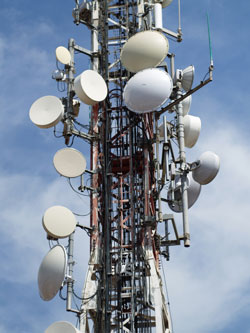
Some Wireless Internet Service Providers do not use cellular networks. Instead, they have their own towers and beam and point to point signal to a small dish antenna on your roof. These are very private lines and can have Gigabit or higher speeds.

Satellite broadband and satellite phone have been around for years. The broadband using geostationary satellites can be very reliable and speeds have been improving with newer generations of satellites. The half second or more of latency due to the distance to geosynchronous orbit is one sticking point. LEO or Low Earth Orbit satellite constellations, primarily SpaceX Starlink, reduces the latency to something similar to terrestrial broadband. Bandwidths are also competitive for many applications. Just stating now is direct to handset service that turns satellites into alternative cell towers. Soon there will be no dead spots, even in the most remote areas.

What to Do About Specialty Services?
Those fire alarms, fax machines and elevator phones that were designed for twisted pair copper and nothing else still have hope. AT&T, among others, is offering a “POTS Replacement” service that consists of 4G LTE cellular wired to support these services along with built-in battery backup. Why 4G LTE? This standard can mimic the old phone lines and is still readily available.

The One Remaining Copper Service
There is still one very popular copper broadband service, but it is not from any phone company. This is Cable Broadband that is brought in on coaxial copper wiring. In reality, the cable companies have converted to fiber optic transmission, but the latest DOCSIS standards let them keep their existing copper coax into your building and still achieve speeds of 1,000 Mbps or even 10 Gbps… competitive with fiber.

Is your company experiencing an upcoming loss of service due to copper decommissioning? No time to wait. Find out what copper replacement services are available for your business needs. You may be surprised to find you can actually get more capability at a lower cost.


Click to check pricing and features or get support from an expert technology specialist.


Follow Telexplainer on Twitter


Wednesday, April 30, 2025

Today’s Best Business Broadband Options

By: John Shepler

If you are still using a copper wireline service, such as DSL or T1, for your business Internet connection, it’s time to upgrade your service… before you are forced to.

Find today's best Internet connections for businessForced to? Why would that be? Fact is, the major telecom companies are all in the process of decommissioning their copper wire assets. Basically anything that uses century-old twisted pair wiring is on the way out.

Technology marches on. T1 lines were once considered broadband. They don’t even qualify with today’s standard. DSL? Pretty much an obsolete system that was once a good way to re-purpose standard telephone lines for fast Internet access.

AT&T and others have made it clear that they are either pulling up old copper lines or abandoning them to rust in place. The wire centers or central offices that connect to these lines are being repurposed as data centers for the insatiable needs of AI.

So what are better options? Surprisingly, one of the best is also an older technology that has continuously upgraded to keep it competitive with the times.

Cable Broadband Is a Great Deal for Small Business
That coaxial cable that plugs into the back of a set-top box or cable modem has been a familiar tech standard for many decades. Physically, it’s the same. What’s changed is the signal that comes out that center wire.

Cable was originally analog, just like TV signals back in the day. When the Internet came along, some of the unused TV channels were set aside for digital transmission using a standard called DOCSIS or Data Over Cable Service Interface Specification, an invention of the industry’s R&D organization CableLabs. The current standard is DOCSIS 3.1 with a migration underway to DOCSIS 4.0.

Today’s cable modems are cable of gigabit speeds, with common service levels of 300 Mbps downstream, 30 Mbps upstream. That’s fast enough for pretty much all web browsing, video streaming and data transfer. What’s hard to beat at those speeds is the price. Cable is easily affordable by both consumers and smaller businesses, often with telephone service included.

Wireless Broadband is Now Both Mobile and Fixed
Like cable, cellular wireless had humble beginnings as a mobile telephone service, but has kept up with the times through multiple technology advancements. The first standard that really supported broadband as well as telephone was called 3G. That’s evolved to the current standards of 4G LTE and 5G. With 300 Mbps or so, an iPhone has all the bandwidth it can really make use of.

That high bandwidth, which can reach a Gigabit per second near some of the 5G towers, is easily competitive with fixed broadband services. The capacity limits have been largely eliminated with 5G buildouts and the extra spectrum acquired from government auctions of unused television bandwidth. Now the wireless companies are in a competitive battle to roll out cellular modems that work like cable modems but without the wires. You can put one at a construction site or a pop-up store in minutes. If you move soon, take it with you and have connectivity at your next location.

Cable broadband is being built into laptop computers and tablets and other devices, called the Internet of Things. Remote data acquisition and control are now possible in remote areas that have cell towers but no other connectivity.

Fiber, The Gold Standard and Secret Backbone
The magic that makes cable and cellular broadband so fast is the fiber optic lines that feed these services. It’s all behind the scenes, of course. Even so, you may want to connect directly to fiber yourself.

What’s the fiber advantage? Nearly unlimited bandwidth for one thing. Today’s service levels run from 10 Mbps to 10 Gbps just about everywhere, with 100 Gbps service available in some metro locations. That’s important for medium and larger enterprises with many employees who need simultaneous Internet access.

Another big advantage is symmetrical bandwidth That means if you have 1 Gbps downstream, you also have 1 Gbps upstream. Contrast that with most cable and wireless services that offer much higher download than upload speeds. If you need to transfer files up and down regularly or have demanding video conferencing requirements, this can be important.

A third advantage is very low latency and jitter with minimal congestion. This is because fiber is usually a dedicated service, not shared like cable and cellular. For even higher performance, consider a dedicated line between your company and your cloud service that bypasses the Internet completely.

Need the ultimate in performance? Dark Fiber that you “light” with your own equipment gives you complete control of protocols and bandwidth allocation. It’s like having your own network extended across town or across the country.

Do you need a replacement Internet connection or are ready for a bandwidth upgrade or perhaps even a cost saving? Check out the Business Broadband Options available right now.

Click to check pricing and features or get support from a Telarus product specialist.


Follow Telexplainer on Twitter


Tuesday, December 10, 2024

So Long T1 and POTS, Hello AI

By: John Shepler

Have you gotten the word from your telecom service provider that your T1 lines and POTS telephone lines are scheduled for decommissioning? Perhaps you’ve seen news items to this effect. It’s true. The major landline telephone companies are determined to replace their more than a century old copper cables with the newer technologies of fiber and wireless. It’s happening faster in some parts of the country than others. Like the incandescent light bulbs of the same era, copper telco connections are being relegated to history.

Find fiber and wireless replacements for your copper telecom lines now.Why Do They Hate Copper?
Copper has served us well from the gilded age to this millennium. Copper POTS phone lines are highly reliable and are powered by the phone company. If you lose power, the phone still works because the equipment has battery backup at the central office. If you want the same functionality with your VoIP phones on the Internet, you’ll need add that battery backup at your end.

Copper T1 lines have been the mainstay of both business Internet connections and PBX phone systems for decades. Some companies use them for direct connection from one business location to another. As private lines, they are more secure than the Internet and you avoid the congestion when everyone in the area is trying to work online at the same time.

Like all legacy technology, T1 and POTS lines are getting a little long in the tooth. A T1 bandwidth of 1.5 Mbps was once considered broadband. Now 1.5 Gbps has the same respect. Analog POTS lines and their own unique telephone network are being replaced by LAN and WAN network connected phone systems, often with switching systems in the cloud. As a result, there are fewer and fewer users of these older circuits. Most consumers are primarily dependent on their cell phones and have dropped landline phone. Businesses are heading more and more to the cloud and using fiber optic direct connections to get there.

This is creating quite a dilemma for the phone companies. The incumbent local carriers own all that copper and it is not getting any younger. Fewer customers means less revenue. Corroding wires and insulation result in more any more repair calls. The cost of maintaining that copper plant keeps going up and up.

Copper’s Replacements Are Mostly In-Place
The replacement for all that copper interconnection is fiber and wireless. Fiber has the advantage of nearly unlimited bandwidth. With wavelengths and multiple strands per cable, there is lots of unused capacity that can be pressed into service as data demands increase. The limitation to date has been too few routes installed and lit for service. That’s changing fast. Many cities have seen the future and are contracting for municipal fiber that runs past every home and business. Cellular 5G and eventually 6G require fiber to get the required bandwidths.

The other replacement technology is wireless. The same 5G towers used for phone calls also support fast broadband in the dozens or hundreds of Mbps. Mobile Internet nearly everywhere is already in place. A newer wrinkle is a 5G access point, essentially a phone without the user interface, that installs in a home or business. You have broadband Internet service that is always-on and you don’t need to worry about connecting to a fiber or cable.

There are still dead spots. Sparsely connected areas may not have fiber, cable or cellular coverage. They mostly did have landline phones, though. The replacement for these areas may be GEO or LEO satellite, as they may never get cell towers or fiber lines.

What Becomes of The Copper Facilities?
Oddly enough, the latest technology may provide a new lease on life for the oldest. One proposal is to gut those telco central offices and points of presence and install high powered servers to support the demand for Artificial Intelligence.

The facilities with utility power, battery and generator backup, HVAC, and weatherproof buildings are already in place. By upscaling them to be small data centers located near potential customers, the growing demand for AI services can be supported faster than with all new construction. Another major benefit is the lower latency that comes with having computing at the network edge rather than centralized thousands of miles away.

The copper itself may well be mined to support the need for electrical transmission, electric vehicle propulsion, power generation and more. Some copper cables are pulled out of their conduits as fiber is installed to make room for the new fiber. Copper in the ground and central office wiring may become a welcome source of recycling, much as scrap aluminum is melted down and repurposed. No point in letting it corrode to dust if it costs less to reuse than smelt new ore.

Do You Need Copper Replacement Services?
Have you been notified that your copper telecom services are going to be discontinued or are you just interested in how much more bandwidth you can get for the same or less cost each month? See what fiber and wireless services are available for your business now.

Click to check pricing and features or get support from a Telarus product specialist.


Follow Telexplainer on Twitter


Friday, September 29, 2023

Are T1 Lines Obsolete?

By: John Shepler

Have you been using a T1 line for years, perhaps decades? Yes, they’ve been around that long. At the dawn of the Internet, a T1 line offered business a solid, reliable, high bandwidth connection that made dial-up phone line modems look glacially slow. Nowadays similarly priced bandwidth options make those venerable T1 lines seem equally pokey. So, are T1 lines still a good business solution or in their twilight years?

Upgrade your telecom services from T1 lines to fiber optic, cable or fixed wireless access.The T1 Story
T1 lines are a product of Bell Labs, which created them to serve the telephone industry. The idea was to replace 24 analog phone lines with two pair that carried a digital multiplex of all the phone calls. There were two advantages, It saved copper wiring and reduced background noise. That was especially true for long distance calls that used analog multiplexing to send multiple calls over a single line. If you remember the switchover from analog to digital toll calls, it seemed almost eerie to no longer hear hiss and garbled conversations during your phone conversations.

T1 lines got a an additional use when they were released to business for Internet access. A protocol conversion interface on each end took care of the translation between synchronized phone channels and Ethernet packets. Businesses only knew they had a highly reliable 1.5 Mbps always-on Internet connection. In the late 1990’s and into the first decade of the 2000’s, that 1.5 Mbps was speedy bandwidth.

A variation of T1 lines, called ISDN PRI, still used T1 for multiple phone lines to corporate PBX phone systems. T1 has been a mainstay of phone and FAX communications for businesses since.

The T1 Twilight Years
Two factors are driving T1 lines into retirement. The first is the need for much higher bandwidths. You might have increased your bandwidth in 1.5 Mbps increments by bonding additional T1 lines to make one larger pipe. There is no economy of scale. Three T1s cost three times the price of one line. It's also hard to get above 10 Mbps with this approach.

Today, we think in terms of hundreds of Mbps and 1 to 100 Gbps as the right level of broadband to support cloud services. That means fiber optic rather than copper based line services. T1 is relegated to smaller business applications such as credit card verification, security alarms, multi-line phone systems and email service. Even so, with the increasing availability of fixed wireless access and fiber optic service, prices on the newer technologies are coming down and T1 isn’t becoming more affordable.

The second factor is the local telephone companies that own the twisted pair copper connections needed to bring in T1 lines. The telcos themselves are switching out copper in favor of fiber and chosing to abandon their copper assets. In some larger cities, copper lines are pulled out of conduits so that fiber cables can take their place.

Even smaller businesses are shunning older telco tech such as DSL and T1 in favor of very low cost broadband and telephone from their Cable providers. The newer DOCSIS modems can support gigabit level broadband delivered over traditional coaxial cable.

Are T1 Lines Still Used?
In some areas T1 lines are still being sold and provisioned. They can be especially valuable in rural areas where fiber, cellular and cable services haven’t yet reached. Some businesses may choose to keep their existing phone systems and FAX machines which are supported by the T1 protocol. A T1 line for these applications and fiber or cable for broadband can make a nice combined solution.

The issue is how long T1 service will still be offered. It’s really a question of time. At some point you may find that new T1 lines can’t be ordered and eventually you may get a letter saying that your T1 service will not be renewed. At that point there is no choice but to move on. Cellular 4G LTE modems designed for business can take over many T1 functions where available. Most companies will be switching to fiber optic connections and cloud based phone and FAX solutions.

What is Best For Your Company?
Business grade fiber optic services are now priced much lower on a per Mbps basis than T1, DS3 and other legacy telco services. Fixed wireless using 4G LTE or 5G can be installed quickly and offer higher bandwidths. Gigabit cable broadband is also a great option for many applications. Find out now what bandwidth services are available for your business location so you can make the best decision for your needs.

Click to check pricing and features or get support from a Telarus product specialist.


Follow Telexplainer on Twitter


Wednesday, July 27, 2022

Copper Decommissioning Expands Demand for Metro Ethernet

By: John Shepler

If you are still getting by with last mile Internet over DSL, T1 lines, or Ethernet over Copper, you should take a serious look at Metro Ethernet over Fiber. You’ll get more bandwidth, better pricing and… it will continue to be available.

Metro Ethernet gives you the bandwidth you need at an affordable price.Copper Decommissioning is Now
Copper based telecom services have been the go-to technology for the last century, but not this century. The ubiquitous twisted pair telephone line has supported our needs from the introduction of the telephone through the fevered growth of the commercial Internet. But, like cellphones the size of a brick, the technology has run its course. Copper just can’t keep up with today’s and tomorrow’s needs.

The phone companies know this. The network operators know this. They are well aware that we are way past “peak copper”. As you read this, copper lines nationwide are being retired or “decommissioned”. In some cases the copper is physically ripped out of conduits so that fiber optic cables can be pulled right back in. In other cases the copper bundles in the ground are simply disconnected and left to rust away on their own. In the coming years there will be fewer and fewer copper options available to order, until a copper wireline is as rare as a cranked telephone set.

Fiber is the Future AND the Present
The replacements for copper telco right now are Cable in the form of hybrid fiber/copper systems, Fixed Wireless Access, and Fiber Optic bandwidth. Fiber in cities is also called Metro Fiber or Metro Ethernet. Most urban, suburban and even small town businesses now have access to Metro Ethernet and its flexible options.

Fiber is your most flexible option for several reasons. First, fiber optic strands offer extremely high bandwidths, to 10 Gbps or more. With wavelength division multiplexing, you might get a dozen or more 10 Gbps lambdas, each a virtual fiber in itself. Now, consider that nearly all fiber cables have multiple strands, even dozens, and you can see how fiber bandwidth is nearly unlimited. Once installed, that fiber will likely last as long as you need.

Second, fiber, unlike cable or most wireless, can provide exclusive dedicated line services. You can order private point to point connections and have all of the bandwidth available for your traffic. Compare that to the consumer-oriented broadband services that share bandwidth among many users to keep the cost down. With dedicated Internet access or private point to point lines, you won’t be competing with everybody else for limited resources at high traffic times. This can be especially valuable in connecting your network to a distant cloud provider that hosts business critical applications.

In addition to massive available bandwidth, fiber service is also very scalable. You can typically start off as low as 10 Mbps at pricing comparable with a current T1 line, but with over 6x the bandwidth. Many smaller businesses find that 100 Mbps is plenty, but Gigabit bandwidth is easy to come by and very affordable. If your applications demand it or your workforce is substantial, 10 Gbps is easily available on fiber. Even 100 Gbps is now being offered to larger companies and hospital complexes, content developers, etc.

Why Ethernet over Fiber
The earlier implementations of fiber optic service were based on a telephone company standard called SONET that offered fixed bandwidth levels and was designed for voice calls, not data. While protocol conversion circuitry made SONET the backbone of the Internet, Carrier Ethernet is now the standard to be embraced. This is the same switched Ethernet that runs on your local network, but extended to transport packets over hundreds or thousands of miles.

Metro Ethernet uses the Carrier Ethernet standard running over fiber optic cabling. This makes it virtually plug-and-play with your network. You can even set it up so that your business locations all over the state or country act like they are on one big network. Metro Fiber Ethernet is the new standard for business connections. Network connections within the metro area are often referred to as MAN or Metropolitan Area Network, while those more distant are referred to as WAN or Wide Area Network.

Are you ready to replace aging T1, DS3, DSL or other network services with something more modern that is future-proof and likely less expensive? Check your Metro Fiber Ethernet options for one or more business locations now.

Click to check pricing and features or get support from a Telarus product specialist.


Follow Telexplainer on Twitter


Tuesday, December 14, 2021

From Megabit Copper to Gigabit Fiber

By: John Shepler

You know it’s time to upgrade your WAN bandwidth. There are two major forces at work to make this a necessity. First, the load on your network connections is steadily increasing. Second, legacy copper services that have worked so well for decades are being phased out by the carriers. It’s the right time to make a move to gigabit fiber.

Your path to gigabit Ethernet is here. See what is available now.What’s Driving The Need to Upgrade
Information technology is a different animal than it was in years past. If you’ve been working in technology for ages, you probably remember when computers, their peripherals, and software were all in-house. Connections to the outside were for communication between locations and to the Internet. When there weren’t that many resources to access outside, there wasn’t a need for very high bandwidth.

That’s all changed. The entire IT architecture has been turned on its head. Now, there is very little computing done in-house and a crying need for massive connectivity to the cloud where the computers, storage, and software reside. The Internet has evolved from a simple messaging system to an almost infinitely deep well of resources on all subjects. Communications via the Internet are much more demanding due to the heavy concentration of massive files and high resolution video.

Even small businesses need what used to be considered extremely high bandwidth. Medium and larger companies can’t live without the throughput of high speed fiber optic connections.

Why Copper Connections are Disappearing
Until just a few years ago, twisted pair copper cables connected to a telephone company central office were considered standard fare for both voice and data. That was before the migration away from POTS (Plain Old Telephone Service) landlines. The replacement is VoIP telephony running on the same computer network that interconnects desktop computers, network storage, printers and servers. The in-house telephone switch, called the PBX, has suffered the same fate as most in-house servers. It has moved to the cloud.

The other use for these twisted pair cables was point to point and dedicated Internet connections at 1.5 Mbps. Those T1 lines have faded in popularity as speed demands exceeded their capacity long ago. The upgrade, DS3 delivered on coaxial copper cables, travelled most of the distance multiplexed on SONET fiber optic cable. Only the connection from the curb was copper.

Faced with a waning demand for copper-based telecom services that are ordered less often by businesses and are too slow to support 4G LTE and 5G cellular stations, the telephone companies that own the copper are either ripping it up for recycling or letting it corrode in the ground. It won’t be long and you’ll have to upgrade even if you don’t need the additional bandwidth.

The New Standard is Fiber Optic Ethernet WAN
The majority of telecom traffic now is Ethernet packets. Rather that convert the protocol to and from legacy telco services, Ethernet over Fiber is the new WAN standard.

Bandwidths are typically available from 10 Mbps at the low end to 10 Gbps at the high end, with 100 Gbps available in some major areas.

Like earlier copper telecom solutions, you have the option of setting up point to point private lines or dedicated Internet access. Both are supported by Ethernet over Fiber. Private lines offer dedicated bandwidth so you don’t have to compete with other companies for the capacity of the line. Dedicated Internet Access also gives you exclusive use of last mile connectivity. Of course, the Internet itself is a shared medium.

How about availability? Fiber optic lines are becoming almost ubiquitous these days. The exception is rural areas or remote business and industrial parks that aren’t served by fiber yet. Sometimes you can get near-fiber performance by cable broadband solutions that can reach 1 Gbps of shared bandwidth at bargain prices. If you are located remotely, you can often get 4G LTE and 5G wireless business solutions that many not offer the ultimate in bandwidth, but are often great solutions to replace obsolete copper lines.

Is your business running short on bandwidth or have you been notified that your copper bandwidth options are being discontinued? If so, now is the perfect time to check out prices and availability of gigabit fiber optic bandwidth for your business locations.

Click to check pricing and features or get support from a Telarus product specialist.


Follow Telexplainer on Twitter


Thursday, September 23, 2021

Gigabit Ethernet Replaces DS3 and T3

By: John Shepler

T3 lines and DS3 bandwidth have long been a staple of telecom service offerings. The rise of Carrier Ethernet WAN, point to point microwave for business and DOCSIS 3 cable broadband is causing these traditional telco services to fade into legacy services. Let’s have a look at what’s available for your business in the 50 to 1000 Mbps speed range.

Gigabit Ethernet replaces DS3 and T3 now.Telco’s T1 Line Upgrade
The pioneering work on digital transmission over long distances was done by Bell Labs right after WWII. Their first product was called T-Carrier and consisted of T1 and T3 services that were compatible. T1 lines could replace 24 analog phone lines with one multiplexed T1 line.

T1 was designed to run on the same twisted pair copper wires that supplied analog POTS landlines for easy deployment. T3 is an upgrade that ran on coaxial copper lines and microwave towers at 45 Mbps. It can handle 672 voice lines. The protocol that runs on T3, called DS3, can also be carried on SONET fiber optic circuits. When the Internet arrived, both T1 and DS3 were offered in clear channel versions to carry packetized data. T1 runs at 1.5 Mbps. DS3 or T3 runs at 45 Mbps.

Carrier Ethernet over Fiber Takes Over
Computer generated data far exceeds telephone traffic these days. The near ubiquitous standard is Ethernet on the LAN running the Internet Protocol or IP. With T1 or DS3, you need to do a protocol conversion at each end to go from the computer standard to the telephone standard and back again. The introduction of Carrier Ethernet keeps everything in one standard, Ethernet, from end to end.

Carrier Ethernet has been deployed in two versions. The slower version is Ethernet over Copper or EoC. This is a direct replacement for T1 lines and fractional DS3 service and runs from about 1 Mbps to 20 Mbps or so depending on the length of the circuit. The key feature is that it uses the same twisted pair wiring as T1 line or analog phone lines.

The faster version of Carrier Ethernet is Ethernet over Fiber or EoF. This is the technology that is rapidly taking over the world. EoF gives you end to end Ethernet from about 10 Mbps to 10 Gbps and even 100 Gbps in some areas. As you might expect, Ethernet over Fiber easily replaces T3 lines or DS3 bandwidth over SONET. It also offers the ability to easily upgrade to higher speeds than 45 Mbps any time you want. With a Gigabit Ethernet port, you can start off at 50 or 100 Mbps and scale up to 1,000 Mbps with just a phone call or click of a mouse online. There is no need to change out equipment. Only the speed of the line and your monthly billing will change.

The other big advantage of Carrier Ethernet, and some say the most important one, is the cost reduction compared to traditional telco services. You can get EoF service at DS3 bandwidth speeds of 50 Mbps for a fraction of what you would pay for actual DS3 over SONET. 100 Mbps, 1000 Mbps and 10,000 Mbps are suddenly affordable when you upgrade to Ethernet over Fiber.

Wireless is Fiber Without the Fiber
There are situations where fiber just doesn’t work despite all its advantages. One is is rural or remote areas that haven’t been wired, perhaps not even for telephone. The other is in dense urban areas where fiber has yet to be installed. The cost of construction is astronomical in both situations but that doesn’t mean you are out of luck. Just skip the fiber or wires completely.

Point to point microwave was a staple of telephone long haul. Microwave relay towers would retransmit the phone calls every 30 miles or so. Microwave is still applicable on a smaller scale over reasonable distances. In downtown business districts a dish on the roof pointed at the provider's antenna a few blocks away can give you Gigabit level bandwidth with very little construction cost. it’s also fast to install compared with pulling cables under the street.

In more rural areas, a WISP or Wireless internet Service Provider gives similar service usually at somewhat lower bandwidth levels, but similar to DS3 or better. Customers point their antennas at the service tower which can be miles away, but in a direct line of sight.

Another popular arrangement is to take advantage of the fact that every cell tower is also transmitting Internet traffic for smartphones. 4G LTE is commonly available and can give you the performance of fractional DS3 at least on download. Many smaller businesses can get all the performance they need from 4G without any of the wiring headaches. This is especially valuable for mobile or pop-up stores and individual entrepreneurs. Now that 5G is well into deployment, cellular can easily replace DS3 and higher speeds.

One thing to be aware of with wireless services, especially cellular, is that there are usage limits to most plans. That’s because the system can handle less traffic than fiber and the bandwidth must be shared fairly among users. Even so, if you can get 300 GB per month plans and pay much less than DS3 or even a T1 line, wireless can make a lot of sense.

Cable Broadband Can Mimic Fiber
The old Cable TV networks have been vastly upgraded and are now mostly run on fiber. It’s just that last link into your building that is run with coaxial cable. The protocols have also been upgraded along with the switch from analog to digital television. DOCSIS 3.0 and 3.1 offer high speed performance at bargain prices. You might be surprised to know that DOCSIS 3.0 can support bandwidth up to 1 Gbps download and 200 Mbps upload. The newer DOCSIS 3.1 standard is good to 10 Gbps download and 1 to 2 Gbps upload. When DOCSIS 4.0 is deployed, that upstream capacity will increase to 6 Gbps.

Cable broadband is extremely popular with residential users and many businesses. You just can’t beat the pricing. The only limitations are that cable isn’t available in many rural areas and the bandwidth is multiplexed or shared among many users. Thus speeds can vary. Like wireless, there is a large difference between download speeds and upload speeds. Uploading is typically a tenth or less the speed of downloads. That reflects the way Internet traffic usually flows. In many cases, this may make no difference to your operation, but it you need very high upload and download speeds and dedicated bandwidth, especially for cloud services, you may need fiber optic service through cable companies or other competitive fiber network providers.

Do you still have an old DS3 or T3 contract or simply need high performance, low cost bandwidth in the 50 Mbps or above range? If so, discover what Gigabit Ethernet services are available for your business.

Click to check pricing and features or get support from a Telarus product specialist.


Follow Telexplainer on Twitter


Tuesday, July 14, 2020

Yes, You ARE Overpaying For Your Phone and Data Lines

By: John Shepler

With the economic future highly in question, every business needs to take a long, hard look at what it takes to survive. With future income uncertain and likely reduced, a good place to focus is on reducing expenses. Telecom lines, including data, telephone and Internet, can be a major monthly bill. It’s highly likely that right now you are paying more, perhaps much more, than you could be for the same quality of service.

Save on your telecom costs now.Who’s Gouging Me?
Probably no one is cheating you or even taking advantage of your business. If you like, blame it on the gremlins. You know, those sneaky little critters that make everything break at the worst possible time. They also know how to bleed your budget without you ever knowing.

First, Get Rid of the Waste
You are paying for stuff you don’t need. I suspect you are paying for stuff that you don’t even use. How can that be? Anyone who has ever cleaned house has discovered all sorts of unopened christmas presents, products still in their original packaging, and food way past its safe date. The same is true in business. Things get bought. Some never get used. Others are used awhile, then the situation changes and they are set aside… just in case. Just in case never comes back again.

The worst offenders are subscriptions and contracts you pay for monthly but don’t get any value from. Right now, pull the bills for the last few months related to computing and telecom services. Services are especially sneaky at bleeding your budget because they are often out of sight and out of mind. You don’t trip over them like you do a big piece of equipment.

Now, grab a cup of coffee and go to a quiet space with your bills and some highlighters. You have to walk through these from top to bottom and question everything. Are there lines installed that aren’t being used anymore? Are there cell phone numbers that stopped being used when people left long ago? What about special fax machine lines, alarm connections, direct lines to buildings you got rid of? More DID numbers than you can possible use today? Toll Free numbers you don’t even advertise? Highlight them all. They’ve got to go.

Save a Bundle on What You DO Need
Now that you’ve made arrangements to delete all that extra costly clutter that adds no value, you’re left with the essentials. Of course you need phone lines and broadband service. You may need a direct connection to a cloud service provider or another office. You may well want managed security instead of having to keep someone on staff to fend off cybercriminals. Don’t cut so far to the bone that you hurt your ability to do business. Just get a better deal.

There’s a little secret about telecom services that escapes notice most of the time. Business lines, especially the dedicated ones like T1, DS3, SONET and Carrier Ethernet, are sold on contract. Usually you commit for at least a year, but probably take a 3 year contract for better pricing. Nothing wrong with that. It’s what happens at contract expiration that matters.

You might be tempted to simply renew the same contract at the same price, figuring you are lucky to avoid price inflation. Wrong. This industry is highly competitive and technology is advancing constantly. That translates into lower prices, not higher. For the same money you should get more bandwidth. Otherwise you should get a lower price for the next 3 years at the same bandwidth.

When New is Cheaper
Upgrading your technology could actually save rather than cost. Still nursing an old PBX system that needs maintenance and has pricy replacement parts? Have a look at
VoIP cloud service providers and let them manage the switching gear. All you need is phones and a SIP trunk to the cloud. You also gain new features that old analog desk phones can’t support.

Fiber optic bandwidth connections used to cost an arm and couple of legs. Not anymore. If you are in a built-up, not rural, area there is probably lots of fiber in the ground and overhead. Even the cable companies are leasing out extra fiber capacity. You might find that an upgrade in bandwidth could cost less than you pay for copper service now.

Running your own servers used to be the only way to go. Not anymore. In fact, it’s hard not to save money by pulling the plug and getting your infrastructure in the cloud. This is especially true if you need special high capacity lines to handle customer traffic. That bandwidth is likely cheaper at the remote data center and you’ll only need a lower bandwidth connection to manage the cloud services from your location.

Well, what do you think? Is there opportunity for cost saving in your business? Give these ideas at least a good look before you decide you are doing as well as you can. That includes getting a new current set of competitive quotes on all your line services, telephone, wireless and cloud services to see what might be available that you don’t know about.

Click to check pricing and features or get support from a Telarus product specialist.


Follow Telexplainer on Twitter

Wednesday, June 26, 2019

How to Feed a Hungry WISP

By: John Shepler

We’re a wired nation, except when it comes to locations that are a bit off the beaten path. That includes farms, rural households, businesses beyond the city limits, new subdivisions and some industrial parks. While they may have telephone, thanks to universal service, the availability of broadband Internet access is less of a sure thing. This is where the wireless broadband supplier or WISP fills the gap.

Get the best bandwidth pricing for your WISP.Why WISPs?
WISP or Wireless Internet Service Provider is similar to a cell phone provider, except specializing in high speed Internet access. While even 4G cell service has fairly low usage limits, WISP services are much more generous and try to emulate the type of service you’d get from cable, telco or even fiber optic lines. The real cost to hooking up less populated areas is trenching cable bundles or flying them on utility poles. The WISP eliminates the wires and their associated cost. The tradeoff is that you generally need a small dish antenna and receiver outside to pick up the signal from the WISP tower.

Where Do WISPs Get Their Broadband?
While the WISP distributes broadband much like WiFi, the broadband they serve must come from somewhere. When the Internet was young, T1 lines did an excellent job of feeding the WISP, just like they did feeding cell towers out in the countryside. The beauty of T1 is that it can be sent virtually any distance over standard twisted pair telephone wiring. The downside is that the bandwidth is fixed at 1.5 Mbps per T1 line. Higher speeds can be accomplished by adding or bonding additional lines to double, triple or quadruple the speed. The practical limit is around 10 to 12 Mbps. Pricing goes up linearly as you add each line.

Higher Speed Copper Lines
A newer technology that also runs over twisted pair copper is Ethernet over Copper (EoC). This service offers higher speeds, say 20 or 30 Mbps or even higher. Transmission is distance limited, but EoC is now more available beyond the city limits. Cost is much more attractive per Mbps than T1, if moderate speeds are adequate for what you need.

Business Cable Broadband can provide hundreds of Mbps these days but has suffered from very limited deployment outside of metro areas. That has changed somewhat as the cable has been extended to outlying subdivisions and business parks. If you can get this service and the Cable Company is OK with using it for a WISP, the cost will be very attractive.

Fiber Optic Service
The new gold standard of bandwidth service is fiber optic lines. These used to be few and far between, but provider competition has made them far more common even in rural areas. You can thank 4G cellular for providing the incentive to trench fiber conduits into rural areas. Prices have come down dramatically with Ethernet over Fiber (EoF) services. These are highly reliable and easily scalable up and down in bandwidth to meet your needs. Bandwidths of 10 Gbps up to 100 Gbps are common now.

Microwave Transmission
Why not feed wireless with wireless? That’s not a crazy idea and is being used more and more as telco companies upgrade to 5G towers. Microwave is a point to point wireless service. You mount a small dish on your tower and point it toward the service provider. It’s like fiber but without the fiber.

SDN Combines Bandwidth
What if you need more bandwidth than any one supplier can provide? One option is to combine them using a technique called SDN or Software Defined Network, also known as SD-WAN or Software Defined Wide Area Network. The SDN controller manages traffic to get the best performance for each packet. You can combine T1, EoC, cable broadband, microwave, fiber optic lines and even satellite Internet to create a higher speed robust feed for your WISP tower.

Do you operate a WISP service or have one in the planning stage? Find out what bandwidths and pricing are available for your desired locations now. A friendly consultant will help you sort through the options.

Click to check pricing and features or get support from a Telarus product specialist.


Follow Telexplainer on Twitter


Tuesday, April 09, 2019

Can SD-WAN Solve Your Low Bandwidth Problem?

By: John Shepler

Can SDN or SD-WAN solve your low and unreliable bandwidth problem? Hey, you can probably solve your bandwidth problems right now by upgrading to a dedicated higher bandwidth service with a service level agreement, such as Ethernet over Fiber from a top-tier carrier. A better question is how can SD-WAN give you faster and better bandwidth at a more affordable price point?

WAN Man Coffee Mug. Get yours here...The Cause of Low & Unreliable Bandwidth
Companies with bandwidth woes generally fall into one of two categories. The first is being stuck with bargain basement options because of very limited budgets. The other is being frustrated because the service needed isn’t available in that particular location at any cost.

The really low cost options tend to be broadband services that were designed for the cost sensitive consumer market and then re-branded for business. These include DSL and cable broadband certainly, but may also include cellular wireless and some two-way satellite.

What these services have in common is that the bandwidth pool is shared among however many users are online at the moment. That makes your speed fluctuate during the day. They also tend to be Internet only. If you want point to point you have to set up an encrypted tunnel with VPN or take your chances on security. Finally, they tend to be offered as “best effort” information services with no uptime or performance guarantees.

Are All Non-Telecom Regulated Services Low Quality?
No. That’s unfair and untrue. Cable speed and performance has grown by leaps and bounds, especially since the introduction of DOCSIS 3.0 and now 3.1. You can get fiber speeds at bargain prices in most populated areas. Reliability tends to depend on the local service provider. Some have almost perfect uptime. Others are less dependable.

Likewise, cellular wireless and satellite have experienced technology upgrades over the years. Both suffered from low bandwidth, congestion and spotty service. That’s not much of a problem anymore. With 4G and now 5G wireless, fiber-like bandwidths are becoming commonplace with solid service. Satellite, too, is now 100 Mbps nationwide with gigabit service on the way. Spot beams provide highly reliable fade margins.

Both cellular and satellite do have limitations, however, Satellite has a latency issue that won’t be overcome until the Low Earth Orbit constellations are in place. Both services are bandwidth limited by the amount of spectrum available, so there is only so much to go around. That means data limits to keep some users from hogging the scarce resources. If you hit the limit, you either pay more or have your bandwidth throttled for the remainder of the month.

Just What Can SD-WAN Do About These Limitations?
SD-WAN or Software Defined Wide Area Network, part of the Software Defined Network (SDN) technologies, can’t change the laws of physics, provider unreliability, or service availability. What it can do is manage a collection of limited performance bandwidth options to create a single higher performing network.

This works because not every connection you have will have the same latency, packet loss, speed or reliability. Besides the inherent differences in technology, performance often varies moment to moment. Sometimes the cable runs blindingly fast. Sometimes it’s all clogged up. Same with wireless, satellite and even DSL.

No human can sit there with a switch and direct traffic fast enough to send each packet down the best or most appropriate path by the instant. A computer can. That’s what SD-WAN is all about. A processor running software monitors multiple links. It then follows a plan for where to route traffic and it keeps track of it all.

The Other SD-WAN Secret
Another thing that makes SD-WAN effective is that not all traffic is equally demanding. VoIP voice calls are extremely sensitive to latency and packet loss. Data file backups aren’t. Many cloud based business applications need high performance all the time. Some aren’t all that fussy. With that in mind, a SD-WAN controller can see what demands there are for service, what paths are available and with what instantaneous performances. It can pick and choose where to route traffic for the most optimum use of the resources you have provided.

Your choice of SD-WAN links might include DSL, cable, T1 lines, satellite, 4G or 5G wireless, point to point microwave, Ethernet over Copper or Ethernet over Fiber, and even SONET fiber optic lines. The right mix depends on what performance you must have, what connections are available and your budget for bandwidth.

Are you struggling to do business because your current bandwidth solution just isn’t getting the job done? You should know that you have more options now than ever before, especially since SD-WAN became available. Tell a network bandwidth consultant about your particular business needs and see if you can do a lot better than what you are living with now.

Click to check pricing and features or get support from a Telarus product specialist.


Follow Telexplainer on Twitter

Business products with the WAN Man theme are available through our Zazzle Gigapackets store.

Monday, October 15, 2018

Lit Buildings Have Near Infinite Bandwidth

By: John Shepler

Among the many opportunities for locating your business, one group of buildings is special. These are the lit buildings, otherwise known as fiber lit buildings. Find one of these and your bandwidth woes will be over.

Lit Building Definition
What is a lit building? In this case, it’s not a building with all the lights turned on. The lit building meaning is that this particular facility is already “lit” for fiber optic Internet and, likely, point to point bandwidth service. The light this is referring to is the laser beam that shines down the glass fibers to transport digital signals at high speeds.

What’s So Great About Fiber Lit Buildings?
Pretty much every business today, from the smallest hamburger stand to the largest multinational corporation has a need to communicate electronically. Do you or any of your employees ever use a computer? Obviously, you have a need for connectivity. Even the smallest retail businesses have to process credit cards and likely need to place Internet orders, send and receive emails. and perhaps run a website. If you are not online, you are probably not in business.

Seems obvious, until you move into a new facility and find out there is no Internet in the place. If it’s a stand alone building or you are the first tenant in a strip center, office building or warehouse, you’ll be the one who has to order service and have it installed. It’s then that you find out that there are construction costs involved in bringing in the cabling and having the termination equipment set up and working with the provider. That’s all before you can plug-in your network.

Lit buildings take most of that grief away because the expensive and time consuming construction work has already been done. All you need to do is contract with the carrier who has lit the building to add an account for your business. Then just plug in your router to the termination point they give you and… Voila! … you are up and running.

What Services Are Available in Lit Buildings?
The advantage that fiber optic connections have over traditional landlines and even cable is that they can support nearly infinite bandwidth. Oh, there are technical limits to how many Gigabits or Terabits per second you can cram through a fiber strand, but they are pretty hard to breach. The modulation and multiplexing techniques are getting more sophisticated every day, leading to new upper limits on bandwidth through even a single fiber strand. A 10 Gbps service is no challenge. Now 100 Gbps is getting easy to come by. If that’s not enough to support an industrial park or office campus, fiber cables can bundle 100 or more individual strands that each operate independently.

The range of services available spans pretty much everything you can ask for. Most popular is Ethernet over Fiber, which is directly compatible in nearly all LANs. Bandwidth is easily scalable from 10 Mbps to 10 Gbps and beyond. Many carriers are now giving users portal access so they can adjust service bandwidth at will. Traditional SONET services like OC3 to OC48 may also be available. These can even be demultiplexed to provide traditional T1 line or ISDN PRI phone service. SIP trunking for VoIP and direct cloud connections are generally a standard offering.

Why NOT Go With Fiber?
Fiber is a truly transparent bandwidth transport in the literal sense of the word. It’s future proof and easily scales to meet your needs as your business grows. The only hangup may be that fiber is often not the least expensive solution for very small businesses and tight budgets. For that, the service of choice is business cable broadband. As long as the cable passes your location, you can probably get hooked up with 1000 Mbps of asymmetrical shared bandwidth at a bargain price. Many times there isn’t even a construction fee. Also, availability of cable is completely unrelated to whether the building is already lit for fiber.

Are you considering a move? Before signing a lease, make sure your bandwidth needs will be met now and for as long as you’ll stay there. Check for lit building fiber optic services and cable broadband availability now, to be sure.

Click to check pricing and features or get support from a Telarus product specialist.


Follow Telexplainer on Twitter

Monday, April 16, 2018

Private Lines and Virtual Private Networks

By: John Shepler

Businesses often have need for a private line to communicate between headquarters and branch offices, factories & warehouses, retail franchises or suppliers. What’s important is reliable connections with security and transparency. The ideal private line gives you the same experience as your local area network.

Find private line and virtual private network solutionsClassic Point to Point Private Lines
Telephone companies have offered private lines since the analog days. Security systems and radio station studio to transmitter links are examples of private lines that were often little more than pairs of wires that ran directly from one location to another via the central office.

Digital communication introduced the T1 point to point private line that serves the same purpose. Bits go in one end and come out the other. T1 lines at 1.5 Mbps, DS3 at 45 Mbps and OC3 at 155 Mbps all offer private line service. Latency and packet loss are low. Speeds are fixed at the capacity of the line.

These private lines work well for connecting a central headquarters as a hub to branch offices as spokes. It takes one line per branch with the central switch or router directing traffic. The lines themselves serve as very, very long network wires to interconnect the LANs at the various locations.

Ethernet Private Lines
Since Ethernet is the protocol used on virtually all local networks today, it makes sense to have the private line running the same protocol. The telco solutions already mentioned require a protocol conversion module to convert between Ethernet and the proprietary protocol that runs on the lines themselves.

Carrier Ethernet private lines run the Ethernet protocol on the line itself. Carrier Ethernet is available as Ethernet over Copper for lower speed connections and Ethernet over Fiber for 10 Mbps to 10 Gbps, with 100 Gbps becoming more available.

Ethernet services have more carriers competing for business which tends to reduce prices per Mbps. The cost per Mbps is almost always less for Ethernet and scalability is much easier. You can have a Gigabit Ethernet port installed and order any bandwidth from 10 Mbps up to 1000 Mbps. When you want an increase or decrease in capacity, a simple phone call to the carrier will make that happen quickly with no equipment changes required.

MPLS Networks
Private lines are a great solution if you only need to interconnect a few locations in a small geographical area. As the number of locations and their distance from headquarters increases, the cost goes up quickly. Each line has a charge and it varies with distance.

A popular alternative is the MPLS or Multi-Protocol Label Switching network. This is a privately run network that uses a proprietary protocol called label switching instead of the more common TCP/IP. The fact that access is limited to subscribers only and the uniqueness of the LS protocol provide a level of security even though you are sharing the network with other users.

MPLS operators work to ensure that you have no awareness of other traffic. Bandwidth, latency, jitter and packet loss are carefully managed to meet the needs of all subscribers with extra margin for bandwidth bursting when needed.

MPLS is also known a MPLS VPN or Virtual Private Network. That’s because it isn’t truly private and fully dedicated to your use like a private line. If you are feel that you need a additional level of security, you do have the option to encrypt your data before it enters the MPLS network.

Why choose MPLS? It’s a big money saver over long distances where private lines get expensive. All you need is a short private line connection to the network at each location and instructions to the operator as to how to route your traffic.

Internet VPN Solutions
The Internet is the least cost wide area networking solution with highest geographic connectivity. Performance can vary widely. It’s also the least secure network you can find. Anyone and everyone can easily get a connection, and they do.

How can you make the Internet act like a private line? You provide your own encryption from point to point. Two popular approaches are IPsec based on software installed on each computer and SSL or Secure Socket Layer that is already built into web browsers.

Choosing a Private Line Solution
Which approach is best? It depends highly on how many locations you have, where they are, what traffic you intend to send, and what level of performance you require.
There are cost/benefit tradeoffs to each of the above solutions. What’s right for you? An expert consultant will be happy to review your private line or VPN network needs and provide one or more solutions that can do what your business needs done.

Click to check pricing and features or get support from a Telarus product specialist.


Follow Telexplainer on Twitter

Tuesday, September 19, 2017

Replacements for GigaMAN and Other Discontinued Line Services

By: John Shepler

AT&T announced that it is going to discontinue some of its line services because the demand just isn’t there anymore. “Ho, Hum,” you say, “Who needs telegraph lines anymore anyway?”

Are your line connections about to disappear due to obsolescence? See what else is available here.Not So Old-Timey
Well, it turns out that the services in question are not corroding copper lines in the middle of nowhere. They are cutting edge technology from not so long ago. I’m talking about GigaMAN Gigabit Ethernet point to point service and DecaMAN 10 Gigabit Ethernet service that interconnects geographically separate LANs.

The affected customers include those in 11 states: Arkansas, California, Illinois, Indiana, Kansas, Michigan, Missouri, Ohio, Oklahoma, Texas and Wisconsin.

Take a second and pick your jaw up off the floor. How is it possible that high speed fiber optic Ethernet service could be on the discontinue list so soon? Even more important, what replacement options are available?

Replacement Technology
It turns out that technology really is moving this fast. GigaMAN and DecaMAN serve very useful purposes for companies that need dedicated high bandwidth, low latency connections they can count on. AT&T has come up with an even better technical solution called ADE or AT&T Dedicated Ethernet that goes beyond the GigaMAN and DecaMAN solutions. ADE offers speeds ranging from 1 Gbps up to 100 Gbps.

The new AT&T technology supports not only Ethernet formats, but other protocols as well. Their system embeds data signals within an Optical Transport Network (OTN). That network offers a standardized way to “wrap” various protocols in containers that can all be carried on the same industry standard format fiber optic wavelengths.

Where is This All Going
The two digital transport technologies that are growing rapidly are fiber and wireless. Fiber demand is being pushed by ever increasing amounts of video content being generated and exchanged. It is being pushed even more by the move from local data centers to remote cloud services. High connection speeds with low latency are essential if you want the same or better productivity from your applications when they are cloud hosted as when they are in the server room down the hall.

Ironically, perhaps, another huge demand for fiber optic transport capacity is the move to higher speed wireless services. Older generation cell towers could be served well by copper-based T1 lines that were almost universally available and provisioned over the same twisted pair cables that provide landline telephone service. LTE 4G and the coming 5G bandwidths far exceed the capacity of even multiple bonded T1 lines. Only point to point wireless and fiber optic lines have the necessary bandwidth to support 4G, 5G and beyond.

Is Copper a Goner?
Twisted pair copper connections have served the telecommunications industry well for over a century. Even T1 digital has been widely deployed for half a century. Will it still be with us half a century from now? I seriously doubt it.

Cellular phones are now so ubiquitous that the majority of consumers see no need for the old wired landline anymore. Businesses are dropping POTS (Plain Old Telephone Service) for VoIP telephony and Unified Communications. Both of these newer protocols run on computer networks, not traditional telephone wiring. Smaller companies may opt to connect to their service providers via cable broadband, but medium and larger companies connect directly with fiber optic lines.

It has gotten so bad that telephone companies are petitioning the FCC to let them abandon their old copper lines in the ground rather than having to deal with ever corroding connections for fewer and fewer paying customers. It will no doubt begin as a refusal to connect new locations, but how long before even existing customers are told that they’ll no longer have dial tone? Months? A few years?

That leaves the interesting situation of businesses who still have analog POTS phone service, ISDN PRI multiple phone lines, T1 dedicated data lines and Ethernet over Copper point to point and dedicated Internet service. These connections may still be widely available while demand is high. You know, though, as more and more buildings are lit for fiber, business will quickly jump on the fiber links that offer higher bandwidth options and lower costs per Mbps. It’s likely that line of sight and 5G cellular wireless will fill the gaps where fiber construction costs are just too high for some locations.

How To Ensure Continuing Service
The best way to ensure that your business will have the voice, data and video transport services that you need is to make sure you have options. That’s easier today than ever before. A generation ago, the incumbent local telephone companies ruled the roost and you took whatever they had available and paid whatever the bill said. No more.

Deregulation has spawned a wealth of competition. Initially that meant new companies renting those same telephone company lines to deliver alternative service, often at a better price. Fiber optics has changed that landscape. Now there are many fiber optic network companies that own the fiber in the ground and will connect you directly to their networks, avoiding the phone company facilities completely. The result is price competition that is reducing the cost of bandwidth by an order of magnitude or more. Get 10 Mbps Ethernet for what you used to pay for a 1.5 Mbps T1 line. Get 100 Mbps for a few times that price. Gigabit Ethernet is now affordable for many if not most businesses. Even 10 Gbps and 100 Gbps are within reason if you need that much capacity.

Are you concerned about upcoming loss of your voice, video or data connections or what might be in the planning stages? How would you like to get more bandwidth for less cost that you pay now? If that sounds interesting, see just how many competitive bandwidth options are available right now for your business locations.

Click to check pricing and features or get support from a Telarus product specialist.


Follow Telexplainer on Twitter

Sunday, June 18, 2017

Faster Internet Connectivity

By: John Shepler

More is often better when it comes to Internet access speed. Yes, at some point the bandwidth of the line is so wide and the latency so low that your connection appears to be transparent. That’s not the case for most of us. We’re bandwidth limited to what we can afford and what is available. So, do we have to settle for limited throughput? Not necessarily, and certainly not until we’ve checked out all the options now available.

Move up to high speed Internet connectivityTimes Have Changed
One thing that holds us back in achieving faster Internet connectivity is the status quo. We’re comfortable with our Internet service provider and may not give it much thought. You might have just lucked into a good broadband service years ago or did a thorough search before selecting your current provider and service level. Just remember… that was years ago. In Internet years, that’s forever!

The Oldies: T1 and DSL
T1 lines and DSL were once the hot tech services. In fact, they may have been the only thing affordable at the time. Sure, there were T3 lines (also called DS3 service) and telco provided SONET fiber, but those were grossly expensive and only ordered if you REALLY needed them.

DSL is pretty much yesterday’s tech. T1 lines, however are still alive and well. They’re either on very old contracts that haven’t been reviewed in years or for special needs like rural locations where there isn’t much else. Todays T1 lines cost about half what they did a decade ago and you can bond them to create higher bandwidths. For most of us, though, there are better choices.

Cable Business Broadband
Today’s most popular entry level broadband service is business cable. It’s 10x to 20x the speed of a T1 line for less cost… if you can get it. In metro areas, no problem. Outside of town, not so much. The DOCSIS standard has been upgraded over the years so that 100 Mbps bandwidth is fairly easy to find. Even 1,000 Mbps is possible with DOCSIS 3.0, the current standard. A max speed of 10 Gbps is possible with the latest release, DOCSIS 3.1.

Note that these speeds are typically only available for download. Upstream capacity is often a tenth the downstream bandwidth. That works great for typical Internet access, but can be a limitation if you upload large files extensively. Also, cable broadband is a shared service. You share the available bandwidth with others on the cable rather than having it all to yourself.

Fiber Optic Ethernet
If future-proof highly reliable high speed Internet access with nearly unlimited dedicated bandwidth and low latency is what you really want, then fiber optic Internet connections are the real answer. The pioneering but expensive legacy SONET fiber services, such as OC-3, OC-12 and OC-48, are being quickly replaced by Ethernet over Fiber or EoF.

Carrier Ethernet is a perfect match to your local area network and offers scalable bandwidth from 10 Mbps to 10 Gbps, and up to 100 Gbps in select areas. It’s the most cost effective service you can get in terms of $ per Mbps. You also have the option of starting with the bandwidth you need today and quickly scaling up as needed in the future, usually with no hardware changes required.

High Speed Wireless
While fiber is the most desirable connectivity, it isn’t available everywhere. This is especially true in rural areas or even just beyond the metro limits. If fiber lines run to or close by your building, then you are in luck. Otherwise construction costs might be totally unacceptable regardless of the monthly lease fees.

If wires, including cable and fiber, aren’t the answer for you, then wireless may get the job done. There are two good options to consider. One is fixed point business Internet that picks up the tower signal using a small antenna on your building. The other is two-way business satellite that uses a small dish pointed at the southern sky to do the same thing.

Fixed Point Wireless
These providers are also known as WISPs or Wireless Internet Service Providers. Small Business Internet is similar to cable broadband but without the cable. You may get up to 50/5 Mbps of shared bandwidth for a very reasonable monthly price with no data caps. Enterprise Business Internet offers symmetrical dedicated bandwidth like Ethernet Fiber from 10 Mbps up to 1 Gbps with low latency for sensitive traffic like voice and video. Like other services, you’ll need to be in a location that is served by a strong WISP signal.

Satellite Wireless
The one nearly universal Internet connectivity service is broadband business satellite. Perched thousands of miles over the equator, satellites the size of school busses beam strong signals that blanket the USA and beyond, including islands and ships at sea. Two-way satellite has long been used by gas stations, restaurants, bank branches and other small commercial locations that have limited access needs. The new generations of “birds” are serious contenders with wireline and fiber. Look for bandwidth options around 15 Mbps now and up to 100 Mbps soon. Latency is pretty much stuck around half a second due to the enormous distances involved. That may or may not be a factor depending on how sensitive your applications, like voice, video and cloud services, are to these time delays.

Did you know that there were so many options to get faster Internet connectivity for your business? Whether you are a large, medium or small organization, check out your options for high speed broadband Internet service at your location.

Click to check pricing and features or get support from a Telarus product specialist.


Follow Telexplainer on Twitter

Tuesday, March 28, 2017

Is There Business Fiber Optic Internet Near Me?

By: John Shepler

Are you still struggling with DSL or some other Internet service that is burdened by low speeds, network congestion, high latency, packet loss or all of these? It’s a frustration, isn’t it? What’s more, you are probably losing more money every month than you would spend to upgrade to high performance fiber optic broadband service. The big question: “Is there business fiber optic Internet near me?”

Get Fiber Optic Internet Busieness Service Results Times Have Changed
When you first moved up from dial-up ISDN, or X.25 connectivity to broadband, options were probably few. There was a time when DSL was state of the art. Even ADSL shared on a standard phone line offered a huge advance in line speed over what else what available.

If you could afford them, T1 lines were a lot more stable and reliable, although speed was capped at 1.5 Mbps… still plenty in the early days of e-commerce.

Many businesses opted for satellite as a way to connect retail locations to the home office. High latency and weather outages were just something to be dealt with.

But, this is ancient history. The whole nature of business operations has changed dramatically over the last couple of decades. The Internet isn’t just for email or looking up information anymore. It’s IS your connection to all-things in the cloud and around the world. There’s no good reason to just get by with whatever connectivity you’ve had. That is, not when fiber optic Internet might be right next door and a fraction of the cost it was when you last took a look.

Fiber Has Been Sneaking Up on You
It’s a fact that conduits full of fiber optic cables have been quietly being trenched into both urban and rural right of ways all across the country. You don’t see headlines about this anymore, because it isn’t breaking news that somebody just put a fiber cable in the ground like it used to be. Fiber is now considered vital infrastructure and is being routinely installed, just like gas pipes and power lines. You almost have to be a little careful where you plant a shovel in the ground these days. You might just chop a fiber cable in two…. and that is one expensive situation to fix.

Who’s Burying Fiber Cables Nearby?
The telephone company is the traditional installer of telecom infrastructure including copper and fiber lines. In fact local telcos pretty much own all of the twisted pair copper in the ground and on the poles. Fiber… not so much.

While telephone companies are, indeed, in a mad dash to upgrade their physical plants to meet the nearly insatiable bandwidth demands of 4G and soon to be 5G wireless, cloud services and video distribution, there are other major players too.

You might think of cable companies as married to coax copper lines. That’s what they install in your building, after all. What you don’t see is that those coax lines terminate to fiber lines not far away. Cable fiber forms the backbone of their networks. It’s only recently that the major cable companies have offered business users fiber connections to their network. Get business cable fiber and you’ll have almost unlimited bandwidth, low latency and minimal packet loss, all at a reasonable price.

Independent network companies are the other big source of fiber optic infrastructure. These companies have built out their own regional and national fiber networks and may well completely bypass both the telephone and cable companies to hook you up directly.

So, How Do I Get Fiber?
You can get out there and do your own research, but you may miss some of the best fiber providers. They don’t necessarily have a local office or advertising. Your best shot to get the most options at the best competitive pricing is to go through a bandwidth broker. This is a company that has relationships with dozens of service providers and the service maps to know exactly what is available and how close it is to your location. You might even be surprised to learn that the building next door is already lit for fiber broadband and it is no trouble at all to get you a connection quickly.

Want to find out right now where fiber optic Internet services are relative to your business (not residential) address? Take a minute or so to enter your address and get a map and list of fiber optic Ethernet broadband near you. Then use the handy inquiry form to describe just what you are looking for and how you’ll use it to get pricing and install times for the best service options.

Click to check pricing and features or get support from a Telarus product specialist.


Follow Telexplainer on Twitter

Sunday, December 18, 2016

Data Caps: What They Are and How to Avoid Them

By: John Shepler

If you are a moderate or heavy online user, you have probably bumped up against data caps at some point. Just what's the story behind these seemingly arbitrary usage limits and how do you work around them?

Get a real data cap you can wear from Zazzle!OK, What IS a Data Cap?
A data cap is nothing more than a limit to the amount of data you can transfer through a communications channel over some period of time. While providers could set limits per hour or day, data caps are almost always defined now as so many MB or GB of usage per month. Your allocation is reset at the beginning of each month or 30 day period. You draw down your allocation over the time period as you surf the web, transfer photos, videos or data files, or backup your computer to the cloud. If you run out of data before you run out of month, there are consequences.

Why Caps Are Imposed
Data caps, especially tight ones, tend to be imposed on channels where capacity is limited. There are so many users and they each would like to have the link to themselves. If there isn't enough bandwidth to go around, the capacity that is available has to be rationed among the pool of users. This can be done by apportioning the bandwidth in Mbps among the pool of users. The other option is to let each user have the max bandwidth they are paying for but limit how much they can use the channel. That keeps heavy users from "hogging" the resources 24/7 so that lighter users never get much in the way of access.

Where do you find these data caps? Wireless services have had them from the get-go. Satellite is really another form of wireless and has similar usage limits. Wireline and fiber optic services have much more capacity than wireless channels, so the data caps are set much higher. While you might be limited to 20 GB per month on a LTE cellular wireless plan, that limit is more like 500 GB on a cable broadband plan. Only the heaviest Internet users will likely hit the cable usage limit so most people think there really is no limit.

It's important to note that data caps are really there to police fair usage of a limited resource that is shared among many users. All consumer broadband services and their equivalents sold to businesses are shared bandwidth services. The service provider buys an unlimited usage telecommunications line and then divvies it up to serve its paying customers. Each customer is assigned a bandwidth limit of "up to" so many Mbps and a usage limit of so many MB or GB per month. This arrangement keeps the most customers happy most of the time.

What Happens If You Go Over the Limit?
There are various ways of enforcing fair use of an Internet channel. Cellular plans started out setting a fixed usage limit and then automatically charging for every MB or GB you went over the limit. The danger of a plan like this is that you may not know how much you've exceeded your allocation until you get an astronomical bill. Most providers will give you the courtesy of a notification when you approach or exceed your limit to avoid the sticker shock.

A more draconian method of dealing with overages is to simply cut off service once the limit is reached. At that point you have to manually contact the provider and buy some extra capacity to get through the month or cease usage.

Neither of these usage limit methods goes over well with broadband customers. A kinder, gentler arrangement is to forget about cutting off service, but limit your access speed once you hit the limit. You might get throttled back to 10 percent or so of normal service bandwidth until your account resets at the start of the next billing period. This is unpleasant, but at least you can always get online to some extent.

What About Unlimited Usage Plans?
Check the fine print on your contract. You're likely to find something that specifies a "fair usage" limitation. Sometime they don't specify a hard limit but say that the provider has the right to impose fair usage restrictions. In fact, you may have all the capacity you want... at least for awhile. The fair usage clause tends to be imposed if you are someone who is using the service far and beyond what the bulk of other users are doing, or if the provider lands a lot of customers and doesn't have the ability anymore to give them all they want.

Services like satellite and cellular wireless have definite limitations due to the number of radio channels they are licensed to use and the carrying capacity of the particular technology they are using. Higher speed doesn't automatically get you higher data caps. If you aren't careful, that higher bandwidth will simply allow you to use up your allocation quicker.

Is There Any Way Around Data Caps?
You might not know this, but there are dedicated private lines and Internet connections that don't have any data limitations at all. These are the professional grade copper and fiber lines that the service providers themselves order and partition to sell to you and a hundred or a thousand other customers. Businesses, but not residential customers usually, can also order these telecom services and have all the capacity to themselves.

Typical line services are T1 at 1.5 Mbps, the classic standard, T3 or DS3 at 45 Mbps, OC3 SONET at 155 Mbps, Ethernet over Copper at 10 to 50 Mbps, and Ethernet over Fiber at 10 Mbps to 10 Gbps. These are called "dedicated" line services because all of the resources are dedicated to YOUR business. That means you get 100% of the line speed all the time. It also means that you get all of the line capacity. You can load up a 100 Mbps Ethernet line to full capacity for the entire month and not pay a penny extra. Your monthly lease cost is fixed.

How About Costs?
Well, that's the rub. You will pay more for a dedicated line service than you will for a shared bandwidth service, as you'd expect. Even so, there's little value is paying a low ball price for a service that doesn't give you the capacity you need. If you wind up paying overages every month, it might make a lot more sense to simply pay up for a line that doesn't have overages. You can then forget about having to watch your usage all the time or limit the activities of your employees.

When Does Dedicated Line Service Make Sense?
If your application naturally taxes the capacity of a communications line, such as a service or content provider or a company that has critical business applications in the cloud, you may be happier with dedicated line services beyond the unlimited usage. Dedicated lines have constant rather than varying bandwidth, plus low latency, jitter and packet loss.

What type of bandwidth service is best for your company and your applications? Check dedicated and shared bandwidth service options and get free consulting help now to help you sort through the options available for your business location.

Click to check pricing and features or get support from a Telarus product specialist.


Follow Telexplainer on Twitter