Showing posts with label DOCSIS 3. Show all posts

Thursday, September 23, 2021

Gigabit Ethernet Replaces DS3 and T3

By: John Shepler

T3 lines and DS3 bandwidth have long been a staple of telecom service offerings. The rise of Carrier Ethernet WAN, point to point microwave for business and DOCSIS 3 cable broadband is causing these traditional telco services to fade into legacy services. Let’s have a look at what’s available for your business in the 50 to 1000 Mbps speed range.
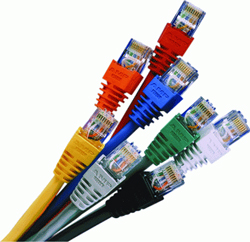
Gigabit Ethernet replaces DS3 and T3 now.Telco’s T1 Line Upgrade
The pioneering work on digital transmission over long distances was done by Bell Labs right after WWII. Their first product was called T-Carrier and consisted of T1 and T3 services that were compatible. T1 lines could replace 24 analog phone lines with one multiplexed T1 line.

T1 was designed to run on the same twisted pair copper wires that supplied analog POTS landlines for easy deployment. T3 is an upgrade that ran on coaxial copper lines and microwave towers at 45 Mbps. It can handle 672 voice lines. The protocol that runs on T3, called DS3, can also be carried on SONET fiber optic circuits. When the Internet arrived, both T1 and DS3 were offered in clear channel versions to carry packetized data. T1 runs at 1.5 Mbps. DS3 or T3 runs at 45 Mbps.

Carrier Ethernet over Fiber Takes Over
Computer generated data far exceeds telephone traffic these days. The near ubiquitous standard is Ethernet on the LAN running the Internet Protocol or IP. With T1 or DS3, you need to do a protocol conversion at each end to go from the computer standard to the telephone standard and back again. The introduction of Carrier Ethernet keeps everything in one standard, Ethernet, from end to end.

Carrier Ethernet has been deployed in two versions. The slower version is Ethernet over Copper or EoC. This is a direct replacement for T1 lines and fractional DS3 service and runs from about 1 Mbps to 20 Mbps or so depending on the length of the circuit. The key feature is that it uses the same twisted pair wiring as T1 line or analog phone lines.

The faster version of Carrier Ethernet is Ethernet over Fiber or EoF. This is the technology that is rapidly taking over the world. EoF gives you end to end Ethernet from about 10 Mbps to 10 Gbps and even 100 Gbps in some areas. As you might expect, Ethernet over Fiber easily replaces T3 lines or DS3 bandwidth over SONET. It also offers the ability to easily upgrade to higher speeds than 45 Mbps any time you want. With a Gigabit Ethernet port, you can start off at 50 or 100 Mbps and scale up to 1,000 Mbps with just a phone call or click of a mouse online. There is no need to change out equipment. Only the speed of the line and your monthly billing will change.

The other big advantage of Carrier Ethernet, and some say the most important one, is the cost reduction compared to traditional telco services. You can get EoF service at DS3 bandwidth speeds of 50 Mbps for a fraction of what you would pay for actual DS3 over SONET. 100 Mbps, 1000 Mbps and 10,000 Mbps are suddenly affordable when you upgrade to Ethernet over Fiber.

Wireless is Fiber Without the Fiber
There are situations where fiber just doesn’t work despite all its advantages. One is is rural or remote areas that haven’t been wired, perhaps not even for telephone. The other is in dense urban areas where fiber has yet to be installed. The cost of construction is astronomical in both situations but that doesn’t mean you are out of luck. Just skip the fiber or wires completely.

Point to point microwave was a staple of telephone long haul. Microwave relay towers would retransmit the phone calls every 30 miles or so. Microwave is still applicable on a smaller scale over reasonable distances. In downtown business districts a dish on the roof pointed at the provider's antenna a few blocks away can give you Gigabit level bandwidth with very little construction cost. it’s also fast to install compared with pulling cables under the street.

In more rural areas, a WISP or Wireless internet Service Provider gives similar service usually at somewhat lower bandwidth levels, but similar to DS3 or better. Customers point their antennas at the service tower which can be miles away, but in a direct line of sight.

Another popular arrangement is to take advantage of the fact that every cell tower is also transmitting Internet traffic for smartphones. 4G LTE is commonly available and can give you the performance of fractional DS3 at least on download. Many smaller businesses can get all the performance they need from 4G without any of the wiring headaches. This is especially valuable for mobile or pop-up stores and individual entrepreneurs. Now that 5G is well into deployment, cellular can easily replace DS3 and higher speeds.

One thing to be aware of with wireless services, especially cellular, is that there are usage limits to most plans. That’s because the system can handle less traffic than fiber and the bandwidth must be shared fairly among users. Even so, if you can get 300 GB per month plans and pay much less than DS3 or even a T1 line, wireless can make a lot of sense.

Cable Broadband Can Mimic Fiber
The old Cable TV networks have been vastly upgraded and are now mostly run on fiber. It’s just that last link into your building that is run with coaxial cable. The protocols have also been upgraded along with the switch from analog to digital television. DOCSIS 3.0 and 3.1 offer high speed performance at bargain prices. You might be surprised to know that DOCSIS 3.0 can support bandwidth up to 1 Gbps download and 200 Mbps upload. The newer DOCSIS 3.1 standard is good to 10 Gbps download and 1 to 2 Gbps upload. When DOCSIS 4.0 is deployed, that upstream capacity will increase to 6 Gbps.

Cable broadband is extremely popular with residential users and many businesses. You just can’t beat the pricing. The only limitations are that cable isn’t available in many rural areas and the bandwidth is multiplexed or shared among many users. Thus speeds can vary. Like wireless, there is a large difference between download speeds and upload speeds. Uploading is typically a tenth or less the speed of downloads. That reflects the way Internet traffic usually flows. In many cases, this may make no difference to your operation, but it you need very high upload and download speeds and dedicated bandwidth, especially for cloud services, you may need fiber optic service through cable companies or other competitive fiber network providers.

Do you still have an old DS3 or T3 contract or simply need high performance, low cost bandwidth in the 50 Mbps or above range? If so, discover what Gigabit Ethernet services are available for your business.


Click to check pricing and features or get support from a Telarus product specialist.


Follow Telexplainer on Twitter


Wednesday, July 22, 2015

Backing Up Broadband

By: John Shepler

In the last couple of decades, broadband Internet access has gone from being a marginally used business tool to a critical infrastructure for most companies. Both speeds and traffic have increased by orders of magnitude. So, answer this question: “what happens if your broadband goes down?”

If you think that Ethernet makes the world go round, you might just be right. Find products with this design nowWe’ve Quietly Become Dependent
The conversion from traditional to automated business processes and digital communications have taken place so gradually that many companies don’t quite realize what would happen if it all suddenly went dead. You know what happens if you lose power. That facility is temporarily out of business. You know what happens if your data center loses power. Your computer-based processes are out of business. If that’s not acceptable, then what have you done to ensure continuing operations?

The Danger of Single Point Failures
What is the communications equivalent of battery and diesel generator backup for electrical power? It’s one or more redundant communications paths. If you have a single broadband line powering your network, you have what’s known as a “single point failure”. That’s one place where a failure of any sort puts you out of business. You can have all sorts of extra computers, printers, servers, battery backup and people cross-trained to take over whatever is a priority task regardless of who gets sick. It’s all for naught if yours is an online business and there is no way you and your customers can connect.

Start With the Best Line You Can Get
There are broadband services and then there are broadband services. They really break down into two categories. There are telecom services designed for high reliability and often available with service level agreements, a type of performance guarantee. Then there are “best effort” services designed for low cost and no performance guarantees. Which do you suppose is best for your critical operations?

Telecom based services, such as T1, DS3, SONET, Ethernet over Copper and Ethernet over Fiber are examples of dedicated high reliability services. So are MPLS networks if you want to create a private “Intranet” among your own facilities. DSL, Cable, Cellular and other broadband services popular with consumers generally fall into the “best effort” category. Best effort means just that. The carrier will make their best effort to keep you up and running, but there is no guarantee of what that will wind up being.

The Need For Redundancy
Even the best technology can go awry. Amplifiers short out, backhoes cut through copper and fiber cables with alarming regularity, and technicians make mistakes, perhaps disconnecting your circuit instead of the one they intended. Accidents will, indeed, happen, but that doesn’t mean your business has to be the victim.

One tried and true way to protect yourself from equipment failure is to have a backup in place. If one fiber optic line is good, two are better… with some caveats. Redundant lines really need to be independent. Ideally, you want to get them from different carriers who run them in different cable bundles that even leave your facility in different directions.

I remember a few years ago when our Cable company had one of those backhoe mishaps. It took two days to get TV and broadband restored because they had to splice over 100 fiber strands to complete the repair. You could have leased ten of those strands to make your connection redundant and you would have lost everything in one big chop.

Can Cable Backup Fiber?
Business cable broadband can actually be a very good way to get redundancy into your communications without doubling the budget. Cable services have gotten a lot more reliable since they switched from large coaxial trunks to fiber optic runs to the curb or neighborhood.

The DOCSIS 3 standard, that is now almost universal, offers bandwidth capability in the hundreds of Mbps, even up to 1 Gbps in some locations. The cost per Mbps is just a fraction of what you’d pay for Ethernet over Fiber or legacy SONET. That’s because cable service is, indeed, “best effort”, the bandwidth is shared, not dedicated, and the bandwidth is asymmetrical. That is, download speeds are much higher than upload speeds.

Taking all that into account, you may sleep a lot better at night knowing that if your premium dedicated fiber takes a hit, you can continue operations uninterrupted with broadband cable that is unrelated to your main service. You simply need a way to ensure automatic failover so that your employees and customers won’t see a service interruption.

Other Options
Some companies are quite happy to have T1 lines, Ethernet over Copper, two-way satellite, or even 4G LTE wireless as backup services for their main channel. Any channel that is completely independent is a good backup candidate. The only real limitation to any of these is the amount of bandwidth available and latency low enough not to impact what you are doing with the broadband connection.

Are you feeling that a single high capacity line is leaving you vulnerable to a service interruption? Why not look into an affordable broadband backup service for peace of mind?

Click to check pricing and features or get support from a Telarus product specialist.


Note: Products with the theme "Ethernet Cables Earth" shown on this page are available through the Gigapacket Zazzle Store.


Follow Telexplainer on Twitter

Monday, June 16, 2014

WAN Network Connections From Copper to Fiber

By: John Shepler

LAN, MAN and WAN speeds continue to rise as content demands more and more bandwidth. This is increasing pressure on both copper and fiber based telecommunication networks for more frequent speed upgrades. Let’s take a look at what the options are for both traditional TDM (Time division Multiplexing) and IP (Internet Protocol) networks.

Discover your copper and fiber bandwidth options.The Legacy of Copper Telecom Lines
Copper has been the mainstay of electronic communications, starting with the telegraph and then the telephone networks. The telegraph, of course, is long gone. The telephone is undergoing a technology shift where voice is becoming a converged network service. With the implementation of 4G LTE wireless, even cellular phone will soon move away from voice only channels to integration with data.

Clearly, analog POTS (Plain Old Telephone Service) is in its twilight years. What will remain for decades to come is its installed base of twisted pair copper lines that connect to nearly every building, commercial and residential. That copper still has value because it can transport digital signals as well as analog.

Digital T1 Lines
The oldest digital protocol for data transmission on twisted pair copper (not including telegraph) is still going strong. It’s the T1 line used for telephone trunking, point to point data, and dedicated Internet connections. T1’s history is that it was developed to transport multiple phone conversations digitally using existing telephone cabling. T1 can transport service over wide areas using signal regenerators to clean up the signal every 6,000 ft. You can get T1 nearly anywhere you can get landline phone service. The one limitation is its 1.5 Mbps bandwidth.

While 1.5 Mbps used to be considered broadband, it’s no longer adequate except for PBX telephony, casual Web access, email and point of sale credit card verification. This bandwidth is similar to 3G wireless. Wireless is rapidly moving to 4G wireless, with speeds an order of magnitude higher. Wired services are also moving to 10 or 15 Mbps as a minimal requirement.

Bonding T1 Lines & Ethernet over Copper
T1 is enjoying continued usefulness by bonding the bandwidth of multiple T1 lines to make one larger service level. This is practical up to 10 or 12 Mbps, but gets too expensive and hard to find available bundles of unused copper pair above that. What’s needed is a different technology that gets more bandwidth out of the same copper.

That technology is now available and called Ethernet over Copper or EoC. Ethernet is a departure from T1 in the way the bits are organized on the line, but serves the same purpose. It uses exactly the same copper pair cabling with multiple pairs bonded to increase bandwidth. The differences are that EoC is available in increments from about 3 to 45 Mbps and it is distance limited. Near the central offices, high speeds are available. A few miles away there may be no EoC service at all. In between, there are different service levels possible.

There have been some major advances in transmission of data over copper pair wiring, with some installations supporting bandwidths as high as 100 or 200 Mbps. These are uncommon. Another copper technology, Cable broadband using coaxial copper cables and a modulation scheme called DOCSIS 3, can reliably deliver 100 Mbps or more bandwidth. Even 1 Gbps is not unheard of, although not that widely available. Another service called DS3 or T3 offers 45 Mbps over a pair of coaxial lines where available.

Fiber Optic Services for Unlimited Bandwidth
What really gets the job done at higher bandwidths is fiber optic cabling. Fiber bandwidth is nearly unlimited, especially when wavelengths are bonded to create very large services. Like, copper, fiber also has a legacy history and a newer technical approach.

Traditional fiber optic service is based on a telephony standard called SONET (Synchronous Optical NETwork). Familiar service levels are OC-3 at 155 Mbps, OC-12 at 622 Mbps and OC-48 at 2.4 Gbps. Higher levels include 10 Gbps and 40 Gbps.

Ethernet over Fiber (EoF) is a Carrier Ethernet service like EoC, but using fiber rather than copper transmission. Fiber Ethernet is highly cost competitive and readily available from 10 Mbps on up to 10 Gbps. Today’s most popular service levels are 100 Mbps Fast Ethernet and 1,000 Mbps Gigabit Ethernet (GigE). In some areas, 100 Gbps service is available to businesses.

Wavelengths Options
Fiber enjoys another advantage over copper in that it supports multiple 10 Gbps wavelengths through a process called WDM or Wavelength Division Multiplexing. This means you can run different protocols on completely separate wavelengths within the same fiber strand. This provides a high degree of flexibility for financial institutions and others with demanding applications.

As you can see, there are a wide variety of options on both copper and fiber transmissionall currently available. What works best for your organization is a function of application requirements, scale and budget. You’ll likely have multiple technologies and multiple vendors to choose from.

Click to check pricing and features or get support from a Telarus product specialist.


Follow Telexplainer on Twitter

Monday, March 17, 2014

Your 50 Mbps WAN Bandwidth Options

By: John Shepler

The 50 Mbps bandwidth level has become very popular lately because of business requirements for cloud services, remote data center access, big data files, ecommerce, high resolution image transfer and video content distribution. You should know that there are several options to acquire 50 Mbps bandwidth connectivity. Let’s take a look at the advantages and limitations of each.


DS3 & T3
The classic telecom service at this level is DS3, also known as T3. It was developed by the telephone companies to transport large numbers of simultaneous calls between switching centers. DS3 actually runs at 45, not 50 Mbps, but this is close enough for many applications. DS3 is a time synchronous channel technology, not packet based. Therefore you need a DS3 interface module for your router. You may also acquire a managed router provided by your service provider to take care of this protocol conversion.

Copper / Fiber Hybrid
DS3 is actually a hybrid fiber & copper technology. It is delivered to the curb over fiber optic cable and then connected to your equipment using coaxial cables for transmit and receive. The same fiber optic cables that pass your location can also deliver true fiber bandwidth at the OC3 level. In fact DS3 likely rides as one signal on an OC3 carrier.

OC3 Fiber Optic
If you want the entire OC3 service, it runs at 155 Mbps, the equivalent of 3 DS3’s plus overhead. Some carriers will install OC3 but rate limit the bandwidth to 45 or 50 Mbps. If you don’t need more bandwidth than this, there are some cost savings involved. You may also have the option to upgrade to the full OC3 capability when you need it.

Carrier Ethernet
The new competitor to OC3 is Carrier Ethernet. This is an extension of the Ethernet that runs on your company network but scaled up for long distance transmission. The interface with your equipment is easy. You simply plug into an Ethernet connector installed by the service provider. Carrier Ethernet can be provided over twisted pair copper telco wiring or fiber optic cable. While it is possible to transmit 50 Mbps Ethernet over copper for limited distances, it is far more likely that you’ll have this service delivered over fiber.

DS3, OC3 & Ethernet Compared
Let’s compare DS3, OC3 and Ethernet over Fiber. All three will give you 45 to 50 Mbps in dedicated, symmetrical bandwidth. All three are highly reliable and come with service level agreements. DS3 and OC3 have been around longer and may be easier to find. Carrier Ethernet is newer, but where available it often has a significant cost advantage. It is also easier to scale Ethernet bandwidth up and down as you need to. Popular Ethernet bandwidths range from 10 Mbps on up to 10 Gbps, with 50 and 100 Mbps now commonly used in business.

The Cable Broadband Alternative
An alternative service called D3 or DOCSIS 3 is provided by cable companies. This is the same technology now used for residential cable broadband. The business version runs on the same cable but has options like static IP addresses and higher priority customer service. The advantage of D3 is that you get a lot of bandwidth for the money. For half what you’d pay for DS3 or Ethernet, you can get 50 Mbps business cable broadband. However this isn’t the same type of bandwidth. The total bandwidth on the cable is shared among many users, so your line speed will constantly vary. It is also asymmetrical, meaning that your download speed may be 50 Mbps, but your upload speed may be limited to 5 Mbps or so. This isn’t a problem for email or Web access, but may not work for other applications. Also, this service is provided on a “best effort” basis with no service level agreements. Availability of this service is limited to locations near the main cable run.

How to Choose?
Which type of bandwidth will work best for your business needs? Get advice and fast quotes on 50 Mbps WAN bandwidth or service from 10 Mbps on up to 10 Gbps and higher, please call toll free (888) 848-8749 or enter your inquiry.

Click to check pricing and features or get support from a Telarus product specialist.


Follow Telexplainer on Twitter