Showing posts with label fiber. Show all posts

Thursday, July 18, 2024

How Fiber Future-Proofs Your Business

By: John Shepler

Chances are that connectivity is not just another expense item in your business. It is critical to your being in business and for your employee productivity. What you need is solid, reliable, fast, low latency and uncongested network connections to the Internet, cloud services, and your other business locations. This is the time to ensure you have it now and in the future.
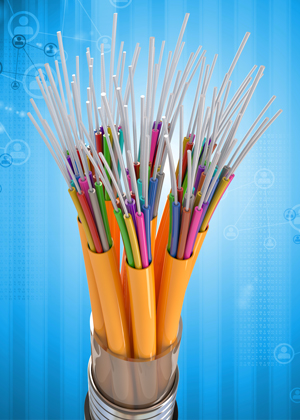
Fiber optic bandwidth for your business.What You Are Looking For Is Fiber
Telecommunications, the genesis of computer to computer connections, was historically built on twisted pair copper wiring. That era is essentially over. The remaining T1 lines and DS3 coax are relics of an earlier day and will soon be moved to the recycling bin. Not only have they been eclipsed in bandwidth, but the infrastructure buildouts now are based on multi-strand fiber optic cables.

Fiber historically has been expensive and rare. That changed with the introduction of Ethernet over Fiber or EOF services directly compatible with today’s most popular computer networks. Fiber optic Ethernet has the widest availability of bandwidths and the lowest cost per Mbps or Gbps. In many areas, fiber is available to just about every business location and in others it soon will be. As you drive down the road you can see crews installing underground fiber conduits in both business and residential areas.

Where Do You Want to Connect?
The most popular connections are to the public Internet. This is a must if you are going to communicate with customers and suppliers. You can also use the Internet to connect to cloud services and link multiple business locations. The beauty of the Internet is that it is already built-out to connect just about everyone, everywhere. This makes worldwide connections fast and inexpensive.

While the Internet itself is a shared network that doesn’t favor one user over another, you can improve your company’s connection by using dedicated instead of shared access. A DIA or Dedicated Internet Access line is a private connection between your business and your Internet Service Provider. It lets you avoid the congestion that can occur when you are sharing access locally with many other business and consumer users.

Dedicated Cloud On-Ramps
Productivity is key to any business. If a key element to your productivity is provided by cloud services, you may be plagued with varying slowdowns and even dropouts caused by a congested Internet not able to keep up with the massive flow of data between you and your cloud provider. The solution is a direct line between your network and your cloud service provider. This is called a cloud connection or cloud on-ramp. It shields you from competition for bandwidth from other users. Such a dedicated leased line can make the cloud server perform like it is right down the hall.

Multiple Locations on the Same Network
Within your building, you have complete control of your LAN that connects terminals, PCs, printers, storage and so on. With multiple locations, you need some way to connect their networks, since they can’t all be on the same LAN… or can they? Dedicated fiber optic bandwidth can go a long way to creating the perception that all of your users, and perhaps some customers and suppliers, are on the same network with the same performance. This is usually done with a central hub and separate links to each location. For vastly separated locations, you can also achieve similar performance with a dedicated link to a MPLS or Multi-Protocol Label Switching network that provides regional, national or international coverage.

How Fast is Fast?
While single Megabits per second was once considered speedy, It doesn’t cut it for most uses today. Even consumers are demanding 300 Mbps, 600 Mbps or even 1 Gbps or more for their Web access and video streaming. Businesses, especially those with cloud services, must have at least this much. Entry level connections of 1 Gbps are now common. As demands increase or business size expands, 10 Gbps is a readily available and affordable service level. Once core network speeds of 100 Gbps are now being offered to businesses in metro areas and will soon be universally available.

How is this possible? Fiber optic strands have nearly unlimited bandwidth capacity. The limitation is often defined by the equipment powering, switching and terminating the strands. Wavelength division multiplexing divides one strand into a dozen or a hundred separate high bandwidth connections. Each cable may have a dozen to a hundred separate fiber strands.

How much low latency high performance bandwidth do you need? You may be surprised to find how much costs have come down the last few years. See now the availability and pricing for fiber optic connections that can grow with your business.


Click to check pricing and features or get support from a Telarus product specialist.


Follow Telexplainer on Twitter


Monday, January 23, 2023

What Replaces DSL, T1, ISDN PRI, EoC?

By: John Shepler

Have you seen recent cost increases for your copper-based telecom services? Did you even get a letter saying that service will be discontinued? This situation will only get worse, as telcos sunset their aging copper wire assets in favor of more modern technologies such as fiber and wireless. It’s time to make a change.

Find copper line network replacements now. The Copper That Isn’t Going Anywhere
The copper that’s in trouble is twisted-pair analog copper telephone lines. They started the electronic communication revolution over a century ago and have run their course from innovation to obsolescence. There is another copper network line, however, that is still going strong. That is cable broadband using coaxial copper cable as a curb to premises connection.

The copper nature of cable services is something of a fooler. The vast majority of the network is fiber optic based. Only the last few hundred feet is the well known RG-6 terminated with an F-type connector. You might think of this wiring as old-school, but with the latest DOCSIS modems, it can easily deliver Gigabit broadband up to 10 Gbps.

Cable companies offer television, broadband and telephone service over the same cable line at a very reasonable cost that is attractive for small businesses, especially those that can use the TV feature for their customer waiting rooms.

Fiber Optic: The New and Improved Copper
The telephone and network industry standard that is replacing twisted pair copper is Ethernet based fiber optic service. The original standard, SONET, is still the backbone of many networks, but has actually transitioned from carrying channelized telephone calls to packet based Ethernet network traffic. Newer networks are all Ethernet, to reflect the standard Ethernet protocol used in the majority of digital networks worldwide.

Ethernet over Fiber has the advantage that it plugs directly into company routers and is vastly scalable, from 10 Mbps to 10 Gbps just about everywhere, and up to 100 Gbps in many metro locations. Fiber takes over from copper data services, include DSL, T1, DS3 and even the newer Ethernet over Copper. EoC was meant to provide higher bandwidth using the same twisted-pair infrastructure, but is falling victim to the decommissioning of the copper bundles themselves.

Business telephone, which standardized its own analog and digital networks, is largely switching to a computer networking standard of Voice over IP or VoIP. This offers the benefit of supporting many newer technology features and allows computers and phones to share the same company Local Area Network.

To make VoIP work, your phones need to connect to the Public Switched Telephone Network to make and receive outside calls. This is done using a standard called SIP or Session Initiated Protocol that runs on the network and connects to your phone service provider over an Ethernet WAN connection, using fiber. Both the Internet and direct connections can be employed. SIP trunks replace analog phone lines and ISDN PRI trunks to carry telephone traffic to the PSTN.

The Special Case of POTS Replacement
In many cases, the move to fiber optic private line and Dedicated Internet Access will handle business needs for voice, video and data traffic. There are special cases of FAX, fire alarms, burglar alarms, elevator phones, analog point of sale systems and some others that are specifically designed to phone company standards and don’t work well on packet based networks, such as the Internet.

For these uses, you may want to look into specialized POTS (Plain Old Telephone Service) replacement options. These usually work wirelessly through private connections to the LTE cellular phone network and don’t traverse the Internet at all. An advantage of POTS replacement equipment is that it connects directly to the systems you already have.

Fixed Wireless Where There Is No Fiber
The day may come where fiber is everywhere, but today were are still in the build-out phase. Fiber is going into the ground at a rapid pace, but in more rural locations are still waiting for access. Even metro areas that don’t have lit fiber installed may be faced with huge construction costs to connect to the fiber access points.

The alternative is to skip the fiber but get high speed Ethernet bandwidth using Fixed Wireless Access. FWA is similar to cellular broadband but is intended to connect to in-house networks rather than cell phones. In fact, the major cellular companies are in competition to offer 5G Fixed Wireless broadband service to both residential and commercial users.

Other wireless companies, often called WISPs for Wireless Internet Service Providers, don’t handle cell traffic but have towers that serve a limited area with wireless Internet access.

Other microwave-based FWA providers focus on business customers with high bandwidths that can reach 10 Gbps. This can be private line as well and Internet service. An advantage to business FWA is that a small dish or other antenna can be installed on your building for reliable operation and service can get started in days rather than weeks or months for fiber construction.

Are you facing a loss of your traditional DSL, T1, ISDN PRI, EoC or analog telephone service and need replacement soon? If so, you may have an opportunity to upgrade your service and save money at the same time. Check out telephone and network replacement options now.

Click to check pricing and features or get support from a Telarus product specialist.


Follow Telexplainer on Twitter


Wednesday, January 19, 2022

Fixed Wireless As Fiber Backup

By: John Shepler

You need large amounts of rock solid bandwidth to enable your business systems, including telephone, conferencing and business process software in the cloud. Normally, that says fiber optic connectivity. But what if that fiber gets cut (it happens) or just can’t be installed soon enough or the construction is just too expensive? Then what? If you happen to be located in the right areas, fixed wireless can be your best solution.

Take a look at fixed wireless microwave as a backup or substitute for fiber optic connectivity.What is Fixed Wireless?
Cell phones have brought mobility to all of us, including having both a phone and a small computer in our pockets. This is wireless mobility. Each device has a modem and radio that communicates with the nearest cell tower. As you move, the session keeps getting handed off to the next towers as you get closer to them. All of this is imperceptible to you, the user. The complexities of handling mobile signals is hidden in the cellular network.

Perhaps you’ve tethered your phone to your PC to keep working when your cable or landline Internet service was interrupted. That’s an example of fixed wireless. It’s the same as mobile wireless, but you’re not moving.

Cellular Fixed Wireless
Ideally, you’d like to tether your entire network to your phone during an outage rather than just one PC. Some phones allow this by acting as WiFI hotspots. In a small business, you may find this work-around to be just fine for short periods of time. Not being able to walk away with your phone can be a real inconvenience. Running out of minutes and getting cut off or big overage charges can be an even bigger inconvenience.

Fortunately, there are fixed cellular services designed for exactly this use. The box you receive looks something like a Wi-Fi router. It has better antennas than your phone, an Ethernet jack to feed your network, and, perhaps, built in WiFi routing. Some have provisions for mounting an antenna outside in weak signal areas.

Best of all, fixed cellular wireless services for business know that you can’t get by with a few Gigabytes a month. You can order 100 GB and more, even unlimited (within reason) usage. Services include 4G LTE and, now, 5G to give you the speed you need to run your business.

Microwave Fixed Wireless
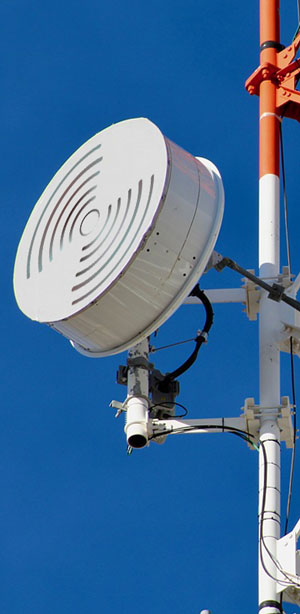
The big brother to cellular is point to point microwave fixed wireless. This is a modern version of the old telco point to point microwave relay. You get a small dish or other microwave antenna that attaches to the side of your building or sits on the roof. It points directly at the provider’s antenna at their central location. This is a line of sight service and generally limited to metropolitan areas.

A major advantages of this type of service is that it is private and dedicated to business use. You won’t be competing with everybody else’s cell phones for bandwidth. The bandwidths can be as high as 1 Gbps or even 10 Gbps. They can also be symmetrical, unlike cellular. With many services your upload and download speeds are the same and your bandwidth is guaranteed. Usage limits? Not usually an issue.

You might even think of microwave fixed wireless as fiber optic without the fiber. Ditching the physical fiber means fewer construction headaches and delays. It is possible that you can have service installed in as little as a few days compared with weeks or months if your building isn’t already lit for fiber.

An unexpected benefit is that fixed wireless can have lower latencies than fiber services with the same bandwidth. That’s because the wireless signal is a direct beam from provider to you. Fiber systems tend to weave all over town with lots of switching gear in the path. Lower latency is critical to some businesses, especially in financial trading. It’s a boon for improving the quality of VoIP phone calls and video conferencing, and for interactive processes running in the cloud.

Cellular broadband uses the Internet and whatever latencies and congestion exist. Fixed Wireless can avoid the Internet and its limitations, or be connected to the Internet so that you can easily connect to customers and suppliers.

Why Not The Best of Both Fiber and Wireless?
Perhaps the best arrangement for your business is a combination of fiber optic service and fixed wireless service. Why both? One reason is to get service started fast with fixed wireless and then add fiber when you can get it installed.

Once you have both running, consider keeping your fixed wireless as a backup to the fiber. Fiber interruptions, often caused by the cable being cut during unrelated construction work, can take days to repair, leaving you high and dry. With automatic failover installed, your traffic will simply move to the wireless link without interruption. When the fiber comes back online, the system will switch back.

Note that fixed wireless offers a true diversity path to fiber. That means fiber and wireless are very unlikely to exhibit failures at the same time. Some businesses think they have this in place by ordering redundant fiber lines or even fiber services from two separate providers. What they don’t realize is that all the fiber serving their location runs in the same bundle or conduit and can all be taken out at the same time by one accident.

Do you need fast installation of high speed business connectivity and/or a robust backup to the fiber you already have? Consider microwave fixed wireless service for your bandwidth needs.

Click to check pricing and features or get support from a Telarus product specialist.


Follow Telexplainer on Twitter


Tuesday, May 25, 2021

When You Need Massive Bandwidth

By: John Shepler

Most businesses do just fine with common bandwidth offerings from telco, cable and fiber service providers. Sometimes, though, your application just won’t squeeze through the pipe. You need more than typical WAN bandwidth. You need massive bandwidth.

Find massive bandwidth for your big data. How Massive Are We Talking?
Over the last few decades, mirroring the growth of the Internet, WAN bandwidth needs have multiplied from a paltry T1 level of 1.5 Mbps up to 10 or 20 Mbps for the smaller businesses, at least 100 Mbps for companies with many employees, to a now commonly expected Gigabit per second.

Those bandwidths levels are easily accommodated by most service providers. Copper twisted pair can bring in 20 Mbps or so. Cable broadband is good for at least 100 Mbps and pushing 1 Gbps in many areas. Fiber optic service easily delivers 1 or 2 Gbps and can readily scale to 10 Gbps. Where you might find yourself limited is in rural or underserved locations where your choice is still T1 lines, LTE or 5G wireless, or synchronous satellite broadband.

Massive bandwidth starts at 10 Gbps and goes up from there. Can you reasonably take advantage of 100 Gbps up and down? OK. How about 400 Gbps, 800 Gbps or even a full Terabit per second? Those are carrier level services, but not out of the realm of possibility for the most data or streaming intensive businesses.

Who On Earth Needs THAT Much Bandwidth?
What were absurd levels of bandwidth are now aspirational and may become common sooner than you think. One big driver is the move of everything digital to the cloud. When your data center was just down the hall, nobody worried about bandwidth. You can string as much fiber as you want above the ceiling tiles. Once you pay for installation, usage is pretty much free.

Not so much anymore. When the connection leaves your building you lose control. You’re not going to string any cable across town, much less across several states. For that you need to hand off your traffic to a carrier or service provider. This third party will then lease you the amount of bandwidth you need, or at least can afford, for a monthly fee. The carrier, not you, takes care of all maintenance and reliability between locations.

Some companies get a surprise when they realize that the 30 Mbps Internet connection that was more than adequate when the data center was on premises is now painfully slow when all the applications are in the cloud. One solution is to install a high speed direct line to the cloud service provider and keep the old Internet connection as-is. That solves the bandwidth problem and avoids business critical apps having to deal with the vagaries of Internet performance.

Another application that just won’t play on standard connectivity is content distribution. If you are sending massive amounts of content consistently, you may need to avoid the standard Internet and move over to a purpose built privately run network called a content delivery network. These are designed to handle continuously high levels of video or data without congestion.

Sometimes you only need massive data for a brief time. Say you have Terabytes of disk drives full to the brim and you want to send that to the cloud for safe keeping or to a customer who needs those design or simulation models on their system. Shoving it through a normal connection will take forever. Is there a better option?

Colocation and Cloud Data Centers
If there is one place that you’ll find massive bandwidth already installed and running, it is in cloud and colo centers. Both are massive facilities with nearly unlimited servers, disk drives and bandwidth connections from multiple carriers. The difference between cloud and colo is that cloud centers provide all of the equipment and service needed. A colo or colocation facility lets you bring in your own equipment and set up your own data center in their racks and cages. It’s like what you would have at home, but in a shared building with plenty of space, backup power, HVAC, security and even round the clock staffing.

Some colos will provide a direct fiber hookup between your company and any others located in the same facility. if you need to connect outside, you won’t have to worry about finding a service provider or paying hefty fees to bring in service from afar. They are already inside and serving other customers. You just get a hookup at whatever bandwidth you need.

More Exotic Massive Bandwidth Options
There really is no limit to how much bandwidth you can utilize these days, other than your budget. If you can afford it, consider these options:

Wavelength Services
Most fibers are now lit with DWDM or dense wavelength division multiplexing. That means multiple lasers feeding the same fiber, but on different frequencies or wavelengths. A wavelength can handle perhaps 10 Gbps and each fiber strand can handle perhaps 100 wavelengths. Combine them all and the total bandwidth is mind boggling.

Many carriers are now leasing entire wavelengths for your use. It’s like a fiber within a fiber. Some will combine multiple wavelengths to create 100 Gbps and higher bandwidths for you, or you can lease the wavelengths and multiplex them yourself.

Dark Fiber
The ultimate in bandwidth and control is had by leasing one or more dark fiber strands. Dark means that the fiber is in the cable but totally unused at present. You add the laser termination and multiplexing equipment at each end and “light” the fiber.

Dark fiber is as close to having your own in-house cabling as you can get outdoors. There is nobody else’s traffic to contend with. You decide how much capacity to press into service. Run out of bandwidth? Just upgrade your terminal equipment. Same fiber, more Gbps. You don’t have total control. The carrier still owns and maintains the fiber physical plant, including cabling and repeaters. The rest is up to you.

Are you feeling unduly restricted when it comes to bandwidth to efficiently run your business and take advantage of new opportunities? If so, look into higher bandwidth fiber optic services now. You may find them more affordable than you think.

Click to check pricing and features or get support from a Telarus product specialist.


Follow Telexplainer on Twitter


Tuesday, May 21, 2019

20/20 Mbps Speed on Copper and Fiber

By: John Shepler


Business broadband bandwidth requirements have been on a steady slope upward. Some of this is the change from mostly text based information to graphical and video content. More is due to moving business processes from local desktop computers and company servers to cloud providers. Simple T1 lines and other low speed connections are no longer adequate. Entry level WAN (Wide Area Network) speeds, including Internet broadband, are now in the tens of Megabits per second.

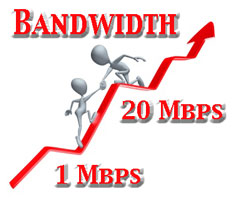
Moving up to 20/20 Mbps bandwidthA popular service level for smaller businesses and remote workers is 20/20 Mbps. This is fast enough to support a single user, small team or small retail location while still being very affordable. Let’s take a look at the options available.

What is 20/20 Mbps?
The term 20/20 Mbps means 20 Mbps bandwidth in both directions. That’s 20 Mbps upload and 20 Mbps download. When the upload and download speeds are the same, the connection is said to be symmetrical. It makes no difference if you are watching a video clip or backing up files to cloud storage, the bandwidth is the same. In fact, if the connection is full-duplex, as most business grade lines are, you can be downloading and uploading at the same time without slowing down.

Wireline Connections
The 20 Mbps line speed, or bandwidth, is way beyond the capability of a T1 line that runs flat out at 1.5 Mbps. It’s also too much to achieve by bonding multiple T1 lines together. Does that mean that delivery over standard multi-pair telco lines is impossible? Not at all. Newer technology called Ethernet over Copper (EoC) can easily deliver that speed and perhaps even more provided that your business location is close enough to the telephone company office.

Telephone companies own all that twisted pair copper that connects telephone desk sets. The same bundles can carry T1 service and the newer Ethernet over Copper. Regardless of which service provider offers you the EoC service, it will come in on those telco lines. So, the phone company has to have the right termination equipment and you need to be within a couple of miles or so of the office. In populous areas, that’s generally the case.

Fiber Optic Connections
The whole world is converting to fiber at a rapid pace. One of the main drivers is the need for high bandwidth to cellular towers to support 4G and 5G broadband services. The other driver is the ever higher bandwidth requirements of business as cloud services expand.

Fiber is the gold standard of bandwidth connectivity. If you have a fiber optic line installed to your business location, you’ve pretty much future-proofed your business. It’s almost impossible to need more bandwidth than the fiber can support. Even if that happened, there are usually many fiber strands within a fiber optic cable.

Ethernet over Fiber (EoF) is the upgrade to EoC. You can get 20/20 Mbps dedicated, symmetrical bandwidth at a very reasonable price anywhere that fiber is available. Dedicated means that it is for your use only and the line speed doesn’t vary. Both EoF and EoC are dedicated services, although other types of bandwidth might not be.

Another advantage of Ethernet over Fiber is that it is easily scalable. That means that if you get 20/20 Mbps service now and in a few years need to move up to, say 50/50 Mbps because of a growing business, that can be done with a simple phone call to your provider and likely no equipment changes. Some carriers even offer user control panels that let you change bandwidth levels at will.

How about Cable, Satellite and Wireless?
Cable, Satellite and Wireless services have evolved to offer 20/20 Mbps bandwidth and beyond. These services may be less expensive that EoC or EoF, but they are likely to be shared, not dedicated bandwidth and asymmetrical (different upload and download speeds) rather than symmetrical. Satellite and Wireless tend to have some usage limits due to limited resources. In some locations you can get dedicated symmetrical microwave delivery that offers similar performance to EoC or EoF but without the wires.

Are you ready for a bandwidth upgrade but unsure what is the best option for your business? Our knowledgeable consultants can give you good advice and get you the best price on the service you need. Find business bandwidth options over copper, fiber, cable, satellite and wireless now.

Click to check pricing and features or get support from a Telarus product specialist.


Follow Telexplainer on Twitter

Tuesday, April 09, 2019

Can SD-WAN Solve Your Low Bandwidth Problem?

By: John Shepler

Can SDN or SD-WAN solve your low and unreliable bandwidth problem? Hey, you can probably solve your bandwidth problems right now by upgrading to a dedicated higher bandwidth service with a service level agreement, such as Ethernet over Fiber from a top-tier carrier. A better question is how can SD-WAN give you faster and better bandwidth at a more affordable price point?

WAN Man Coffee Mug. Get yours here...The Cause of Low & Unreliable Bandwidth
Companies with bandwidth woes generally fall into one of two categories. The first is being stuck with bargain basement options because of very limited budgets. The other is being frustrated because the service needed isn’t available in that particular location at any cost.

The really low cost options tend to be broadband services that were designed for the cost sensitive consumer market and then re-branded for business. These include DSL and cable broadband certainly, but may also include cellular wireless and some two-way satellite.

What these services have in common is that the bandwidth pool is shared among however many users are online at the moment. That makes your speed fluctuate during the day. They also tend to be Internet only. If you want point to point you have to set up an encrypted tunnel with VPN or take your chances on security. Finally, they tend to be offered as “best effort” information services with no uptime or performance guarantees.

Are All Non-Telecom Regulated Services Low Quality?
No. That’s unfair and untrue. Cable speed and performance has grown by leaps and bounds, especially since the introduction of DOCSIS 3.0 and now 3.1. You can get fiber speeds at bargain prices in most populated areas. Reliability tends to depend on the local service provider. Some have almost perfect uptime. Others are less dependable.

Likewise, cellular wireless and satellite have experienced technology upgrades over the years. Both suffered from low bandwidth, congestion and spotty service. That’s not much of a problem anymore. With 4G and now 5G wireless, fiber-like bandwidths are becoming commonplace with solid service. Satellite, too, is now 100 Mbps nationwide with gigabit service on the way. Spot beams provide highly reliable fade margins.

Both cellular and satellite do have limitations, however, Satellite has a latency issue that won’t be overcome until the Low Earth Orbit constellations are in place. Both services are bandwidth limited by the amount of spectrum available, so there is only so much to go around. That means data limits to keep some users from hogging the scarce resources. If you hit the limit, you either pay more or have your bandwidth throttled for the remainder of the month.

Just What Can SD-WAN Do About These Limitations?
SD-WAN or Software Defined Wide Area Network, part of the Software Defined Network (SDN) technologies, can’t change the laws of physics, provider unreliability, or service availability. What it can do is manage a collection of limited performance bandwidth options to create a single higher performing network.

This works because not every connection you have will have the same latency, packet loss, speed or reliability. Besides the inherent differences in technology, performance often varies moment to moment. Sometimes the cable runs blindingly fast. Sometimes it’s all clogged up. Same with wireless, satellite and even DSL.

No human can sit there with a switch and direct traffic fast enough to send each packet down the best or most appropriate path by the instant. A computer can. That’s what SD-WAN is all about. A processor running software monitors multiple links. It then follows a plan for where to route traffic and it keeps track of it all.

The Other SD-WAN Secret
Another thing that makes SD-WAN effective is that not all traffic is equally demanding. VoIP voice calls are extremely sensitive to latency and packet loss. Data file backups aren’t. Many cloud based business applications need high performance all the time. Some aren’t all that fussy. With that in mind, a SD-WAN controller can see what demands there are for service, what paths are available and with what instantaneous performances. It can pick and choose where to route traffic for the most optimum use of the resources you have provided.

Your choice of SD-WAN links might include DSL, cable, T1 lines, satellite, 4G or 5G wireless, point to point microwave, Ethernet over Copper or Ethernet over Fiber, and even SONET fiber optic lines. The right mix depends on what performance you must have, what connections are available and your budget for bandwidth.

Are you struggling to do business because your current bandwidth solution just isn’t getting the job done? You should know that you have more options now than ever before, especially since SD-WAN became available. Tell a network bandwidth consultant about your particular business needs and see if you can do a lot better than what you are living with now.

Click to check pricing and features or get support from a Telarus product specialist.


Follow Telexplainer on Twitter

Business products with the WAN Man theme are available through our Zazzle Gigapackets store.

Monday, August 20, 2018

Gigabit Internet Speed Is Easy to Find

By: John Shepler

It’s almost breathtaking how fast Internet bandwidth needs have mushroomed. Just yesterday 10 Mbps was considered high speed broadband. Today it’s more like 100 Mbps for even medium size offices. If your businesses is involved in video production, heavy use of cloud applications, software delivery or has lots of employees or customers, Gigabit Internet speeds are no longer a luxury. Fortunately, they’re easy to come by.

I definitely need more bandwidth - products with this theme, find here.#1 Choice: Ethernet over Fiber
The beauty of fiber is that it is future proof. The fiber in the ground today will support the bandwidths of tomorrow. 1 Gbps today. 10 Gbps next year. Perhaps 100 Gbps in the coming years.

The preferred technology is Ethernet over Fiber. This is the same Ethernet that you run now on your local area network. Most NICs (Network Interface Card) are 10/100/1000 Mbps. With CAT5E or CAT6 wiring and Gigabit switches, you are perfectly matched to access the Internet as fast as your network will run.

Ethernet over Fiber replaces SONET, an older technology that requires specific interfaces for different service levels. Ethernet over Fiber is different. Your LAN supports equipment running at different speeds. So do Ethernet Internet connections. More importantly, you can install fiber with an Gigabit Ethernet edge router and order any speed service you want. Typical service levels vary from 10 Mbps to 1 Gbps. You pay less for lower speed service if you don’t need the full GigE bandwidth. When you do, upgrading is just a phone call or control panel adjustment away.

The Lower Cost Option: Cable Broadband
Cable has come a long way from its early days of low speeds and spotty performance. That’s thanks to the deployment of HFC (Hybrid Fiber Cable) systems that have fiber optic cabling for the core of the network. Only the drop to your building is still coaxial cable. The other big improvement has been the development of DOCSIS 3.0 modems good to 1 Gbps and the newer DOCSIS 3.1 modems good to 10 Gbps.

With cable broadband capable of 10 Gbps performance, what’s the incentive to install fiber? In many cases, the real incentive is to stick with cable. It offers the advantages of much lower cost, triple-play options that include broadband, phone and television, and fast installation. As long as your business is near the cable run, you can be hooked up quickly and easily with little or no installation cost.

Cable speeds rival fiber and your connection to the cable modem is standard Ethernet. Yet, the cost per month is a fraction of what you pay for equivalent fiber performance. What’s the catch?

There are some differences in service, which may or may not make any difference to your business. First, cable bandwidth is shared among users, not dedicated to your exclusive use the way fiber is. You may notice that your Internet speed varies throughout the day. Most of the heavy use is for consumer video streaming, though, and that occurs mostly in the evening.

Cable bandwidth is also asymmetrical. In other words, you get 1 Gbps download but perhaps 100 Mbps upload. That matches the needs of most Internet access, but can be a problem if you often transfer large files to other locations or upload large files to servers or cloud applications.

Fiber services may offer the option of point to point connections between business locations. Cable broadband connects you to the Internet. However, you can set up a VPN between locations connected to the Internet and achieve secure point to point connectivity… at a much lower cost than dedicated fiber connections.

Which Gigabit Option to Choose?
it should be noted that many cable companies will now offer you access to their core fiber networks as well as coaxial cable broadband. Cable fiber is the same high performance network as other Ethernet over Fiber providers. That includes bandwidth that is scalable, dedicated and symmetrical. Compare Gigabit bandwidth options and see which service most closely matches your business needs.

Click to check pricing and features or get support from a Telarus product specialist.


Follow Telexplainer on Twitter

Tuesday, August 12, 2008

XO Offering Ethernet to the World

Step right up, telecommunications carriers worldwide. Here's your chance to access 4 million commercial buildings in the United States to offer your services via Ethernet. All this is available to you thanks to the new Ethernet Hub service from XO communications.

"Yaaawwwwn," you say? As a business telecom services user, what do you care what one carrier offers another? Well, there's good reason for you to care. But if, and only if, you are interested in saving money on your voice and data service leases.

I thought that might get your attention. To understand how you may benefit, you need to see what's hidden within the recent XO Ethernet Hub press release. The devilish savings, if I may coin a phrase, are in the details.

XO Communications is what is called a competitive carrier. That means that they were never part of the incumbent local exchange carriers, what's become of the old Bell Telephone system. This is a relatively new telecom carrier, but it's still a billion dollar company with over 4,000 employees. What's more impressive is that their nationwide network is all new technology, with about a million miles of metro fiber, 18,000 miles of fiber between cities, and 75 markets with wireless services available.

That's not the profile of your stodgy old telecom, and it is why XO has something to offer other carriers who look wistfully at the massive Carrier Ethernet presence that XO has established for itself. That presence includes those 4 million commercial buildings, each reachable for Ethernet service.

Ethernet WAN service, also called Carrier Ethernet or Metro Ethernet, offers a way to extend your corporate network across town or across the country with a minimum of technical fuss and bother. It uses the familiar Ethernet protocol that you're already proficient with. Ethernet service prices are exceptionally low because there are no legacy telcos providing the "last mile" access the way you expect when ordering SONET or T-Carrier voice and data services.

XO's Ethernet bandwidth options range from 5 Mbps all the way up to 10 Gbps. The higher bandwidth options require fiber optic terminations, but it's possible to get lower tier speeds delivered via EoC or Ethernet over Copper. If fiber construction costs are too high and you are located within a couple miles of a XO Point of Presence, EoC can connect you to their network using the already-installed copper pairs that terminate in your building.

Now you've got an idea why XO Communications is perfectly suited to be your next service provider. The next step is to check out typical Ethernet service pricing and find out what bandwidth and costs savings are available for your business.


Click to check pricing and features or get support from a Telarus product specialist.


Follow Telexplainer on Twitter