Showing posts with label gigabit. Show all posts

Monday, May 23, 2022

Gigabit to 10 Gigabit to 100 Gigabit WAN

By: John Shepler

Business WAN (Wide Area Network) bandwidth needs have accelerated, as more operations are moved to the cloud and more employees are working remotely. Fortunately, there are very good provider solutions available to create high bandwidth links from point to point and to the Internet.

High bandwidth fiber optic services that are right for your business.Fiber Optic Ethernet WAN
Fiber optic connectivity is now clearly the gold standard for business bandwidth. If you are still using legacy T1 lines, ISDN PRI, or DS3 bandwidth, you are probably running out of bandwidth and likely headed for obsolescense. Many carriers are starting to decommission their copper-based services due to high maintenance costs and declining customer interest. It’s time to upgrade.

All fiber is not created equal, however. The legacy SONET technology introduced decades ago by the telephone companies is also getting long in the tooth. What’s better? The new standard is called Carrier Ethernet or Ethernet WAN.

Fiber Optic Ethernet WAN is an extension of the switched Ethernet standard used on virtually every Local Area Network. The technical standards make it easy to connect the LAN to the WAN without going through any intermediate protocol conversions. It’s Ethernet from end to end. This is the standard that most every service provider is offering, including many of the legacy telephone companies that have adopted it for their own networks.

Advantages of Fiber Ethernet WAN include ease of scaling bandwidth without having to change interface hardware. Order 10 to 50 Mbps starter service and easily upgrade to 100 Mbps or 1 Gbps, usually by using an online portal or making a phone call. Truck rolls are seldom needed unless you are ordering service beyond what your terminal equipment can handle.

Pricing is very attractive. You can start with lower bandwidth services from 10 Mbps to 100 Mbps and likely pay the same or less than you pay now for your copper based services. You almost always get more bandwidth for the same cost or pay less for the replacement bandwidth at the same service level.

Cost savings are even more dramatic as you go up in bandwidth. The cost per Mbps or Gbps compared to legacy solutions gets lower and lower as you go up in speed. Costs have also been dropping over time as technology improves, carriers build-out fiber runs, and competition increases. If you have a contract that is more than a few years old, you can likely save money with a new service.

Multi-Gigabit Solutions
There was time, and it was only a few years ago, that 1 Gbps or 1,000 Mbps broadband or private line service was the holy grail of connectivity. Not anymore. Fiber isn’t rare the way it used to be. It’s very common, now, to have fiber running extensively in metro business areas. Often there are multiple competing providers that result in very attractive pricing.

Fiber build-outs are multiplying, as more and more businesses demand higher and higher bandwidths and cell towers are upgraded to support millimeter wave 5G cellular service.

1 Gigabit bandwidth is common for business, with more demanding applications upgrading to 10 Gigabit service. The next move is to 100 Gbps Fiber Optic Ethernet WAN. Although that may seem ridiculously high for smaller businesses, it is not unreasonable for large hospital campuses and medical centers with multiple imaging facilities. Other high users are universities, research laboratories, government entities, video production houses, architectural firms and manufacturers. With 5G wireless supporting bandwidths in excess of 1 Gbps and cable companies offering at least that much to consumers, 10 Gbps is quite reasonable for highly automated businesses that have made the transition to digital. 100 Gbps is simply the next logical increment.

Dark Fiber and Fixed Wireless Access
Lit fiber optic WAN is likely to remain the standard for business for the foreseeable future. However, there are special situations where related technical solutions make sense.

Dark Fiber is an option for businesses that want more control of their connections, almost as if they owned the link themselves. Many network providers have extra unlit fiber strands in their cables available for spares and future expansion. They may be willing to lease an entire fiber strand or a wavelength on one of the strands. What is available depends on the locations you wish to link. Advantages of dark fiber include being able to run any protocol you wish and the enhanced security of being the only user on a particular fiber or wavelength.

Fixed Wireless Access (FWA) uses microwave frequencies instead of fiber to carry the traffic. Many cellular companies use FWA to backhaul traffic to their remote towers instead of having long and isolated fiber runs. Bandwidths can be in the Gigabit to 10 Gigabit range and offer dedicated private line service or connections to the Internet. Think of FWA as fiber without the physical fiber. You have an antenna on your building instead. A major advantage of FWA is that installation can be done in days versus months to have fiber trenched in were none is currently available.

Are you ready for a bandwidth upgrade from older copper services or expensive SONET fiber? Fiber Optic Ethernet WAN, Dark Fiber and Fixed Wireless Access may offer exactly what you need at better prices than ever before.


Click to check pricing and features or get support from a Telarus product specialist.


Follow Telexplainer on Twitter


Tuesday, May 25, 2021

When You Need Massive Bandwidth

By: John Shepler

Most businesses do just fine with common bandwidth offerings from telco, cable and fiber service providers. Sometimes, though, your application just won’t squeeze through the pipe. You need more than typical WAN bandwidth. You need massive bandwidth.

Find massive bandwidth for your big data. How Massive Are We Talking?
Over the last few decades, mirroring the growth of the Internet, WAN bandwidth needs have multiplied from a paltry T1 level of 1.5 Mbps up to 10 or 20 Mbps for the smaller businesses, at least 100 Mbps for companies with many employees, to a now commonly expected Gigabit per second.

Those bandwidths levels are easily accommodated by most service providers. Copper twisted pair can bring in 20 Mbps or so. Cable broadband is good for at least 100 Mbps and pushing 1 Gbps in many areas. Fiber optic service easily delivers 1 or 2 Gbps and can readily scale to 10 Gbps. Where you might find yourself limited is in rural or underserved locations where your choice is still T1 lines, LTE or 5G wireless, or synchronous satellite broadband.

Massive bandwidth starts at 10 Gbps and goes up from there. Can you reasonably take advantage of 100 Gbps up and down? OK. How about 400 Gbps, 800 Gbps or even a full Terabit per second? Those are carrier level services, but not out of the realm of possibility for the most data or streaming intensive businesses.

Who On Earth Needs THAT Much Bandwidth?
What were absurd levels of bandwidth are now aspirational and may become common sooner than you think. One big driver is the move of everything digital to the cloud. When your data center was just down the hall, nobody worried about bandwidth. You can string as much fiber as you want above the ceiling tiles. Once you pay for installation, usage is pretty much free.

Not so much anymore. When the connection leaves your building you lose control. You’re not going to string any cable across town, much less across several states. For that you need to hand off your traffic to a carrier or service provider. This third party will then lease you the amount of bandwidth you need, or at least can afford, for a monthly fee. The carrier, not you, takes care of all maintenance and reliability between locations.

Some companies get a surprise when they realize that the 30 Mbps Internet connection that was more than adequate when the data center was on premises is now painfully slow when all the applications are in the cloud. One solution is to install a high speed direct line to the cloud service provider and keep the old Internet connection as-is. That solves the bandwidth problem and avoids business critical apps having to deal with the vagaries of Internet performance.

Another application that just won’t play on standard connectivity is content distribution. If you are sending massive amounts of content consistently, you may need to avoid the standard Internet and move over to a purpose built privately run network called a content delivery network. These are designed to handle continuously high levels of video or data without congestion.

Sometimes you only need massive data for a brief time. Say you have Terabytes of disk drives full to the brim and you want to send that to the cloud for safe keeping or to a customer who needs those design or simulation models on their system. Shoving it through a normal connection will take forever. Is there a better option?

Colocation and Cloud Data Centers
If there is one place that you’ll find massive bandwidth already installed and running, it is in cloud and colo centers. Both are massive facilities with nearly unlimited servers, disk drives and bandwidth connections from multiple carriers. The difference between cloud and colo is that cloud centers provide all of the equipment and service needed. A colo or colocation facility lets you bring in your own equipment and set up your own data center in their racks and cages. It’s like what you would have at home, but in a shared building with plenty of space, backup power, HVAC, security and even round the clock staffing.

Some colos will provide a direct fiber hookup between your company and any others located in the same facility. if you need to connect outside, you won’t have to worry about finding a service provider or paying hefty fees to bring in service from afar. They are already inside and serving other customers. You just get a hookup at whatever bandwidth you need.

More Exotic Massive Bandwidth Options
There really is no limit to how much bandwidth you can utilize these days, other than your budget. If you can afford it, consider these options:

Wavelength Services
Most fibers are now lit with DWDM or dense wavelength division multiplexing. That means multiple lasers feeding the same fiber, but on different frequencies or wavelengths. A wavelength can handle perhaps 10 Gbps and each fiber strand can handle perhaps 100 wavelengths. Combine them all and the total bandwidth is mind boggling.

Many carriers are now leasing entire wavelengths for your use. It’s like a fiber within a fiber. Some will combine multiple wavelengths to create 100 Gbps and higher bandwidths for you, or you can lease the wavelengths and multiplex them yourself.

Dark Fiber
The ultimate in bandwidth and control is had by leasing one or more dark fiber strands. Dark means that the fiber is in the cable but totally unused at present. You add the laser termination and multiplexing equipment at each end and “light” the fiber.

Dark fiber is as close to having your own in-house cabling as you can get outdoors. There is nobody else’s traffic to contend with. You decide how much capacity to press into service. Run out of bandwidth? Just upgrade your terminal equipment. Same fiber, more Gbps. You don’t have total control. The carrier still owns and maintains the fiber physical plant, including cabling and repeaters. The rest is up to you.

Are you feeling unduly restricted when it comes to bandwidth to efficiently run your business and take advantage of new opportunities? If so, look into higher bandwidth fiber optic services now. You may find them more affordable than you think.

Click to check pricing and features or get support from a Telarus product specialist.


Follow Telexplainer on Twitter


Wednesday, December 16, 2020

100, 1000, 10000 Mbps Internet Speed

By: John Shepler

Business Internet speed requirements have increased dramatically as computer and software technology has advanced. It’s also true that our long distance WANs (Wide Area Networks) have become more like umbilical cords than transmission pipes. Today, 100 Mbps, 1000 Mbps and even 10000 Mbps Internet connections are common and necessary. Fortunately, pricing has plunged as speed has jumped, making these bandwidth levels affordable.

Find 100, 1000, 10000 Mbps Broadband100 Mbps Fast Ethernet
100 Mbps is the new benchmark bandwidth, replacing the traditional DS3 bandwidth at 45 Mbps. DS3 is part of the telco TDM standard as an upgrade to slower T1 lines. At one time, DS3 could be supplied on a T3 coaxial copper line or microwave signal, but is now demultiplexed or “dropped off" by a SONET OC3 legacy fiber optic service.

The lower cost option for 100 Mbps bandwidth is cable broadband running DOCSIS on small diameter coaxial lines. These are the familiar “cables” installed for cable TV and broadband. In most cases, 100 Mbps is the download speed. The upload speed may be 10 Mbps or less. The service is also multiplexed or shared among subscribers, so actual bandwidth may vary somewhat. Even so, 100 Mbps cable broadband works very well for many work from home situations, home based businesses, small offices and small retail businesses.

For larger or technically more demanding applications, 100 Mbps Ethernet over Fiber gives you 100 Mbps upload and download speeds or symmetrical service. This service is also dedicated or private. You and you alone have access to all the bandwidth and it is consistent at 100 Mbps. While this service requires a fiber drop rather than cable, pricing is quite reasonable and readily available for most business locations.

1000 Mbps Gigabit Ethernet
Gigabit Ethernet or GigE provides 10x the bandwidth of Fast Ethernet. Like the 100 Mbps service, you can now get this level of service through a cable broadband provider in many areas. The step up in speed makes it easier for many users to connect in your office. It also facilitates more demanding applications like heavy video streaming or conferencing.

Gigabit Ethernet over Fiber is a premium service that is getting more affordable every day. Many medium and larger businesses opt for this service as it is highly reliable, with low latency, jitter and packet loss combined with high enough bandwidth to be transparent even with many concurrent users. The symmetrical bandwidth enhances the performance of cloud based applications and remote backup where upload speed is important.

10,000 Mbps Gigabit 10 Gig Ethernet
10 Gigabit Ethernet or 10GigE is the fastest bandwidth service available to most business users. At this level, you can connect large offices, factories, warehouses and retail stores to the Internet or as point to point private lines. Bandwidth is symmetrical and private, as you would expect. While DOCSIS cable is theoretical capable of supporting 10 gigabits, this is currently a fiber optic service almost exclusively.

When you get to these bandwidth levels, some other options become available. You can opt for the standard fiber optic connection or lease an entire wavelength or lambda on the fiber. This increases your privacy and, thus, security level. For even greater control, you can lease an entire dark fiber and light it yourself or have the carrier do that.

Advancing Bandwidth Levels
Like processing speed and number of cores on a chip, metropolitan and wide area network bandwidths are continuously increasing. In select areas, 100 Gigabit Ethernet over Fiber service is now available for business. With Dense Wavelength Division Multiplexing, you can easily achieve that by lighting dark fiber and, perhaps, even move up to Terabit per second bandwidth levels if the budget allows.

Are you looking for reasonable high business bandwidth levels at your current location or needing to connect a new facility? Know that high bandwidth broadband and private line services are more available and affordable than ever before. Get quotes from multiple providers and decide the best option for you.

Click to check pricing and features or get support from a Telarus product specialist.


Follow Telexplainer on Twitter


Friday, October 16, 2020

Lower Cost Last Mile Fiber

By: John Shepler

What is the most critical part of the Internet? To you, the user, it’s that last mile connection to your place of business. That’s usually the limiting factor and where most of the problems are. What you need is a better connection, and fiber is the gold standard.

Get a fiber optic last mile Internet connection now.Last Mile Limitations
Don’t get me wrong. There are no guarantees on the Internet. Your priority is the same as everyone else’s. When nodes get congested or name servers go down, the people connecting on a shoestring and the well-healed are both affected. That said, the Internet has matured to the point where the backbone networks are highly reliable and have plenty of bandwidth.

If you need the ultimate in connection quality between multiple business locations, you need to look to private solutions, such as point to point dedicated connections and MPLS networks. These have much stricter control of bandwidth, latency, jitter and packet loss. They are pricey and they don’t connect to the general public. That’s why the Internet is indispensable for nearly all businesses for sales and customer service.

The last mile connection is where pricing and quality vary all over the place. The biggest differentiator is shared vs dedicated bandwidth. Dedicated bandwidth means that you have exclusive use of the line capacity. What you don’t use simply idles until it is needed.

Seems like that’s the way it should always be, but the Internet wouldn’t have expanded geometrically the way it has if everyone had to pay for a dedicated line. Instead, carriers such as cable and wireless companies, buy high capacity dedicated lines and then multiplex them to share among many users. The idea is that not everyone is online at the same time and even if they are, most are not uploading or downloading at a given moment.

Prior to so many people working at home, most of the heavy consumer activity took place in the evening and business use was limited to daytime. Now, daytime demand is heavy for everyone using shared bandwidth. When it gets too heavy, line speed for everyone is reduced until the load lightens.

Dedicated High Speed Connections
Your best performance will come through a dedicated, symmetrical high speed link. Symmetrical means that upload and download speeds are the same. That tends to be case with dedicated lines. Shared bandwidth tends to be asymmetrical with much higher download than upload speeds.

You also want to connect through a top tier Internet Service Provider. These are larger companies that pay to connect directly to the Internet backbone. Smaller ISPs pay transport fees to the larger companies to connect through them to the Internet. It’s one more link in the chain.

You can get dedicated lines in both copper and fiber technologies. There are some microwave service providers who can deliver an equivalent connection wirelessly. These tend to be short range line-of-sight connections in major metro areas.

Copper solutions include the traditional T1 and DS3 (also called T3) lines. Newer technology is Ethernet over Copper which uses the same twisted pair cabling as T1 lines, but can support much higher speeds, although bandwidth tends to decrease with distance to the central office.

Fiber used to be a rare and expensive proposition, but that has all changed in recent years. Even cable companies have deployed fiber as their main transport network and some will sell you dedicated fiber optic Internet connections in addition to their more typical coaxial copper shared bandwidth services.

Fiber solutions include traditional telco Optical Carrier services such as OC3, OC12 and OC 48. The newer technology is Ethernet over Fiber. it’s generally much less expensive and highly scalable. That means you aren’t stuck with the bandwidth you first installed. You can start off with 10 or 100 Mbps and easily scale up to 1 Gbps, 10 Gbps or even 100 Gbps as the need arises. That alone is a great cost saver. The competitive nature of today’s fiber marketplace has greatly reduced the price of bandwidth far below what you might expect.

The buildout of cellular towers for 4G LTE and 5G has created a fiber construction boom. Many buildings have also been connected by fiber for business use. These are great places to have an office because the heavy construction costs of bringing in fiber have already been paid. If you don’t have fiber in your office yet, it may still cost little or nothing to bring a fiber bundle in. That’s because there is likely a point of presence fairly close and carriers each want to be first to “light” a building and garner the business of the tenants.

Do you need a reasonably priced highly reliable last mile connection to the Internet? Get multiple competitive quotes now and see how much bandwidth you can really afford.

Click to check pricing and features or get support from a Telarus product specialist.


Follow Telexplainer on Twitter


Wednesday, September 16, 2020

10 Gbps Dedicated Internet Access Has the Speed You Need

By John Shepler

Gigabit Internet is something of a gold standard for high speed business connections. Sometimes, though, even 1 Gbps doesn’t get the job done. At that point you need to consider a move up… to 10 Gigabit Internet.

Find 10 Gbps DIA bandwidth now.Who Needs 10 Gbps Bandwidth?
Most small businesses and probably all residential Internet users have no real need for this performance. The bragging rights are far offset by significant monthly lease fees. This is serious bandwidth for demanding applications that make having it more than worth the cost.

Not long ago the only place you’d find 10 Gbps pipes were in the backbones of carrier networks, including the Internet itself. Time marches on and what was adequate a decade ago is marginal performance today. Those 10 Gbps lines have gone from rare and hard to get to fairly common and readily available to business.

Cloud services and colocation centers certainly need access to gigabit, 10 gigabit and even higher connection speeds. Large corporations with thousands of employees, all connected, can also justify this speed. High tech firms and those using high tech tools may also require higher speeds. Content providers? Absolutely. Hospital and medical centers with large imaging requirements certainly can’t be waiting around for file transfers.

What’s Involved In Acquiring 10 Gigabit Service?
Speeds this high are almost always going to be delivered on fiber optic cable. The interesting thing about fiber is that once you have it installed it is as easy to get high speeds as it is to get much more modest service. That’s because the fiber itself is capable of tremendous throughput. The limiting factors are the number of strands in the fiber bundle and the termination equipment on both ends.

The first standard for high speed fiber transmission was developed by the telephone companies and called SONET for Synchronous Optical NETwork. You may have heard of OC-192, which is the 10 Gbps SONET Optical Carrier level. Nowadays, most competitive networks and even the telcos are moving to Carrier Ethernet. Ethernet is directly compatible with nearly all local area networks. It is also easily scalable from typically 10 Mbps to 10 Gbps and even higher speeds. What’s even more important for most business users is that Carrier Ethernet, also called Ethernet over Fiber, is generally far more available and far less costly than the older SONET technology.

Many competitive regional, national and international carriers now offer 10 Gig Ethernet access as well as point to point private lines. That means you may have several competitive offers to consider.

Why 10 Gbps Dedicated Internet Access?
Think of the Internet as the proverbial electronic superhighway with a backbone of major interstate and international roadways and millions of on-ramps. Unless you are part of the Internet itself, you will be connecting through one of these on-ramps. They vary greatly in performance.

The best performance you can expect on the Internet is to connect to the network backbone through a high tier provider using a dedicated connection. Dedicated means that you and you alone have use of the bandwidth you have leased. That sounds like the way it should be, but most Internet connections designed for consumers and smaller businesses are shared, not dedicated. By multiplexing many customers on the same line, cable, satellite and cellular wireless companies can offer low cost reasonable speed connections to their customers.

The other characteristic to look for is symmetric bandwidth. That means 10 Gbps in both the upstream and downstream connections. Those low cost options are usually asymmetrical, with download speed high and upload speed low.

Bandwidth to Grow With Your Needs
Since Carrier Ethernet is so scalable, you can often order the bandwidth you need today with the option of upgrading incrementally as your needs grow. With a 10 Gbps port, you can order 1 Gbps, 5 Gbps or some other speed and pay for the performance you are actually using. As long as you have enough port speed, you can often upgrade with just a phone call to your supplier or even through your online account.

Are you cramped for bandwidth but concerned that what you really need is not available or too expensive? You’re likely in for a pleasant surprise, so go ahead and request competitive quotes from Dedicated Internet Access providers serving your business address.

Click to check pricing and features or get support from a Telarus product specialist.


Follow Telexplainer on Twitter


Monday, August 20, 2018

Gigabit Internet Speed Is Easy to Find

By: John Shepler

It’s almost breathtaking how fast Internet bandwidth needs have mushroomed. Just yesterday 10 Mbps was considered high speed broadband. Today it’s more like 100 Mbps for even medium size offices. If your businesses is involved in video production, heavy use of cloud applications, software delivery or has lots of employees or customers, Gigabit Internet speeds are no longer a luxury. Fortunately, they’re easy to come by.

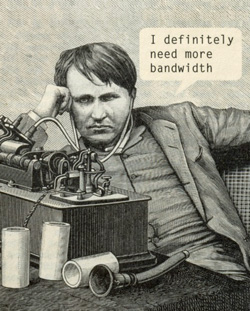
I definitely need more bandwidth - products with this theme, find here.#1 Choice: Ethernet over Fiber
The beauty of fiber is that it is future proof. The fiber in the ground today will support the bandwidths of tomorrow. 1 Gbps today. 10 Gbps next year. Perhaps 100 Gbps in the coming years.

The preferred technology is Ethernet over Fiber. This is the same Ethernet that you run now on your local area network. Most NICs (Network Interface Card) are 10/100/1000 Mbps. With CAT5E or CAT6 wiring and Gigabit switches, you are perfectly matched to access the Internet as fast as your network will run.

Ethernet over Fiber replaces SONET, an older technology that requires specific interfaces for different service levels. Ethernet over Fiber is different. Your LAN supports equipment running at different speeds. So do Ethernet Internet connections. More importantly, you can install fiber with an Gigabit Ethernet edge router and order any speed service you want. Typical service levels vary from 10 Mbps to 1 Gbps. You pay less for lower speed service if you don’t need the full GigE bandwidth. When you do, upgrading is just a phone call or control panel adjustment away.

The Lower Cost Option: Cable Broadband
Cable has come a long way from its early days of low speeds and spotty performance. That’s thanks to the deployment of HFC (Hybrid Fiber Cable) systems that have fiber optic cabling for the core of the network. Only the drop to your building is still coaxial cable. The other big improvement has been the development of DOCSIS 3.0 modems good to 1 Gbps and the newer DOCSIS 3.1 modems good to 10 Gbps.

With cable broadband capable of 10 Gbps performance, what’s the incentive to install fiber? In many cases, the real incentive is to stick with cable. It offers the advantages of much lower cost, triple-play options that include broadband, phone and television, and fast installation. As long as your business is near the cable run, you can be hooked up quickly and easily with little or no installation cost.

Cable speeds rival fiber and your connection to the cable modem is standard Ethernet. Yet, the cost per month is a fraction of what you pay for equivalent fiber performance. What’s the catch?

There are some differences in service, which may or may not make any difference to your business. First, cable bandwidth is shared among users, not dedicated to your exclusive use the way fiber is. You may notice that your Internet speed varies throughout the day. Most of the heavy use is for consumer video streaming, though, and that occurs mostly in the evening.

Cable bandwidth is also asymmetrical. In other words, you get 1 Gbps download but perhaps 100 Mbps upload. That matches the needs of most Internet access, but can be a problem if you often transfer large files to other locations or upload large files to servers or cloud applications.

Fiber services may offer the option of point to point connections between business locations. Cable broadband connects you to the Internet. However, you can set up a VPN between locations connected to the Internet and achieve secure point to point connectivity… at a much lower cost than dedicated fiber connections.

Which Gigabit Option to Choose?
it should be noted that many cable companies will now offer you access to their core fiber networks as well as coaxial cable broadband. Cable fiber is the same high performance network as other Ethernet over Fiber providers. That includes bandwidth that is scalable, dedicated and symmetrical. Compare Gigabit bandwidth options and see which service most closely matches your business needs.

Click to check pricing and features or get support from a Telarus product specialist.


Follow Telexplainer on Twitter

Tuesday, July 12, 2016

Gigabit Metro Fiber Ethernet Means Business

By: John Shepler

More and more companies are running out of bandwidth as demanding applications eat up every Mbps of LAN, MAN and WAN bandwidth they can access. Are you doomed to fight a losing battle or is there a good technical solution available?

Look into Metro Ethernet bandwidth service for your business and beat the slow bandwidth blues!More Bandwidth to the Rescue
Don’t expect to roll back the clock and be able to do business today and tomorrow with the connections you ordered yesterday. X.25 is long gone. T1 lines have about had their last hurrah. Ethernet over Copper is a temporary solution, at best, to buy you time for what you really need to do. That is, connect to the world via fiber optic bandwidth

But What About Cable?
Cable broadband, also called D3 or DOCSIS 3 for the technical standard, is actually a good solution for some applications. Just don’t kid yourself. That cable connection doesn’t really go very far until it hooks up with the cable company’s metro fiber plant. The junction box may be a few blocks away or it might be handing on the utility pole you can see from your office.

The same is true for T3 or DS3 bandwidth, the longstanding upgrade path from T1 lines. The connection to your equipment may be a pair of coaxial cables, but they only go out to the street. At they point they join up with a SONET fiber optic system owned and maintained by the local telephone company.

What’s Special About MetroE Fiber?
Ethernet is the newer and future-proof technology for carrying digital traffic on fiber optic systems. It is based on the same Ethernet standards used for your local area networks. Certain standards have been added to fit with carrier operations, but otherwise it is switched Ethernet.

That means the interface between your LAN and the carrier’s MAN or WAN is trivially simple. Just plug in and go, like you would with any router or switch. No special interface cards are needed. Chances are that the carrier who is providing your service will install a managed router at your business to define the network edge.

Metro vs Internet
Metro Ethernet, strictly speaking, is a network that serves a particular city or city plus suburbs. The most common use has been to interconnect business locations that are geographically close. These may include headquarters, data centers, warehouses and branch offices. Some companies choose to include suppliers and important customers on their MetroE network for high connection speed and security.

Metro Ethernet is a point to point or multipoint service that directly connects particular locations. You can elect to order ELAN service that actually extends your local network to the other locations. It’s just like you ran your own cables across town, but without the prohibitive expense of doing so.

The Internet is another animal. It’s actually a massive worldwide network made up of national, regional and city-wide networks that all agree to a common standard. Metro Ethernet is not the Internet, but it can connect to it. MetroE networks can also connect to each other over longer distances, especially when ordered through the same carrier.

Why Order Metro Ethernet?
You can think of Carrier Ethernet or Metro Ethernet as the new gold standard in telecommunications. It gives you high bandwidth connections that are easily scalable and low in latency, jitter and packet loss. You have exclusive use of the bandwidth you’ve ordered. It’s also generally covered by a service level agreement to ensure that you get the highest level of availability.

That’s important because the tradeoff between Metro Ethernet and Cable Broadband is not so much in the connection method. Cable provides you with a shared bandwidth service that varies in speed depending on how heavy the usage is. Service is generally on a “best effort” basis rather than any particular guarantees of performance or availability. Thus, the lower price for a given bandwidth level. Some businesses, especially smaller ones, find this tradeoff well worth making. Others with large user bases and critical applications may find that only dedicated service is acceptable.

By the way, many Cable companies also offer Metro Ethernet service on their fiber backbones. It’s a different class of service with a different pricing structure than the coax connected business broadband offering.

Is Metro Ethernet For You?
If you are running out of bandwidth or already at the limit, or simply want a service that can easily be upgraded in the future, you should take a serious look at Metro Ethernet for your business. You may be able to get a break on construction costs or even have them waived if you sign a long term contract, have high enough bandwidth requirements or can join forces with other business customers in your building. There are likely multiple carriers serving your area. Find out what each can offer with a set of competitive quotes for Metro Ethernet service now.

Click to check pricing and features or get support from a Telarus product specialist.


Follow Telexplainer on Twitter

Monday, March 16, 2015

T1, DS3, EoC or Fiber?

if you need more than a Gigabit of bandwidth, you’re down to a choice of fiber or fiber. But what about less demanding network needs? Say you need from 1 Mbps on up to 100 Mbps. Now you have a number of flavors of twisted pair copper and coaxial cable connectivity, as well as fiber optics. What’s the best way to go these days?

I definitely need more bandwidth humorous mousepad. See the full collection here...It’s Important and It Isn’t
What you choose for a bandwidth connection can seem like a critical decision. Relax. The fact is that as long as you choose dedicated Internet access or point to point private lines, you’ll be getting similar performance. What’s different will be the availability of each service and the price.

A Word About Dedicated vs Shared
I should point out that there is a tremendous difference between dedicated and shared bandwidth. You get a lot more bandwidth when you choose something like business cable broadband. But, that bandwidth has different upload and download speeds and you share what’s available with other users. That means your slice of the pie will vary all the time. Even so, when you get up to 10 or 100 times the download bandwidth at the same price, it’s a pretty enticing deal. If it works for your needs, that can be the smart way to go.

T1 vs EoC
T1 lines have traditionally been the entry point for business bandwidth. You get a rock solid 1.5 Mbps x 1.5 Mbps circuit with low latency, jitter and packet loss. Availability is excellent. Even prices have come down dramatically in recent years. The only weakness is that bandwidth level. While 1.5 Mbps used to be pretty decent broadband, it hardly qualifies anymore.

You can bond T1 lines together to create higher connection bandwidths. Two lines give you twice the bandwidth or 3 Mbps. Add more and you can ramp this up to 10 or 12 Mbps. That’s still plenty for many businesses, but it gets a bit pricey as you go up in bandwidth.

A competing technology is EoC or Ethernet over Copper. This service uses the same multiple twisted pair copper, but bandwidths are usually higher. EoC starts about 3 Mbps and easily goes up to 10 or 15 Mbps. Maximum bandwidth capability goes down with distance from the originating office, but close-in you can get 25, 30 or 50 Mbps. Occasionally even higher.

How about the cost comparison between T1 and EoC. EoC is cheaper for the same quality of service. If available, you can often cut you bandwidth costs in half for symmetrical, dedicated private lines or Internet access. The higher the bandwidth, the better the deal.

T1 or EoC vs DS3
The traditional upgrade path from T1 used to be DS3. It’s a jump from 1.5 Mbps (or 12 Mbps bonded) up to 45 Mbps. In some cases you can get fractional DS3 that creates intermediate bandwidth options.

The thing about DS3 is that it really isn’t a completely copper solution. The connection to your equipment is a pair of coax cables. But, most of the distance to the carrier’s office is handled by SONET fiber, typically OC3. That means there needs to be some fiber in the area for DS3 to be available.

Today the upgrade path is from T1 to Ethernet over Copper. DS3 is a possibility, but you need to compare costs to see what is a better deal at your particular location. Any of these technologies will give you reliable high performing connections.

Ethernet over Fiber
Fiber optic service used to mean SONET, the legacy telecom standard. SONET is still available with service levels of OC-3, OC-12 and OC-48. It’s a rock solid service, but doesn’t upgrade quickly or easily and can be pricey by today’s standards.

The new gold standard is Ethernet over Fiber. Most new network services are designed around Ethernet for several reasons.

First, it’s a very easy interface to your local network. Ethernet connects to Ethernet seamlessly. It also enables additional services, such as layer 2 switched LAN to LAN connections.

Second, Carrier Ethernet has been designed to be easily scalable. Instead of a few fixed service levels, you can order just about any bandwidth increment. If you change your mind or have a greater need later, you can get a bandwidth increase with a simple phone call to you provider. In some cases, you can do it yourself via a Web browser.

Third is cost. Ethernet over Fiber is the core of many new service providers with regional, national and international footprints. Even the big legacy carriers are making the move from switched circuit to packet switching technology (Ethernet) because that’s the future. As a result, there are a lot more opportunities for Fiber Ethernet service options than traditional fiber services and greater competition. You’ll generally pay dramatically less for service at the 10, 100 and 1000 Mbps level. Even 10 Gbps is becoming readily available at affordable prices for more demanding needs.

Choosing Your Bandwidth Options
Like every other business decision, the best option is to gather as much information and quotes from as many service providers as possible. You can do this with one simple inquiry to get competitive bandwidth service quotes and expert recommendations.

Click to check pricing and features or get support from a Telarus product specialist.


Note: The humorous mousepad about needing more bandwidth, along with many other items in the same theme, is available from the Gigapacket Zazzle store.


Follow Telexplainer on Twitter


Thursday, April 24, 2014

E-Rate Discounted Broadband Internet for Schools and Libraries

By: John Shepler

Schools and libraries are clamoring for high speed Internet access. In our connected world, broadband has become a utility that enables business, personal development and learning of all types. While many, if not most, public resources have Internet access of some kind, pressure is mounting to increase the access speed to enable more users and more sophisticated applications. What stands in the way of doing this? Cost.

Find E-Rate broadband Internet discount service for your school or library.Discounted Service is Available
Fortunately, there is a government program that makes it possible for most K-12 schools and libraries to upgrade their broadband Internet at discounted rates that vary from 20% to 90% of the service cost. Instead of poking along at a few Mbps, it’s now quite reasonable to make the leap to fiber optic service offering 100 Mbps Fast Ethernet or 1,000 Mbps Gigabit Ethernet.

Better Pricing Plus Affordability Equals Higher Bandwidth
Part of the affordability for higher bandwidth comes from the rapid expansion of competitive fiber optic services for business users. Competitive carriers have driven down the price per Mbps of broadband so that even GigE bandwidth is within reason for most companies and other organizations. Schools and libraries have the extra benefit of support through the government E-Rate program that makes possible discounted telecommunications, Internet access and internal connectivity.

How E-Rate Works
E-Rate gets it funding from the Universal Service fee charged to telecommunication companies. Originally, the idea was to create a pool of resources to ensure that everyone had telephone service, even if they couldn’t afford it. The ability to make and receive telephone calls was considered a strategic necessity for the country. Times change and the traditional landline is fading into obscurity. What’s replacing it as a necessity is broadband and mobility. With that in mind, the Federal Communication Commission has broadened the Universal Service Fund to include Internet as well as telephony.

Who Qualifies for E-Rate Discounts
E-Rate is targeted at two specific entities: schools and libraries. Each school, school district and library that wants the discounts submits an application through the administrator of the program, USAC or the Universal Service Administrative Company. Each carrier or service provider who wants to offer E-Rate qualified services must also apply and be assigned a SPIN or Service Provider Identification Number. As you might expect, there are various official forms that need to be completed. More information can be found on the USAC website.

How the Discounts are Calculated
The size of the discount for each school or library is based on the level of poverty and the urban/rural status of the population served. That sounds like it might be a pretty difficult thing to figure out. The determination is made much easier by basing it on the percentage of students eligible for the national school lunch program. Better off areas might only qualify for 20% service discounts. Those with severe poverty might qualify for discounts as high as 90%.

The Size of E-Rate Funding
How much money are we talking about? The E-Rate program funding cap for FY2014 is over $2.4 billion. If your school or library isn’t getting your share of the discounts applied to Internet service, it’s likely well worth your while to get on board. Others who are already benefiting from E-Rate service discounts and feeling the need to upgrade service levels should know that many major service providers now offer E-Rate qualified services. One or more is likely to be able to provide the kind of bandwidth you need, ranging from 10 Mbps on up to 10 Gbps.

Bandwidth Upgrades are Needed Now
A recent report indicated that many libraries nationwide are feeling the need to move as quickly as possible to 100 Mbps broadband. School districts with heavy classroom and administrative use may need to have Gigabit bandwidth installed. With fiber based Ethernet service, bandwidth levels are very scalable and can usually be increased without equipment changes.

Finding E-Rate Services
Are you looking for new or upgraded Internet access for your eligible school district or library system? Find carriers offering E-Rate bandwidth services quickly and easily now.

Click to check pricing and features or get support from a Telarus product specialist.

Note: Photo of Duluth Central High School courtesy of Wikimedia Commons


Follow Telexplainer on Twitter


Tuesday, May 24, 2011

Is 1 Tbps The Next Optical Network Standard?

For residential and corporate users just getting comfortable with 100 Mbps broadband, the need for bandwidths in the Terabit per second range seem very far in the future. Not so for network operators. The discussion is getting lively right now as to whether the next optical networking standard speed will be 400 Gbps or 1 Tbps.

Fiber optic bandwidth standards are now considering 400 Gbps and 1 Tbps.What’s driving the need for new higher standards? It’s the inevitable march of technology from Kbps to Mbps to Gbps and soon to Tbps. The last lively discussion was whether to move up from 10 Gbps to 40 Gbps or go all the way to 100 Gbps. You’ll notice that the new proposed standards are 10x or one order of magnitude above those levels.

That makes sense because there is something of a “Moore’s Law” that applies to bandwidth as well as computer processing. Moore’s Law, formulated by Gordon Moore of Intel, proposed that the number of transistors on an integrated circuit would double every year. Despite the fact that no one knew exactly how to do this more than a increment or two into the future, technology advancements have come along on schedule to keep Moore’s law viable for decades. The latest announcement of 3D transistors looks to keep the processing improvements going for the foreseeable future.

What about bandwidth? There is a prediction called Butter’s Law formulated by Gerald Butters of Bell Labs that says the amount of data coming from an optical fiber doubles every nine months. This is complemented by Nielsen’s Law, from consultant Jakob Nielsen, that says that bandwidth available to users increases 50% per year.

Based on this, getting standards in place for faster optical networks needs to proceed quickly. There’s little time to waste before we start talking about 10 and 100 Tbps networks and thinking ahead to Petabit per second networks.

What on Earth is driving these requirements? Is it simply technology gone wild on its own development cycle or is there a real need for such bandwidths. If there isn’t now, there soon will be. It can be summed up in one word: Video.

Video traffic now dominates the Internet. It’s said the Netflix alone may be the largest single application. Netflix might have been first out of the chute when it comes to streaming video content on a massive scale, but it won’t be in that position alone for long. Most new televisions and set top boxes have Internet connectivity built-in. The same is true for gaming consoles, which also make nice video set top boxes.

But don’t most people get their video programming over the air, through cable or satellite dishes? They do for now because those are the mature technologies. The bit switch from analog to digital OTA broadcasting has had a unexpected side effect. Having to buy new sets and make tricky antenna adjustments to receive the digital broadcasts has caused some TV viewers to rethink their options. The latest trend is to forego over the air broadcasts in favor of Netflix and video downloads directly from the Internet.

Far from being horrified, the FCC is considering auctioning off more of the TV spectrum to wireless broadband services. Smartphones and now tablet computers, particularly the iPad, are creating an almost insatiable demand for 3G and 4G bandwidth to support high definition video. There’s a proposal being floated to allow broadcasters to share frequencies taking advantage of the multiple program capability of each channel.

Likewise, Ethernet over Copper and DOCSIS Cable are easily capable of 100 Mbps broadband but start to strain above that. Further technical advances may push the upper limit on copper delivery but it’s just a matter of time before we have fiber to every premises. Verizon is leading the way with its FiOS passive optical service to the home and most medium and large business that don’t have fiber yet are taking a hard look at the lower cost of Gigabit Ethernet, where available.

How about your business? Are you feeling pinched by bandwidth services that are no longer as capable as they were when you installed them? You should know that business bandwidth prices have dropped significantly in the last few years, fueled by new technology developments and high levels of competition in metro areas. You may be able to get a lot more for your bandwidth dollar than you think. If you haven’t checked in awhile, this is a good time to get prices and availability on fiber optic bandwidth services. You may be surprised about what is available today.

Click to check pricing and features or get support from a Telarus product specialist.


Follow Telexplainer on Twitter

Thursday, June 26, 2008

Aggressive Passive Optical Networking

PON or Passive Optical Networking is proving to be a cost effective technology for establishing fiber to the premises for residential and business users. So fast is this technology developing that PON is blowing through standards almost as soon as they are released. The latest increment is 10 Gbps GPON being demonstrated by Ericsson. Do I hear 100 Gbps? How about Tbps?

Well, not so fast (so to speak). Bandwidth demands are certainly rising in home applications and business WAN networks. But the transition from wireline to fiber has really just gotten underway. Not that you'd know it by watching the development of PONs.

The big appeal of passive optical networks versus the active variety is capital expense. In a SONET or Ethernet fiber optic network the cable is passive but transmission, reception and control is done with active electronic circuits at every node. This results in fine increments of multiplexed bandwidths and support for a wide variety of protocols and upgrades. That's the beauty of optical fibers. Once the considerable cost of construction has been paid off, the possibilities for pressing bandwidth into service is almost limitless. It gives carriers a lot of flexibility but at a price.

The thing about residential broadband is that cost really matters. In fact, the daunting bill for replacing the sunk costs of the century old copper wire infrastructure with higher capacity fiber has held back the telcos, cable operators and competitive carriers alike, until just recently. PON changes the equation. PON doesn't make high bandwidth packet transmission cheap, but it does make it much cheaper.

It's the P in PON that does the trick. The passive designation means not just the cable, but the distribution system as well. There is an active Optical Line Termination or OLT at the central office. Each premises gets an ONU or Optical Network Unit, which is also an active electronics box. In between everything else is practical. Passive optical splitters divide the fiber beam from the main line to multiple drops. There are typically 32 drops from a single trunk line, although that can vary from more to fewer depending on the length of the lines.

Then there are the PON standards. The first was APON or ATM based Passive Optical Networking. ATM or Asynchronous Transfer Mode is a technology based on small cells instead of large packets. It was primarily for business applications.

Next is BPON or Broadband Passive Optical Networking. This ITU-T G.983 standard offers downstream and upstream speeds of 155 (OC3 bandwidth) or 622 Mbps (OC12 bandwidth).

Speeding this up further is GPON or Gigabit Passive Optical Networking, standardized as ITU-T G.984. GPON offers downstream speeds of 1.25 Gbps and 2.5 Gbps. Upstream speeds supported are 155 and 622 Mbps, plus 1.25 and 2.5 Gbps.

The EPON or Ethernet Passive Optical Networking standard is supported by IEEE 802.3ah and offers 1.25 Gbps both upstream and downstream.

Now comes 10 Gbps GPON offering 10 Gbps of passive optical networking or 4x the capacity of GPON. There is also a 10GEPON. That's 10 Gigabit Ethernet Passive Optical Networking now in development under IEEE 802.3av. Seems like that should be enough for now, but with 100 Gbps core networks being demonstrated and 40 Gbps being deployed by long haul carriers, 100 Gbps GPON may not be that far in the future.

The mad dash for fiber optic deployment is having a beneficial effect of reducing the cost per Mbps for Ethernet WAN business users as well as residential broadband/television/telephone users. Just in time, too, as video and other high bandwidth application are sucking up packet speed as fast as it becomes available.

Click to check pricing and features or get support from a Telarus product specialist.


Follow Telexplainer on Twitter

Thursday, May 29, 2008

What Makes a Great MAN

Metropolitan Area Networks were once the realm of telecom companies and major corporations only. But something has changed recently to make access affordable for even small and medium size companies. If you need to communicate between two or more locations in town, you might just benefit from access to a metro network.

Metro Ethernet is the new way to provide data connections in metropolitan areas. This includes major cities and suburban areas. There are two types of Ethernet MAN service. E-Line is an Ethernet Line that connects two locations. A common application is between a main business location and a remote data center. The E-Line is also good if you want to connect to a warehouse, factory or branch office.

The other type of Ethernet MAN service is E-LAN. While E-Line is point to point, E-LAN is for multi-point connections. It's like a LAN, only spread across a city. This is also called WAN or Wide Area Network connections. With E-LAN service, you can connect your main office with multiple branch offices or retail locations, warehouses, factories and other locations in the metropolitan area. E-LAN and E-Line connections are good ways to tie local area networks together into a single, larger company network.

What really makes for a great MAN is a combination of speed, reliability and low cost. MAN connection speeds can be just about any bandwidth, but Ethernet MANs typically mirror the standard Ethernet LAN speeds of 10 Mbps, 100 Mbps and 1000 Mbps.

MAN networks typically use fiber optic lines for speed, capacity and reliability. If you want Gigabit Ethernet connection speeds, you'll definitely need to have your building "lit" for fiber optic service. Business locations in major metropolitan areas, where you'll find metro network access, are often "lit" or near a carrier POP, or point of presence. This is especially true for large office buildings with multiple business tenants and colocation facilities where companies house their server farms.

If there is enough bandwidth demand from the clients in your building, carriers will often build-out access connections to "light" the facility. In places where this is too physically difficult or not financially viable, you may still be able to get Ethernet MAN connections using EoC or Ethernet over Copper technology. This is a system that uses existing twisted pair telco wiring to transport Ethernet speeds at 1 to 100 Mbps, depending on distance from the carrier's office.

The best news of all is that competitive carriers have driven the cost of MAN connections far below the traditional telephone company offerings. You may find that using Ethernet MAN service will cost only a fraction of what you expected to pay. How little? Find out using our GeoQuote Ethernet Service Locator service to see what's available for your business address.

Click to check pricing and features or get support from a Telarus product specialist.


Follow Telexplainer on Twitter

Sunday, December 16, 2007

What is Ethernet WAN?

The most exciting development in business broadband since the plunging prices in T1 service is Ethernet WAN. Just what is Ethernet WAN and why should you be interested?

As you probably know, Ethernet has become the reigning standard in LANs or Local Area Networks. One might say that Ethernet is now ubiquitous. Every PC desktop and notebook computer comes with an RJ45 Ethernet jack. You may or may not get a CD ROM drive, probably won't get a floppy disc drive, and may never use the telephone modem jack anymore. But you will get an Ethernet connection. The speed of that connection has been creeping up from 10 Mbps to 100 Mbps to 1 Gbps and, soon, 10 Gbps.

Now consider that your company's LAN runs at 1 Gbps. Your computer's Ethernet drop is likely running at 100 Mbps and your connection to the outside world is an astounding 1.5 Mbps. No, that's not a misprint. It's 1.5 Megabits/second not 1.5 Gigabits per second. That's the typical dedicated Internet bandwidth for many small and medium size companies. It represents the bandwidth of a T1 line, which is 1.5 Mbps for both upload and download speeds. That's less than 2% of the bandwidth your computer can support.

Now there are a couple of good reasons for this. First, There are usually many more computers on a company LAN than accessing outside resources at any given time. That means the LAN backbone needs much higher bandwidth than the outside or WAN (Wide Area Network) connection. Second, WAN bandwidth is orders of magnitude more expensive than LAN bandwidth. Only the T1 line price reductions of the last few years have made T1 connections affordable. Larger companies might bond multiple T1 lines together to get higher bandwidths. Or, take the next step to DS3 bandwidth at 45 Mbps.

What's changed the picture recently is an increasing demand for higher bandwidths brought on by the need to move larger files faster and the convergence of voice and data onto a single network. VoIP telephony gets rid of a completely separate telephone network, but taxes the LAN and WAN bandwidths of the data network. Video uploads and downloads can really swamp a WAN connection. So can overnight file backups for off-site storage.

The service that offers the best chance to relieve this network congestion is Ethernet WAN. It's just what you might guess. Ethernet extended off-premises or into the Wide Area Network. How wide? Metro Ethernet services a single town or metropolitan area. Long Haul Ethernet can easily span the country or the world. It's not at all unreasonable to connect two or more locations separated by thousands of miles and have the network behave like they are right next door. That's the beauty of Ethernet. There's no fancy protocol conversion required to transport it on legacy telephone company services, such as SONET OC3, OC12, OC48, etc. It comes to you on an RJ45 jack that plugs into your switch or router. If you can connect two buildings on your site, you can connect the New York office to the one in Los Angeles. This long haul service is also called Carrier Ethernet and there are many carriers offering it.

The other big advantage of Ethernet WAN service is that it is far cheaper than traditional fiber optic services on a Mbps basis. You can save as much as half the cost on a Fast Ethernet vs DS3 connection, a Gigabit Ethernet or GigE connection vs SONET OCx service, and even traditional T1 lines. Prices vary as does availability. Metro areas are the most highly connected, with many buildings already wired for Ethernet service by competitive carriers. If you are in one of these office buildings or within a mile or so, you could be getting a huge price break on your bandwidth needs right now. Even if your area isn't lit with fiber optic cable, Wireless Ethernet is becoming available at very attractive prices with quick installation times.

So, how do you cash in with Ethernet WAN services? You can check for fiber lit buildings near your location using our handy Ethernet Buildings Instant Locator. Whatever the results, talk it over with our Ethernet consultants and see what can be done to get you a better deal on voice and data network pricing.

Click to check pricing and features or get support from a Telarus product specialist.


Follow Telexplainer on Twitter

Wednesday, August 08, 2007

Ethernet Bandwidth is Downright Cheap

You know that compared to consumer bandwidth solutions, such as DSL or Cable, business bandwidth is pricey. That's always been because business grade services are touted to provide exclusive use of the lines and that they are regulated services with guarantees of reliability (availability.) But it's also because professional grade telecommunication lines are individually engineered and almost always involve both a competitive carrier for the long haul and the incumbent local phone company for last mile connectivity.

In the past few years, fierce competition has driven the cost of dedicated T1 Internet connections from over a thousand dollars a month down to under four hundred dollars a month in major metropolitan areas. But higher bandwidth services needed for video transport, medical image transmission, and engineering data are still priced at eye-popping levels. Small and mid-size companies can find themselves bandwidth restricted if they can't pony up the monthly lease fees for fiber optic grade services.

On top of the high prices for legacy telecom services, changes in technology are making traditional TDM or Time Division Multiplexing protocols less desirable than packet based systems. TDM services such as T1, T3, DS3 and OCx were fielded starting in the 1950's at the behest of the phone companies. No surprise then that the TDM protocol is based on increments of 64 Kbps, the bandwidth needed to support one digital phone call. You want more bandwidth? Just pack in more channels. But today's data communications are based on packets, not channels. You can put packets into channels, but isn't it more efficient to just transmit them as packets all the way?

You bet it is. Nearly all computer generated information originates at an Ethernet interface. That's typically 10, 100 or 1,000 Mbps, but increasingly 10 Gbps on corporate networks. While Ethernet LANs are the defacto standard within organizations, TDM is the protocol of most WAN or Wide Area Networks. When you want your data or VoIP telephony to leave the building, it has to be transformed into TDM protocols for interface with the public telecom network. Well, that's how it's been. But that's changing rapidly.

All telecom carriers have recognized the need to move from TDM To IP based networks and are moving in that direction. The competitive (non-incumbent) carriers are especially aggressive in that transformation. It's partly because they don't have legacy TDM networks to support and partly because they need to get the jump on the deeply entrenched phone companies in order to grab market share.

Let's take a look at some representative pricing and you'll see the difference. You'll pay a national average of $450 a month for a T1 line supporting DS1 service at 1.54 Mbps. That's about $292 per Meg for long haul bandwidth. Move up to DS3 on a T1 line or fiber optic carrier and you get 45 Mbps for around $5,000 on average. The economy of scale brings your cost per Meg down to $111. Those prices are maybe half what they were five years ago, but still beyond the reach of many companies that could make good use of that bandwidth.

Now compare these established TDM services with native Ethernet or IP network services. A 100 Mbps Fast Ethernet connection will set you back $2,000 a month. Yeah. That's really less than half the cost for over twice the bandwidth of DS3. Your cost per Meg is down to $20. Gigabit Ethernet or GigE connections can be had for an average of $12,000 a month for 1,000 Mbps. That's a mere $12 per Meg. If you wanted GigE over SONET based OC48 fiber optic TDM service, the cost would likely be ten to twenty times as much.

Now the rub. While prices for Ethernet transport are downright cheap by traditional telecom pricing standards, you have to be where the carriers are. Trenching fiber out in the boonies is astronomically expensive regardless of who's doing it. The way to get bargain bandwidth prices is to go where the service is already available. That means locating in a building that is already lit or moving your servers to a colo center, also known as a carrier hotel. But how do you find these oases of high bandwidth?

That's been made easy now by a new service called "Shop For Ethernet." It's a service of Telarus, a master agency for many competitive carriers and innovator in automating the telecommunications services shopping experience. Telarus has wed the science of real-time access to carrier databases to Google Maps. In a matter of seconds, not days or weeks, you can enter the address of your current building location and find out if you've already been "lit" for Ethernet and Gigabit Ethernet service. Plus you'll also get map markers that show the locations of other buildings in the area that are currently lit by major carriers. That's important because once a building is lit, or provisioned with fiber optic service, it's a LOT less expensive to provide businesses located there with high bandwidth services.

Want to give it a try? You've got 5 seconds, right? Go ahead and enter your building address now to find out instantly which buildings in your area have the Fast Ethernet and Gigabit Ethernet WAN services you want. If you wish, you can then enter your contact information to have an Ethernet specialist provide you with highly competitive pricing.

Click to check pricing and features or get support from a Telarus product specialist.


Follow Telexplainer on Twitter