Showing posts with label microwave. Show all posts

Wednesday, January 19, 2022

Fixed Wireless As Fiber Backup

By: John Shepler

You need large amounts of rock solid bandwidth to enable your business systems, including telephone, conferencing and business process software in the cloud. Normally, that says fiber optic connectivity. But what if that fiber gets cut (it happens) or just can’t be installed soon enough or the construction is just too expensive? Then what? If you happen to be located in the right areas, fixed wireless can be your best solution.
Take a look at fixed wireless microwave as a backup or substitute for fiber optic connectivity.What is Fixed Wireless?
Cell phones have brought mobility to all of us, including having both a phone and a small computer in our pockets. This is wireless mobility. Each device has a modem and radio that communicates with the nearest cell tower. As you move, the session keeps getting handed off to the next towers as you get closer to them. All of this is imperceptible to you, the user. The complexities of handling mobile signals is hidden in the cellular network.

Perhaps you’ve tethered your phone to your PC to keep working when your cable or landline Internet service was interrupted. That’s an example of fixed wireless. It’s the same as mobile wireless, but you’re not moving.

Cellular Fixed Wireless
Ideally, you’d like to tether your entire network to your phone during an outage rather than just one PC. Some phones allow this by acting as WiFI hotspots. In a small business, you may find this work-around to be just fine for short periods of time. Not being able to walk away with your phone can be a real inconvenience. Running out of minutes and getting cut off or big overage charges can be an even bigger inconvenience.

Fortunately, there are fixed cellular services designed for exactly this use. The box you receive looks something like a Wi-Fi router. It has better antennas than your phone, an Ethernet jack to feed your network, and, perhaps, built in WiFi routing. Some have provisions for mounting an antenna outside in weak signal areas.

Best of all, fixed cellular wireless services for business know that you can’t get by with a few Gigabytes a month. You can order 100 GB and more, even unlimited (within reason) usage. Services include 4G LTE and, now, 5G to give you the speed you need to run your business.

Microwave Fixed Wireless
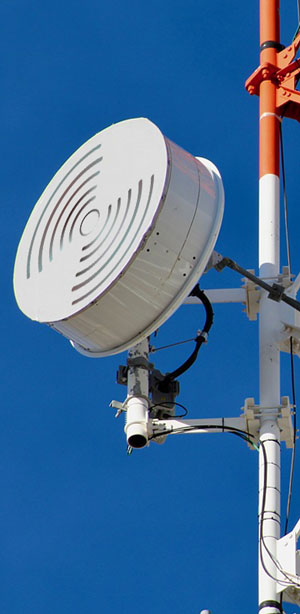
The big brother to cellular is point to point microwave fixed wireless. This is a modern version of the old telco point to point microwave relay. You get a small dish or other microwave antenna that attaches to the side of your building or sits on the roof. It points directly at the provider’s antenna at their central location. This is a line of sight service and generally limited to metropolitan areas.

A major advantages of this type of service is that it is private and dedicated to business use. You won’t be competing with everybody else’s cell phones for bandwidth. The bandwidths can be as high as 1 Gbps or even 10 Gbps. They can also be symmetrical, unlike cellular. With many services your upload and download speeds are the same and your bandwidth is guaranteed. Usage limits? Not usually an issue.

You might even think of microwave fixed wireless as fiber optic without the fiber. Ditching the physical fiber means fewer construction headaches and delays. It is possible that you can have service installed in as little as a few days compared with weeks or months if your building isn’t already lit for fiber.

An unexpected benefit is that fixed wireless can have lower latencies than fiber services with the same bandwidth. That’s because the wireless signal is a direct beam from provider to you. Fiber systems tend to weave all over town with lots of switching gear in the path. Lower latency is critical to some businesses, especially in financial trading. It’s a boon for improving the quality of VoIP phone calls and video conferencing, and for interactive processes running in the cloud.

Cellular broadband uses the Internet and whatever latencies and congestion exist. Fixed Wireless can avoid the Internet and its limitations, or be connected to the Internet so that you can easily connect to customers and suppliers.

Why Not The Best of Both Fiber and Wireless?
Perhaps the best arrangement for your business is a combination of fiber optic service and fixed wireless service. Why both? One reason is to get service started fast with fixed wireless and then add fiber when you can get it installed.

Once you have both running, consider keeping your fixed wireless as a backup to the fiber. Fiber interruptions, often caused by the cable being cut during unrelated construction work, can take days to repair, leaving you high and dry. With automatic failover installed, your traffic will simply move to the wireless link without interruption. When the fiber comes back online, the system will switch back.

Note that fixed wireless offers a true diversity path to fiber. That means fiber and wireless are very unlikely to exhibit failures at the same time. Some businesses think they have this in place by ordering redundant fiber lines or even fiber services from two separate providers. What they don’t realize is that all the fiber serving their location runs in the same bundle or conduit and can all be taken out at the same time by one accident.

Do you need fast installation of high speed business connectivity and/or a robust backup to the fiber you already have? Consider microwave fixed wireless service for your bandwidth needs.


Click to check pricing and features or get support from a Telarus product specialist.


Follow Telexplainer on Twitter


Monday, November 16, 2020

Wireless Business Internet Options

By: John Shepler

We live in a wired world. Your business is tethered to infrastructure of electrical power, telephone and Internet by a variety of copper cables. Electric power and landline phone are almost universally available, thanks to national plans and regulations.

Wireless Business Internet solutions for you.Internet? Not so much. While copper and fiber optic broadband are readily available in metro and suburban areas, as you get farther from the city center you options go down. Out in rural areas? There’s often no such thing as wired Internet infrastructure. You either go without or… go wireless.

Point to Point Microwave
Think of point to point microwave as fiber optic without the fiber. At high enough frequencies that could be an actual light beam from a laser, although it is much more common to use the centimeter and millimeter wave bands.

PTP microwave uses small dish antennas at the sending and receiving ends. This is a fixed, not mobile, service and you need the antenna on your building high enough to see the other dish without obstructions. These high frequencies don’t penetrate objects well, but they can supply high bandwidths of a Gigabit per second or more.

While PTP microwave established itself in dense metro areas that might be expensive to add fiber or cabling or take too long for construction, you see these little dishes on cell towers out in the country for the same reason. If there is a provider serving your area, you might be in luck for this service.

Wireless Internet Service Providers
A WISP, as it is known, is a centrally located tower that provides wireless Internet service to a small service area circling the tower. This is point to multi-point rather than a dedicated PTP link. Think of WISPs as high powered WiFI outdoor routers. Like PTP, you’ll need an outdoor antenna, perhaps one of those small dishes, pointed at the tower. They may operate in licensed or unlicensed spectrum and deliver typical broadband speeds.

WISPs are popular where fiber and cable don’t reach, but they are local operations. You may or may not have one that serves your location.

Cellular Broadband Service
Just about everyone has a smartphone these days and making phone calls is the least of the services we expect. No, it’s the broadband Internet connection feeding a myriad of apps that keeps us glued to the screen. That same broadband can be harnessed for business applications using an access point that has all the circuitry needed for broadband but minus the screen and telephone capability.

For limited or infrequent use, you might pick up one of these access points at a big box store. Have it set up for the carrier of your choice. These work well in areas where the cellular signal is strong and usually come with fairly limited usage plans. Plug the access point into your router or buy one that comes with a WiFi router and you can serve your entire business.

A more robust version designed especially for business uses specially designed antennas for better signal pickup or an outside antenna that will give you a strong signal even in rural areas. These business grade access points are usually 4G LTE or 5G where available. They also come with more extensive data plans, some even unlimited… just what you need to run a business with employees.

What makes this really attractive is that the cellular infrastructure is already widespread and extending out into many rural areas and smaller towns. If your business needs to move from job site to job site or your operate pop-up stores, cellular broadband may be the only reasonable option that will follow you.

Satellite Broadband
Yes, there are areas really out in the boonies where there is no cellular service and even landline phone and electric power are hard to come by. You can still get Internet, though. How? With a satellite dish pointed at the southern sky where the geostationary communication satellites are parked. Newer high power satellites offer high speeds, reliable service, reasonable data plans for business and reasonable prices.

The big limitation of satellite business broadband is the latency that is inherent in the long distances that the signal must travel up to the bird and back down. This half to one second or so delay can be an annoyance for business processes that use the cloud or VoIP phone calls and video conferences. For email, web browsing, remote data acquisition and file transfers, latency might not be much of an problem at all.

The latency issues will likely be solved by the new constellations of Low Earth Orbit or LEO satellites. These orbit hundreds rather than tens of thousands of miles up and support latencies similar to cable or long haul fiber. SpaceX is first to market with an extensive fleet of broadband satellites that will provide worldwide coverage, even at sea, in a few years. Other providers will likely follow, as the potential market for connecting the disconnected is enormous.

Are you in serious need of reliable broadband Internet service for your business at a reasonable price? Find out what wired and wireless solutions are available for your locations now.

Click to check pricing and features or get support from a Telarus product specialist.


Follow Telexplainer on Twitter


Wednesday, June 26, 2019

How to Feed a Hungry WISP

By: John Shepler

We’re a wired nation, except when it comes to locations that are a bit off the beaten path. That includes farms, rural households, businesses beyond the city limits, new subdivisions and some industrial parks. While they may have telephone, thanks to universal service, the availability of broadband Internet access is less of a sure thing. This is where the wireless broadband supplier or WISP fills the gap.

Get the best bandwidth pricing for your WISP.Why WISPs?
WISP or Wireless Internet Service Provider is similar to a cell phone provider, except specializing in high speed Internet access. While even 4G cell service has fairly low usage limits, WISP services are much more generous and try to emulate the type of service you’d get from cable, telco or even fiber optic lines. The real cost to hooking up less populated areas is trenching cable bundles or flying them on utility poles. The WISP eliminates the wires and their associated cost. The tradeoff is that you generally need a small dish antenna and receiver outside to pick up the signal from the WISP tower.

Where Do WISPs Get Their Broadband?
While the WISP distributes broadband much like WiFi, the broadband they serve must come from somewhere. When the Internet was young, T1 lines did an excellent job of feeding the WISP, just like they did feeding cell towers out in the countryside. The beauty of T1 is that it can be sent virtually any distance over standard twisted pair telephone wiring. The downside is that the bandwidth is fixed at 1.5 Mbps per T1 line. Higher speeds can be accomplished by adding or bonding additional lines to double, triple or quadruple the speed. The practical limit is around 10 to 12 Mbps. Pricing goes up linearly as you add each line.

Higher Speed Copper Lines
A newer technology that also runs over twisted pair copper is Ethernet over Copper (EoC). This service offers higher speeds, say 20 or 30 Mbps or even higher. Transmission is distance limited, but EoC is now more available beyond the city limits. Cost is much more attractive per Mbps than T1, if moderate speeds are adequate for what you need.

Business Cable Broadband can provide hundreds of Mbps these days but has suffered from very limited deployment outside of metro areas. That has changed somewhat as the cable has been extended to outlying subdivisions and business parks. If you can get this service and the Cable Company is OK with using it for a WISP, the cost will be very attractive.

Fiber Optic Service
The new gold standard of bandwidth service is fiber optic lines. These used to be few and far between, but provider competition has made them far more common even in rural areas. You can thank 4G cellular for providing the incentive to trench fiber conduits into rural areas. Prices have come down dramatically with Ethernet over Fiber (EoF) services. These are highly reliable and easily scalable up and down in bandwidth to meet your needs. Bandwidths of 10 Gbps up to 100 Gbps are common now.

Microwave Transmission
Why not feed wireless with wireless? That’s not a crazy idea and is being used more and more as telco companies upgrade to 5G towers. Microwave is a point to point wireless service. You mount a small dish on your tower and point it toward the service provider. It’s like fiber but without the fiber.

SDN Combines Bandwidth
What if you need more bandwidth than any one supplier can provide? One option is to combine them using a technique called SDN or Software Defined Network, also known as SD-WAN or Software Defined Wide Area Network. The SDN controller manages traffic to get the best performance for each packet. You can combine T1, EoC, cable broadband, microwave, fiber optic lines and even satellite Internet to create a higher speed robust feed for your WISP tower.

Do you operate a WISP service or have one in the planning stage? Find out what bandwidths and pricing are available for your desired locations now. A friendly consultant will help you sort through the options.

Click to check pricing and features or get support from a Telarus product specialist.


Follow Telexplainer on Twitter


Thursday, April 21, 2011

Ethernet over Fixed Wireless Broadband

Many companies have discovered the cost and performance benefits of Metro Ethernet services over copper and fiber optic cable. But did you know that there was a third option? It’s Ethernet over Fixed Wireless and it can get you the bandwidth you need both quickly and affordably.

See if fixed wireless Internet access will work for you. Click for pricing and availabilty.Ethernet over Fixed Wireless (EoFW) differs from the portable or mobile wireless services we are most familiar with. While most WiFi, WiMAX or LTE services offer broadband Internet access within a given service footprint, they are intended for general use. There is generally no encryption and no directionality. You use a smartphone or laptop computer, sometimes with a USB adaptor, to get connected to the network. The bandwidth is limited and shared. You’re never quite sure how fast the connection is going to run.

Fixed wireless is a completely different service. The only thing it has in common with 3G and 4G cellular broadband is that it doesn’t use wires. It doesn’t use their microwave channels nor their towers. This is a private service sold to businesses, not consumers.

What does Ethernet over Fixed Wireless have to offer? You’ll get speeds similar to wireline services, secure data transmission, fast installation and a service level agreement. In other words, a dedicated wireline connection without the wireline.

TelePacific is now a major player in this relatively new field, after acquiring the assets of Covad Wireless. They offer two levels of service, one to compete with T1 lines and Ethernet over Copper, plus a higher speed service that competes with DS3 bandwidth.

Wireless Super-T T1-class Business Internet provides scalable bandwidth from 1 Mbps to 6 Mbps. That’s what you’d get from bonding up to 4 T1 lines or an EoC service. But what if you are outside the limited EoC footprint for your area and you don’t want to wait for T1 service to be installed? TelePacific can install service and have it working within days of an order. You’re talking weeks for a T1 line and who knows how long if you want to bring in fiber.

Speaking of fiber, are you in need of higher bandwidth but beyond the capability of bonded T1 or EoC and blanching at the cost of fiber construction? TelePacific can have you up and running in typically 30 to 45 days using their professionally engineered and installed licensed microwave equipment. Bandwidth levels of 10, 15, 20, 30 or 45 Mbps are available in California and Nevada. Higher bandwidths from 50 to 100 Mbps are available in California. No need for expensive DS3 cards and routers. You connection is a Fast Ethernet interface.

Even if you already have high capacity lines to support your business, are you sure that you’re ready if disaster strikes. What if those cables get cut? How long will you be out of business before they get spliced back together? This is where TelePacific’s HiCap wireless service can save the day. The path to your ISP is wireless and they offer a network-diverse route to the internet.

A specialized service you may find valuable is TelePacific Wireless Event Service. They can provide you with standard service from 2 to 6 Mbps or higher bandwidth from 10 to 40 Mbps to support your trade show, sporting event, company or customer event, film festival, concert on on-location film shoot. They even provided Internet access on the beach for a surfing competition. It’s all engineered and handled by TelePacific. You just show up, plug in and access the Internet.

Does this whet your appetite for the benefits of getting your business bandwidth without the usual wired connections? If so, get pricing and availability for Fixed Wireless Broadband Service to support your business needs.

Click to check pricing and features or get support from a Telarus product specialist.


Follow Telexplainer on Twitter