Showing posts with label low latency. Show all posts

Wednesday, April 17, 2024

Is 5G Bandwidth Slicing The New Private Network?

By: John Shepler

The Internet is a wonderful way to connect… except when it isn’t. Oh, it works great for much of what we need: universal connectivity, rock bottom cost, and support for most applications. It’s when we need higher than usual performance or extreme reliability that our broadband connections can fall short. Latency, packet loss, and congestion can degrade interactive applications or make them impossible to implement. What to do? Switch to private networks.

5G bandwidth slicing for private networks.What is a Private Network?
The Internet is what is known as a public network. It’s accessible by just about everyone, everywhere. All you need is an account at an ISP, cable company or cell phone provider and you’re connected with always-on broadband.

The beauty of this public network is that it has been built out over several decades so that it literally covers the world. Everyone has equal standing on the Internet. The average user’s traffic gets the same priority as a major corporation, research institute or any of the billions of “things” that are now connected online. This is what is known as network neutrality. The only preferences you can pay up for is a more direct connection to the backbone of the Internet and the amount of bandwidth you have access to.

All this equality sounds great, doesn’t it? Most of the time it serves everyone well. But, if you are trying to have a videoconference at the same time as everyone else is streaming a popular concert or engaged in an important phone call when the rest of the world is doing backups to the cloud, your connection may start to degrade. It’s much worse for high speed interactive gaming, remote surgery, high frequency stock and options trading, or control of an electric vehicle. These applications have a low tolerance for hiccups and delays.

The alternative to the public network is the private network. Your company LAN is a private network. It isn’t shared with every other company or consumers watching online TV. Chances are that it has all the low latency bandwidth you need all the time.

Now, extend that LAN across town or across the country. Can you do that? Yes, you can, but you won’t be building it yourself. Instead, you’ll contract with a network provider that offers private point to point connections. There will be other customers sharing their extensive facilities, but they won’t interfere with you. You will be guaranteed the bandwidth and other network characteristics, such as latency and packet loss, that you contract for.

Types of Private Networks
In the past, nailed-up twisted pair wires, T1 lines and SONET fiber were the way to go. Today, Ethernet over Fiber is the most popular along with MPLS networks.

Ethernet connections use the same protocol as your LAN, so they are easy to interface. You can also order direct point to point, point to multipoint, or mesh networks that connect multiple locations. Ethernet over Fiber offers bandwidths from 10 Mbps up to 10 Gbps, with 100 Gbps becoming more common.

Some popular uses for these Ethernet services include direct connections to cloud providers, interconnecting multiple business locations, and content delivery.

MPLS networks are a specialized technology that offers connectivity over wide areas, including the entire country or even Internationally. MPLS uses its own unique protocol, making it more secure than IP networks. These are multi-user networks, but are managed so that each customer has the bandwidth promised at all times. MPLS networks with Ethernet on-ramps can give you tremendous coverage at less cost than multiple private lines.

5G Slicing as the New Private Network
More and more applications are portable and mobile these days. That means a wired connection just won’t do. Instead, we settle for wireless Internet services, usually over the extensive cellular networks. This started becoming popular when 3G networks were implemented and really took off with 4G LTE. It’s only continued at a faster pace with 5G networks.

The limitation with even 5G is that you are still dealing with Internet broadband and its foibles. Bandwidth is more limited than with fiber and congestion can bring your applications to a crawl during busy times in crowded areas. A feature designed into 5G offers a way around this for an extra charge.

5G slicing technology allows carriers to partition or “slice” off a part of the available bandwidth for private use. Everybody is clogged up on the freeway, but you get to zip along on your own private road. Pretty nice, right?

5G slicing can give you a more direct connection to the Internet for better performance or can remain as a private network or connection to a private fiber network. It’s like your LAN, but with the freedom of being wireless over wide areas.

On their own campuses, some companies are implementing private 5G networks to gain the same advantages. 5G slicing takes this a step further to give you connectivity anywhere you go. That includes moving vehicles as well as smartphones, tablets and all those “things” the need connectivity but don’t perform well on the Internet.

Issues with 5G Slicing
The implementation of 5G slicing is just starting to roll out, so you may or may not be able to find this service yet. One concern is how much slicing can there be if everybody wants a private piece of the spectrum. While 5G bandwidth, especially on the new higher frequencies, is more plentiful, there are practical limits to how much traffic can be carried over the air. This is why there is still a mad scramble to make more frequencies available for 5G, including some spectrum currently assigned to the military.

Another potential bug-a-boo is the old network neutrality issue. How can a network be neutral when you can pay up for a private box seat? For now, regulators seem to be OK with 5G slicing as long as the main core of the network used for Internet is not prioritized, or that some services aren’t being throttled for competitive advantage. As more and more of the wireless spectrum goes private, it remains to be seen how much pushback there will be.

Would private networking be an advantage for your business? Find out what bandwidth services are available now for your business locations.

Click to check pricing and features or get support from a Telarus product specialist.


Follow Telexplainer on Twitter


Monday, May 11, 2015

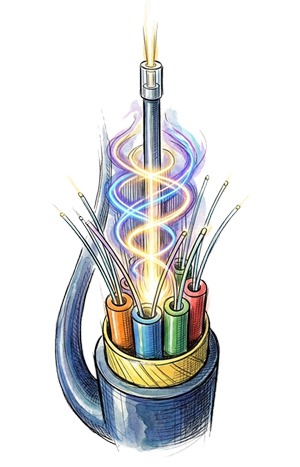
Why Your Next Wire Should Be Glass

By: John Shepler

The telecommunications industry was build on copper wire. So was the computer networking industry. You’re well versed in the installation and maintenance of metal wire technology. Cat5e or Cat6 cabling gets the job done for most of your networking needs. So, why should you be looking at fiber optic exclusively for your next connection?

Find products with the theme of "A Wire Made of Glass" at the Gigapacket Zazzle store.The WAN vs the LAN
Ethernet over copper works great over short distances. That’s why it is so popular for in-house network wiring. Most users don’t have NICs that run faster than 1000 Mbps and seldom really need even that much bandwidth. Running fiber to the desktop seems like an expensive and unnecessary project.

Where fiber shines in-plant is long stretches between floors or other buildings. It’s also important between some networking equipment that really can benefit from 10 to 100 Gbps or higher bandwidths.

The WAN is another matter. Ethernet was originally designed with short interconnections in mind. The specs for Carrier Ethernet added provisions that let common carriers extend your LAN anywhere in-town, between cities or around the world. There’s even a product called Ethernet over Copper or EoC. It uses multiple pairs of existing twisted pair wiring between your location and the telco office.

That gets Ethernet from in the building to several miles away. But that’s the rub. EoC bandwidth falls off with distance. It is intended to be an upgrade from copper-based T1 lines to increase bandwidth from T1’s 1.5 Mbps on up to 10 or 15 Mbps. In some short run situations, that can be increased to 20, 30, 50Mbps or even higher.

Glass Is The Future
You might be surprised to learn that there is almost a stampeded among businesses from their old copper WAN connections to fiber optic service. Most new installations should really take a look at fiber options first. Only if fiber isn’t really needed because of low bandwidth requirements or unavailability in rural areas, do you want to settle for copper services like T1 or EoC.

The first reason, as you probably suspect, is bandwidth. Business bandwidth needs have multiplied recently. The reason is that more and more business processes are being automated for gains productivity. Software is far more sophisticated than is was a short while ago. Multimedia, especially video content, sucks up bandwidth orders of magnitude faster than text based messaging and reports. More jobs that depend on computers or network connected machines combined with more sophisticated processing means much faster connections are needed for communications.

The “Cloud” is another driver. Behind all the magic, the cloud is really just a big, big data center located too far for a LAN connection. The cloud is sold as a way to transform capital investments into monthly expenses and reduce the cost of local maintenance and support staff. Economy of scale and the ability to scale resources for any given user in near real-time are attractive benefits. The one fly in the ointment is network bandwidth.

Cloud-based computing and telecommunications demands a lot more performance from your wide area connections than simple telephone lines or Internet service used primarily for email and casual web browsing. Productivity, along with voice and video performance, depend on high bandwidth, low latency connections.

Not Yesterday’s Fiber
Fiber optic bandwidth service has a history of being expensive and hard to get. That has changed dramatically in recent years. What started off as a niche technology for the telephone companies to transport huge bundles of phone calls between switching centers has morphed into routine connectivity for private line and Internet service. Buildings are being “lit” at a rapid rate to supply fiber optic bandwidth as a utility, something like electricity and water. In today’s information age, digital connectivity really needs to be considered a utility.

Another big driver is the cell phone industry. In the decades since cellular service was introduced, its use has shifted from simple mobile phone calls to full-blown computer applications running on smartphones, tablets and laptop computers. Carriers can’t build out 4G wireless fast enough to meet the demand. The work on 5G is well underway.

T1 lines were perfect for cell towers handling voice traffic and performed well until 3G start to be replaced by 4G. Even bonded T1 lines can’t keep up with 20 or 30 Mbps, much less higher speeds. That means it has become imperative to get fiber to every cell tower. Fiber is no longer rare. It’s being installed in underground conduit and flying on utility poles everywhere you look.

Fiber That Makes Sense For Your Company
The best deals in fiber optic bandwidth right now are for Ethernet over Fiber (EoF) service rather than the traditional SONET telco standards. EoF has the advantages of being highly competitive among multiple carriers, easy to scale up and down in bandwidth, low in latency, packet loss and jitter and a lot lower priced than you may think.

The most popular Ethernet over Fiber services right now are 10 Mbps as an entry level for smaller businesses, 100 Mbps Fast Ethernet for most established companies, and 1000 Mbps GigE for medium and larger operations and companies with high bandwidth demands, such as video production or computer aided design and manufacturing. School districts also find Gigabit Ethernet attractive to serve their many facilities.

Are you acquiring bandwidth for a new location or looking to upgrade the copper service you already have? Now is the perfect time to take a look at what’s available in fiber optic bandwidth service for business.

Click to check pricing and features or get support from a Telarus product specialist.

Note: Products with the humorous theme "A Wire Made of Glass" shown on this page are available through the Gigapacket Zazzle Store.


Follow Telexplainer on Twitter

Monday, January 05, 2015

T1 is Your Rural Broadband Solution

By: John Shepler

While metro areas enjoy a plethora of broadband Internet services, those outside the city limits or living on farms or ranches have little to pick from. Often all that seems available is smartphone 4G and two-way satellite. But, wait! There’s another option you may not be aware of that could be perfect for your rural business, farmstead or work from home. It’s T1 dedicated Internet access.

Rural farm silo in a blue sky Kindle folio. Get one for yourself now.T1 is Everywhere
T1 line service is available just about anywhere you can get ordinary POTS analog phone service. That’s because T1 runs on standard telephone company twisted pair copper wiring. The same cable that brings in telephone service probably has a couple of unused pairs available for a T1 line.

T1 is a digital service designed by Bell Labs with regenerators to boost the signal. You can get service even if you are miles out in the countryside.

No Data Caps
The biggest limitation for wireless services, like 4G and satellite, is that the airwaves have only so much capacity to serve all their customers. This is why providers enforce data caps. Such caps used to be laughably low, but now are typically 5, 10 or 15 GB per month. That’s probably enough for a single user of email and web browsing. Your quota gets used up quickly with high def video, software downloads, cloud applications and data backups.

What happens when you hit the cap limit? It varies among providers. The cellular companies will charge you overages on a per GB basis. Satellite providers will either throttle down your bandwidth or cut you off until you buy more capacity.

T1 lines have no data caps. The line runs at a constant speed all the time. You can choose to load it up 24/7 and get as many bytes through the pipe per month as you can at 1.5 Mbps, or just use it as-needed during business hours. The full capacity is always there available for your use.

Dedicated, Not Shared
Another reason that some services have data caps is that the bandwidth is shared, not dedicated. T1 lines are also known as dedicated Internet access or DIA. The dedicated part means that the line is for your use exclusively. There are no other users.

That may sound obvious, but it’s not what you have with satellite, 3G & 4G wireless, or even cable and DSL. All of these are shared bandwidth services. They are typically priced lower than equivalent telecom wireline services because the bandwidth at any given time is divvied up among the users who are online. If you are the only one, you get the full capacity of the system. Usually, you are sharing the available capacity with dozens, hundreds or thousands of other users. This is why these services advertise their bandwidth as “up to” so many Mbps.

T1 lines are a fixed dedicated bandwidth. It’s not “up to 1.5 Mbps”. It’s 1.5 Mbps all the time.

Minimal Latency
Shared bandwidth services that get congested with too much traffic and all geosynchronous satellite channels have a particular issue called latency. Latency is a time delay between when a packet is sent and when it is received. If you are only dealing with 10 mSec or or so of line latency you’ll probably never notice it. However, when that latency rises to 100, 200, or even 500 mSec you’ll really notice it.

Satellite links have the highest latency simply because even light takes a millisecond to travel each 186 miles. That’s the familiar physics constant of 186,000 miles per second. When the signal has to travel 23,000 miles up to the satellite and another 23,000 back down you’ve lost about a quarter of a second. TCP/IP needs to be acknowledged, which doubles this latency. Add a little for ground and satellite equipment processing and you’re easily at 500 mSec or half a second best case.

Now you know why television reporters have to pause before the anchor can ask a question and vice-versa. You’ll have the same effect using VoIP telephony on a geosynchronous satellite link. Plan on treating your phone conversations like you were using a walkie-talkie or other two-way radio. Only one person at a time can talk or you’ll be talking over each other.

T1 lines have minimal latency. It’s pretty much determined by the length of the connection plus a little added for equipment processing. We’re talking tens and not hundreds of milliseconds. That works perfectly for VoIP or ISDN phone trunks, two-way video conferences, and just about anything you want to do on the Web, including working remotely or using cloud hosted applications.

Symmetrical Bandwidth
Shared bandwidth services are typically asymmetric. That means they have much higher download than upload speeds. Usually a factor of x10. That works fine for accessing websites or downloading files or video. It’s not so great for uploading files or backing up data to remote sites.

T1 lines are symmetric. They have 1.5 Mbps download and an equal 1.5 Mbps upload speed.

VPN Compatible
Some services, especially satellite broadband, don’t work well with the VPN or virtual private networks used by remote workers to connect to their employers. Satellite companies may even warn you that their service doesn’t play well with VPN because of the signal processing in their system. T1 has no such limitations. It’s a good match for VPN applications.

Highly Reliable
T1 lines were developed by the telephone companies for their own use in transporting bundles of phone calls. The technology is robust and well-proven. Outages are rare. If someone cuts the cable or a piece of network equipment fails, T1 lines get fast attention and quick repair. Often you can get a SLA or Service Level Agreement that spells out the mean time to repair as well as other characteristics such as latency, jitter and packet loss.

Broadband Options
While 1.5 Mbps may be as much as many users need for small business operations or working remotely, its not high bandwidth compared to many other services. One option is to bond two or more T1 lines together to get double, triple or even higher speed. Another option is to use a related technology called Ethernet over Copper (EoC). This service has similar characteristic to T1 but much higher bandwidth available. Unlike T1, EoC isn’t available everywhere and speed decreases with distance from the originating office.

Reasonable Costs
The final factor is cost. You can expect to pay more for dedicated T1 line service than you will for the consumer and other shared bandwidth services. There used to be a huge difference is price, but T1 costs have come down dramatically in recent years while other services have chosen to increase bandwidth and raise prices accordingly. If you have a serious need for connectivity and are frustrated by the lack of options or lack of performance in the options you do have, then you should give T1 a serious look. It might be a very good match with your needs.

Click to check pricing and features or get support from a Telarus product specialist.


Follow Telexplainer on Twitter

Wednesday, September 10, 2014

Benefits of Migrating From T1 to Fiber

By: John Shepler

If you’ve been using T1 lines for years, maybe decades, you know how solid and reliable they are. Your natural inclination is to stick with what’s working. After all, why mess with success? You should know that there are really good reasons to do just that.

Moving up in bandwidth beyond T1 linesWhat’s So Great About T1 Lines?
The appeal of T1 lies in its design and technical maturity. T-Carrier technology, which includes T1, E1 and T3 (DS3) line services, was developed in the mid-twentieth century for long distance telephone trunking to replace noisy analog carriers. Being digital, it was easy to expand the role of T1 lines to carrying packets as well as PCM audio telephone calls.

T1 Service Characteristics
T1 lines come into your building on one or two twisted copper pair using the same wires that carry multi-line telephone. This means that you can get T1 just about anywhere you can get regular POTS phone service. The service is symmetrical, meaning that upload and download speed are the same. There are no usage limits. Whatever you can load on the line during the month, you can transport. This is a dedicated private line, meaning you are the only user and security is high. So, with all that going for T1, why would you want to make a change?

Time Marches On
The 1.5 Mbps bandwidth of T1 was more than enough for business users… once upon a time. Today, 1.5 Mbps is still enough for credit card verification, email, casual Web browsing, and backup for small computer systems. It’s not a bad choice for small retail operations and offices, especially in rural ares where other bandwidth services are hard to come by.

Most users are used to higher bandwidths now, even on their smartphones. They expect faster response and really need it to efficiently do their jobs. That’s OK. You can get higher bandwidth from T1 lines. It’s done by bonding two or more together to make one large pipe. The size of that bandwidth pipe ranges from 3 Mbps on up to about 10 or 12 Mbps. If you need more than that, you’ll have to look elsewhere.

How About T3/DS3?
A faster version of T1 is T3, also known as DS3. The terms T3 and DS3 generally mean the same thing, although, strictly speaking, T3 refers to the physical line and DS3 is the organization of the data.

T3/DS3 isn’t just a little faster than T1, it’s a lot faster at 45 Mbps. This is more than enough for most small operations and many medium size companies. That makes T3/DS3 the logical upgrade from T1, right?

Yes and no. T3/DS3 is, indeed, a popular line service. It’s available in many business locations, but not nearly as many as T1. That’s because T3 doesn’t use twisted copper pair wiring. It’s provisioned on a pair of coaxial cables. That’s only for the last few hundred feet at most. T3/DS3 is transported primarily by fiber optics. If the fiber passes near your location, you may be able to get T3/DS3. If not, you’ll need to stick with copper.

The Ethernet over Copper Option
A newer technology than T1 is called EoC or Ethernet over Copper. This never was a a telephone company product. It’s an extension of the LAN Ethernet protocol for metro connections. Whatever goes on your LAN can be carried by EoC.

The big advantage of Ethernet over Copper is that it uses the same twisted copper pair as T1 lines. A more advanced modulation scheme allows EoC to offer speeds ranging from 3 Mbps on up to 50 Mbps, sometimes higher. The tradeoff is that the farther you are from the provider office, the less bandwidth is available. EoC is quite popular in the 10 and 20 Mbps bandwidths.

Moving Up to Fiber
Carrier Ethernet is available over fiber as well as copper. This is called EoF or Ethernet over Fiber. Once you move up to fiber, the bandwidth limitations disappear. Fiber optic service typically starts at 10 Mbps, with 100 Mbps and 1 Gbps as popular service levels. Some companies and now requiring 10 Gbps EoC, which is more and more available.

You may already know that fiber optic service comes in two protocols: SONET and Ethernet over Fiber. SONET is an older service that is the fiber optic extension of T-Carrier. DS/T3 is generally transported to the curb over a SONET service.

Choosing Ethernet vs SONET
SONET fiber services typically range from OC3 at 155 Mbps on up to OC-192 at 10 Gbps, although higher bandwidths are available. The increments are 155 Mbps, 622 Mbps, 1.2 Gbps, 2.4 Gbps and 10 Gbps.

Carrier Ethernet works differently. There aren’t large increments in bandwidth. You can pretty much specify the bandwidth you want in the 10 Mbps to 10 Gbps range. Popular service levels are 10 Mbps, 100 Mbps and 1 Gbps. You’ll recognize these as standard Ethernet LAN speeds.

Ethernet over Fiber is not only much more scalable than SONET, it is generally less expensive. The cost difference can be dramatic in some locations. You may pay half or less for EoF as you would for SONET. You’ll still get highly reliable professional grade service with low latency, jitter and packet loss.

Are you feeling stymied by the limitations of your old T1 lines? Now may be the perfect time to migrate your connectivity to Ethernet over Fiber at a lower cost than you might expect. You’ll also be laying the groundwork for future expansion, with higher bandwidth levels quickly available as you need them.

Click to check pricing and features or get support from a Telarus product specialist.


Follow Telexplainer on Twitter

Monday, July 07, 2014

How Your Internet Connectivity Works

How much do you know about the technical inner workings of the Internet? We tend to think of it as a very, very large cloud… and it is. Let’s take a peek inside, courtesy of this fascinating Internet Infographic from Telex:

Data Center - Behind the Internet Cloud

What Connectivity Do You Need?
To take full advantage of what the Internet can actually do, you need a solid connection from your business location to the backbone of the Internet. This is what a Tier 1 service provider can give you. You can’t afford to make that direct connection, but a large carrier can. What you order is called “dedicated Internet access”. That’s bandwidth that is assigned to your operation and no one else. With DIA, you’ll get the most consistent bandwidth along with the lowest latency, jitter and packet loss available. It the next best thing to a private network or a direct point to point line service.

Click to check pricing and features or get support from a Telarus product specialist.


Follow Telexplainer on Twitter

Wednesday, April 30, 2014

Fiber Optic Connections from USA to Paris, France

By: John Shepler

For many companies, business is a global effort. Some simply import and export. Others have offices and factories worldwide. All need connectivity from their business locations in the United States to other locations thousands of miles away. More importantly, they need the right type of connectivity.

Find fiber optic connections to Paris, France and other locatons in Europe.Direct Internet Access (DIA) will get the job done for many smaller organizations that simply need email, file transfers and web access. More sophisticated operations want to link their local area networks in each location as if they were one giant LAN.

Others need low latency to support two-way video conferencing, VoIP telephony, financial trading, cloud access and other real-time delay sensitive applications.

Ethernet over Fiber and MPLS networks are the first choice of most companies with important electronic business processes in the US. But, what is possible if you need international access, such as to the European continent?

Zayo has been a leader in both domestic and international high performance bandwidth solutions. They operate an extensive fiber optic network nationwide. Many customers use the Zayo network to link their various operations from state to state. What you may not realize is that Zayo also connects transatlantically to an expanding fiber network that also covers Europe.

You can think of the Zayo long haul European fiber network as a loop that interconnects London, Amsterdam, Frankfurt and Paris. From there you can get to just about any location on the Continent via Zayo or other metro and WAN connections.

What’s new is a greatly expanded presence in Paris, France. Zayo is becoming a major network provider in the Paris metro area by acquisition of the French infrastructure company, Neo Telecoms.

What resources is Zayo adding to its international network assets? First, an already built-out fiber plant consisting of 350 metro route miles in Paris. That fiber connects more than 500 on-net buildings plus 9 colocation centers across France. Zayo will now have an additional 36,000 square feed of data center space serving France.

Neo Telecom created Paris’ first fiber optic MAN (Metropolitan Area Network) to support business in the city. Their services include dark fiber, IP, Ethernet, wavelength and colo. More than 600 enterprise customers and other carriers are already on the network. They are primarily involved in the financial, tech, media and telecom sectors.

Zayo itself operates 77,000 fiber route files in the US and Europe plus 27 carrier-neutral colocation facilities in the United States.

Does your company do business in both France and America? If so, you now have a single provider in Zayo who can meet your domestic and international network connectivity needs. You may be especially interested in Gigabit Ethernet and MPLS IP network services that can transparently link your LAN’s worldwide and to collocated data centers and cloud services.

Other services of interest include 25,000 miles worth of dark fiber, wavelengths with up to 100 Gbps bandwidth in metro and intercity links, traditional SONET fiber from DS3 to OC192 for point to point, hub/tail and dedicated rings, mobile infrastructure and Tier 1 IP network peering.

Now would be a good time to investigate the ever expanding domestic and international colocation and interconnection services available from Zayo and other high performance service providers. Call toll free (888)-848-8749, or submit an online inquiry anytime.

Click to check pricing and features or get support from a Telarus product specialist.

Note: Map of France courtesy of Wikimedia Commons.


Follow Telexplainer on Twitter

Wednesday, January 22, 2014

The Value of Low Latency Fiber Optic Connections

By: John Shepler

If you are frustrated with your network performance, especially those connections going to the Internet or other business locations, you may be suffering from a latency related problem. Let’s take a quick look at achieving lower latency network connections for businesses and organizations:


When you are involved in very demanding applications where maximizing network performance is critical to success, such as high frequency financial trading, it’s clear that you need to focus on minimizing latency. Some companies have gone so far as to co-locate in the same facility as the stock exchanges to be a matter of feet rather than miles from the servers.

Most applications are nowhere near that demanding, but do require some attention to bandwidth, latency, packet loss and jitter. These are areas where private lines and MPLS networks shine and the Internet doesn’t do so well. Revisions to the network neutrality doctrine might, and I emphasize might, offer some performance increase for the Internet. That will be done by giving some traffic priority over other traffic.

Still, if you want to take control of your destiny, you need control of all of your network connections and you’ll only get that with services that you own or can lease with strict performance guarantees.

What common applications are highly sensitive to latency issues? Anything real time certainly is. That includes VoIP telephone systems, any network voice services, teleconferencing and telepresence.

Slightly more tolerant are interactive services that are not strictly real time. Think cloud servers. You issue commands or requests and the server sends back responses. Delays in cloud server response have come as a shock to some companies that thought they would get more performance, not less, when they moved from local data centers to the cloud. After all, cloud resources are virtually infinite, aren’t they? Even if they are, you’ve got to take the link between you and the cloud into consideration. Any latency caused by limited bandwidth, network congestion or equipment induced time delays are going to show up as an unexpected pause in data going up and down between you and the cloud.

If you upgrade to higher performance network connections, will your latency problems go away? Not unless you also manage your local network to minimize latency on critical applications. You’ll need multiple classes of service so that voice packets get priority and interactive cloud packets are next in line. Big data transfers, email, downloading videos and even casual Web browsing have to take a lower priority and they generally can. Companies that are just implementing enterprise VoIP to replace old-school analog phones are more likely to run into these issues than those who have worked the bugs out of their networks over the years.

What class of network connection service is optimum for your needs? There are a wide variety of private and public connections, each with a particular performance and price tag. Why not get a fresh set of low latency bandwidth quotes available at your business locations. This service is fast and the cost can be lower than you expect.

Click to check pricing and features or get support from a Telarus product specialist.


Follow Telexplainer on Twitter

Monday, January 13, 2014

MPLS Networks vs The Internet

By: John Shepler

Businesses with multiple locations have a requirement that single location companies don’t. They need to reliably connect their various offices, factories, warehouses, medical centers or school campuses at a reasonable cost. Let’s take a look at how MPLS networks, private lines, and the Internet can be deployed to do just that:


What it really comes down to is how much network performance is required to support your business activities and what you are willing to pay. If you have stringent demands for high voice quality on outside calls, such as customer service lines, or expect high productivity from your critical cloud services, you need to seriously consider private line or MPLS network solutions. You won’t be happy with what you get from the Internet and it may wind up costing you way more than you save on monthly telecom costs.

On the other hand, if you are a small operation that primarily communicates via email and websites, perhaps with cloud data backup, you may well get by with Internet VPN services. This is especially true if you have more patience than money and need a low cost solution no matter what. You’ll greatly improve your satisfaction level if you employ a dedicated private line as your last mile connection to the Internet. Most Internet issues are caused end user connections that just aren’t designed for demanding needs.

Why not take a few minutes and investigate what’s available in network bandwidth connections for your particular business locations.

Click to check pricing and features or get support from a Telarus product specialist.


Follow Telexplainer on Twitter

Monday, January 06, 2014

How Fiber Optic Metro Ethernet Works

By: John Shepler

Are you paying a small fortune for all the lines you need to connect your multiple business locations? Would you like more flexibility in scaling bandwidth when needed along with guaranteed dedicated bandwidth that is low in latency, jitter and packet loss? You may be missing out by not using this important network connection service. Let’s have a look at a what fiber optic Metro Ethernet connections can do for your business:


Did you notice the big cost advantage in having one service provider in charge of the core network and the last mile connections to each location? Major Metro Ethernet providers have this capability and can offer you a cost savings by using their facilities rather than having to lease portions of the links from the local telephone company.

There are also network services available that aren’t offered by legacy SONET/SDH connections. Most useful is probably Ethernet LAN service. This standardized Carrier Ethernet service creates a fully meshed layer 2 bridge LAN that ties together the in-house networks at each location. Employees perceive that they are all on the same network regardless of where they are located.

This would be a good time to learn more about Ethernet bandwidth options for your business with free consultation, solutions tailored to your particular needs and rapid price quotes that you’ll find very attractive for your IT budget.

Click to check pricing and features or get support from a Telarus product specialist.


Follow Telexplainer on Twitter

Monday, December 16, 2013

Ethernet vs T1 in Under 3 Minutes

By: John Shepler

Have you been hearing a lot of buzz about Ethernet bandwidth services and wonder what all the fuss is about? Is Ethernet really a better deal than the T1 lines you’ve used for years? What about making the move off copper an on to fiber? How do the economics work? Let’s take a look at this short explainer on Ethernet vs T1 service…


Are you sufficiently intrigued to learn more about which connectivity and hosted services make the most sense for your business situation? Get prices and availability now for Ethernet, T1 and other connectivity options.

Click to check pricing and features or get support from a Telarus product specialist.


Follow Telexplainer on Twitter

Thursday, September 12, 2013

Finding Lit Buildings and Near Net Fiber Buildings

By: John Shepler

Fiber optic bandwidth service is becoming a staple of modern business. Yet, not everyone has it. Some businesses are just too small to make good use of the 10 Mbps+ bandwidth available over fiber and are happy to stick with T1 lines or lower speed Ethernet over Copper service. Some businesses remember the high prices they encountered when they last checked fiber service pricing and don’t know how much more affordable it is now. Many others could easily get fiber but don’t know that it is already in their building or right next door.

Find buildings nearby that already have fiber optic service available. Fiber optic bandwidth isn’t the esoteric product it used to be. Now even consumers are demanding fiber to the premises (FTTP) to support high definition television and on-demand video. Businesses moving to the cloud are finding that the old connectivity doesn’t cut it anymore. Only fiber has the capacity combined with low latency, jitter and packet loss to give you efficient connections with your cloud services. If you are in the video production or distribution business or need to transport large volumes of medical images, then fiber is pretty much a given.

So, how do you go about getting fiber optic service for your business without breaking the bank? You start by finding out what’s readily available to you. If the building you are in already has one or more fiber optic lines pulled-in and connected then it is said to be “lit.” A lit building almost guarantees that you’ll be able to order fiber optic service. The hard work has already been done. What costs a bundle is the construction required to run the fiber optic cable from the carrier’s closest point of presence overhead or underground to your facility and hook up the termination equipment in the telecom room.

Unlike twisted copper pair, even a single optical fiber has tremendous capacity. Right now 10 Gbps is typical, although that can be multiplied using multiple lasers transmitting at different frequencies or wavelengths down the same fiber. This is called DWDM or Dense Wavelength Division Multiplexing. If you like, you can generally lease an entire wavelength yourself. It’s an optical private line. You own the total capacity to use as you wish.

Most often, you’ll want a lower level service standardized under SONET (Synchronous Optical NETwork) or Ethernet over Fiber (EoF). These services can give you a fraction of the total capacity of the fiber at a small fraction of the cost. Bandwidth can be cost effective at as little as 10 Mbps for EoF and can easily be scaled up to 100 or even 1,000 Mbps and up to 10 Gbps.

One thing to know about lit buildings is that generally they are lit by just one carrier. That carrier will provide service to everyone in the building. You need to find out who that is and what services they have to offer.

What if no carrier has lit your building yet? Surprisingly, that’s still true for the majority of business buildings, even at this late date. In that case you want to know who has lit buildings closest to yours. Why? It’s because the cost of constructing fiber is a function of distance. It’s a lot cheaper if you only have to connect next door than if you have to reach down the block. It’s much less expensive than if the closest fiber is a mile or more away.

If your building is lit, then it is considered to be on network or “on-net”. If you are not receiving service, then you are “off-net.” As you can imagine, there is a clear price difference between facilities that are on and off-net. If you are off-net but close to a building that is on-net, then you are considered to be “near-net.” This is a good position to be in because it is generally very practical to get new fiber optic service into near-net buildings.

This all makes sense, but how do you know if you are on, off or near a fiber network and which carrier or carriers are involved? That’s a daunting task to do as an individual if all you have is a telephone and a copy of the Yellow Pages. Even a web search will give you some possible carriers, but not all of them, and it won’t tell you anything about your network status. Fortunately, there is a specialized search tool that specifically locates fiber optic services for any given location.

This is the patented Telarus GeoQuote software that you can access for free. You simply enter your business address and the system will search its database to provide you a map and list of nearby fiber optic locations. It’s all automated and can be accessed from any web browser anytime, day or night. There’s no obligation, but you do have the option of having a telecom brokerage consultant give you the latest competitive pricing for options that apply to your location. The one limitation is that this service only works for business addresses and is not for residential users.

Are you ready for a pleasant surprise? Go ahead and check your business location for available fiber optic services. Even if you’ve done some research on your own lately, you may well find options that you didn’t even know were available.

Click to check pricing and features or get support from a Telarus product specialist.


Follow Telexplainer on Twitter

Monday, July 08, 2013

Ethernet over Copper FAQ - Part 3

Ethernet over Copper FAQ - Part 3

Ethernet over Copper bandwidth service may well be the perfect solution to your business needs. Here are some additional FAQs that might help answer some of the questions you may have about this relatively new technology.

Get prices, bandwidths and support for Ethernet over Copper line service...Q: Can Ethernet over Copper be used for business telephone?

A: While EoC is not a direct replacement for traditional analog or ISDN PRI telephone lines, it can be a cost effective upgrade and offer increased call capacity. Ethernet over Copper easily supports VoIP and SIP Trunking because it is a packet rather than channel based line service. EoC offers low jitter, latency and packet loss to preserve voice quality. Many of today’s PBX systems now interface to SIP trunks as well as ISDN PRI to provide multiple outside phone lines at a cost savings. This gives you a wide choice of telephone line options.

Q: Does EoC work for video conferencing?

A: Ethernet over Copper is a good solution for video conferencing because it offers higher bandwidths needed for today’s high definition real-time video along with symmetrical bandwidth that provides the same speed in both directions. EoC also works well for downloading or streaming video.

Q: How does EoC support cloud services?

A: Cloud services over the Internet and by direct connection need higher bandwidth levels, symmetrical bandwidth and low latency. EoC is a dedicated business grade service that supports the cloud communication needs of small and medium size organizations. Larger companies will want Ethernet over FIber to provide the necessary bandwidth to support the productivity of many employees

Q: What is Fast Ethernet over Copper?

A: Fast Ethernet over Copper or FastE is a 100 Mbps dedicated symmetrical bandwidth service that supports the maximum speed of many network devices. FastE is now suitable for even smaller companies that have moved their IT infrastructure to the cloud. While some companies have Fast Ethernet MAN and WAN service brought in on multiple copper pair, Fast Ethernet over fiber optic link is a more popular way to get bandwidths of 100 Mbps or more.

Q: What is a combination copper-fiber solution?

A: Copper and fiber can combine to give you a reasonable bandwidth level quickly while you wait for the higher bandwidth fiber provides but isn’t immediately available. How it works is that you order both a copper and fiber solution from one provider who agrees to cancel the copper contract at no penalty as soon as the fiber is up and running.

Q: When does Ethernet over MPLS make sense?

A: The beauty of MPLS or Multi-Protocol Label Switching networks is that they can transport nearly any protocol of traffic. In fact, they routinely transport multiple protocols without any customer being aware that other customers are also using the network. Ethernet over MPLS often has cost savings benefits, especially over nationwide and international distances. With Ethernet Virtual Private LAN service, you can connect a dozen or hundreds of business sites around the world as if they were on the same corporate LAN.

Are you ready to improve your company’s connectivity or get the same performance you have now at a lower price? If so, you should check availability and pricing for Ethernet over Copper services suitable for your commercial location.

Click to check pricing and features or get support from a Telarus product specialist.

You may also be interested in reading Ethernet over Copper FAQ (Part 1) and Ethernet over Copper FAQ (Part 2).


Follow Telexplainer on Twitter


Wednesday, June 27, 2012

All My Access Is In Texas

If the state of Texas is where you do business, you’ll want to be aware of Alpheus Communications and their regional network connecting the major cities in Texas. In addition, they have colocation data center facilities in the Lone Star State. This gives you the advantage of security, reliability and low cost connectivity while keeping everything reasonably nearby.

Find metro and long haul network connections in Texas...The Alpheus regional fiber optic network offers high bandwidth and low latency between Dallas, Fort Worth, Waco, Bryan, Austin, San Antonio, Laredo, McAllen, Harlingen, Corpus Christi, Victoria and Houston. Long haul connections can take your traffic anywhere in North America at bandwidth speeds ranging from DS-1 (1.5 Mbps) up to OC-192 (10 Gbps).

Network connectivity is available in a wide range of options. These include Dedicated Internet Access (DIA), Metro Ethernet, Private Line and Managed Wavelength. Alpheus clients can connect with each other through a cross connect arrangement called Metrolocity. You can choose from bandwidth speeds ranging from DS-1 to OC-12 (622 Mbps) and peer with other enterprises and competitive communications service providers. You do not have to colocate or build facilities to other carriers to make these connections. They’re provided by Alpheus as part of their Metrolocity peering.

Alpheus operates four hub facilities in Houston, Dallas, Austin and San Antonio. Their network operations center (NOC) is also located in Houston. The Austin and Houston data centers are SAS 70 Type II Audit Certified to meet the demanding needs of enterprise clients. These data centers give you the security, reliability and scalability you need to host enterprise applications, disaster recover solutions, high performance websites, Software as a Service (SaaS) applications and general IT operations infrastructure. You’ll find hubbed and point to point service from DS-1 to OC-192, Gigabit Ethernet and 10 Gbps managed wavelengths.

Some clients find even SONET, GigE and wavelength services too limiting. To meet their needs, Alpheus Communications offers dark fiber solutions. With dark fiber, capacity is determined by the terminal equipment, usually DWDM (Dense Wavelength Division Multiplexing). In essence, you become operator of your own fiber optic network. That means you have the ability to transport any protocol or multiple protocols at once. Leverage wavelengths to create massive bandwidth for transporting near-limitless amounts of information.

Perhaps a Gigabit Ethernet connection is enough to meet your needs. Alpheus is set up to connect you across the metro markets in Texas or across the country. You can choose from point to point or point to multipoint GigE connectivity. Bandwidth options vary from 51 Mbps on up to 1 Gbps if you don’t need the full 1,000 Mbps right away. Rate limiting is flexible. There are three different classes of service available. The highest is load sharing. With this, Alpheus provides two physically diverse unprotected connections and you have two client interfaces. You take care of the protection switching. The other grades are Network Protection, which does have network protection features but no client protection, and completely unprotected service.

Are you interested in Texas Metro Ethernet service? If so, Alpheus can give you layer 2 networking services that include point to point, point to multipoint and any to any WAN connectivity. This connectivity takes place over a redundant MPLS network on a self-healing DWDM fiber backbone. Your port interfaces include 10/100 Mbps FastE, 1000 Mbps GigE and 10 Gbps Ethernet. Alpheus has last mile connectivity solutions that include Ethernet over Copper, Ethernet over NxT1 and Ethernet over NxDS3 plus Ethernet over Wireless to get you connected no matter where you happen to be.

Do you need network access in Texas? You’re in luck. Get pricing, features and availability of Texas metro and long haul network connections from Alpheus and other high quality network service providers.

Click to check pricing and features or get support from a Telarus product specialist.


Note: Map of Texas courtesy of WikimediaCommons.


Follow Telexplainer on Twitter

Monday, May 14, 2012

Getting Network Connections Into Europe

While many companies need only domestic WAN connections to run their businesses, an increasing number need links to other parts of the world. European markets are especially important for financial trading and sales & support within the EU. The question is how domestic US organizations get connected into Europe and how they do that cost effectively.

Get network connectivity into Europe...The good news is that there are a number of carriers that span the Atlantic and offer connectivity into major European cities. Some American-based carriers have arrangements to hand off traffic to data centers in Europe. AboveNet recently announced just such an arrangement with ancotel GmbH of Frankfurt, Germany.

Hooking up with ancotel’s Kleyer 90 data center gives AboveNet access to more than 430 service providers who represent 63 countries. These include bandwidth services, VoIP providers, hosting companies, content delivery networks and cloud networking. About 75% of the traffic that goes in and out of the Frankfurt data center is routed to destinations outside of Germany.

In addition, Frankfurt itself is a major financial hub for Europe. AboveNet specializes in low latency connections that support high speed trading. They offer a Gigabit Ethernet service between New York and London with the extreme low-latency needed for algorithmic trading and the secure completion of financial and banking transactions. AboveNet’s low-latency transatlantic service reaches the key financial locations in London including, Slough, The City and Docklands. In the New York Metro area, they connect you with Manhattan and New Jersey, including Newark, Weehawken, Secaucus, Carteret and Clifton. Metro access under 1 msec to hundreds of buildings in the New York and London metro markets.

Another carrier with a global reach is Level 3 Communications. They have multiple fiber optic connections from the New York metropolitan area cross the Atlantic and landing in England, France, Ireland, Denmark and the Netherlands. From there, fiber networks connect to Germany, Spain, Italy, Norway, Sweden, Finland and other European destinations. They have an extensive network covering North America, so that your traffic is on-net even if you aren’t located on the East Coast.

Global Telecom and Technology also has extensive network connectivity in the United States and Europe. They have access to over 100,000 point of presence (POPs) worldwide and experience with installing networks in over 80 countries. GTT offers both international WAN connectivity and International Dedicated Internet Access (DIA).

What kind of international connectivity can you expect to find? The classic solution is a point to point telecom connection running over fiber optic undersea cable. At the low end are T1 lines in the United States and E1 lines in Europe. These run at 1.5 Mbps and 2 Mbps respectively. Faster services are the SONET/SDH fiber optic connections from OC-3 at 155 Mbps on up to OC-192 at 10 Gbps and perhaps OC-768 at 40 Gbps. Network cores are currently being upgraded to 100 Gbps. An alternative service is Carrier Ethernet at 10 Mbps on up to 10 Gbps. Ethernet can be configured as a point to point dedicated line or a point to multipoint connection to link multiple locations.

MPLS networks are becoming increasingly popular for international network connections. You can interconnect all your domestic business locations with a mesh network connection running over MPLS. That MPLS network can also include locations in Europe or elsewhere across the globe. What MPLS offers is high performance, security and lower costs than multiple point to point line connections.

Does your business need access to Europe to include sales, distribution or manufacturing? Do you perhaps have special requirements such as high bandwidth or ultra low latency for financial services? If so, there are telecom services available to meet your needs. In many cases, you can get multiple competitive bids for international network connections and choose which carrier to do business with.

Click to check pricing and features or get support from a Telarus product specialist.


Follow Telexplainer on Twitter

Tuesday, April 03, 2012

Private Networking With Wavelength Services

There comes a time in the growth of a company when standard telecom services just won’t get it done anymore. This is when the IT department starts contemplating buying or renting dark fiber to get the bandwidth, latency and control they need. There’s another alternative that should be considered, however. That’s managed wavelength services.

See how managed wavelength services can give you the bandwidth and low laency you require...What’s a wavelength? It’s one color or lambda on a fiber optic strand. That’s right, fiber optic lines have more than one light beam running through them. Each color represents a different wavelength or frequency of laser light. Because they are different colors, these light beams will mix within the optical fiber strand but one will not interfere with another. It’s like they are completely different pairs of wires in a copper bundle or channels on a cable system.

Why have multiple wavelengths? It’s a matter of efficiency. The cost of the equipment to transmit and receive multiple lambdas is far less than the cost to trench or fly hundreds or thousands of miles of fiber optic cable. Each cable has multiple strands. Each strand has multiple wavelengths. Because of this, each fiber installation has massive bandwidth capability available for commercial use.

The technology that makes wavelengths possible is called DWDM or Dense Wavelength Division Multiplexing. The “dense” designation means that many wavelengths are loaded onto the fiber with close spacing between them. DWDM terminal equipment must have precise and stable control of the grid of light wavelengths on the fiber. There is an ITU (International Telecommunications Union) standard for this so that equipment is common for the industry. There can be as many as 160 channels or wavelengths, all in the infrared C and L bands, on each fiber strand.

What carriers who own fiber assets are doing is offering entire wavelengths for lease to companies that need high levels of bandwidth. Integra Telecom is a good example of a company offering wavelength services on their metropolitan and long haul fiber optic network. One of the nice features of wavelengths is that you can pick your protocol. Integra offers traditional SONET Interface options of 2.5 Gbps and 10 Gbps. You can also get Ethernet Interface options of 1 GigE and 10 GigE.

What Integra is offering is called managed wavelength services. That differs from dark fiber, where you are responsible for all the terminal equipment on each end of the fiber, or unmanaged wavelengths where the carrier simply feeds a wavelength with the signals and perhaps interface modules that you supply. A managed solution means that Integra is responsible for providing the terminal equipment and monitoring the network 24/7 with surveillance and network alarms from their Network Operations Center (NOC).

What you get is a highly reliable, high bandwidth, low latency point to point optical wavelength service for long haul or metropolitan connections. Integra operates a 5,000 mile high speed long haul network with metro services in many major cities of the Western United States and connections to Chicago, New York City, Ashburn, VA, and Dallas. Within the 35 markets across 11 Western states, they operate a 3,000 mile metro access network that includes more than 1900 fiber-fed buildings. If your business is located in Arizona, California, Colorado, Idaho, Minnesota, Montana, Nevada, North Dakota, Oregon, Utah or Washington, you can benefit from the Integra best-in-class fiber optic network, including wavelength services.

What types of businesses are ideal for wavelength services? Companies needing business continuity and disaster recovery solutions, Ethernet transport and optical storage connectivity or data storage connectivity. If you have more than one data center, chances are you need the “big pipes” that wavelengths can provide.

Can your business do better using wavelengths than what you have now for telecom services? Get competitive quotes for managed wavelength services from Integra and other high performance competitive carriers to see for yourself.

Click to check pricing and features or get support from a Telarus product specialist.


Note: Image of light spectrum from prisms courtesy of Marcellus Wallace on Wikimedia Commons.


Follow Telexplainer on Twitter

Tuesday, March 20, 2012

5 Ways to Access An MPLS Network

MPLS networks have become a highly desirable option to expensive proprietary WAN networks or the public Internet with its performance and security issues. Let’s take a look at what MPLS networks have to offer and the variety of options that you can use to gain access.

Check pricing and access options for MPLS business networking...You might think of an MPLS network as something of a private Internet for business. MPLS networks are privately owned and operated and don’t offer resources or connectivity for residential users. MPLS is a B2B or Business to Business service. There are numerous service providers, each with their own MPLS networks having regional, national or international service footprints. In addition, there are service providers who specialize in interconnecting MPLS networks to create an even larger reach. The result is a multiple-MPLS or MPLS Mesh network.

MPLS is often the core network of a major service provider. The reason is the versatility offered by this technology. The underlying network is either IP native or SONET/SDH fiber optic service at 10 Gbps or higher. Many networks are now migrating from 40 Gbps to 100 Gbps, which is considered state of the art. What makes the network MPLS is a unique switching and routing scheme that is protocol-agnostic.

The name MPLS is an acronym for Multi-Protocol Label Switching. Multi-Protocol means that the network will accept Voice, Data or Video IP, SONET, T-Carrier or other traffic types. At any given time, the network may be transporting a wide variety of protocols without corruption or interference. Label Switching is the technique that wraps each packet that enters the network with a tag that is used only to forward that packet to the correct destination with an appropriate class of service. Those labels are removed as the packets exit the network in exactly the same state as they arrived.

Think of MPLS networks as private superhighway systems and access as the on and off ramps. A major advantage of procuring MPLS network service for long haul transport is that you only need to worry about getting your traffic to and from the network. The network operator optimizes performance of the MPLS network to ensure adequate bandwidth with low latency, jitter and packet loss. You need the means to get to and from that network with your traffic intact.

EarthLink Business offers a nationwide access-agnostic MPLS network with Service Level Agreements (SLA) based on Class of Service (CoS). They offer 5 different access technologies based on what makes sense at each business location. Note that you can easily mix and match access methods and still maintain complete CoS right up to your own network edge. Here’s what you have to pick from.

The classic and still most popular access method is T1 lines. They are almost universally available over common twisted pair telco wiring that is already installed to most business locations. T1 lines offer 1.5 Mbps symmetrical bandwidth that can be increased by bonding more T1 lines together. EarthLink boasts 4 hour mean time to repair (MTTR) private T1 lines if there is ever a link problem.

Many companies have looked to DSL as a lower cost alternative to T1. ADSL is an asymmetrical bandwidth service with higher download than upload speeds. Earthlink is the first provider to offer CoS traffic management over DSL, making this access method viable for serious business use.

Ethernet over copper (EoC) and fiber (EoF) is a strong competitor to T1, DS3 and higher speed SONET fiber services. Ethernet is a better match to IP traffic than switched-circuit oriented TDM (Time Division Multiplexing) technologies. Ethernet is highly scalable and lower in cost on an Mbps basis, where available.

Wireless access works for companies with new location that need rapid provisioning and for low cost access where DSL is unavailable. 3G and 4G cellular-based bandwidth is often available in rural areas and offers T1 and better speeds without the landline. Fixed wireless microwave transmission offers higher speeds that can be an effective alternative to fiber.

Another unique service from EarthLink is MPLS IPsec. You may recognize IPsec or IP SECurity as a VPN technology used to make connections over the Internet secure. The security comes from using the 3DES encryption algorithm (168 bit). That’s the finance industry standard for network layer encryption. IPsec allows businesses to procure Internet access from a local provider in outlying areas and connect securely to the corporate MPLS network.

Is MPLS a good fit for your business networking needs? Which access methods are right for your various locations? You can easily find this out with a complementary set of MPLS network and access service quotes to compare with your current WAN solution. You may be surprised by the savings possible.

Click to check pricing and features or get support from a Telarus product specialist.


Follow Telexplainer on Twitter

Wednesday, March 07, 2012

Mix and Match Interconnection Services With Telx

In the cloud, it’s all about connectivity. In fact, connectivity is becoming the weak link in the chain as cloud service providers establish larger, faster, more robust clouds. You may be able to compute at Terabits per second, but that doesn’t help if you can’t get the data in and the results out fast enough. Inadequate connections threaten to stifle innovation in the cloud. That threat is being met by a new suite of service options from Telx called the Connect Portfolio.

Find high performance connection services for your high performance applicationsTelx made its name in colocation. Their 17 data centers nationwide offer world-class facilities for space & power, HVAC protection, redundancy, security & access controls. If Telx had remained a colocation center, they would be among the top choices for outsourcing data center facilities. But what Telx saw, that others are only now starting to realize, is how the cloud would so quickly become the service model of choice.

The other core competency that Telx has developed is connectivity. They were into connectivity before most companies realized how critical it would become in cloud-centric world. The original impetus for Telx’s connectivity portfolio was in support of their colocation customers. Moving your servers to a colo facility gets you off the hook for providing your own backup power, environmental control and security. You still need to worry about how you will connect to the world. That’s where having an extensive suite of connectivity options gives colocation a leg up on private data centers. The bigger the colo, the more carriers want access to the meet-me room. How many carriers are going to establish POPs in your company’s communications closet?

In a sense, Telx has captured the cloud. Instead of being satisfied with being a high bandwidth switchboard that connects many companies to many bandwidth providers, Telx has invited cloud service providers to move in to Telx facilities. With a suite of cloud providers in-house, businesses needing high performance cloud access are invited to do the logical thing and move right on into Telx facilities also. It doesn’t take long before there is a big cloud of providers and a large field of users that interconnect without ever leaving the building.

What’s the advantage of that? The big one is minimal latency along with nearly unlimited bandwidth. Connectivity is short runs of copper and fiber cabling run through a central patch panel. Latencies are measured in nanoseconds and microseconds. All the switch, router, regenerator claptrap associated with long haul networks is eliminated.

Another advantage is cost. Within a Telx facility there are multiple service providers for everything vying for your business. That’s a lot different from trying to convince a carrier to build out a fiber run to your facility and have them eat the cost. With the effort of in-house connections being almost trivial, construction costs disappear from the decision process. It’s then a buyer’s market for companies who’s equipment racks are surrounded by service providers.

So important is the cloud, that Telx has rebranded its colo facilities as C3 Cloud Connection Centers. Within those centers, customers can choose from a suite of connectivity options in the Telx Connect Portfolio. These are divided into four categories. Dynamic Connect includes EtherConnect, Video Conferencing Connect and Carrier Connect. The Direct Connect option offers ultra low latency connectivity through use of passive Cross Connect interconnection panels. The IP Connect option focuses on IP networks within the Telx C3 data centers, accessed through the Telx Internet Exchange and Dedicated Internet Access products. The Network Connect option lets businesses establish multiple location connectivity, including a Metro Connect option that connects multiple data centers within the same geographical area.

Are you frustrated with the limited connectivity options available to your company? You may be a candidate for high performance interconnection services from Telx and other high performance service providers.


Click to check pricing and features or get support from a Telarus product specialist.


Follow Telexplainer on Twitter

Wednesday, February 29, 2012

New Low Latency Fiber Optic Services For Atlanta

Atlanta, Georgia is a major hub for fiber optic traffic serving the United States and International destinations. It’s also the home of many Fortune 500 companies and thousands of enterprises in need of high performance bandwidth services. AboveNet has recognized a growing need in the Atlanta metro market and is making a major expansion of its low latency fiber optic routes for downtown Atlanta, Alpharetta, Buckhead and Norcross.

Find high bandwidth fiber optic services for the Atlanta, Georgia metro area...AboveNet is a highly competitive carrier that focuses on high bandwidth connectivity. They operate about 2.3 million fiber miles in top US and European markets feeding more than 2,800 optically-enabled commercial buildings. Their major hubs in the SouthEast are Atlanta and Miami, with others in Houston, Austin, Dallas, Phoenix, Los Angeles, San Francisco / San Jose, Portland, Seattle, Denver, Chicago, Boston Philadelphia, Baltimore, The New York Metro Area and the Washington DC Corridor. In addition, AboveNet connects to Asia in Tokyo, Japan and to Europe in London, Amsterdam, Frankfurt and Paris.

These AboveNet hubs are connected by DWDM (Dense Wavelength Division Multiplexing) equipment that terminates the fiber runs. Most backbone trunks offer 10 Gbps, with individual city locations providing up to 40 Gbps connectivity for carriers and companies that need this capacity.

AboveNet is making its complete suite of high performance bandwidth services available to businesses in the Atlanta metropolitan area. These include both Metro Area Network (MAN) and Wide Area Network (WAN), plus WDM Wavelength Services, Metro Ethernet, WAN Ethernet and IP Transit.

Few providers can offer wavelength services for MAN users. These include standardized Carrier Ethernet services that have the MEF 9 and MEF 14 certificates. Single wavelength service offers a 40 Gbps, 10 Gbps, 2.5 Gbps or 1 Gbps wave service to extend your corporate LAN/WAN to multiple metro area locations. Data mirroring can be done with a Fiber Channel, ESCON or FICON wave. Both protected and unprotected options are available.

Metro WDM applications include virtualization and the serverless office, real time transactions backup and high speed business continuity, streaming multimedia, Storage Area Network (SAN), delivering mission critical enterprise data and applications, and e-commerce transactions. There are basic, enhanced and custom wave solutions to meet any business requirement up to 40 Gbps.

WAN services allow you to reach beyond your metro area to connect with other metro locations are around the world. eXpressWave long haul optical transport is a point to point inter-city connection service that supports voice, data and video between more than 78 city pair combinations. Bandwidth options include 1 Gbps, 2.5 Gbps and 10 Gbps going from POP to POP. Metro connectivity is available in top US and European cities for companies with national and international business locations.

Do you have a business in the Atlanta metro area or other major city in the US that needs very high performance connectivity for metropolitan, national or international business needs? If so, get pricing and features for the fiber optic bandwidth solutions you need from AboveNet and other high performance carriers.


Click to check pricing and features or get support from a Telarus product specialist.


Note: Photo of downtown Atlanta at twilight courtesy of Wikimedia Commons.


Follow Telexplainer on Twitter