Showing posts with label FTTC. Show all posts

Wednesday, June 27, 2018

Fiber to the Curb and Premises

By: John Shepler

Copper is rapidly disappearing in telecommunications networks. It’s replacement, fiber optic cabling, may be run through the same conduits when copper bundles are removed, or it may be trenched nearby. The old copper lines are then left to slowly return to nature, much like obsolete two lane highway superseded by newer interstate construction.
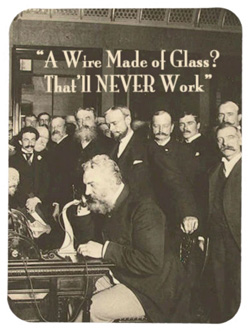
A Wire Made of Glass Tech GiftsBut, you say, I still have copper connections. The RJ45 cable to my computer is clearly twisted pair copper wiring. So is the coaxial cable that provides broadband to the office. Just where is all that fiber you are talking about?

Mostly Fiber Outside, Mostly Copper Inside
The quiet revolution in fiber optic transmission is occurring just out of sight. The reason is simple. Standard Ethernet cabling works great in the home or office. You can easily get 1 Gbps and perhaps even 10 Gbps performance… as long as you keep the cables short. That’s 100 meters or 328 feet for CAT5e or CAT6 at 1 Gbps and CAT6A at 10 Gbps. CAT 6 can also do 10 Gbps at 180 feet or less.

In most smaller offices you never need longer runs to get to the nearest switch or router. Since most network equipment you use every day has a RJ45 10/100/1000 Mbps interface, you’ll probably never have to deal with a fiber optic connection. That is, unless you work in the IT department in a company large enough to have one, or work for one of the telecom carriers.

Just beyond your view, the interface changes from copper to fiber optic wiring. Why? Speed and distance. If you want 100 Mbps Fast Ethernet or 1,000 Mbps Gigabit Ethernet, you need fiber to carry those high speed packets across campus and beyond. You may have copper patch cables at each end, but in-between it’s all fiber.

Fiber To The Curb
If you don't look inside the beast, you can pretend that the Internet is millions of miles of shiny copper wire in a web that covers the Earth. Actually, that’s how it started out. Today that notion is as dated as those obnoxious dial-up tones. The world’s long distance networks have long since been converted to fiber. Fiber is also rapidly replacing the local telco physical plant. When hurricanes and other disasters strike, the phone companies jump to install new fiber to replace plastic coated and even paper coated multi-pair bundles that might be many decades old. Both capacity and reliability are improved and higher speed services are possible.

Why, then, do telephone and broadband connections look the same as they always have? Someday they’ll be changed out, too, but right now it makes more sense to avoid the high cost of running new lines in from the street or rewiring old buildings. The trick to keeping the old twisted pair and coaxial cable able to meet today’s needs is to run the fiber to the junction box at the curb and connect to the existing copper. As you might guess, this is called Fiber To The Curb or FTTC. It’s a stop-gap measure that works well… for now.

Fiber To The Premises
The next logical step is for the service providers to just run the fiber right to your building and give you a fiber or copper connection at the demarcation point. For business bandwidth services, this is becoming the norm. Tens of thousands of cell towers are also being newly served by fiber optic lines. These replace the trusty T1 lines that work great up through 3G, but aren’t up to 4G speeds and certainly not 5G wireless.

This service is logically called Fiber To The Premises or FTTP. For residential service it is often referred to as FTTH or Fiber To The Home. There are two main flavors being deployed. One is active fiber that has all the electronics end to end. The other is a less expensive approach called passive fiber that uses passive optical splitters to connect multiple locations to one shared active fiber strand.

Is It Time to Upgrade to Fiber?
You can pretty much bet that whatever provider you use is running their core network on high speed fiber, probably at 40 Gbps or 100 Gbps. The question is whether they are connecting to you via legacy copper twisted pair leased from the telephone company or bringing fiber right to the premises. Cable companies use HFC or Hybrid Fiber Coax systems, so the less expensive coax broadband service joins their fiber plant nearby on a pole or curb termination box. Cable companies can also connect you directly to their fiber network for higher performance services.

The beauty of bringing fiber to your premises is that it helps future-proof your service. If you install, say, a Gigabit Ethernet port, you can subscribe to any line speed up to 1 Gbps. If you only need 100 Mbps or even 10 Mbps right now, you’ll have the option to turn up the speed quickly with only a phone call. Some providers are now letting their customers log into the system and upgrade their service themselves. Billing accounts for upgrades and downgrades automatically.

Not sure what service makes the most sense for your business? Discuss your needs with one of our expert consultants and see the range of bandwidth options available for your location.


Click to check pricing and features or get support from a Telarus product specialist.


Follow Telexplainer on Twitter


Note: A humorous collection of tech giffts with the theme, "A Wire Made of Glass" are available through Zazzle.

Tuesday, June 24, 2008

DOCSIS 3.0 Fiberizes Cable Broadband

Cable MSOs (Multiple System Operators) have been left grinding their teeth as Verizon's FiOS fiber to the home service blows away the broadband capabilities of coaxial TV cable. Well, perhaps not for long. A new upgrade to the DOCSIS cable broadband standard enhances digital download speeds right into fiber optic download territory - without the FTTH connection.

DOCSIS is the acronym for Data Over Cable Service Interface Specification, the standard for cable modems. In order for cable broadband to work on a systems designed for analog television signals, DOCSIS uses one or more standard TV channels on the download side. The upload channels have to do something different than normal TV reception requires. They have to send information in the reverse direction, from customer premises modem back to the cable head end. To avoid a collision with all those signals coming down, the upstream connection uses frequencies below the TV band.

Cable systems have been running DOCSIS version 1.0, 1.1 or 2.0. They are all based on using a single 6 MHz standard TV channel to carry about 40 Mbps in the downlink direction. Now, 40 Mbps sounds like pretty decent bandwidth if you could get it. But you can't. That 40 Mbps has to be shared between you and all your neighbors. Up to 1,000 of them all getting the same feed on the same channel. Across town, other users are sharing a different channel.

This level of oversubscription explains why your connection speed varies so much. What you experience at any moment in time depends on how many other users are online and whether they are casually surfing the web or downloading videos.

Network performance can be improved by increasing the number of channels available to serve cable modems and assigning fewer users per channel. But to really goose up the bandwidth, you need wider channels. Wider channels don't play with the TV system, but you can bond channels together to combine their bandwidths. It's philosophically similar to bonding channels to increase bandwidth on T1 business lines. That's what the DOCSIS 3.0 specification does. It provides for bonding up to 10 channels of 40 Mbps each for a total of around 400 Mbps. There is a possibility that this could be expanded to 1 Gbps or more in the future.

So, there's no fiber involved? This is done all over standard coax cable? Actually, there is fiber involved behind the scenes. Most cable systems are designed around a combination of fiber optic cable distribution to neighborhood nodes and then copper coaxial cable the premises. This is a HFC or Hybrid Fiber/Coax system. From the customer's point of view it doesn't matter. the customer connection is a F connector on a RG-6/U cable.

The network performance, however is very fiber-like. If your computer says you're connecting at 40 to 50 Mbps it's hard to tell without looking if there is a fiber optic cable plugged into the back of that modem or not. Some Comcast cable customers may have DOCSIS 3.0 by the end of this year.

There are now three competing systems designed to increase broadband Internet access speeds for residential users. FTTP or Fiber to the Premises is the system chosen by Verizon. It's a pure fiber optic network from central office to the user. AT&T is taking a different approach of FTTC or Fiber to the Curb. From there a high speed DSL connection carries the signal into the premises over telephone line. Cable operators use the HFC or Hybrid Fiber/Coax with fiber to neighborhood nodes and then conventional TV cable into the premises.

It seems logical that all-fiber networks are going to have the highest ultimate bandwidths eventually. But for now, the hybrid networks of fiber & telephone wiring or fiber & coaxial cable are doing a good job keeping up with the steady advance of premium service bandwidth.


Follow Telexplainer on Twitter

Tuesday, January 29, 2008

Pair-Bonding Expands Business Bandwidth

AT&T is using a two-prong approach to delivering higher speed digital services, such as U-Verse and faster broadband Internet access. The first is FTTH or Fiber To The Home, a fiber optic link that terminates at the customer premises. The second is FTTC or Fiber To The Curb. With FTTC, the fiber optic cable terminates in a neighborhood junction box and existing copper telephone lines are used to bring the signals the last few hundred to few thousand feet. It is widely expected that AT&T will use pair-bonding to as much as double the delivered bandwidth over copper wires.

Pair-bonding is a technique that bonds, or connects, two pair of unshielded twisted pair copper wire (UTP) so that they behave as one cable with twice the bandwidth. Most homes have two pair already installed from the early days of analog telephony. The second pair is generally used to bring in a second telephone line.

It stands to reason that if pair-bonding will work with DSL signals to residential customers, then it should also work for business lines. Indeed it does. Pair-bonding is a common technique used to increase a T1 point to point or dedicated Internet service connection from 1.5 Mbps to 3 Mbps. But pair bonding doesn't have to stop there. You can bond 3 T1 lines together for 4.5 Mbps, 4 T1s give you 6 Mbps, and so on up to 10 or 12 Mbps as a practical limit. These higher order options are often available, since businesses are generally wired with many more copper pairs than residences.

So why not just go with FTTP or Fiber To The Premises for business locations instead of bonding pairs of copper. Can't you get even higher bandwidths that way? That's usually the case. Ethernet over fiber generally starts at 10 Mbps. Fast Ethernet at 100 Mbps is more common. Gigabit Ethernet is often available using the same fiber connection.

The reason to chose one technology over the other is availability. Fiber optic connections are widely available in major downtown metropolitan areas with many large office buildings. As you get farther afield, fiber availability diminishes. The cost of trenching new fiber has to be justified by a large number of potential customers in the area. If your building is lit for Ethernet, or one nearby is, Ethernet over fiber optic cable is likely to be your lowest cost per Mbps solution.

Even if fiber hasn't made it to your business park or smaller downtown area, it's comforting to know that it is possible to expand your business bandwidth by using pair-bonded T1 lines. T1 services is available most everywhere you'd locate a business. Find out how much bandwidth is available to your business location so you can meet your business expansion needs.

Click to check pricing and features or get support from a Telarus product specialist.


Follow Telexplainer on Twitter