Showing posts with label business cable. Show all posts

Wednesday, June 26, 2019

How to Feed a Hungry WISP

By: John Shepler

We’re a wired nation, except when it comes to locations that are a bit off the beaten path. That includes farms, rural households, businesses beyond the city limits, new subdivisions and some industrial parks. While they may have telephone, thanks to universal service, the availability of broadband Internet access is less of a sure thing. This is where the wireless broadband supplier or WISP fills the gap.
Get the best bandwidth pricing for your WISP.Why WISPs?
WISP or Wireless Internet Service Provider is similar to a cell phone provider, except specializing in high speed Internet access. While even 4G cell service has fairly low usage limits, WISP services are much more generous and try to emulate the type of service you’d get from cable, telco or even fiber optic lines. The real cost to hooking up less populated areas is trenching cable bundles or flying them on utility poles. The WISP eliminates the wires and their associated cost. The tradeoff is that you generally need a small dish antenna and receiver outside to pick up the signal from the WISP tower.

Where Do WISPs Get Their Broadband?
While the WISP distributes broadband much like WiFi, the broadband they serve must come from somewhere. When the Internet was young, T1 lines did an excellent job of feeding the WISP, just like they did feeding cell towers out in the countryside. The beauty of T1 is that it can be sent virtually any distance over standard twisted pair telephone wiring. The downside is that the bandwidth is fixed at 1.5 Mbps per T1 line. Higher speeds can be accomplished by adding or bonding additional lines to double, triple or quadruple the speed. The practical limit is around 10 to 12 Mbps. Pricing goes up linearly as you add each line.

Higher Speed Copper Lines
A newer technology that also runs over twisted pair copper is Ethernet over Copper (EoC). This service offers higher speeds, say 20 or 30 Mbps or even higher. Transmission is distance limited, but EoC is now more available beyond the city limits. Cost is much more attractive per Mbps than T1, if moderate speeds are adequate for what you need.

Business Cable Broadband can provide hundreds of Mbps these days but has suffered from very limited deployment outside of metro areas. That has changed somewhat as the cable has been extended to outlying subdivisions and business parks. If you can get this service and the Cable Company is OK with using it for a WISP, the cost will be very attractive.

Fiber Optic Service
The new gold standard of bandwidth service is fiber optic lines. These used to be few and far between, but provider competition has made them far more common even in rural areas. You can thank 4G cellular for providing the incentive to trench fiber conduits into rural areas. Prices have come down dramatically with Ethernet over Fiber (EoF) services. These are highly reliable and easily scalable up and down in bandwidth to meet your needs. Bandwidths of 10 Gbps up to 100 Gbps are common now.

Microwave Transmission
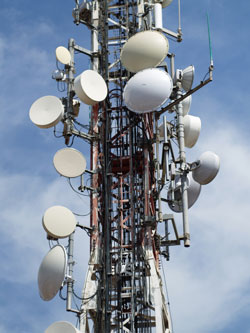
Why not feed wireless with wireless? That’s not a crazy idea and is being used more and more as telco companies upgrade to 5G towers. Microwave is a point to point wireless service. You mount a small dish on your tower and point it toward the service provider. It’s like fiber but without the fiber.

SDN Combines Bandwidth
What if you need more bandwidth than any one supplier can provide? One option is to combine them using a technique called SDN or Software Defined Network, also known as SD-WAN or Software Defined Wide Area Network. The SDN controller manages traffic to get the best performance for each packet. You can combine T1, EoC, cable broadband, microwave, fiber optic lines and even satellite Internet to create a higher speed robust feed for your WISP tower.

Do you operate a WISP service or have one in the planning stage? Find out what bandwidths and pricing are available for your desired locations now. A friendly consultant will help you sort through the options.


Click to check pricing and features or get support from a Telarus product specialist.


Follow Telexplainer on Twitter


Thursday, February 15, 2018

Business Internet Service For Everyone

By: John Shepler

Unlike consumer Internet access, business Internet service has the reputation of being prohibitively expensive and sometimes hard to get, especially in rural areas. Much of that reputation goes back to a time when the incumbent telephone companies were the only provider available. Your choices were, indeed, limited and pricing could make your eyes bug out. Today’s deregulated environment has matured to the point where any business that needs and wants an Internet connection can get one… and at prices that won’t bust the budget.

Find your best small business Internet service options now.Best Options for SOHO, Small Office, Home Office
The smallest businesses are the sole proprietors. Often, these are one person consultancies, remote workers, "gig" workers or web designers who work from home offices. When at the client, they’re carrying a laptop or tablet, plus a smartphone. Budgets are tight, so they want to minimize the cost of Internet access… just as long as it gets the job done.

The lowest cost option for bootstrap operations is residential cable broadband at the home office and 4G LTE cellular on the road. You can pair your tablet and laptop with your smartphone where WiFi is not available. It doesn’t get cheaper than this. Note: Contact your local Cable company for residential broadband.

If you have special requirements such as static IP addresses, any type of server or symmetrical bandwidth, you'll be needing to look at Internet services designed for commercial operations.

Professional Offices
When your business needs a commercial office, you’re probably supporting more than one person. Insurance sales agents, physicians, and any business that wants walk-in clients fits this category. You won’t be able to get residential broadband at a commercial address, but you can get basically the same service branded as “business broadband.” Cable is still an excellent option, with bandwidths up to 100 Mbps common and more than adequate to support a small team. You may even set up a guest WiFi network for clients or bundle television service for waiting rooms.

Higher Tech Offices
Businesses that are tech oriented support such niceties as in-house servers, call centers, and mission critical cloud applications. If you do as much or more uploading as downloading or run a server, cable broadband with its shared bandwidth may be too limiting. Better choices include dedicated Internet access provisioned on Ethernet over Copper at 10 to 50 Mbps or Ethernet over Fiber at 10 Mbps to 10 Gbps. Fiber gives you more options, but isn’t always available, even with construction costs added. Costs are at least several times higher than cable, but performance is more robust for sensitive applications like VoIP telephony and cloud access.

Retail
Most restaurants and bars find the business cable bundles of Internet, television and telephone compelling. It’s a package that is more than adequate and well priced. Special circumstances involve pop-up retail stores that show up just in time for holidays or are located at special events. Wireless 4G is a good fit here. This service works like a smartphone but is built into a special access point that includes a high performance antenna to ensure a strong signal. You can plug in a wired network or WiFi router depending on your needs.

Out In The Boonies
Rural businesses, including retail, agribusiness, machine shops, farms and ranches, gas stations, and so on have needs like their city counterparts, but no wires or fiber nearby. Wireless 4G may work if you can live with the usage limits, which are similar to phone services. If not, high speed satellite can be a better option. Bandwidths up to 100 Mbps are readily available with 1 Gbps coming. Location is unimportant as long as you can point the dish at the bird in the Southern sky with a clear view. The newer satellites have a lot more capacity, meaning that you can get much higher usage limits that fit the needs of many businesses. Pricing is similar to cable and lower speed fiber.

Is Anyone Still Using T1?
Because it was designed to work using the same cable as analog telephone service, you can still get T1 just about anywhere you can get a landline phone. The bandwidth is only 1.5 Mbps, but it is rock solid and reliable. T1 works for applications like credit card verification, email, and light web browsing. Performance is similar to 3G cellular. Prices on T1 lines have fallen so much in recent years that this legacy service is still a good choice in some circumstances.

More Options Than You Think
Are you a small business owner or or an IT consultant serving small clients? You may be surprised at the variety of Business Internet Service Options available now at the locations you need.

Click to check pricing and features or get support from a Telarus product specialist.


Follow Telexplainer on Twitter