Are you running out of bandwidth on your telecom connections? You’ve gone as far as you can with bonded T1 lines. Now you’re considering making the move up to fiber optic services. You’ve heard that those are really expensive and that you can get hit with construction costs on top of the monthly lease price. Is that really true? Is there such as thing as cost effective fiber optic connections?

A lot of what everybody knows about fiber optics is long out of date and may be preventing them from making a smooth and painless transition to unlimited bandwidth options. For one thing, there are options available right now that weren’t around even a few years ago. Pricing has also come down considerably due to competition and new technology. Let’s take a closer look at the fiber optic connections that are located nearby.
Before we start looking down fiber strands for a solution, have you considered the latest in copper technology? Copper is way more than T1 or DSL these days. Ethernet over Copper technology gives you up to 45 Mbps in many business locations. That’s as much as many businesses really need. It’s relatively inexpensive, highly reliable and is provisioned over multiple twisted pairs. Those pairs, by the way, are probably already installed in your building for multi-line telephone service.
Another copper service is cable business broadband. It’s not for everyone, but if you can benefit from shared bandwidth up to 100 Mbps download and 10 Mbps upload for Internet access, the price is right. It’s about the same as a T1 line.
Entry level fiber optic service actually starts with DS3 at 45 Mbps. Nobody thinks about DS3 being a fiber service. It’s delivered over two coaxial cables and often referred to as a T3 line. However, that copper cable only goes as far as the street at most. The rest of the path is over a multiplexed SONET fiber optic service.
It is OC-3 SONET fiber optic service that is fiber all the way. OC-3 was the first fiber optic service available to most businesses. It offers bi-directional 155 Mbps dedicated bandwidth for point to point or dedicated Internet access connections. OC-3 is part of the SONET (Synchronous Optical NETwork) family of traditional telecom services. Next up the line is OC-12 at 622 Mbps, OC-24 at 1.2 Gbps, OC-48 at 2.4 Gbps, OC-192 at 10 Gbps and OC-768 at 40 Gbps.
Competing directly with SONET is now Ethernet over Fiber (EoF). Ethernet over Fiber is a Carrier Ethernet service that is easily scalable so you can increase bandwidth incrementally. That means more intermediate bandwidth steps than SONET and fewer equipment changes. The provider installs an Ethernet port that delivers your service. This is almost always selected at 100 Mbps, 1 Gbps or 10 Gbps. You can get any speed service you want up to the capacity of the installed port. Many carriers are now routinely installing 1 Gbps ports so that start off as low as 10 Mbps and work your way up to 1 Gbps with only a phone call.
How about pricing and availability? It varies greatly, although you should know that there is a big competitive buildout underway nationwide. It’s not just the traditional telecom companies. There are new players with their own fiber networks that run IP at the core. They don’t have a legacy SONET infrastructure to maintain, so they’ll run Ethernet over Fiber right to your door.
The big trick is to have your building “lit” by one or more carriers for fiber optic service. In multiple tenant business buildings there is enough opportunity to attract carriers to install service at little or no cost. If you are the only user, the bar is higher. Some providers are so aggressive that they’ll waive construction costs if you buy a reasonable amount of bandwidth and they don’t have to run the drop too far. Others will ask you to kick in at least a small portion of the construction expenses.
Monthly lease prices have plunged over the last decade for both SONET and the newer Ethernet services. Competition from peers and Ethernet vs SONET has driven fiber optic bandwidth costs down to a fraction of what they were during all the hoopla of the tech boom years before 2000. If you haven’t gone out for quotes in, say the last few months, your jaw will likely drop when you see how much you can get for your bandwidth dollar these days.
What’s the best way to get a reasonable suite of competitive quotes? Use a bandwidth broker, like Telarus, to get
multiple fiber optic service quotes for your location. Their automated GeoQuote (tm) system is so fast that you can get quotes up to 1 Gbps instantly online with no cost or obligation. If you like what you see, an expert consultant will help you sort through the options at your convenience. Go ahead and give it a try now.
 Note: Photo of fiber optic conduit spools courtesy of Wikimedia Commons.

 What is DOCSIS?
DOCSIS is the technology that enables traditional cable TV providers to also offer broadband Internet service on the same cable at the same time. The term is an acronym for Data Over Cable Service Interface Specification. It is the product of Cable Television Laboratories, Inc., CableLabs, a non-profit group supported by the cable system operators.
DOCSIS has evolved along with the Internet. The original spec was DOCSIS 1.0 released in 1997 and defined standards for 40 Mbps download and 10 Mbps upload. VoIP and QoS mechanisms were added by the early 2000’s, along with a boost in upstream data rates to 30 Mbps.
A significant improvement was introduced with DOCSIS 3.0 in 2006. Now cable companies could offer 1 Gbps downstream and 200 Mbps upstream with channel bonding. Support for IPv6 was also introduced at this time. With these improvements, it could be said that cable was a serious competitor to fiber optic services.
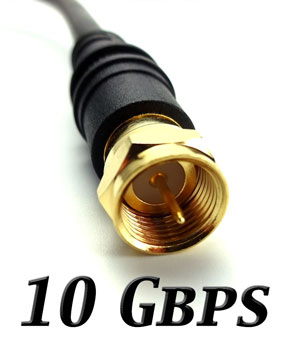
DOCSIS 3.1 in 2013 increased maximum downstream capacity to 10 Gbps with 1 to 2 Gbps upstream and is widely embraced by cable operators. DOCSIS 4.0, the latest version, increased the upstream rate to 6 Gbps in 2017. DOCSIS 4.0 is still in the early stages of production testing and deployment. The ultimate plan is to have full duplex symmetrical bandwidth on cable of 10 Gbps.
How Can Copper Cable Run So Fast?
Truth be told, it’s been a lot of years since cable TV networks were built with coaxial copper cable from the antennas at the head-end all the way to individual households and business locations. Virtually all systems of any size now use a technology called HFC or Hybrid Fiber Cable. The core network is fiber optic cable just like fiber network providers operate. The difference is that those companies run fiber right to the demarcation point within the building, while cable service terminates the fiber somewhere in the neighborhood and the makes the final run with the familiar coaxial cable. It was HFC that really enabled cable providers to offer serious broadband service.
Access Cable Fiber Networks Directly
Cable networks serve extensive metropolitan areas and their suburbs. Multi-system operators have fiber that interconnects their networks and connects to the Internet backbone. Major cable companies have gotten into the business of competing directly with competitive fiber optic networks by offering businesses the option to connect to their fiber networks without going through the copper interface.
There are advantages in going the fully fiber route. You may be able to get faster speeds and fully symmetric and dedicated connections by avoiding the cable modem. Remember that cable broadband is an inherently shared service. You are on the same last-mile Internet connection as dozens or hundreds of your neighbors. As such, you may find the the congestion level and speed of service vary throughout the day. It all depends on what everybody else is doing.
This is the reason that businesses, especially those with significant business processes running in the cloud, opt for dedicated Internet access and point to point private lines. You can get those at low speeds with traditional telco services such as T1 lines and higher speeds with DS3 bandwidth, SONET fiber optic services, Ethernet over Fiber and MPLS networks.
What service will meet your needs depends on how sensitive your operations are to line speed and latency, along with jitter and congestion. Cable broadband, especially at the DOCSIS 3.0 and above levels, provides many, many businesses with highly usable and reliable service at excellent pricing levels. Other companies with more sensitive needs may need to access fiber itself and set up more dedicated and private connections to achieve the performance they require for maximum productivity.
Find out now what cable, fiber and twisted pair copper broadband options are available for your business and what each has to offer.
What is DOCSIS?
DOCSIS is the technology that enables traditional cable TV providers to also offer broadband Internet service on the same cable at the same time. The term is an acronym for Data Over Cable Service Interface Specification. It is the product of Cable Television Laboratories, Inc., CableLabs, a non-profit group supported by the cable system operators.
DOCSIS has evolved along with the Internet. The original spec was DOCSIS 1.0 released in 1997 and defined standards for 40 Mbps download and 10 Mbps upload. VoIP and QoS mechanisms were added by the early 2000’s, along with a boost in upstream data rates to 30 Mbps.
A significant improvement was introduced with DOCSIS 3.0 in 2006. Now cable companies could offer 1 Gbps downstream and 200 Mbps upstream with channel bonding. Support for IPv6 was also introduced at this time. With these improvements, it could be said that cable was a serious competitor to fiber optic services.
DOCSIS 3.1 in 2013 increased maximum downstream capacity to 10 Gbps with 1 to 2 Gbps upstream and is widely embraced by cable operators. DOCSIS 4.0, the latest version, increased the upstream rate to 6 Gbps in 2017. DOCSIS 4.0 is still in the early stages of production testing and deployment. The ultimate plan is to have full duplex symmetrical bandwidth on cable of 10 Gbps.
How Can Copper Cable Run So Fast?
Truth be told, it’s been a lot of years since cable TV networks were built with coaxial copper cable from the antennas at the head-end all the way to individual households and business locations. Virtually all systems of any size now use a technology called HFC or Hybrid Fiber Cable. The core network is fiber optic cable just like fiber network providers operate. The difference is that those companies run fiber right to the demarcation point within the building, while cable service terminates the fiber somewhere in the neighborhood and the makes the final run with the familiar coaxial cable. It was HFC that really enabled cable providers to offer serious broadband service.
Access Cable Fiber Networks Directly
Cable networks serve extensive metropolitan areas and their suburbs. Multi-system operators have fiber that interconnects their networks and connects to the Internet backbone. Major cable companies have gotten into the business of competing directly with competitive fiber optic networks by offering businesses the option to connect to their fiber networks without going through the copper interface.
There are advantages in going the fully fiber route. You may be able to get faster speeds and fully symmetric and dedicated connections by avoiding the cable modem. Remember that cable broadband is an inherently shared service. You are on the same last-mile Internet connection as dozens or hundreds of your neighbors. As such, you may find the the congestion level and speed of service vary throughout the day. It all depends on what everybody else is doing.
This is the reason that businesses, especially those with significant business processes running in the cloud, opt for dedicated Internet access and point to point private lines. You can get those at low speeds with traditional telco services such as T1 lines and higher speeds with DS3 bandwidth, SONET fiber optic services, Ethernet over Fiber and MPLS networks.
What service will meet your needs depends on how sensitive your operations are to line speed and latency, along with jitter and congestion. Cable broadband, especially at the DOCSIS 3.0 and above levels, provides many, many businesses with highly usable and reliable service at excellent pricing levels. Other companies with more sensitive needs may need to access fiber itself and set up more dedicated and private connections to achieve the performance they require for maximum productivity.
Find out now what cable, fiber and twisted pair copper broadband options are available for your business and what each has to offer.


