Showing posts with label AI. Show all posts

Wednesday, August 12, 2026

Make Data Centers Community Friendly

By: John Shepler

There is a huge tech standoff underway right now. It’s between the nearly insatiable demand for additional data centers and community refusals to allow them to be built. Is there any way to satisfy both groups? I think there is.
Why We Need More Data Centers
Why is there such a building frenzy for data centers all of a sudden? Most business IT and e-commerce is well established. What’s new is the recent introduction of powerful Artificial Intelligence or AI tools. AI, itself, isn’t all that new. It dates back to the 1950’s. Over the decades these software applications have been expanded to play chess, answer Jeopardy questions, scan medical images, and search data bases.

In the last few years, more powerful and general purpose applications like ChatGPT, Claude, Gemini and Microsoft Copilot have been introduced and business has gone wild. Every company is afraid that every other company is going to gain a competitive edge by enhancing employee productivity or simply eliminating staff. So, just about everyone is trying their hand at using AI tools. Those tools are supported by powerful processors located in… you guessed it… data centers.

Is This Revolution for Real?
Like the Internet boom that really picked up steam in the 1990’s, AI is likely to transform how we work & live. Also, like the Internet, it isn’t going to happen suddenly and all at once. The Internet and e-commerce took a generation to fully develop. It’s likely AI will follow a similar path to widespread adoption.

What that means is that this immediate need for near-infinite new data centers is probably overblown. Once everyone has had a chance to play with the tools to see what they can do, businesses are going to reconsider how many tokens they really want to buy for experimentation. Some applications will show great promise. Others will turn out to be blind alleys with no return on investment.

In the long run we are going to live in a more technical world and data centers are going to power it. We've been through the massive buildout of factories and shopping centers. We’re now going to switch to data centers and have to figure out how to integrate them into our environment.

Why Are Data Centers a Problem?
Companies building new data centers are naturally trying to get the most benefit from the least cost. That means siting where power is readily available and taking advantage of where land is flat and cheap, especially if TIF (Tax Increment Financing) districts or other tax incentives are available. Communities anxious to bring in new tax revenue have jumped at the chance to get someone to build business infrastructure, only to have regrets later.

A data center isn’t like a factory or shopping center. Once construction is completed, it supports only a few of tech and maintenance jobs and doesn’t primarily serve the local community. Fiber optic Internet means data centers can serve customers anywhere.

What communities are disappointed with is the rise in electric bills for everyone as the massive power needs of the data center are supported, often with new power construction needed. Another complaint is noise. Giant fans for cooling and diesel generators or turbines for power are upsetting to residents in the countryside or subdivisions near where data centers are sited. The power is often needed to supplement limited utility sources as well as backup. Finally, cooling can mean a massive draw on local groundwater that threatens utility users.

How to Make Data Centers Community Friendly
The key to success here seems to mean structuring a deal where both sides benefit. The data center companies need to show a favorable return on their investment or it makes no sense to build, at least in that location. The communities need to be sure that benefits exceed the costs including financial, social, and environmental or they will reject the application.

First is the run-up in electricity rates. Electric bills have been steady for years as heavily using industries relocated overseas and energy saving from things like LED lights and TV sets replaced earlier power hogs in the home. Data center power demand has introduced a new upswing in the need for power generation. One solution is re-commissioning shutdown nuclear plants. New smaller and faster to bring on-line nuclear generators are nearing deployment but won’t be a big factor for years.

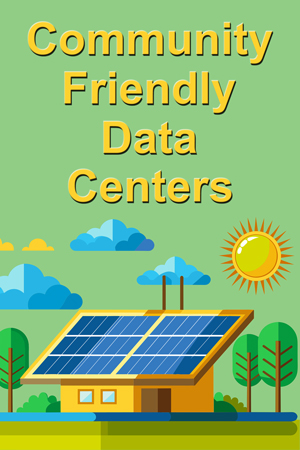
Coal plants get the thumbs down for environmental, but fuel cells using natural gas, like the ones from Bloom Energy, are quiet and more acceptable. Solar, wind and battery don’t cause environmental problems, but can still get objections depending on where sited. OK. Those data centers have enormous flat roofs that can be built to support significant solar power production during the day when demand is highest all-around. Data center companies can also fund off-site solar fields to the feed the grid. Construct extra capacity and utility prices for everyone else should come down, not go up.

Battery storage for overnight and inclement weather is quite practical. Tesla is deploying utility battery storage worldwide. Once again, if the data center funds more capacity than it needs, the community will benefit and should welcome the addition.

Siting is critical. You can’t stick a giant noisy facility near a high-end subdivision and not get serious blowback. Better to get way out in the countryside or in some undesirable area where abandoned factories are decaying or landfills are being reclaimed. Using closed-loop water or refrigerant for cooling limits the drain on well water. Heat dissipation will have to be done without roaring like a jet engine.

Now, forget trying to get tax incentives. Pony up the same taxes as anyone else and create a decommissioning escrow fund for when the facility has reached its useful life and everyone should be happy. Any extra contributions for local schools or roads just sweetens the pot.

If these data centers really are as valuable as promoted, there should be enough money to satisfy both shareholders and community stakeholders. You’ll know the tide has turned when people start requesting data centers be built nearby.

Thursday, October 16, 2025

Is Network as a Service Right For Your Business?

By: John Shepler

Running a company network can be a big operation. Perhaps too big. You need lots of capital expenditures for switches, routers and software. Then you need staff to plug everything together, deal with system failures and constantly keep on top of updates, security patches and incoming threats. But, hey, isn’t that just the price in being in business today? There really isn’t any way to avoid all this cost and hassle and still operate, is there? Or IS there?

Get a quote for Network as a ServiceNetwork as a Service
Actually there is a new trend in network management that might work to your advantage. Instead of doing it all yourself, how about buying the network functions and capacity you need as a service?

You’re familiar with the migration of everything data center to the cloud. Now, the network is moving there too. All that stuff you would otherwise buy and manage, including switches, routers, and security appliances, can be had on a pay-as-you-go basis. What’s more, you can easily scale up and down as your business needs change. No more buying equipment like crazy to meet a demand and then trying to offload it as surplus when the need evaporates.

NaaS takes care of acquiring the physical devices needed to make the network function, but also handles ongoing support. It has the smarts to optimize the network for optimum performance and keep everything up to date. In addition, NaaS can support automatically onboarding new users and supporting new locations without a lot of muss and fuss at your end.

What Does AI Have to Do With It?
Artificial Intelligence is the latest buzzword in business productivity with great promise for future profitability. Actually, AI is here already and has been quietly integrated in all sorts of technology behind the scenes. AI is important to Network as a Service in that the network is being virtualized, adding all sorts of complication. But AI can run this, optimizing the network and responding to changes as they arise. As businesses need to integrate multi-clouds and multiple locations, the workload on IT staff can go through the roof. Letting AI handle all this complexity on a real-time basis can give you much more capability without soaring expenses.

But Will It Help YOU?
Could Network as a Service be advantageous for your company? Maybe, maybe not. The way to make a decision is to find out the costs and capabilities of NaaS options suitable for your size business. Get a complementary quote now and see if you can get more for your network dollar.

Click to check pricing and features or get support from an expert technology specialist.


Follow Telexplainer on Twitter


Wednesday, June 25, 2025

Goodbye Employees, Hello Bandwidth

By: John Shepler

Office employment has been undergoing a major shift since the rise of the Covid Pandemic in 2020 and it’s likely to accelerate rather than return to “normal.” Office buildings nationwide have been emptying out, some being converted to residential units or commercial malls. Even with employees being ordered to return to the office or be replaced, things aren’t really going to go back to mass commutes five days a week, as we’ll soon see. This also has major ramifications for the bandwidth you’ll need and where you’ll need it.

Bandwidth to support the changing business officeReluctant Office Workers Offer Opportunities
How do you get ‘em back in the office after they’ve seen work from home?

That might be the title of a song for the 2020’s. The abrupt culture shock from everyone being sent home, with most expected to keep on working, did indeed break the expected paradigm of where you are supposed to be all day. Once appropriate computers and Internet connections got settled, quite a few customer service reps, programmers, and other information workers found they could work just as well from a spare bedroom or dining room table as in the corporate cubicle. Their productivity even improved without the distractions of office chatter or pro-forma meetings.

Employees might have picked up an hour or two of extra personal time not spent commuting and some could drop the expense of outside daycare for children. Meanwhile, companies that continued this arrangement after the pandemic threat had passed found they could reduce office space expense, including real estate and utilities.

One demand that might have increased is the need for fast highly reliable bandwidth to connect now far-flung individuals. Residential Internet connections have improved greatly during this millennium. High speed cable broadband, fiber to the home and 5G fixed wireless access have made most connections nearly transparent. For more demanding applications, SD-WAN and dedicated point to point private lines can reduce latency and congestion.

Not All of Us Are Coming Back to the Office
Remote work may be a boon for some employees and their employers, but many other companies, including some of the largest ones, want the old culture of co-located teams back for camaraderie and supervision. In fact the managers are insisting on it. To some extent this coalescence will occur, but there is another force at work that is going to disrupt it again.

Artificial Intelligence is heralded to be the next dramatic productivity improvement. There is a mad scramble on to build data centers and secure baseload power to support the coming tsunami of AI applications. These promise to be far more sophisticated than the inane chatbots on many sites that can’t seem to answer the simplest questions. Expect these to get a lot smarter. A lot of the coming AI will not be customer facing. It will handle back office paperwork, data entry, report writing, proposal generation, language translation, code generation, graphic arts, network monitoring & troubleshooting, quality control, financial analysis, legal research and medical image diagnosis just to name a few.

In other words, the century long migration from farm to factory to office is about to hit a brick wall of automation. There is already concern that new hires in white collar professions will be facing an increasingly tough job market, followed by job eliminations right up the ladder.

What Network Technology Will You Need?
If office automation is soon taking over, what do you need to plan for to support this transition? In addition to remote worker systems and bandwidth, you’ll need robust connectivity to the AI data centers where many of these applications will reside. Any apps that deal with the customer directly will require substantial Internet connections, likely right from the data center. Your office team will also need solid connections to those same data centers. The Internet may not be adequate for high bandwidth, low latency, jitter, packet loss and general congestion. A dedicated fiber optic private line, also called a cloud on-ramp, can make this connection transparent and help maximize productivity.

A lot of your communications may be in the form of video conferences, including a mobile workforce and well as the office staff. Don’t forget to include enough mobile bandwidth so that the people in the field are as well connected as those in the office.

Finally, you may be looking at whole new systems of computers, phones, pads and other devices that integrate your staff, management, suppliers and customers along with the AI applications that make it all work seamlessly.

Are your business needs in a state of change? Yesterday’s solutions might not support your future. Let an experienced technology advisor help you acquire the networking services you need to stay at the top of your markets.

Click to check pricing and features or get support from a Telarus product specialist.


Follow Telexplainer on Twitter


Tuesday, December 10, 2024

So Long T1 and POTS, Hello AI

By: John Shepler

Have you gotten the word from your telecom service provider that your T1 lines and POTS telephone lines are scheduled for decommissioning? Perhaps you’ve seen news items to this effect. It’s true. The major landline telephone companies are determined to replace their more than a century old copper cables with the newer technologies of fiber and wireless. It’s happening faster in some parts of the country than others. Like the incandescent light bulbs of the same era, copper telco connections are being relegated to history.

Find fiber and wireless replacements for your copper telecom lines now.Why Do They Hate Copper?
Copper has served us well from the gilded age to this millennium. Copper POTS phone lines are highly reliable and are powered by the phone company. If you lose power, the phone still works because the equipment has battery backup at the central office. If you want the same functionality with your VoIP phones on the Internet, you’ll need add that battery backup at your end.

Copper T1 lines have been the mainstay of both business Internet connections and PBX phone systems for decades. Some companies use them for direct connection from one business location to another. As private lines, they are more secure than the Internet and you avoid the congestion when everyone in the area is trying to work online at the same time.

Like all legacy technology, T1 and POTS lines are getting a little long in the tooth. A T1 bandwidth of 1.5 Mbps was once considered broadband. Now 1.5 Gbps has the same respect. Analog POTS lines and their own unique telephone network are being replaced by LAN and WAN network connected phone systems, often with switching systems in the cloud. As a result, there are fewer and fewer users of these older circuits. Most consumers are primarily dependent on their cell phones and have dropped landline phone. Businesses are heading more and more to the cloud and using fiber optic direct connections to get there.

This is creating quite a dilemma for the phone companies. The incumbent local carriers own all that copper and it is not getting any younger. Fewer customers means less revenue. Corroding wires and insulation result in more any more repair calls. The cost of maintaining that copper plant keeps going up and up.

Copper’s Replacements Are Mostly In-Place
The replacement for all that copper interconnection is fiber and wireless. Fiber has the advantage of nearly unlimited bandwidth. With wavelengths and multiple strands per cable, there is lots of unused capacity that can be pressed into service as data demands increase. The limitation to date has been too few routes installed and lit for service. That’s changing fast. Many cities have seen the future and are contracting for municipal fiber that runs past every home and business. Cellular 5G and eventually 6G require fiber to get the required bandwidths.

The other replacement technology is wireless. The same 5G towers used for phone calls also support fast broadband in the dozens or hundreds of Mbps. Mobile Internet nearly everywhere is already in place. A newer wrinkle is a 5G access point, essentially a phone without the user interface, that installs in a home or business. You have broadband Internet service that is always-on and you don’t need to worry about connecting to a fiber or cable.

There are still dead spots. Sparsely connected areas may not have fiber, cable or cellular coverage. They mostly did have landline phones, though. The replacement for these areas may be GEO or LEO satellite, as they may never get cell towers or fiber lines.

What Becomes of The Copper Facilities?
Oddly enough, the latest technology may provide a new lease on life for the oldest. One proposal is to gut those telco central offices and points of presence and install high powered servers to support the demand for Artificial Intelligence.

The facilities with utility power, battery and generator backup, HVAC, and weatherproof buildings are already in place. By upscaling them to be small data centers located near potential customers, the growing demand for AI services can be supported faster than with all new construction. Another major benefit is the lower latency that comes with having computing at the network edge rather than centralized thousands of miles away.

The copper itself may well be mined to support the need for electrical transmission, electric vehicle propulsion, power generation and more. Some copper cables are pulled out of their conduits as fiber is installed to make room for the new fiber. Copper in the ground and central office wiring may become a welcome source of recycling, much as scrap aluminum is melted down and repurposed. No point in letting it corrode to dust if it costs less to reuse than smelt new ore.

Do You Need Copper Replacement Services?
Have you been notified that your copper telecom services are going to be discontinued or are you just interested in how much more bandwidth you can get for the same or less cost each month? See what fiber and wireless services are available for your business now.

Click to check pricing and features or get support from a Telarus product specialist.


Follow Telexplainer on Twitter


Friday, June 21, 2024

AI Is Going to Eat Your Bandwidth

By: John Shepler

We may be nearing the end of the age of person to person communications, or at least human communication dominating the use of telecom resources. The decline began when computers started using our phone lines to exchange data. It’s only accelerated since nearly all computers are now connected to the Internet at broadband speeds. Even so, much of that computer activity is in the service of people accessing websites, messaging and sending email, posting on social media, watching videos, backing up their files and doing their jobs. Not for long. Pretty soon machines will cut us out of the loop and simply talk among themselves.

Beware the Internet of Things. Join the fun!The Rise of Artificial Intelligence
The scary thing about artificial intelligence, or AI, is how insidious it is. It’s actually been creeping in for decades, probably since the start of the computer age. There’s a lot of AI in search engines, although we may not think of it that way. Most software, in fact, has been adding analytical and decision making capability deep under the hood. You may not be specifically asked your preferences, but that doesn’t mean the program isn’t figuring things out or selecting what information to display and how.

More recently we’ve seen an explosion of “chat bots”, intelligent assistants such as Siri and Alexa, and some quirky writing and photo capabilities in ChatGPT. In fact, it’s the last one that has fueled an explosion of interest and investment in what is called Generative AI, the tech that “creates” all that new content at the push of a button.

NVIDIA can’t make big enough processors on a large enough scale to sate the demand. Data centers are expanding to host more and more servers and new centers are rapidly under construction. One big worry is where all the energy is going to come from to feed the exponentially demanding power-hungry AI processes. Some data centers are being built right next to power plants to grab and many megawatts as they can.

How Nuts is This Going to Get?
One might suspect that we’re in an AI mania combined with a speculative bubble in anticipation that artificial intelligence will render pitiful human capabilities and their jobs obsolete in the matter of a few years… or less. The computer age has certainly eliminated or greatly reduced some roles, like telephone operators and adding machine clerks (human computers), but added new ones as fast or faster. The new AI fever sees the elimination of writers, graphic artists, analysts, software coders, customer service representatives and even law clerks as imminent.

Not so fast. The chat bots I’ve dealt with are complete simpletons that can’t solve much of any real problem. The writing is tedious. The artwork is artificial at best, and inane at worst (how many extra fingers can you add to a person’s hand?). Self driving trucks? Look out when they come barreling around a curve during an ice storm.

I suspect the AI crazy has hyped up expectations far beyond what is really going to work anytime soon. However, that doesn’t mean there isn’t a real germ of innovation underway. One example is the “Internet of Things” that is being touted as the real driver of 5G wireless. Better, faster, cheaper and smaller electronics makes it possible to add both processing and communications to any device. That can be any tool, any monitor, any control system, and most products. It is only logical that these “things” will communicate with other “things”, including computer systems, without our constant knowledge or intervention. The more of these “robots” that are deployed, the more sophisticated the software needed to keep them employed efficiently.

What to Likely Expect
Yes, technology marches on in the name of progress. We’re not going back to living in mud huts or slaving in dingy factories, and the nature of what we do at work will continue to evolve. The increase in productivity should improve our standard of living if we’re smart about it as a society. At any rate, the demands on technical infrastructure are surely going to accelerate.

You can expect more devices on every network, talking faster and demanding faster results. The “cloud” may become an “overcast.” Both fiber optic and wireless bandwidth requirements will move up another order of magnitude or more. A 100 Mbps connection may have been plenty not long ago. Now we clamor for a Gigabit line, with 10 Gbps an emerging business standard. How long before 100 Gbps is routine and 1 Tbps starts looking like a requirement? Within the data center, this could be tomorrow. For access, maybe the day after tomorrow.

How about your business? Are new tools, processes and devices straining the capability of your data center or WAN network? We can help. Get pricing and support on bandwidth and hosting for your current and future needs right now, before those needs become a crisis.

Click to check pricing and features or get support from a Telarus product specialist.


Follow Telexplainer on Twitter


Note: This article was not generated by any AI. It was written by one human (myself) who only worries about the machines scraping the Internet and regurgitating copyrighted material far and wide without any thought of compensation to the author, a real and present danger.

Wednesday, March 20, 2024

How AI is Helping to Improve Call Centers

By: John Shepler

All of us have been frustrated when making calls to customer service… and it seems to be getting worse. High costs and labor shortages serve to dishearten the poor customer hanging on the phone for hours and, also, the companies who desperately need to provide a favorable experience to keep their customers and attract new ones. Tech correspondent David Pogue discusses this situation and possible solutions in this CBS News report:


Did you catch that the likely solution going forward is a combination of traditional call center agents and new artificial intelligence software. The example in the story is called Grace. Here’s a more detailed look at how Grace works as a stand-alone agent:


Of course, even the most advanced AI agents come to a screeching halt when confronted by unique or complex situations. That’s where the best solution is to transfer immediately to a trained human agent. Some of the best agents are located in countries outside the United States and English is not their first language. Many US customers are put off by interacting with an agent with a heavy foreign accent, even though this agent has excellent technical skills. A new AI tool that can help is from a company called Sanas. The software works to change the speaker’s accent without otherwise affecting the conversation. You can try it out online and compare how actual call center agents sound with and without the AI support.

Behind the Scenes
Not all AI tools directly interact with customers. More mundane, yet important, applications include optimizing networks to get the best performance. SD-WAN is a simple system that combines multiple Internet or direct line connections and continuously chooses what traffic to direct down what path. Highly sensitive functions like VoIP phone calls and teleconferences get highest priority on for the lowest latency paths. Less sensitive operations, like remote backups, get lower priority and lesser performing paths.

AI software is also valuable for intelligently routing calls to ensure that they go to the next available person that can properly handle them and to track down key players regardless of whether they are at their desks or on the move.

Do you have communications issues that might be helped with newer or better technical solutions? Things are changing rapidly. Get support and find out what telecom solutions can really benefit your company.

Click to check pricing and features or get support from a Telarus product specialist.


Follow Telexplainer on Twitter