Showing posts with label information technology. Show all posts

Wednesday, August 12, 2026

Make Data Centers Community Friendly

By: John Shepler

There is a huge tech standoff underway right now. It’s between the nearly insatiable demand for additional data centers and community refusals to allow them to be built. Is there any way to satisfy both groups? I think there is.
Why We Need More Data Centers
Why is there such a building frenzy for data centers all of a sudden? Most business IT and e-commerce is well established. What’s new is the recent introduction of powerful Artificial Intelligence or AI tools. AI, itself, isn’t all that new. It dates back to the 1950’s. Over the decades these software applications have been expanded to play chess, answer Jeopardy questions, scan medical images, and search data bases.

In the last few years, more powerful and general purpose applications like ChatGPT, Claude, Gemini and Microsoft Copilot have been introduced and business has gone wild. Every company is afraid that every other company is going to gain a competitive edge by enhancing employee productivity or simply eliminating staff. So, just about everyone is trying their hand at using AI tools. Those tools are supported by powerful processors located in… you guessed it… data centers.

Is This Revolution for Real?
Like the Internet boom that really picked up steam in the 1990’s, AI is likely to transform how we work & live. Also, like the Internet, it isn’t going to happen suddenly and all at once. The Internet and e-commerce took a generation to fully develop. It’s likely AI will follow a similar path to widespread adoption.

What that means is that this immediate need for near-infinite new data centers is probably overblown. Once everyone has had a chance to play with the tools to see what they can do, businesses are going to reconsider how many tokens they really want to buy for experimentation. Some applications will show great promise. Others will turn out to be blind alleys with no return on investment.

In the long run we are going to live in a more technical world and data centers are going to power it. We've been through the massive buildout of factories and shopping centers. We’re now going to switch to data centers and have to figure out how to integrate them into our environment.

Why Are Data Centers a Problem?
Companies building new data centers are naturally trying to get the most benefit from the least cost. That means siting where power is readily available and taking advantage of where land is flat and cheap, especially if TIF (Tax Increment Financing) districts or other tax incentives are available. Communities anxious to bring in new tax revenue have jumped at the chance to get someone to build business infrastructure, only to have regrets later.

A data center isn’t like a factory or shopping center. Once construction is completed, it supports only a few of tech and maintenance jobs and doesn’t primarily serve the local community. Fiber optic Internet means data centers can serve customers anywhere.

What communities are disappointed with is the rise in electric bills for everyone as the massive power needs of the data center are supported, often with new power construction needed. Another complaint is noise. Giant fans for cooling and diesel generators or turbines for power are upsetting to residents in the countryside or subdivisions near where data centers are sited. The power is often needed to supplement limited utility sources as well as backup. Finally, cooling can mean a massive draw on local groundwater that threatens utility users.

How to Make Data Centers Community Friendly
The key to success here seems to mean structuring a deal where both sides benefit. The data center companies need to show a favorable return on their investment or it makes no sense to build, at least in that location. The communities need to be sure that benefits exceed the costs including financial, social, and environmental or they will reject the application.

First is the run-up in electricity rates. Electric bills have been steady for years as heavily using industries relocated overseas and energy saving from things like LED lights and TV sets replaced earlier power hogs in the home. Data center power demand has introduced a new upswing in the need for power generation. One solution is re-commissioning shutdown nuclear plants. New smaller and faster to bring on-line nuclear generators are nearing deployment but won’t be a big factor for years.

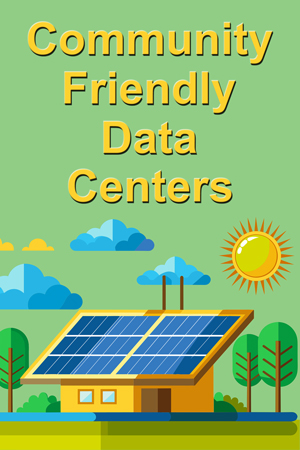
Coal plants get the thumbs down for environmental, but fuel cells using natural gas, like the ones from Bloom Energy, are quiet and more acceptable. Solar, wind and battery don’t cause environmental problems, but can still get objections depending on where sited. OK. Those data centers have enormous flat roofs that can be built to support significant solar power production during the day when demand is highest all-around. Data center companies can also fund off-site solar fields to the feed the grid. Construct extra capacity and utility prices for everyone else should come down, not go up.

Battery storage for overnight and inclement weather is quite practical. Tesla is deploying utility battery storage worldwide. Once again, if the data center funds more capacity than it needs, the community will benefit and should welcome the addition.

Siting is critical. You can’t stick a giant noisy facility near a high-end subdivision and not get serious blowback. Better to get way out in the countryside or in some undesirable area where abandoned factories are decaying or landfills are being reclaimed. Using closed-loop water or refrigerant for cooling limits the drain on well water. Heat dissipation will have to be done without roaring like a jet engine.

Now, forget trying to get tax incentives. Pony up the same taxes as anyone else and create a decommissioning escrow fund for when the facility has reached its useful life and everyone should be happy. Any extra contributions for local schools or roads just sweetens the pot.

If these data centers really are as valuable as promoted, there should be enough money to satisfy both shareholders and community stakeholders. You’ll know the tide has turned when people start requesting data centers be built nearby.

Tuesday, December 14, 2021

From Megabit Copper to Gigabit Fiber

By: John Shepler

You know it’s time to upgrade your WAN bandwidth. There are two major forces at work to make this a necessity. First, the load on your network connections is steadily increasing. Second, legacy copper services that have worked so well for decades are being phased out by the carriers. It’s the right time to make a move to gigabit fiber.

Your path to gigabit Ethernet is here. See what is available now.What’s Driving The Need to Upgrade
Information technology is a different animal than it was in years past. If you’ve been working in technology for ages, you probably remember when computers, their peripherals, and software were all in-house. Connections to the outside were for communication between locations and to the Internet. When there weren’t that many resources to access outside, there wasn’t a need for very high bandwidth.

That’s all changed. The entire IT architecture has been turned on its head. Now, there is very little computing done in-house and a crying need for massive connectivity to the cloud where the computers, storage, and software reside. The Internet has evolved from a simple messaging system to an almost infinitely deep well of resources on all subjects. Communications via the Internet are much more demanding due to the heavy concentration of massive files and high resolution video.

Even small businesses need what used to be considered extremely high bandwidth. Medium and larger companies can’t live without the throughput of high speed fiber optic connections.

Why Copper Connections are Disappearing
Until just a few years ago, twisted pair copper cables connected to a telephone company central office were considered standard fare for both voice and data. That was before the migration away from POTS (Plain Old Telephone Service) landlines. The replacement is VoIP telephony running on the same computer network that interconnects desktop computers, network storage, printers and servers. The in-house telephone switch, called the PBX, has suffered the same fate as most in-house servers. It has moved to the cloud.

The other use for these twisted pair cables was point to point and dedicated Internet connections at 1.5 Mbps. Those T1 lines have faded in popularity as speed demands exceeded their capacity long ago. The upgrade, DS3 delivered on coaxial copper cables, travelled most of the distance multiplexed on SONET fiber optic cable. Only the connection from the curb was copper.

Faced with a waning demand for copper-based telecom services that are ordered less often by businesses and are too slow to support 4G LTE and 5G cellular stations, the telephone companies that own the copper are either ripping it up for recycling or letting it corrode in the ground. It won’t be long and you’ll have to upgrade even if you don’t need the additional bandwidth.

The New Standard is Fiber Optic Ethernet WAN
The majority of telecom traffic now is Ethernet packets. Rather that convert the protocol to and from legacy telco services, Ethernet over Fiber is the new WAN standard.

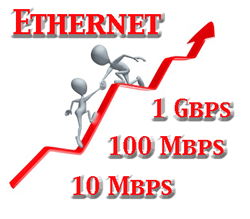
Bandwidths are typically available from 10 Mbps at the low end to 10 Gbps at the high end, with 100 Gbps available in some major areas.

Like earlier copper telecom solutions, you have the option of setting up point to point private lines or dedicated Internet access. Both are supported by Ethernet over Fiber. Private lines offer dedicated bandwidth so you don’t have to compete with other companies for the capacity of the line. Dedicated Internet Access also gives you exclusive use of last mile connectivity. Of course, the Internet itself is a shared medium.

How about availability? Fiber optic lines are becoming almost ubiquitous these days. The exception is rural areas or remote business and industrial parks that aren’t served by fiber yet. Sometimes you can get near-fiber performance by cable broadband solutions that can reach 1 Gbps of shared bandwidth at bargain prices. If you are located remotely, you can often get 4G LTE and 5G wireless business solutions that many not offer the ultimate in bandwidth, but are often great solutions to replace obsolete copper lines.

Is your business running short on bandwidth or have you been notified that your copper bandwidth options are being discontinued? If so, now is the perfect time to check out prices and availability of gigabit fiber optic bandwidth for your business locations.

Click to check pricing and features or get support from a Telarus product specialist.


Follow Telexplainer on Twitter


Thursday, January 22, 2015

Now VoIP is Spelled C-L-O-U-D

By: John Shepler

Thomas Edison first hears about VoIP telephone technology. Get this poster for yourself.When VoIP telephony first appeared on the scene, it looked distinctly like a different way to make a phone line. In fact, a lot of the motivation in switching technologies was based on trying to avoid long distance toll charges on the PSTN. We’ve come a long way from Analog Telephone Adaptors (ATA) to IP PBX. The next big migration is away from in-house VoIP systems and out to the cloud. It’s a migration that could easily turn into a stampede.

The Need For Speed
What’s driving the continuing innovation in VoIP technology? It’s all part of the business reorientation away from ownership. The “great recession” exacerbated a trend that was already underway. Business wants and needs to be nimble. Timelines that used to be measured in years are now months. This is especially true for seasonal businesses, but can affect everybody. Why do you want to be stuck with assets that are too much or too little for what you need right now? Why, indeed, when you have to option to match resources to needs on the fly?

Nimble is the Cloud
That’s the promise of the cloud. As one tenant among many at a datacenter with seemingly unlimited resources, you can quickly scale up and down as needed. It’s unlikely that your needs will tax the system or leave it sitting idle. If the providers are doing their jobs, there will be plenty of capacity for everyone and enough in reserve to handle unexpected requirements.

Contrast that with running your own data center in-house. Running out of capacity? You better get to work preparing the justification and requests for more capital. Then get the equipment and software ordered, installed and on-line… before external events bring your business to its knees. That’s weeks, months and sometimes years.

Much easier just to make a phone call or, better yet, log-in to your online control panel and activate or deactivate resources. An unexpected flood of orders is cause for celebration instead of panic when you can respond instantly. Business fall off a cliff? No need to be stuck paying for idle capital when you can be rid of it and its unjustified expense in a moment.

Why Do You Really Need a Phone System?
The obvious reason to have a business phone system is for critical communications among employees, customers and vendors. Actually, that’s the reason to have the phone function. You don’t really need to have the system yourself.

The telephony cloud solution is called Hosted VoIP or Hosted PBX. All that “big iron”, as these systems are lovingly referred to, go out the door. They are replaced by cloud services that take care of call switching and connections to the public telephone system. How that’s done is invisible to you. Your phones work the way they should and you don’t have to deal with having to maintain a morass of wiring and rack equipment.

You also don’t have to cough up the capital needed to purchase a premises telephone switching system or replace one that has reached its capacity limit or useful life. Adding or removing phone from a hosted system is almost trivial. You’ll always have exactly the right level of resources to meet today’s needs. You also have the peace of mind that comes from knowing if things change tomorrow, you can easily accommodate the new situation.

The Technology Advantage
Another promise of VoIP technology is that phone networks become more like computer networks. In fact, there is generally one network that serves both phones and computing equipment. Building phones with little computers inside expands the possible functions they can do and make it easy to integrate them with desktop computers for combined operations. That’s especially valuable for call center operations.

The cloud hosted phone system also may have the capability to integrate mobile phones as well as the hardwired variety. Few in-house PBX systems can do that. In the end, you want employees to be able to do their jobs whether they are at their desks, out in the field, in a hotel room or anywhere else. That’s something technology can accomplish today… but you can’t do it with yesterday’s gear.

Are You Missing Out?
The telephone cloud has developed so rapidly that many companies aren’t even aware of the capability that’s out there and how cost effective it can be. Could you benefit from a hosted VoIP phone solution ? You might be able to sooner than you think.

Click to check pricing and features or get support from a Telarus product specialist.


Follow Telexplainer on Twitter

Monday, May 12, 2014

Non-PBX Telephone Solutions

By: John Shepler

We all know what business telephone systems look like. The very smallest consist of a single desk set or a cordless system with multiple handsets but still one line. Next up are key telephone systems where each phone has buttons to access 2 to 6 outside lines. Beyond that is the realm of the Private Branch Exchange or PBX. This is the standard for most business office applications… or at least it was.

Non-PBX telephone systems for your organization.Why PBX?
What made PBX systems popular was the opportunity to get away from having to pay the telephone company for internal calls and lines that mostly sat idle. Yes, there was a time when every phone had its own line to the telco and its own incoming phone number. If you wanted to call someone down the hall, you had to place a local phone call just like if you called someone across town. Each of those calls rang the register at the local phone company.

Direct Connections
It seems obvious today that calls from desk to desk inside your own building should be direct connections. There’s no need to use an outside line to go down to the telco switch and another line to come right back. A simple connection between the two local phones works just fine. What’s needed is a switch like the one at the telephone company office, but for inside the business only. That’s what a PBX is. It’s a miniature telephone exchange switch. That’s the “private” in Private Branch Exchange.

Why PBX Seemed Ideal
All internal calls are managed by the PBX on its own wiring. There are no per-call charges. The PBX also manages outside lines that are used for calls that come in to or leave the premises. There are almost always fewer outside lines than phones because many calls are internal and most phone sit idle while other work is being done. This optimizes the cost of telephone service for the business, right?

Escalating Costs
That was true when PBX was the only game in town. The one fly in the ointment is the cost of the PBX system including maintenance and repairs, and the everyday effort needed for moves, adds and changes. That PBX is just a machine. It doesn’t know that you moved your phone to another location until you tell it to use a different set of wires.

Flexibility Issues
PBX systems aren’t all that flexible, either. Each machine has a capacity. Sure, you can upgrade to add more phones… up to a point. Then you have to install a much larger system when your business grows beyond what your current equipment will support. That’s a major capital investment.

What’s a Better AlternativeToday?
Like many innovations in information technology, moving your phone system to the cloud offers a number of advantages. Yes, there is still something that provides the same function as your old PBX. But, it is a largely software driven system that is located remotely, has nearly unlimited expansion capacity and, best of all, you don’t have to pay for it. You only pay to use the system.. and that’s pay as you go.

How Cloud Communications Works
Cloud communications, also called Hosted PBX or Hosted VoIP, is a virtual PBX system offered as a service. What you have in-house are telephones that plug into your local area network instead of standard telephone jacks. The connection from the network to the service provider is called a SIP trunk. It serves the same function as the analog or digital lines to the phone company that you have now.

What You Gain With a Hosted Solution
The beauty of a hosted PBX solution is that you can move phones around at will without any wiring changes. Just plug the phone into another network jack and the system will recognize it and know who it is assigned to. Adding or removing phones from the system is done through a simple browser interface. Some cloud suppliers will even provide you with business phone sets as you need them. It’s included in the “per seat” cost of your service.

Day to Day Operations
How does this work on a day to day basis? Your phones still act like normal telephones. You can make internal calls with no per-minute charges, often even if the other phone is at a branch office on the other side of the country. Only calls that have to go over the public telephone system will still have per-minute charges, like you pay today.

Advanced Calling Features
Hosted PBX systems are always up to date and have advanced calling features you may not enjoy today, such as the ability to include mobile phones within the system. They have a dedicated staff to keep the switching equipment working 24/7. In the rare event that tornado or flood destroys your office, your phone system will still work. You just need some working phones and a network connection to the cloud to be back in business.

Check Out The Value of Non-PBX Solutions
Are you looking at a new business phone system or facing a costly upgrade cycle? Before you go the PBX route, take a look at what a hosted PBX solution offers in the way of performance and cost control for your organization.

Click to check pricing and features or get support from a Telarus product specialist.


Follow Telexplainer on Twitter

Monday, February 03, 2014

How You Can Benefit From Wavelength Services

By: John Shepler

What do you do when you have a need for high bandwidth, security and flexibility in your WAN connections? This may be the time to take a closer look at wavelength services.


What tradeoffs should you do to ensure that you’re getting the right bandwidth for your operation? Certainly, there is the protocol competition between the dedicated point to point line services provided by SONET/SDH and Ethernet over Fiber. Both will get your packets from point A to point B, but you may find that locations lit for EoF have access to much higher bandwidths for the same lease price or a cost savings if you don’t need a BW upgrade.

One important consideration is the protocol that you wish to transport. Ethernet is easiest to connect and most efficient over Ethernet WAN services. SONET/SDH is designed for TDM, but can also support packet switched networks. The waters have been muddied lately by the addition of Ethernet over SONET that gives you Ethernet services running on mature SONET fiber optic networks.

Another tradeoff worth doing is lit fiber vs dark fiber. Wavelengths are a lit fiber service. They are fully managed in the sense that the carrier provides the fiber path plus the terminal equipment that accepts and delivers your traffic. You don’t need to be concerned about the inner workings of the network because the carrier takes care of that for you.

The big advantages of dark fiber are improved security, since you are providing the terminal equipment at each end of the fiber, and the ability to create your own wavelengths. You’ll need to invest in the CWDM (Coarse Wavelength Division Multiplexing) or DWDM (Dense Wavelength Division Multiplexing) equipment. By doing that, you can have as many wavelengths as you wish, each running a different protocol. You can even multiplex wavelengths to create higher bandwidth pipes.

What is the right connectivity solution for your needs? Get expert recommendations on fiber optic wavelength services now.

Click to check pricing and features or get support from a Telarus product specialist.


Follow Telexplainer on Twitter

Monday, January 27, 2014

Is Your Network Capacity Drying Up?

By: John Shepler

It can sneak up on you without warning. One day, the network is running smoothly. Next day it’s all congested. How did that happen? More importantly, what can you do about it?


Network capacity, especially MAN and WAN network capacity, can dry up quickly as applications become more demanding. Video is a major bandwidth hog. Backups to remote data centers can also chew up a lot of your capacity. Worst of all is The Cloud. You might think that your troubles are over when you outsource your applications to cloud service providers. What is often forgotten is that all that user bandwidth supplied by your LAN must now be supplied by the WAN. Not just any bandwidth, mind you. It needs to be low latency bandwidth or you’ll still have troubles.

Why low latency? You know that latency is critical for sensitive real time apps like VoIP telephony or high definition video conferencing. But how about those business applications that moved from the local data center to the cloud? Latency is easy to control locally. It can be an issue on long distance connections, especially if you elected to use the Internet as your cloud connection service. Latency shows up as hesitation in cloud response. A little can be annoying. A lot can be a major productivity killer.

Fortunately, high bandwidth low latency connectivity is easier than ever to fit into your IT budget. Prices have plummeted in recent years on everything from old school T1 lines on up to the SONET/SDH and fiber optic Ethernet. Even MPLS networks for connecting multiple business locations may cost less than you think.

If you haven’t gone out for competitive price quotes in a few years, you’re in for a pleasant surprise. You may find that you can double your MAN or WAN bandwidth for the same telecom budget that you have now. By upgrading from TDM based SONET fiber optic services to Ethernet over Fiber, you may well be able to afford a lot more capacity than you have now. The cost per Mbps or Gbps is much more attractive for Carrier Ethernet, especially if you get your service from a competitive provider who can provide both core network and last mile connections on their own network.

Could you use a bandwidth upgrade soon? Perhaps even right now? Get fast bandwidth quotes customer tailored to your particular needs now.

Click to check pricing and features or get support from a Telarus product specialist.


Follow Telexplainer on Twitter

Tuesday, January 03, 2012

The Ubiquitous Cloud of 2012

The business skies are clouding for 2012. This cloud isn’t a sign of foul weather ahead. Just the opposite. The cloud of 2012 brings relief to businesses living on a razor’s edge with little confidence in their ability to predict the future. Why try to be a forecaster when you can simply position yourself to respond as needed, depending on which way the wind blows?

The future of cloud services is bright...Is there climate change afoot? One could easily argue that the business climate has already changed. Many businesses have found themselves stuck in the doldrums where nothing moves at all. Others experience volatility, where they are not sure which way the breezes will blow tomorrow. How many managers long for the old days, not that many years ago, when growth was robust, the path ahead was crystal clear, and there were no storms brewing on the horizon?

The best remedy for this new, new climate may not be to run away from developing clouds, but toward them. The IT cloud can be the solution you need to fend off those other clouds of doubt, worry and ill-weather. What the information technology cloud can do is let you ride with the wind and tack as needed to meet your business goals. Technically, what cloud services do is let you move from an ownership model of investing, maintaining and upgrading to a rental model of pay-as-you-go.

Ownership has its advantages. It puts you in control. Your business capital is right down the hall where you can see it. Nobody can take it away from you because it’s yours. You can do with it what you wish. There is depreciation to help the bottom line and once it is paid off, you own it without further payments... or so you think.

The problem with the ownership model for technology is that today’s servers and PBX systems aren’t like steam engines, lathes, CNC machining centers or mainframe computers. You don’t buy a monster machine for your company and expect it will still be going strong long after you retire. The half-life of anything powered by electronic chips or dependent on the vagaries of the World Wide Web is almost shorter than the time you need to get it fully productive.

Your capital investment is also the start of your costs, not the end. Even if breakdowns are infrequent, there is a steady stream of upgrades, modifications and security features to be installed and tested. That means ongoing costs for both software and personnel. None of this stuff runs perfectly for long with your back turned. There is always the need to deal with something that has dropped offline or needs a soft reset. It is nature of anything microprocessor based to get lost in its nearly incalculable software paths. It’s rare that you need to shutdown a box to stop the smoke from pouring out. It’s a given that you’ll need to unplug it and plug it back in to “magically” fix whatever is hung up.

There’s no denying the inherent nature of technology. The real question is whether it makes more sense for you to take ownership of these issues or pawn them off on someone else. A decade or two ago, the answer was clearly to do as much in-house as possible. Today? Launching those monkeys off your back and into the cloud is looking better and better.

I haven’t dropped the word “outsourcing” yet, but this is the time to embrace it. In simplest terms, you hire someone else to do things that are more cost effective for them to handle than for you to do yourself. On a macro scale, there can be major societal upheaval caused by suddenly shifting 100,000 jobs from here to there. On a micro scale, business by business, the evolution from doing everything in-house to buying services from other companies specialized in that service can increase your agility to compete in a world where the view of tomorrow is murky. Outsourcing technology to the cloud is going to be big in 2012, perhaps enveloping.

What can you transfer to the cloud? Technology tools are prime candidates. You use these tools to perform your business, they aren’t the core of your business. Does it make any difference to the nature of what you are doing whether you own that rack of servers, rent the same boxes from a colocation center or pay by the hour to use virtualized servers in the cloud? Not if they all do exactly the same function.

Technology services in the cloud now include virtual servers that can be expanded or contracted instantly, pools of disk storage, high bandwidth Internet connections, network security, development platforms, enterprise software packages, and telephone communications. That’s right, you no longer need a telephone system in your office. You still need the phones, of course, but the switching system and the outside trunk lines to the public telephone network can be provided by the cloud. That includes contact and call centers as well.

There must be a good reason for all the fervor surrounding cloud based services. Is it simply the fashionable new thing for business or are we experiencing a fundamental shift in how we will run businesses for the foreseeable future? If this is the new mode of operation to be competitive, how long do you want to wait before checking it out? It’s likely well worth your while to at least compare cloud options to what you are doing now. Then decide whether a small cloud, large cloud or no cloud at all makes the most sense for your business.

Click to check pricing and features or get support from a Telarus product specialist.


Follow Telexplainer on Twitter

Monday, May 23, 2011

Global Crossing Ups Ante On Network Security

What’s a major expense for organizations that nobody wants to talk about? Security breaches. It seems like every few days there’s another big splash in the news about user accounts and credit card numbers being compromised. There’s the direct cost of having to make up for losses, but there’s the larger cost of concerned customers abandoning or avoiding the company out of fear they’ll be the next victims.

Get managed security options for your company. Click for features and pricing.These are the security horror stories we hear about. What generally isn’t reported is the espionage and theft of intellectual property that goes on behind the scenes. Your competitive advantage can be neutralized in minutes when key trade secrets and client lists are downloaded by unethical competitors and professional thieves.

Most companies are more attuned to network security than ever before. But is it enough? Judging from breaking news stories and industry buzz, not hardly. This is why Global Crossing is expanding its portfolio of security solutions for enterprise customers.

Global Crossing is well known as a leading worldwide IP network provider serving 40% of the Fortune 500 and hundreds of carriers, mobile operators and Internet service providers. They have the resources and the reach to deal with threats on an international basis. They also have the need, as their customers are prime targets for nefarious activities.

Global Crossings expanded suite of network security measures now includes a new SIEM or Security Information and Event Management platform. This resides in the Global Crossing Security Operations Center (SOC) where a team of security professionals, analysts and engineers monitor and assess network security issues on a full time basis. The reports and analysis are delivered to the proprietary uCommand portal for each customer.

The suite of security features includes a firewall, intrusion prevention service, web content filtering, antivirus and antispam appliance provided by Fortinet. This is augmented by additional professional services that include security policy review and creation, penetration testing, vulnerability assessments, incident response and security assessment and audit.

This is a multi-pronged approach that starts with evaluation and design of policies, procedures and technical measures, continuously monitors for threats, automatically thwarts them in progress and reports the attacks, plus jumps into action to deal with new issues as they arise.

The challenge of network security is that it is a rapidly evolving field with highly motivated and increasingly sophisticated perpetrators pitted against equally motivated security professionals. The more valuable your assets and the more your company depends on network connections and an online presence, the greater the threat to your operations.

Are you feeling the need for improved network security? If you are beyond what out of the box antivirus programs can do for you, a managed security solution may be your most cost effective option. Whether you have a small retail store or a Fortune 500 corporation to secure, get pricing and features of managed network security options new. You’ll likely sleep a lot easier knowing that someone in the security center is watching out for your interests.

Click to check pricing and features or get support from a Telarus product specialist.


Follow Telexplainer on Twitter

Monday, March 21, 2011

From CAPEX to OPEX In The Cloud

There’s a new cost model for Information Technology. It’s a move from high CAPital EXpense or CAPEX to OPerational EXpense or OPEX. What’s driving this change? It has to do with the uncertainty of the business climate and the availability of cloud computing services.

Cloud services move you from capital intensive to pay as you go IT services.What’s wrong with the way we’ve always done it? The legacy practice of building on-site environmentally controlled data centers and stocking them with server racks, arrays of disk storage and network appliances works very well if you can come up with capital to implement this plan.

There are also operational costs in the form of electricity, bandwidth and staffing, not to mention the near-constant process of patching and upgrading software. Those software packages aren’t cheap, either.

Traditional Information Technology is capital intensive. That hasn’t been a problem until recently because it was accepted business practice and everybody did it. Then along came the “Great Recession” and everything changed. We’ve had a lot less certainty about the economy the last few years. Most companies have responded by hunkering down and minimizing cost of all types. For those that see opportunity and want to expand, there’s a dearth of available financing.

Any wonder why cloud services are multiplying before our eyes? The business climate provides the impetus and the cloud provides the solution. It’s a combination that’s turning a trend into a stampede.

What’s so great about moving out there to the cloud? For many companies, it’s a combination of agility and expense versus commitment and capital. There’s nothing going on in the cloud that you can’t do yourself. What cloud service providers offer is a way to offload, or outsource, the infrastructure, platform, software and staffing that isn’t proprietary to your business.

For smaller companies, buying cloud services gives them a robustness of computing that they’ve never had before. If you are too small to have a dedicated IT staff on duty around the clock, you’re pretty much flying by the seat of your pants. You expect that whatever is working today will still be working tomorrow. When a part of the network or process goes down, you troubleshoot as best you can or get on the phone to a consultant or the vendors. It’s not unusual to have long periods of unplanned downtime.

Not so if you get your computing and perhaps your telephone service from a reputable cloud provider. The core business of the cloud services company is to provide a limited number of services and execute them perfectly. They have the equipment, the redundancy and the staff to make sure things are always up and running. It’s what keeps their many customers buying from them. You may not need an extensive array of servers, storage, software or bandwidth, but you’ll benefit from using the same infrastructure as those who do.

For the larger organization, high performance is a basic expectation. What the cloud has to offer the enterprise is a way to increase and decrease infrastructure resources on demand. You need more virtualized servers? You’ve got ‘em. You need more storage? There’s plenty in the pool to draw from. More visitors creating a demand for more bandwidth? No problem. The fiber optic lines are already in place with more bandwidth than any one company can use.

You simply pay for what you need when you need it. That gives you a tremendous flexibility to pursue new business opportunities with the knowledge that if they don’t pan out, you are not committed to a huge computing investment that must be paid off regardless.

Could your small, medium or large enterprise benefit from moving from a capital intensive to a pay as you go expense model for information technology services? Find out by comparing prices and available services from cloud service providers. Then get started at the level that makes the most sense for your organization.

Click to check pricing and features or get support from a Telarus product specialist.


Follow Telexplainer on Twitter

Monday, March 14, 2011

Why Managed IT Services Are So Popular

There’s been a profound shift in the way information technology services are implemented. What’s happened recently is that service providers have entered the realm of managed iT services en masse. Some of this has been a direct result of the rise of cloud computing. Other offerings have been a recognition that both staffing and capital are much more restricted than ever before.

Managed IT Services in the CloudCall it the business environment wrought by the Great Recession or call it a paradigm shift in technology. The upshot is that companies are taking a much closer look at procuring more and more of their IT services through colocation, cloud computing, or managed network services.

Just what makes managed IT services so attractive? To some, it’s a way to put the monkey on somebody else’s back. To others, outsourcing wins the make versus buy cost tradeoff. For many other business, there is so much volatility in the economy that it just makes sense to pay as you go.

Cloud computing fits the pay as you go model perfectly. You know that running your own data center involves buying lots of equipment, installing it in racks located within an environmentally controlled room, and then managing a continuous stream of patches, upgrades and trouble tickets. It’s also a balancing act. If you buy too little in the way of processing or bandwidth, you run the risk of being unable to serve an unexpected surge of customer orders. Buy too much and it sits there unused, but costing just the same.

When you “rent” in the cloud, you have an almost unlimited pool of processing power, storage and customer bandwidth to draw from. There is an expert staff that keeps everything running smoothly 24/7 without your involvement at all. Best of all, you pay for what you need while you need it. Scaling up or down can be done rapidly. There’s less pressure to correctly predict short term business activity when you can adjust on the fly as needed.

Hosted business telephone is another huge growth area for managed IT services. It’s come about for the same reasons that pushed cloud computing in to the limelight. Any business that needs more than a few handsets and outside lines finds itself becoming a small independent phone company. The cost of a PBX system to manage all the in-house and outside connections can run into the tens or even hundreds of thousands of dollars. You traditionally connect it to all those desk phones through its own network and then have staff to manage the moves, adds and changes.

Once enterprise VoIP became feasible using converged voice and data networks, the dedicated phone network was no longer needed. The IT staff could manage the phone equipment too. But why pay for equipment at all? Just extend your LAN with a SIP trunk to a managed service provider and that expensive central switch, the staff needed to keep it running and all the outside phone trunks become something you can rent by the month.

Do you have a dedicated remote data center for backup storage and disaster recovery? It’s a form of expensive insurance you can’t do without unless there’s an equivalent alternative. That alternative is encrypted cloud storage. You have the protection against outages without having to buy and maintain the asset that gives you that protection.

IT departments have also been expected to manage WAN bandwidth, even to the extent of creating their own MAN and WAN networks using dedicated point to point lines. All that grief goes away when you use managed Ethernet and MPLS network services. The service provider has the responsibility of keeping the packets flowing, even in the middle of the night.

Is your company ready to consider managed IT services as an alternative to doing it all yourself? Perhaps you just want to shop for the best deals on these managed services. Either way, get availability and pricing for competitive Managed IT Services now and see how much you can save.

Click to check pricing and features or get support from a Telarus product specialist.


Follow Telexplainer on Twitter

Thursday, February 10, 2011

New Phoenix Data Center Offers Colocation Services

Data centers are expanding as the business climate improves and companies pursue productivity increases and lower costs. Many businesses that never gave a second thought to using colocation facilities are taking another look. In the Southwest USA, a good place to consider is the new PAETEC Data Center in Phoenix, Arizona.

Discover the new PAETEC colocation center in Phoenix and other cloud and colo services.PAETEC has just cut the ribbon on their 4,400 square foot Phoenix data center as part of an expansion program that adds to their facilities in Bethlehem and Conshohocken, PA, Andover, MA., Houston, TX and Milwaukee, WI. Why? Customer demand. The role of Information Technology is changing and the “cloud” has a lot to do with it. PAETEC is positioning itself to capitalize on this movement with services that improve business continuity, information safeguarding, network latency reduction and a reduction of management needs.

The idea behind the cloud is one of economy of scale. You can have every company buying servers and racks, putting them in environmentally controlled rooms, providing the electrical power for both equipment and the cooling needed to take away the heat generated by the equipment, and hiring a staff to tend to the data center facilities. Alternatively, you can have a service provider create a much bigger facility and let companies buy their computing and storage services for a fee.

This is what cloud service providers do. They figure out the IT services that are common to many businesses and then provide those as a service themselves. But isn’t that six of one and a half dozen of another? How is the cloud a net saver of anything?

This is where economy of scale comes into play. The cost of operating a cloud services company doesn’t go up linearly with size. You need a certain amount of real estate, electrical power, HVAC, bandwidth and staffing to create a data center of any size. Having twice as many servers, disk drives and network appliances doesn’t necessarily mean you need to double your staff. Yes, you’ll need more floor space, air conditioning, electrical power and backup generation, but it probably won’t cost twice as much. The same is true for bandwidth. It gets cheaper by the Mbps and Gbps when you order big lines compared to little ones. Your staff can also be more specialized, since they are only dealing with a certain range of facilities and a defined set of services.

The contrast is even more dramatic when you compare the startup cost for small companies to create their own IT services compared to simply purchasing what is needed from a company that already has the facilities and expertise. Web site hosting, for instance, has gotten so cheap when purchased from a large hosting service that small businesses are hard pressed to justify buying and running their own servers. Many of them are now finding that offloading their telephone systems to a Hosted PBX service saves investment and staffing.

The colocation center fits somewhere in-between running your own facilities and outsourcing to the cloud. The colo offers the economy of scale for environmentally controlled and secure server space and WAN bandwidth. Yet, you have the option of providing your own equipment that you maintain yourself. Some colocation providers are now offering cloud-like services that include renting servers and storage they already have available and handling maintenance and repair through their 24/7 technical staff.

Should you be going to the cloud or relocating to a colocation facility instead of trying to do it all yourself? It may be time for a quick study to compare the capital and expense costs that you pay now with the monthly fees to get the same services outside. Get complementary support for pricing and availability of cloud and colocation services so you can do a good job.

Click to check pricing and features or get support from a Telarus product specialist.


Note: Photo of Phoenix skyline courtesy of Wikimedia Commons.


Follow Telexplainer on Twitter

Friday, November 12, 2010

Make Mine Green Hosting

What are two of the biggest challenges facing data centers right now? They’re perhaps not the ones you’re thinking of, but power and cost are real limiting factors to the growth of online everything. Some of the biggest server farms are sited not for the convenience of staff commutes or proximity to major businesses, but out in the boonies away from everything. Actually, not away from everything. What they want to be close to is huge sources of reliable power.

Check out Green Web Hosting from HostGatorThey say that information is power. That’s true in more ways than one. Information technology is power hungry. It takes massive quantities of kilowatts to search databases and crunch numbers, at least for the size of the data sets and the speed that we demand. Servers are machines that turn electricity into heat in the process of computing. A couple of high performance PCs can keep a small office toasty warm. Tens of thousands of rack mounted servers can cook anything nearby, if not for the air conditioning. Considering practical efficiencies of energy conversion, it can take one to two watts of electricity for cooling for every watt consumed by a server.

Data centers are power hungry monsters that have come on the scene just as we’re starting to wonder how we’re going to generate more power. The economic downturn has given us something of a reprieve in the last couple of years, but energy shortages will be back again sooner than any of us dare think. Then we’re faced with a choice of trashing the environment with coal and risking our security by dependence on foreign gas and oil, or waiting decades for additional nuclear reactors to come online. We could just give up and outsource our data center needs to other countries, but then what have we got left?

Forget the doomsday scenario. There’s a much better option and it’s in place now. It’s called green energy. Once ridiculed, both solar and wind are now serious sources of cost competitive electricity. Major solar farms are under construction in California. Windmill farms are sprouting up just about anywhere there is a steady breeze. One of the biggest wind initiatives is underway in Texas, the oil state. What do Texans know that the rest of us better figure out pretty soon? Oil is yesterday’s news. The new oil is wind.

HostGator has figured this out. They’re ahead of the curve in ensuring a reliable source of the power they need and reducing the cost of that power as well. The source is Texas wind energy. HostGator buys theirs through Renewable Energy Credits (RECs) to a Texas windfarm in the amount of 4,009 RECs. Each REC represents 1 megawatt of power, so you get an idea of the scale we’re talking about.

But HostGator doesn’t stop there. They believe in green energy so much that they’ve purchased RECs for 130% of the electricity used to power and cool all of their hosting servers. They’ve also addressed the consumption issue by increasing the electrical efficiency of the servers they use by 36%. That has a multiplier effect in that less power hungry servers also need less cooling. Smart, very smart.

The good news is that even if your business isn’t strategically located near a source of green energy or you can’t afford the capital expense of generating your own solar or wind power, you can still have green website hosting through HostGator. They already host over 4,000,000 domains representing about 1% of the world’s Internet traffic. That includes our own T1 Rex, Ether Rabbit and MPLS Networks Today sites, among others. What’s more, we get a terrific deal on reseller hosting for multiple sites. It actually costs less to get ahead of the game with HostGator than to stay stuck in the past with many conventional hosting services. Clearly, HostGator has this figured out.


Follow Telexplainer on Twitter

Thursday, July 22, 2010

XO Nails Down SIP Trunking Savings

How would you like to save over $88,000 a year for your business just by switching to SIP trunking service?

Not so fast, you with the pushcart. To save this kind of money, you have to have the size of operation that spends that kind of money. I’m getting the number from the new Enterprise SIP Savings Estimator offered by XO Communications, a major competitive voice and data carrier.

Try the new SIP savings calculator from XO Communications


What kind of business saves the big bucks? In this case, one with 1,000 employees located in 10 locations and making half their phone calls within the company. This is not at all unusual for Fortune 500 corporations. In fact, I’ll bet there are many companies in your city that meet this criteria. Perhaps you even work at one. If you are in charge of information technology or telecommunications, this is something that can make you a corporate hero. With nearly all businesses turning over every rock to find cost reductions, SIP services are well worth investigating.

What’s special about SIP and how does it work the savings magic? SIP or Session Initiation Protocol is the switching protocol behind most VoIP implementations. In fact, when you hear the term SIP, you can bet the discussion involves VoIP telephony to some degree. The selling point of enterprise-level VoIP phone systems is that they are big money savers. But the question remains, “how?”

One big source of savings comes from the fact that we are in the digital age and companies large enough to have multiple business locations have those locations tied together with a WAN or Wide Area Network. Some do this with T1 lines and their own proprietary network topology. Others use a private cloud network, once Frame Relay and now MPLS, to create a mesh network that ties all locations together.

But what about telephone? The local PBX telephone system dominates with analog or ISDN PRI trunk lines for outgoing calls. Here’s where the savings come in. Right now you may need to use the public telephone network to make a call from a branch office to the main office or another branch. You pay for each of those calls. But, if you can press you data network to do double duty and transport voice as well as data, you can keep those internal phone calls on your own network and pay no toll charges at all. It’s almost free, since the data network has to be in place anyway.

SIP trunking is a technique that carries both voice and data on the same network. You don’t even need to connect your phone system to the public network. You can install a SIP trunk to a service provider that handles that at lower cost that you may be paying. The SIP trunking provider can also give you broadband Internet service over the same trunk without computer traffic interfering with voice traffic.

Oh, but you need to be a major corporation to save using SIP services, right? No, not at all. Most medium size companies and many small companies can also save money with SIP trunking in place of the separate phone lines and broadband services they buy now. How can you know if it makes sense for your operation? Easy. Get a competitive quote for SIP Trunking services and see just what the cost savings are. You may be surprised at what you’ve been missing out on.

Click to check pricing and features or get support from a Telarus product specialist.


Follow Telexplainer on Twitter

Monday, August 11, 2008

What Becomes Of The Broken Hardware?

As I check this LAN for broken wires
I have visions of server fires
Availability is just an illusion
I desperately need a good solution

What becomes of the broken hardware
Fizzled out after only one year
I know I've got to find
What took us down this time
Maybe.

The root causes go on and on
as the network comes a-crashin' down
Every day tensions get a little stronger
I can't take this heat much longer.

I check the server logs, searching for clues
The staff is glaring at me, wanting some news
Hoping and praying the vendors will care
I keep calling them but getting nowhere

What becomes of the broken hardware
Fizzled out after only one year
I know I've got to find
What took us down this time
Help me, please.

It dawns on me I won't succeed
Until I get the help I really need
To the VAR Network, a plea I'm sending
In hopes this job won't have an unhappy ending

What becomes of the broken hardware
Fizzled out after only one year
I know I've got to find
What took us down this time
I've been searching everywhere
But now I've got a VAR who cares
We'll be working night and day
I know we're going to find a way
Nothing's going to stop us now
This network's gonna run somehow
Hooray!

- John Shepler, with apologies to Jimmy Ruffin


Note: If you find yourself singing this sad song, help is closer than you think. Find computer network and business telephone system experts through the VAR Network for true peace of mind.


Follow Telexplainer on Twitter

Thursday, July 03, 2008

Workaholic and Proud of IT

Are you a workaholic? OK, is technology your profession? Enough said.

Well, did you know that workaholics have their own day of recognition? It's not exactly a holiday. That wouldn't be in keeping with the workaholic tradition. Workaholics Day is July 5. You know, the day when everyone else is recovering from the 4th celebrations.

They're all in a semi-stupor with their ears still ringing from standing too close to the fireworks show. Or nursing burns from foolishly lighting off their own backyard shows. Meanwhile, you're roasting in the server room while installing some much needed hardware upgrades. Holiday weekends are traditionally the best times for hardware and software upgrades. There's little activity in the office and most customers aren't hitting the servers.

Sadly, holiday weekends are just a small slice of the work schedule. All the other days and nights, weekdays and weekends are also work days in this 24/7/365 economy. If you're one of the driven who embrace the "always on" lifestyle, then you are certainly qualified to celebrate your day - Workaholics Day.

So, just how does a workaholic celebrate? More work? That seems redundant. Time off? That seems wasteful. How about proclaiming to the world that you are a workaholic and proud of it. That's it! Put it in their face!

You can do just that with workaholic themed items, such as mugs, T-shirts, bumper stickers, magnets, hats and the like. Cafe Press has a pretty complete selection of stuff for the true workaholic.

Treat yourself, or treat someone you know who really doesn't have time to be shopping for themselves. You can also send a Workaholics Day e-card to share a few smiles with somebody you care about who is slaving away instead of slacking this July 5. Just don't send it from some exotic beach vacation area. Unless, of course, you are actually sitting on the beach with your laptop computer and BlackBerry online and hard at work.


Follow Telexplainer on Twitter

Monday, June 23, 2008

MAN Up

Is wimpy network performance your problem? Has productivity slowed to a crawl because zippy LAN performance is hobbled by too many users trying to get data in and out of the company through that neck of a funnel known as the WAN interface? Are you afraid to walk through the bullpens for fear of the angry stares and derisive comments about IT holding everybody back? If so, it's time to MAN up!

It's not that you need to grow a backbone... Actually it is. The frame relay or T1 connection that served you so well when most information was transmitted via paper, and the mail room served as a network router, has seen its glory days. The pace of activity and the volume of data flowing to customers, vendors and other company sites has tapped out these connections. A constant bandwidth of 1.5 Mbps might have seemed generous, even a bit wasteful, a decade or two ago. Now it's like connecting a soda straw of a WAN to a fire hose of a LAN. It will take a bigger MAN to do the job today.

The MAN for the job is the Ethernet MAN or Metropolitan Area Network. You might not be familiar with this MAN. The Ethernet MAN has come from obscurity to be the hottest ticket in town in only a few years. Ethernet MAN has taken on the incumbent SONET MAN and is winning over businesses left and right. You may not have wanted anything to do with SONET MAN. Incumbent telcos have had a lock on most SONET services and kept the pricing beyond what all the the largest organizations can afford. Ethernet MAN comes into town with two big competitive advantages from competitive carriers. One is Ethernet and the other is price.

Ethernet in point to point and multipoint metro networks makes the connection to your corporate LAN almost trivially easy. The outside line terminates in an Ethernet jack and you just plug-in your switch or router. There's no need to worry about protocol conversions or specialized terminal equipment. It really is Ethernet, just like you use internally.

Ethernet also offer dramatic cost reductions in many cases. SONET can provide dozens, hundreds, or thousands of Mbps. But can you afford it? With Ethernet, you'll most likely find that you can afford to upgrade from that 1.5 Mbps T1 to a 10 Mbps Ethernet connection. Perhaps you'll even be able to justify a 100 Mbps Fast Ethernet connection. That's over twice the bandwidth of DS3 service, but not twice the price. Maybe less, considerably less, than a single DS3 connection.

Need even more bandwidth? Gigabit Ethernet MAN is for you. Of course, you'll need a building that is "lit" for fiber optic service to get 1,000 Mbps. But not necessarily at the lower speeds. Many 10 Mbps connections are provided as Ethernet over Copper, using the same twisted pair telco lines that you already have installed for lower speed services.

Now that you know the advantages of Ethernet service in metro areas, there's really only one thing left to do - MAN up now for higher bandwidth. You'll wish you had done it sooner.

Click to check pricing and features or get support from a Telarus product specialist.


Follow Telexplainer on Twitter

Monday, March 17, 2008

IT Departments are Wearin' the Green

It takes more these days that mere luck o' the Irish to keep information technology costs under control. Many companies are finding that going green can help them keep more green in their coffers. In this case green means environmentally friendly, things that help keep the Earth nice and green as well as help businesses save money.

The first to look for the proverbial pot of gold is in the power being pulled from the grid. What's insidious about power consumption is that it consists of dribs and drabs almost everywhere. All those desktop PCs quietly sitting on desks are fractional amperes each. Watts become Watt-Hours and then Kilowatt-Hours of consumption. If all of that electricity was going into productive activities the cost would easily be swamped out by the profits gained. But it's not. Much of the time computers are idle, people are away from their desks. But the electrons still flow from the wall and you pay for every one of them.

Many companies decided long ago that turning off idle computers and monitors overnight and letting them sleep during the day saved far more money than it cost in shortening the life of the equipment. Truth be told, it's hard to cycle a PC enough to destroy it before it becomes obsolete. Most go to the recycler still working just fine. You do call the recycler when you want to get rid of old PCs and other electronics, don't you? Those circuit boards and CRTs are chock full of toxic substances that can be reclaimed and reused before they escape to poison the water table.

Back to power consumption. In turning off equipment when it is not being used, preferably with a mechanical switch that interrupts the phantom or standby power that nearly everything electronic draws, has a double benefit. It reduces power drawn by the device and also the need to get rid of heat that it generates. Nothing is 100% efficient. When power is brought in, most is used to do important work but some just goes up in heat. Even LCD monitors that don't have fans still run slightly warm to the touch. Incandescent lights are the worst offenders of all. All those lumens of light you want are accompanied by BTUs of heat that you don't. Some office buildings never need to run their furnaces during the work day. They get their heating the expensive way, as a byproduct of electricity consumption.

Nowhere is the heat issue more obvious that in the server room. As more and more cores are packed into less and less space, the heat load of equipment racks goes up and up. More and more air conditioning is needed to deal with the heat rejection. It's a viscious circle. The problem has gotten so intense, so to speak, that equipment designers are starting to focus on higher efficiency power supplies and even things like DC power distribution.

Perhaps you don't need a server room at all. Heresy? Actually it may be more cost effective to locate your equipment at a colocation facility where the cost of power and environmental control can be amortized over many users. An additional benefit of colo facilities is that you may also find much better deals on bandwidth.

Still can't get power consumption low enough? Perhaps you should be generating some of your own. Those big flat empty office building and factory roofs are perfect for rows of solar cells. With a PV array powering a grid connected inverter, you'll be using less grid power during the heat (and light) of the day when it is most expensive. Google is just one of a growing number of companies that is supplementing it's electricity needs with solar power.

Is it time to upgrade your facilities with more efficient computing equipment? Let our network of value added resellers help you find the best deals on servers and network devices that can also help you save the green in more than one way.


Follow Telexplainer on Twitter

Monday, March 03, 2008

Bandwidth Deals for MSPs

Management Service Providers, MSPs, can increase their value added to their clients by expanding the information technology services that they provide to include finding better deals on WAN bandwidth. Few companies realize how much the telecommunications services marketplace has changed over the last few years and the range of lower cost options available to them.

The most basic bandwidth service that most companies should consider is T1 voice and/or data services. T1 lines are highly reliable, usually come with a service level agreement, and have dropped in price by half to two-thirds this decade. Businesses that signed a lease years ago and simply renew without a competitive review of their options could be astounded by how much less they could be paying. Those pressed by additional bandwidth demand may find that they can get 3 Mbps, 6 Mbps or higher symmetrical bandwidth for what they are currently charged for 1.5 Mbps T1 service.

T1 telephone and T1 dedicated Internet access are the two traditional service classes. But companies with heavy telephone use, such as sales organizations or call centers, can benefit from the higher telephone system performance offered by ISDN PRI service delivered over T1 lines. Another lesser known service is T1 Integrated. The integration involves a using a single T1 line to deliver both telephone and Internet service. You can get up to 12 outside phone lines plus broadband Internet service with T1 Integrated lines. Dynamic bandwidth is often available so that all bandwidth not in use for telephony is automatically assigned to the Internet connection.

Many medium size companies or smaller operations with high bandwidth needs are moving to DS3 service at 45 Mbps. This service level, usually delivered via fiber optic connection, has also seen dramatic price reductions. So much so that companies that used to consider T1 services as the best they could afford are now moving up to DS3 bandwidth. A money saving option for those businesses that experience occasional high usage peaks but a lower average level of activity is burstable DS3. The basic line charge is lower than a full DS3 but with the ability to accommodate surges automatically.

An exciting new service unheard of a few years ago is Ethernet. Metro Ethernet offers the ease of network management with bandwidth options of 10, 100 or 1000 Mbps to better match LAN speeds. Remote data center access and disaster recovery are two popular applications. Ethernet can now be extended beyond the metro area by competitive carriers with nationwide fiber optic networks and POPs ( Points of Presence) of their own. Where available, Ethernet solutions, can be the lowest priced high bandwidth solutions by a factor of two or more.

Could your clients benefit from lower cost and more diverse WAN bandwidth options for voice and data? If so, our team of bandwidth experts stands ready to assist you in being the hero.

Click to check pricing and features or get support from a Telarus product specialist.


Follow Telexplainer on Twitter
