Showing posts with label colo. Show all posts

Friday, April 10, 2026

Data Center Opportunities For Your Business

By: John Shepler

Data centers are certainly in the news these days. Most of it focused on the near-viral expansion of AI hyperscale facilities that are overwhelming local power and water utilities, resulting in a contentious standoff between concerned citizens and massive tech innovators. But that’s just a small part of the data center industry. Your business is unlikely to go hyperscale, but you can still benefit from data center services. In fact, it’s likely you need them.
Choose your data center services, cloud or coloWhat is a Data Center?
A data center is where you find data, right? That’s correct. But it’s also where you find the computing, storage, networking and facilities to store and make use of that data. If all you have and use is a single computer, the data center is right inside. But, if you need to support a website, sell online, interconnect multiple computers or process files too big for a single machine, you’ll be using a data center. Even that single computer might want online backup.

Types of Company Data Centers
Data centers come in various sizes, depending on your needs. The simplest is an in-house data center, once called the server closet. It may be as simple as a single rack with a few servers, network disk storage, backup power supply and ventilation or cooling. Security is a lock on the door.

Larger companies create whole rooms or special buildings dedicated to their computing resources. These are enterprise data centers. They are under the control of a single company and dedicated to its needs. Often this facility will be in the same building or on the same campus as other company buildings. However, it may make sense to locate the enterprise data center a distance away for protection from disasters such as fires, floods and earthquakes.

When you get this much equipment, you’ll likely need larger scale HVAC environmental control, fire suppression, security monitoring, and building maintenance. Now the question is whether to provide all this yourself or outsource it. A managed data center is an enterprise data center that is run by a third party. This operator may own the facility and provide the staff. They may also handle IT tasks such as software updates and server maintenance.

Moving Out to a Colo Data Center
A colo or colocation data center is a multi-tenant version of the single company enterprise data center. The colo operator provides the facility, security, environmental control, backup batteries and generators, rack and cage space, and wiring. They also generally have multiple carriers with a presence in the building. You get easy access to massive amounts of bandwidth that might be harder to come by where you are located. That includes fiber, wavelength, and dark fiber services depending on your needs.

The advantage of colocation is that you are saving money vs running and/or owning the facility yourself. That’s the upside of sharing costs. It likely won’t affect a small to medium scale business because you’ll have your own racks and perhaps a cage to house them in for security. When you need to make updates, you just visit the facility.

Some colo companies offer extended services. They will maintain the servers, patch the software, add disks and so on using their in-house tech staff. They may also offer to lease you servers, disks, switches and the like so you don’t have to bear the capital expense. Pick and choose the level of support you want. That’s especially great for smaller companies that don’t have large tech staffs.

Cloud Data Centers
They say there is no cloud. It’s only somebody else’s server. That’s about right. The thing we call the cloud looks a lot like a colocation data center. The difference is that the cloud operator owns and runs everything. Resources are shared among tenants but not segregated like in a colo. Instead, most everything is virtualized. You don’t necessarily know what server is running your process or what disk your data is stored on. It’s likely that many companies are sharing all the facilities.

The cloud might offer even greater cost savings than colo. The massive facilities also have reserve capacity so that you can easily scale up or down as your needs change. It is possible to make this automatic or “elastic” so that you pay for what you use on a moment by moment basis.

This is what is known as the public cloud. There are also special versions of cloud data centers. A private cloud uses the same virtualization as the public cloud, but all resources are dedicated to one company. That can be located within your own facilities or in a third party location that might have many other private clouds physically separate in the same building. A hybrid cloud is a mixture of public and private clouds that share data and applications. You may want privacy for sensitive data but a public cloud for web traffic.

What type of data center is the best match for your business? Compare capabilities and costs for general hosting, managed, colocation and cloud data centers to see what works for you.


Click to check pricing and features or get support from an expert technology specialist.


Follow Telexplainer on Twitter


Tuesday, February 21, 2023

Colocation Hosting vs Cloud Data Centers

By: John Shepler

You’ve run your own in-house data center for years, but business is growing and you’ve hit the limit on what your server room can support. Now you’ve got a choice to make. Lease new space for the additional servers, storage and other appliances you need or consider moving everything to the cloud. It’s a big decision and one that needs careful consideration before funds are committed.

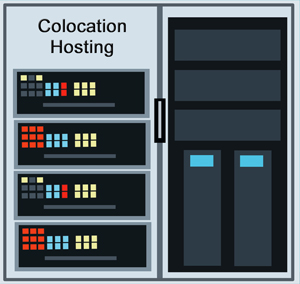
Choose colocation instead of cloud hosting.Isn’t Everyone in the Cloud?
If you read the tech headlines and articles, it looks like everyone is clearing out the old server room and simply leasing cloud services. That does have a lot of attraction. With your data and applications deep within the cloud, you no longer have any capital investment, no power bills, no physical security worries, no HVAC worries, and perhaps less IT support staffing. If you need more bandwidth, server processing or storage, you simply ask the cloud to increase your allowance, perhaps even automaticlly.

Why Wouldn’t You Join the Stampede to the Cloud?
Perhaps you’re feeling a little uncomfortable. You’ve heard that joke: “There is no cloud. It’s just somebody else’s computer.” What it really amounts to is somebody else’s thousands of computers, all nicely divvied-up to share among thousands or millions of clients. The promise of the cloud is that it looks to you like you have your own computing resources all by themselves.

Does that sound exciting or does it give you a bit of a twinge? After all, you’re really happy with how responsive your IT staff is and the control you have over all the equipment and software. There are no other companies sharing your facilities. Security involves keeping bad actors out of the building and on the far side of the firewall. So, is your only choice to bite the bullet and lease a new building for expansion?

Consider the Colo Option
Perhaps a third option is best. Lease space in someone else’s specialized building but keep your computing resources to yourself. This is the idea behind Colo or colocation hosting. These facilities were once called carrier hotels when their tenants were primarily telecom carriers. Now colo is popular with businesses of all sizes.

A colocation facility provides the physical building with controlled access and security personnel. It is staffed 24/7, which may even be more than you are able to provide now. Massive redundant power lines feed the facility so there is never a question of having enough amps to power new equipment. Moreover, that power is backed up by emergency generators and often batteries to keep things running no matter what.

With all that power, you are also going to need to get rid of the heat generated by the electronics. That is handled by redundant HVAC equipment to provide cooling air to the servers and other equipment. Air filters keep the facility dust-free.

What about connectivity? That’s one reason why companies move out of their own facilities and to a colocation center. With so many clients wanting so much bandwidth, major carriers have a presence in the colo. Often you have multiple carriers to choose from and they each have multiple fiber links for dedicated access and Internet service. Not every business is served with high bandwidth fiber yet, but the colocation centers are. They’ll get you as many Gbps as you need along with IP addresses.

Moving to a Colo Facility
When you move to a colo, you lease racks with power and cooling plus connections for bandwidth. Want more security? You can have those racks installed within a locked cage that keeps everybody but your staff out. Your people can come and install their own equipment, do maintenance, and make upgrades as needed.

Many colo facilities also offer additional services if you want them. You can have the colo tech staff monitor, troubleshoot and repair your equipment. You can even lease servers and storage from the colo instead of buying them yourself.

Are you outgrowing your tech facilities but want to explore options other than simply relocating to a cloud? Consider colocation data center facilities as an option that gives you more control but saves money compared to leasing your own dedicated buildings.

Click to check pricing and features or get support from a Telarus product specialist.


Follow Telexplainer on Twitter


Tuesday, May 25, 2021

When You Need Massive Bandwidth

By: John Shepler

Most businesses do just fine with common bandwidth offerings from telco, cable and fiber service providers. Sometimes, though, your application just won’t squeeze through the pipe. You need more than typical WAN bandwidth. You need massive bandwidth.

Find massive bandwidth for your big data. How Massive Are We Talking?
Over the last few decades, mirroring the growth of the Internet, WAN bandwidth needs have multiplied from a paltry T1 level of 1.5 Mbps up to 10 or 20 Mbps for the smaller businesses, at least 100 Mbps for companies with many employees, to a now commonly expected Gigabit per second.

Those bandwidths levels are easily accommodated by most service providers. Copper twisted pair can bring in 20 Mbps or so. Cable broadband is good for at least 100 Mbps and pushing 1 Gbps in many areas. Fiber optic service easily delivers 1 or 2 Gbps and can readily scale to 10 Gbps. Where you might find yourself limited is in rural or underserved locations where your choice is still T1 lines, LTE or 5G wireless, or synchronous satellite broadband.

Massive bandwidth starts at 10 Gbps and goes up from there. Can you reasonably take advantage of 100 Gbps up and down? OK. How about 400 Gbps, 800 Gbps or even a full Terabit per second? Those are carrier level services, but not out of the realm of possibility for the most data or streaming intensive businesses.

Who On Earth Needs THAT Much Bandwidth?
What were absurd levels of bandwidth are now aspirational and may become common sooner than you think. One big driver is the move of everything digital to the cloud. When your data center was just down the hall, nobody worried about bandwidth. You can string as much fiber as you want above the ceiling tiles. Once you pay for installation, usage is pretty much free.

Not so much anymore. When the connection leaves your building you lose control. You’re not going to string any cable across town, much less across several states. For that you need to hand off your traffic to a carrier or service provider. This third party will then lease you the amount of bandwidth you need, or at least can afford, for a monthly fee. The carrier, not you, takes care of all maintenance and reliability between locations.

Some companies get a surprise when they realize that the 30 Mbps Internet connection that was more than adequate when the data center was on premises is now painfully slow when all the applications are in the cloud. One solution is to install a high speed direct line to the cloud service provider and keep the old Internet connection as-is. That solves the bandwidth problem and avoids business critical apps having to deal with the vagaries of Internet performance.

Another application that just won’t play on standard connectivity is content distribution. If you are sending massive amounts of content consistently, you may need to avoid the standard Internet and move over to a purpose built privately run network called a content delivery network. These are designed to handle continuously high levels of video or data without congestion.

Sometimes you only need massive data for a brief time. Say you have Terabytes of disk drives full to the brim and you want to send that to the cloud for safe keeping or to a customer who needs those design or simulation models on their system. Shoving it through a normal connection will take forever. Is there a better option?

Colocation and Cloud Data Centers
If there is one place that you’ll find massive bandwidth already installed and running, it is in cloud and colo centers. Both are massive facilities with nearly unlimited servers, disk drives and bandwidth connections from multiple carriers. The difference between cloud and colo is that cloud centers provide all of the equipment and service needed. A colo or colocation facility lets you bring in your own equipment and set up your own data center in their racks and cages. It’s like what you would have at home, but in a shared building with plenty of space, backup power, HVAC, security and even round the clock staffing.

Some colos will provide a direct fiber hookup between your company and any others located in the same facility. if you need to connect outside, you won’t have to worry about finding a service provider or paying hefty fees to bring in service from afar. They are already inside and serving other customers. You just get a hookup at whatever bandwidth you need.

More Exotic Massive Bandwidth Options
There really is no limit to how much bandwidth you can utilize these days, other than your budget. If you can afford it, consider these options:

Wavelength Services
Most fibers are now lit with DWDM or dense wavelength division multiplexing. That means multiple lasers feeding the same fiber, but on different frequencies or wavelengths. A wavelength can handle perhaps 10 Gbps and each fiber strand can handle perhaps 100 wavelengths. Combine them all and the total bandwidth is mind boggling.

Many carriers are now leasing entire wavelengths for your use. It’s like a fiber within a fiber. Some will combine multiple wavelengths to create 100 Gbps and higher bandwidths for you, or you can lease the wavelengths and multiplex them yourself.

Dark Fiber
The ultimate in bandwidth and control is had by leasing one or more dark fiber strands. Dark means that the fiber is in the cable but totally unused at present. You add the laser termination and multiplexing equipment at each end and “light” the fiber.

Dark fiber is as close to having your own in-house cabling as you can get outdoors. There is nobody else’s traffic to contend with. You decide how much capacity to press into service. Run out of bandwidth? Just upgrade your terminal equipment. Same fiber, more Gbps. You don’t have total control. The carrier still owns and maintains the fiber physical plant, including cabling and repeaters. The rest is up to you.

Are you feeling unduly restricted when it comes to bandwidth to efficiently run your business and take advantage of new opportunities? If so, look into higher bandwidth fiber optic services now. You may find them more affordable than you think.

Click to check pricing and features or get support from a Telarus product specialist.


Follow Telexplainer on Twitter


Monday, July 21, 2014

Carrier Neutral Connectivity at Colocation Data Centers

By: John Shepler

Companies feeling starved for bandwidth may not realize that they’re doing it the hard way. Instead of making the carriers come to you, there are advantages in you going to where the carriers are.

Find Colos and Clouds as an alternative to your local data center.It’s All Happening at the Colo
The places where carriers flock are called colocation or colo centers and carrier hotels. These are large data centers that are meant to serve a variety of tenants. Contrast that with the typical data center that serves only a single company. In fact, most companies want nothing to do with renting out space in their data centers. The security issues alone make them blanch.

Why Do Colocation Centers Exist?
It has to do with economy of scale. Say you have 100 companies and each one needs a data center. They may well construct their own in-house data centers sized to meet their needs. This involves creating a dedicated space that is environmentally controlled, secure, with fire protection and backup power. Uninterruptible power supplies based on batteries and inverters cover short term power glitches. Anything over a few minutes depends on diesel or gas generators outside.

Data Center Costs
As you might expect, there is considerable cost involved in building and running a data center. Aside from the initial capital investment, there are constant operating costs involving air conditioning, electric power and support personnel. These costs persist regardless of business level and the equipment may sit idle for two-thirds of the day. Smaller companies often can’t justify the expense of round-the-clock tech support.

Connectivity Counts
What level of bandwidth you can get and how much it will cost are largely a function of where you are located. If your offices are in a smaller town or rural area, you may have only a single provider to pick from and severe bandwidth limits.

Economy of Scale
Now, what if those same 100 companies decided it would make more sense if they all moved into a single much larger data center that would serve all of their needs. You might think the overall total cost would be similar, but actually they would be much lower.

It’s the economy of scale that saves. Each company only needs racks and cages large enough to house its servers and other equipment. A few larger backup generators can supply emergency power when needed instead of 100 smaller generators on standby. A common security force can handle access control and monitor intrusion sensors. A common tech support group can handle the occasional needs of all companies 24/7.

From Owner to Renter
The tenant companies switch from an ownership to a rental model. They don’t need to overbuild, because they can always rent more or less facilities as needed. The colo operator takes the responsibility of building the facility, providing utilities, security and tech support.

A Magnet for Carriers
Have you ever had a carrier tell you that it’s just too expensive to bring fiber optic service to your company? They might do it, but you’ll be responsible for the construction costs and they can be eye-popping. The colo center, howler, acts like a carrier magnet. They see 100 potential customers for their service and make their fiber available. Most colo centers are near populous areas, making the construction relatively easy.

Will you have a carrier to provide you bandwidth service at the colo? Most likely, you’ll have at least several and perhaps a lot more. Each carrier has its own colo space with racks and cages. It costs them little more to bring in high bandwidth service for 100 companies than a single customer. That, plus the competition of having multiple carriers bidding for your business, makes pricing more attractive than it might be to your own facility.

Meet Me for Service
Colos have an ingenious setup called the “meet me” room or MMR. This is an area dedicated to making cross-connections. The colo operator runs copper or fiber cabling to your racks from the MMR. They also run copper or fiber from the carriers to the MMR. When you contract for bandwidth, the colo patches you to the carrier and you’re all set. If you change your mind, you can work out the next contract with a different carrier and the colo will simply move your patch cord.

One additional advantage of using an MMR is that there is no “local loop” charge because the colo is providing the “last mile” or, in actuality, “last foot” connection.

Two Types of Colos
You should know that there are a couple different types of colos. One is operated by a single carrier. They build the facility for their own needs and then rent out extra space. You can get really high bandwidth and reasonable prices in such a facility, but you may have only one or a few carriers to pick from.

The second type of colo is operated by a third party who is in the colocation business and doesn’t favor any customer or carrier. These are often called carrier neutral facilities because you aren’t required to connect to any particular bandwidth provider.

Clouds and Colos
Cloud services are often located in colocation facilities. This gives the cloud provider a facility to support their extensive servers and storage. If you are collocated within the same facility, then it’s a simple wire or fiber connection to hook you up with one or more cloud service providers.

Are your data center costs higher than you would like or are you having trouble getting the WAN bandwidth you need to support your business? This would be a good time to investigate what’s available from a number of colocation centers and cloud service providers.

Click to check pricing and features or get support from a Telarus product specialist.


Follow Telexplainer on Twitter

Thursday, December 01, 2011

Cloud Connection Centers Go Beyond Colocation

Companies considering a relocation of their IT assets from local data centers to colocation facilities have a new option to consider. It’s the Telx Cloud Connection Centers. Let’s have a look at what you can get in a cloud connection center that is above and beyond traditional colocation or carrier hotel services.

Telx Cloud Connection Centers offer traditional colo services and more...Traditional colocation offers cost savings and service enhancements based on economy of scale. The idea is that one larger environmentally controlled, highly secure and well connected data center is more efficient than hundreds or thousands of stand alone private data centers that have to meet the same requirements. This certainly makes sense. A server in your rack may be the same as the server in the colo rack, except they host hundreds or thousands of them. The backup generators at the colocation center aren’t hundreds or thousands of times larger or more expensive than the one you have in its own building out back. Nor is the fire suppression equipment, HVAC, or 24/7 staffing.

The other advantage that you find in colocation centers is connectivity. There is no way that multiple carriers are going to move into your company just to give you the option of connecting with them. They do just that at the colo. Carriers love to set up shop in colocation centers because they know that there are plenty of potential customers needing high bandwidth WAN connections. Once established, all that is needed is a simple cross connect to connect users and carriers.

In itself, this is a good reason for you to move to a colocation center. Even if you are perfectly happy with your infrastructure and technical staffing costs, how easy is it to get bandwidth? Well located business have many options to choose from. Companies that have built off the beaten path may find that fiber optic services are hard to come by or very expensive to bring in. There’s a strategic advantage in moving your high performance servers and bandwidth demanding public facing applications to a colocation facility. You can then use more modest bandwidth to communicate with your server farm.

Telx takes this to the next level with their Cloud Connection Centers. Telx is a major player in colocation services and carrier connectivity. This year, they’ve started offering a new service called cloudXchange that is a global community of providers and users of cloud services. Members colocate within the Telx facilities. Telx provides the cross connects and other interconnections to link users and providers.

Isn’t the whole idea of the cloud that it is “somewhere, out there” and you save money by buying cloud services on pay as you go basis instead of managing your own equipment? For smaller companies, especially those who don’t want to deal with technicalities, that’s a model that works. Larger organizations have found problems with this simplistic model. A big problem is latency and bandwidth in connection to the cloud. Other issues include the need for private as well as public clouds to ensure security and performance while reducing costs.

The whole movement to the cloud has become so important that Telx has rebranded their 15 colocation and connection centers as Cloud Connection Centers. Within those centers, you have easy access to cloud computing, storage and Software as a Service (SaaS) resources. You have an almost infinite array of options from running your own equipment to completely outsourcing to cloud vendors and any mix in-between.

How strong is this trend to everything in the cloud? Strong enough that Telx is breaking ground on a brand new 215,000 square foot data center in Clifton, N.J. to complement their existing Clifton facility and their New York City center at 60 Hudson St. A private fiber ring will connect 60 Hudson and Clifton to minimize latency.

Are you in the midst of doing private vs public vs hybrid cloud tradeoffs against traditional colocation and operating your own private data center? This would be a good time to explore additional options offered at a Cloud Connection Center to complete your cost/benefit analysis.

Click to check pricing and features or get support from a Telarus product specialist.


Follow Telexplainer on Twitter

Wednesday, August 31, 2011

Managed Hosting in Clouds and Colos

When it comes to hosting, you have all sorts of options. Most individuals and smaller companies opt for shared hosting. It provides decent performance at a rock bottom price. Once you get too big for shared Web hosting, you’ve got a decision to make. Do you do it yourself or opt for a managed solution?

Get competitive quotes for colocation and cloud hosting services...There was a time when you needed the savvy to run your own web server to even get a site up and running. Now that Linux and Windows hosting has become so common and standardized, there are lots of places to get hosted. Even larger companies that insisted on maintaining control by buying their own servers and rack mounting them in their own temperature controlled data centers are taking a second look at colocation and clouds. Why? It’s mostly about cost but also about resources.

One of the big resource bottlenecks today is bandwidth. Certainly, carriers have kept up with offerings at GigE, 10 GigE, OC-768, wavelengths and dark fiber. What they haven’t done is provide universal access. While competitive fiber optic networks are expanding their service footprints every day, the majority of business locations still aren’t lit and aren’t likely to be in the near future. Ethernet over Copper bridges the gap for some. Speeds are up to 200 Mbps now. EoC is distance limited, however, so that your best chance for service is in a downtown business district.

Move to a colocation facility or cloud service, however, and your bandwidth issues may be over. They may not be if you need a high bandwidth pipe between your facility and the cloud. But if most of your bandwidth demand is coming from Internet users rather than in-house users, colos and clouds look pretty attractive. Cloud providers locate with the same facility at major carriers to ensure themselves of almost unlimited bandwidth. You can do the same thing by packing up your high bandwidth demand servers and shipping them to a colo facility. The best deals are where multiple carriers have established points of presence and are willing to bid for your business.

Another attraction of colocation is jettisoning the capital investment and operating costs associated with running your own data center. The colo has high security, backup power, environmental control and a tech support staff available 24/7. You need to provide the same things. Economy of scale favors the colocation company with its much larger facility and lots of customers to amortize the cost.

Smaller companies may find that they can’t afford an around the clock tech staff nor the investment required to build or expand an in-house data center. A move to a nearby colo center can get them the facilities they need for a monthly fee. But why stop there? Perhaps it makes even more economic sense to forget about having your own hardware at all. Why not pay as you go on everything?

This is the appeal of everything-as-a-service. Hedge your bets by renting rather than buying. You can do that at many colocation centers now. They’ll put a server in the rack for you and keep it maintained. It’s just like having your own hardware except that when you don’t need it anymore, you just walk away. Need a bigger server? Don’t buy one. Simply upgrade your colo service.

The cloud does the colo one better. The cloud philosophy is “why commit to any particular hardware at all?” Why, indeed? In the cloud all services are virtualized. You don’t need to know or care what they’ve mounted in the racks. What you are concerned about is how many instances of virtualized servers you need at the moment. If you find that your demands fluctuate, you can increase or decrease the number of servers or amount of storage almost instantly. The well of resources to tap is nearly unlimited.

The problem now is how to sort out the options. Shared hosting is nearly a commodity these days. Get competitive quotes for colocation and cloud hosting services for your IT operations and then compare with what it costs you to provide the same value in-house.

Click to check pricing and features or get support from a Telarus product specialist.


Follow Telexplainer on Twitter

Thursday, May 26, 2011

The Rush To Cloud Service Data Centers

There’s a major migration afoot. It’s a move, almost a stampede, from in-house server rooms to public data centers worldwide. Let’s take a look at what this trend is all about and where it may be leading.

The move is on to data centers offering colocation and cloud services. Click for pricing and availability.The original reason for companies to consider data center colocation was cost savings. The tradeoff is fairly simple. Instead of your organization building and operating its own data center, you ship your servers, switches, routers and network appliances off to a colo facility. That facility offers cost savings through economy of scale. Instead of each business having to come up with environmentally controlled real estate, fire suppression, backup generator power and high bandwidth connectivity, the larger colocation company provides these facilities for hundreds or thousands of customers.

A colo or “carrier hotel”, as they were originally called when the main customers were competitive local exchange carriers, can provide the 24/7 technical staffing that you may not be able to afford. They’ve expanded their suite of services to rent not just rack and cage space, but servers themselves. You no longer have to buy and ship your own equipment. You can rent what you need and have it all set up for you. Even ongoing maintenance can be outsourced to the colo so that your only responsible for the applications you are running.

There is a blending of missions between colocation data centers and hosting companies. The colocation centers have become hosts with the addition of dedicated servers and even virtual servers.

The latest trend in IT is cloud computing and this is where colocation data centers are headed. One good example is PAETEC, a competitive telecom carrier with a national service footprint. PAETEC is known for it’s voice and data services that include T1 lines, DS3, SIP trunking, MPLS networks, OCx fiber optic bandwidth, and Ethernet over copper and fiber connections. Now PAETEC is on a major building spree to nearly triple its 7 data centers spread across the country.

What’s prompting this expansion? It’s all about the cloud. Corporate America has discovered cloud services as a way to control costs, increase flexibility and avoid sometimes unavailable capital investments in infrastructure. The idea of the cloud is very much like the concept of the colocation center with some capability expansions. Infrastructure as a Service (IaaS) allows you to rent all the servers and their related facilities that you need. The difference is that the architecture of the cloud is about making it easy to add and subtract resources rapidly. You can do that when servers are virtual and there are massive amounts of networked disk storage to draw from.

PAETEC is offering cloud-based products in their data centers that include dedicated servers, virtual servers, managed storage on demand and more. Hosted Exchange gives companies a Microsoft Exchange E-Mail server with PAETEC technicians and engineers available for support.

Is it time for your company to consider a move to the cloud or relocation to a colocation center to reduce costs and gain access to more resources as needed? If so, get pricing and availability of Cloud and Colocation Data Center Services near your location.

Click to check pricing and features or get support from a Telarus product specialist.


Note: Photo of clouds and building courtesy of Wikimedia Commons.


Follow Telexplainer on Twitter

Thursday, March 10, 2011

Infrastructure as a Service Providers

Cloud computing is generally acknowledged to comprise three levels. These are Infrastructure as a Service (IaaS), Platform as a Service (PaaS) and Software as a Service (SaaS). The most basic of these and the foundation of the others is infrastructure in the cloud.

Cloud computing providers offer infrastructure on demand. Infrastructure is pretty much what it sounds like. This the basic hardware and operating system software to make it work. Competition for infrastructure in the cloud is that same infrastructure in your own data center. So, why would you want to up and move to the cloud?

There are good business reasons for IaaS. Infrastructure is expensive to buy, it requires constant attention and frequent maintenance, and it starts going obsolete almost as soon as you have it installed. Computing infrastructure is also finicky. It needs a special temperature and humidity controlled environment, physical security and fire protection, and large amounts of both operating and backup power.

There’s also the matter of how much to buy. You certainly need enough resources to accommodate your anticipated daily activities. How about the unforeseen? It’s not that unusual for a company’s product to catch on suddenly, resulting in a flurry of unexpected orders. The same is true for any content that goes viral. One day you’re coasting along at a modest level of activity. The next day the word is out and your servers are brought to their knees by a sudden flurry of new users. All of the social networking sites have experienced this phenomenon at one time or another.

Cloud service providers offer a way to address the limitations of local data centers, often with a considerable cost advantage. Cloud infrastructure providers build a business on scale. They create a large data center with racks full of virtualized and dedicated servers. These are connected with pools of disk storage, security appliances, and multiple diverse network connectivity. All of this is housed in a high security, environmentally controlled facility with both battery and generator backup power.

Doesn’t this sound like what you’d find at a colocation center? Indeed, there are many similarities between colos and cloud service providers. One major difference is in elasticity. An elastic resource is one that can grow and shrink at will. When you install your equipment in a colocation facility or rent equipment and services from them, it is on a well defined contract. Certainly, you have the ability to change your requirements as business conditions improve or degrade. But there’s going to be a time lag of days, weeks or longer to make the necessary changes.

Cloud services are based on a model of utility computing. You don’t need to ask your electric company to give you more or less power. You simply turn equipment on and off. Only when your requirements exceed the maximum capacity you have installed, do you need to ask for a different level of service.

Infrastructure as a Service is based on a pay for what you use basis. The cloud service provider has far more servers, disk drives, Gbps of bandwidth and other resources that you can possibly use. Their economy of scale dictates that they serve many customers, each of whom has no awareness of the presence of the others. Your services are partitioned so that no other user will take your resources or interfere with your operation.

The advantage to business users is that IaaS gives them the resources they need, when they need them, at a cost that reflects actual usage and not spare installed capacity. Capital investments and perhaps difficult to obtain financing are not required. Staffing levels are reduced because the service provider takes care of operations and maintenance on a 24/7/365 basis.

Could your business benefit from using some or many cloud services? You can have a good basis to compare with what you are doing now by getting prices and services from cloud computing providers now.

Click to check pricing and features or get support from a Telarus product specialist.


Follow Telexplainer on Twitter

Thursday, February 10, 2011

New Phoenix Data Center Offers Colocation Services

Data centers are expanding as the business climate improves and companies pursue productivity increases and lower costs. Many businesses that never gave a second thought to using colocation facilities are taking another look. In the Southwest USA, a good place to consider is the new PAETEC Data Center in Phoenix, Arizona.

Discover the new PAETEC colocation center in Phoenix and other cloud and colo services.PAETEC has just cut the ribbon on their 4,400 square foot Phoenix data center as part of an expansion program that adds to their facilities in Bethlehem and Conshohocken, PA, Andover, MA., Houston, TX and Milwaukee, WI. Why? Customer demand. The role of Information Technology is changing and the “cloud” has a lot to do with it. PAETEC is positioning itself to capitalize on this movement with services that improve business continuity, information safeguarding, network latency reduction and a reduction of management needs.

The idea behind the cloud is one of economy of scale. You can have every company buying servers and racks, putting them in environmentally controlled rooms, providing the electrical power for both equipment and the cooling needed to take away the heat generated by the equipment, and hiring a staff to tend to the data center facilities. Alternatively, you can have a service provider create a much bigger facility and let companies buy their computing and storage services for a fee.

This is what cloud service providers do. They figure out the IT services that are common to many businesses and then provide those as a service themselves. But isn’t that six of one and a half dozen of another? How is the cloud a net saver of anything?

This is where economy of scale comes into play. The cost of operating a cloud services company doesn’t go up linearly with size. You need a certain amount of real estate, electrical power, HVAC, bandwidth and staffing to create a data center of any size. Having twice as many servers, disk drives and network appliances doesn’t necessarily mean you need to double your staff. Yes, you’ll need more floor space, air conditioning, electrical power and backup generation, but it probably won’t cost twice as much. The same is true for bandwidth. It gets cheaper by the Mbps and Gbps when you order big lines compared to little ones. Your staff can also be more specialized, since they are only dealing with a certain range of facilities and a defined set of services.

The contrast is even more dramatic when you compare the startup cost for small companies to create their own IT services compared to simply purchasing what is needed from a company that already has the facilities and expertise. Web site hosting, for instance, has gotten so cheap when purchased from a large hosting service that small businesses are hard pressed to justify buying and running their own servers. Many of them are now finding that offloading their telephone systems to a Hosted PBX service saves investment and staffing.

The colocation center fits somewhere in-between running your own facilities and outsourcing to the cloud. The colo offers the economy of scale for environmentally controlled and secure server space and WAN bandwidth. Yet, you have the option of providing your own equipment that you maintain yourself. Some colocation providers are now offering cloud-like services that include renting servers and storage they already have available and handling maintenance and repair through their 24/7 technical staff.

Should you be going to the cloud or relocating to a colocation facility instead of trying to do it all yourself? It may be time for a quick study to compare the capital and expense costs that you pay now with the monthly fees to get the same services outside. Get complementary support for pricing and availability of cloud and colocation services so you can do a good job.

Click to check pricing and features or get support from a Telarus product specialist.


Note: Photo of Phoenix skyline courtesy of Wikimedia Commons.


Follow Telexplainer on Twitter

Monday, August 02, 2010

Business Booming For Telx Interconnection and Colocation

While many companies remain hunkered down and wringing their hands while they wait for the economy to improve, colo provider Telx is on a building boom at their premier data center in Chicago. What kind of sense does that make in recessionary America?

It makes lots of sense if you’re clued-in to what is transforming business and finance. It’s been a long time since accountants wore green eye shades and engineers worked slide rules. Most companies have adopted computer-based workstations connected to servers in the back room. This client-server architecture had a lot to do with increasing the speed of doing business and improving employee productivity in the last few decades. But now some of the savviest companies are adopting new methods and systems to give themselves an edge over their competitors.

Remember when the original justification for computerizing processes was elimination of paper? The “paperless office” became a joke as cheap laser printers and copiers spit out reams of paper faster than they could be hauled to the recycling bin. But when you consider how the speed and volume of transactions has increased, every desk should be piled to the ceiling and the aisles crammed full of paper documents. All the paper you don’t see is in the form of bits and bytes on hard drives spinning away inside your computer and in network storage within the data center. It’s turned out that less paper is the minor benefit of computerization. The big benefit is speed.

We simply do more faster. Companies don’t mail us product brochures anymore. We pull them up online. The time from identifying a need to researching solutions to placing an order has shrunk dramatically. It can all be done from the comfort of the desktop, sometimes in a matter of minutes. Need to coordinate team activities? Let them collaborate online so that those in Seattle can mark up documents for those in New York in real time.

Nowhere has the demand for speed become more dramatic than in the financial industry. You’ve heard of high frequency trading? These are complex algorithms running on high speed servers to electronically issue buy and sell orders to the markets. We’re at the point where milliseconds and even microseconds make a difference in trade profits. The Einsteinian limit of how fast light can move through glass and wire introduces a time delay between locations that simply can’t be reduced. So, how do you beat the competition? You get closer to the markets... physically closer. That’s what Telx provides. Its proximity to the exchanges and the buy-side and sell-side firms at Telx’s strategically collocated facilities. If the upper limit to your potential speed of transaction is a length of patch cord, you are in an advantageous position compared to the competitor hundreds or thousands of miles away.

Low latency colocation facilities near the action are essential for the most advanced players in high frequency finance. But there are other reasons for collocating with suppliers, customers and service providers. The cost of bandwidth is a good reason. With many competing carriers within arm’s reach, or at least down the hall, you’ve got access to the best rates per Mbps or Gbps and none of the expensive build-out costs of stringing wires or fiber cable for miles. If bandwidth is becoming one of your biggest expenses, moving to the colo facility can be a major cost saver. This can easily be the case if your product is video or high volume e-commerce or a popular application with millions of users.

Even smaller companies that aren’t located in a downtown sweet spot for low bandwidth prices may find that colocation gives them the advantage of keeping their physical location where it is but moving their bandwidth-hungry applications to where costs are lower. Cloud computing is another way to leverage the economy of scale in putting the software and servers where the bandwidth is cheapest and accessing the service from wherever you choose to be.

Does your company have demands for low latency or high bandwidth that would benefit from Telx or similar facilities? Are you just looking for ways to reduce your bandwidth costs? If so, you should take a look at the cost advantages of colocation and cloud computing services.

Click to check pricing and features or get support from a Telarus product specialist.


Follow Telexplainer on Twitter

Wednesday, November 14, 2007

Colocation Hosting Bandwidth Options

Where do you get the best deals on bandwidth? Where the telecommunications carriers are, of course. The farther you get from a carrier's POP or Point of Presence, the more you'll pay per Mbps for WAN bandwidth. That means there's only one thing to do. Move in with the carrier. Pack your servers because that really is the right solution.

Do carrier's actually take in boarders? Indeed, they do. CLECs or Competing Local Exchange Carriers often have termination equipment located on the premises of the ILEC or Incumbent Local Exchange Carrier. That's so they can get access to telephone lines to offer competing voice and data services. But what about other businesses?

Business meet carriers at a facility known as a colocation center or carrier hotel. The colocation center, or colo, is sometimes operated by a single competitive carrier. Others are run by third parties offering neutral territory to competing carriers and businesses all looking to make the best deals for IT services. The center operator provides a clean, secure, environmentally controlled building with wiring support infrastructure and backup power.

When you move into a colocation center, you usually bring your own servers and other network appliances. In some centers, you can rent servers on an exclusive or shared basis. You rent rack space for as many units as you need. Power and cooling are provided. You have the option to secure entire racks in locked cages for higher physical security. This is often called colocation hosting, regardless of who supplies the actual server equipment.

You connection to the outside world, including your own network access, is negotiated with the carrier of your choice. You may have several to choose from in a larger facility. Carriers are as anxious to be where the businesses are as businesses are anxious to have proximity to carrier services. Carriers have their own racks or rooms of termination equipment, just like businesses users. Service providers and service users get together in a "meet me" room or with a service drop from their switching rack to your server.

What types of bandwidth deals are available? Usually the best prices on each level of service. Remember that there are essentially no construction costs to provide you with service. Perhaps just a one-time fee for a service drop that may even be waived. Within the facility it is easy to run any type of copper or fiber optic physical connection, so there is no need to settle for installed lines with limited bandwidth just to get service.

Within the center, you generally have the option to get exactly the right type and quantity of bandwidth you need. This includes T1 or DS1, T3 or DS3, OC3, OC12, OC48 and higher SONET services. Also Ethernet from 10 Mbps through Gigabit Ethernet or even 10GigE. Many carriers can quickly and easily adjust the level of bandwidth they provider you on short notice. That's especially true of Ethernet services delivered on fiber optic cable.

So, who chooses colocation hosting rather than keeping everything within their own server rooms? Moving to a "colo" might actually cost you less per month that building, powering, cooling and staffing your own data center. In the case of businesses located outside of downtown metropolitan areas in major cities, especially those in rural areas, the cost of bandwidth may be much higher than in the carrier hotel. Out in the boonies, T1 connections may be all that is practical. It could easily make sense to use that T1 line to communicate with your server farm located within a distant colocation center. Chances are that neither your employees or customers can perceive that the servers running the online part of your business are 50 or 100 miles from your office and not located in the basement.

Does colocation hosting make sense for your business needs? Find out what options and pricing are available for your location with help from our team of voice and data experts. You may be surprised how much you can save by moving in with the carriers.

Click to check pricing and features or get support from a Telarus product specialist.


Follow Telexplainer on Twitter